The natural ways to help kids sleep better that actually hold up over time are simple and boring: a steady bedtime, a dark and cool bedroom, a short calming routine, and daylight plus movement during the day. Those four habits fix more sleep problems than any supplement on the shelf.
This guide covers children from toddler to teen, including autistic children, kids with ADHD, and children who are simply sensitive to light, noise, or touch. Nothing here is medical advice, and no supplement, herbal remedy, or over-the-counter sleep product should be started without talking to your child’s pediatrician first.
Pick one thing. Give it two weeks. That is the whole method behind everything that follows.
Table of Contents
- Natural Ways to Help Kids Sleep Better at a Glance
- 1. Keep a Consistent Sleep Schedule
- What a consistent schedule actually looks like
- How to shift bedtime without a fight
- Adapting a schedule for autistic kids and busy weeks
- 2. Build a Simple Bedtime Routine
- A repeatable 25-minute wind-down
- When a child resists the steps
- 3. Reduce Light and Noise Before Bed Light at night delays the melatonin signal that tells the body it is dark. Overhead lights and hallway spill are the usual culprits, and a single dim lamp in the room often replaces them completely. For light-sensitive children, a light-blocking shade or blackout curtain makes an enormous difference, especially in summer when sunrise starts arriving earlier every week. Noise is the other half. A house that is loud at 9 pm reads as a house that is not going to sleep, so move the dishwasher to a daytime cycle, close bedroom doors, and turn off screens that nobody is watching for sound. 4. Make the Bedroom Comfortable and Sleep-Friendly
- 5. Use a White Noise Machine or Fan
- 6. Try a Calming Sensory Wind-Down
- 7. Limit Caffeine and Stimulating Foods in the Evening
- 8. Encourage Daily Movement and Daylight
- 9. Use Comfort Items and Predictable Choices
- 10. Keep Screens and Strong Stimulus Away at Bedtime
- 11. Address Discomfort From Allergies, Pain, or Sensory Issues
- 12. Track Sleep Patterns and Adjust Gradually
- Frequently Asked Questions
- How long should a child take to fall asleep after starting a bedtime routine?
- What natural helpers are safe for a child who wakes up during the night?
- How can parents help an autistic or sensory-sensitive child sleep?
- When should I talk to a doctor about my child’s sleep problems?
- Are white noise machines safe for babies and young children?
- Can a bedtime routine help children who do not sleep at the same time every night?
Natural Ways to Help Kids Sleep Better at a Glance
Each strategy below targets a different part of the problem. Find the row that matches your child’s actual struggle rather than trying all twelve at once.
| Approach | Sleep challenge it addresses | Effort | Often especially useful for |
|---|---|---|---|
| Consistent sleep schedule | Falling asleep at a different time every night | Medium at first, then easy | Autistic children, ADHD, irregular school or therapy weeks |
| Simple bedtime routine | Bedtime battles and refusal to start | Low once built | Transition-sensitive and preschool children |
| Dim light and less noise | A mind that races once the lights go out | Low | Light-sensitive kids and shared bedrooms |
| Comfortable bedroom | Restless, overheating, or uncomfortable sleep | Medium | Mobility, temperature-regulation, and allergy needs |
| White noise or a fan | Household noise waking the room | Low | Apartments, shared rooms, light sleepers |
| Sensory wind-down | A nervous system that will not switch off | Medium | Sensory-seeking or sensory-avoidant children |
| Fewer stimulating foods | Evening jitteriness and slow settling | Medium | School-age children and teens |
| Daily movement and daylight | A body clock running hours late | Low to medium | Kids with low-energy afternoons or heavy school days |
| Comfort items and choices | Anxiety at the moment of separation | Low | Anxious and preschool-aged children |
| Screens off earlier | Winding down that turns into a fight | Medium | Teens and homes with school devices |
| Check for discomfort | Sleep broken by a physical cause | Varies | Eczema, reflux, allergies, pain, damp bedding |
| Track sleep patterns | Guessing at what is working | Low to start | Any family making a change |
1. Keep a Consistent Sleep Schedule
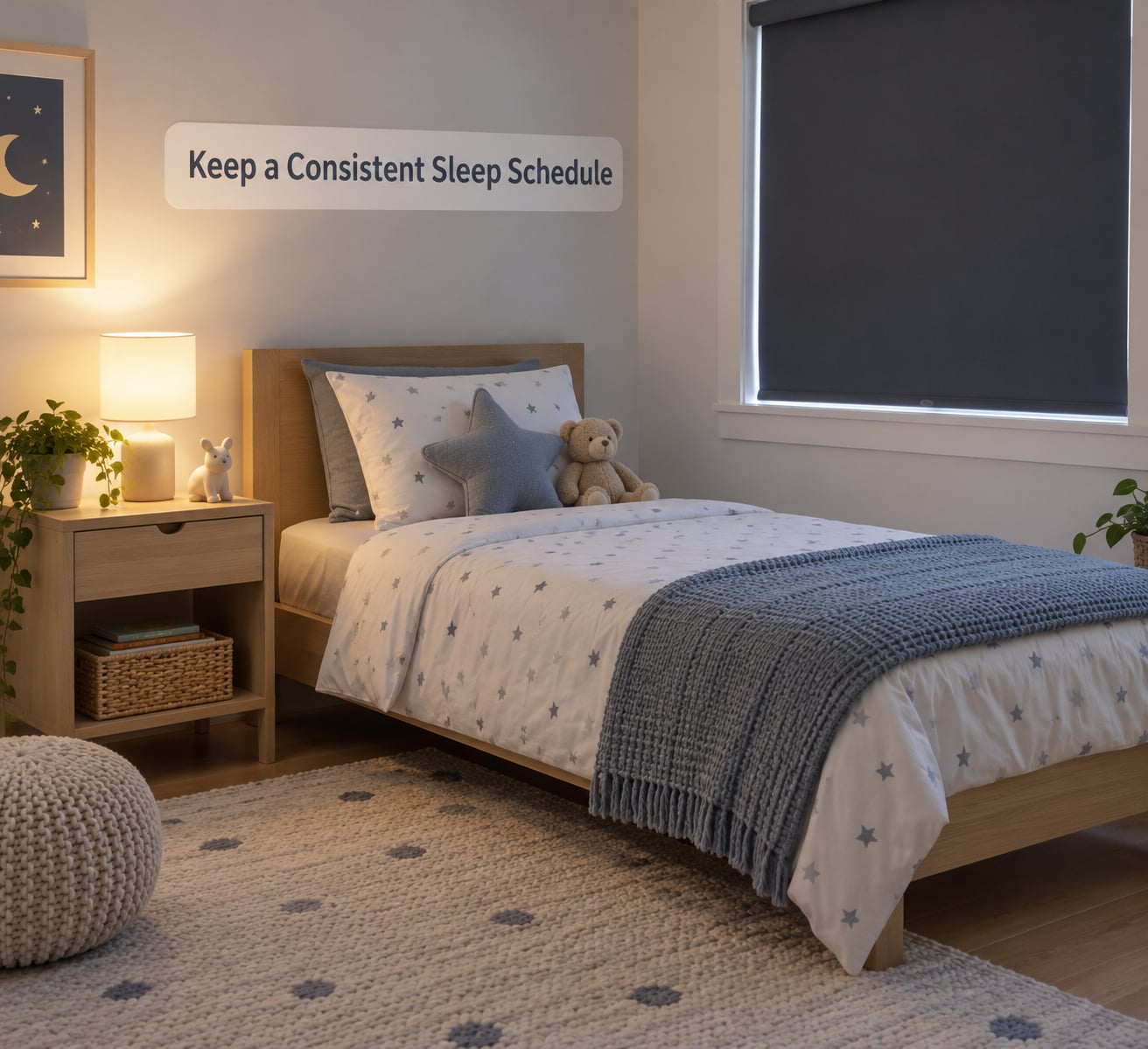
A predictable bedtime and wake time is the foundation every other change leans on. The American Academy of Sleep Medicine recommends roughly 10 to 13 hours of sleep in a 24-hour period for ages 3 to 5, 9 to 12 hours for ages 6 to 12, and 8 to 10 hours for ages 13 to 18.
What a consistent schedule actually looks like
Wake time is the anchor, not bedtime. Waking at the same time each morning, including weekends, keeps the internal clock honest, and children who wake early tend to fall asleep earlier as a result.
A useful check is the wake window, which is the stretch between waking and falling asleep. Most school-age children can manage about 10 to 13 hours awake, and toddlers usually manage less. When bedtime resistance appears in the evening, an over-long wake window is often the reason.
How to shift bedtime without a fight
Move bedtime in 15-minute steps, and only ever earlier, once your child is falling asleep comfortably within about 20 minutes of lights out. That 20-minute benchmark is normal; anything much longer is a sign the schedule is off rather than a character flaw.
Keep weekends within about an hour of the weekday schedule. A late Saturday night looks harmless until Sunday night turns into a two-hour stall.
Adapting a schedule for autistic kids and busy weeks
Visual schedules work well here because they remove the need to argue. A simple chart or even a photo of the order of steps on the fridge handles most of the negotiation that words start.
When therapy, school, or a sibling’s schedule shifts the day, keep the bedtime anchored to wake time rather than to the calendar. We wrote a longer guide on how to help an autistic child sleep through the night that goes into the transition problems in more detail.
2. Build a Simple Bedtime Routine
The routine matters more than its length. Repeating the same short sequence every night conditions the body to wind down, and the sequence becomes the signal that sleep is coming.
A repeatable 25-minute wind-down
Dim the lights and turn off screens, run a bath or shower and get into pajamas, brush teeth, read two or three books, then offer a drink of water and lights out. Keep it under 30 minutes so it never feels like a negotiation.
Write the steps on a picture chart for readers. If your child cannot read fluently, photos work better than words.
When a child resists the steps
One step at a time is the fix. Add a new step only once the current sequence feels ordinary, and expect a week of protest each time something changes. Most families find it settles faster the second time through.
A tag-team approach helps more than it sounds like it should. When the same parent always handles bedtime, the bedtime fight lands on them every night; handing off to a partner often lowers the temperature within a few days.
3. Reduce Light and Noise Before Bed
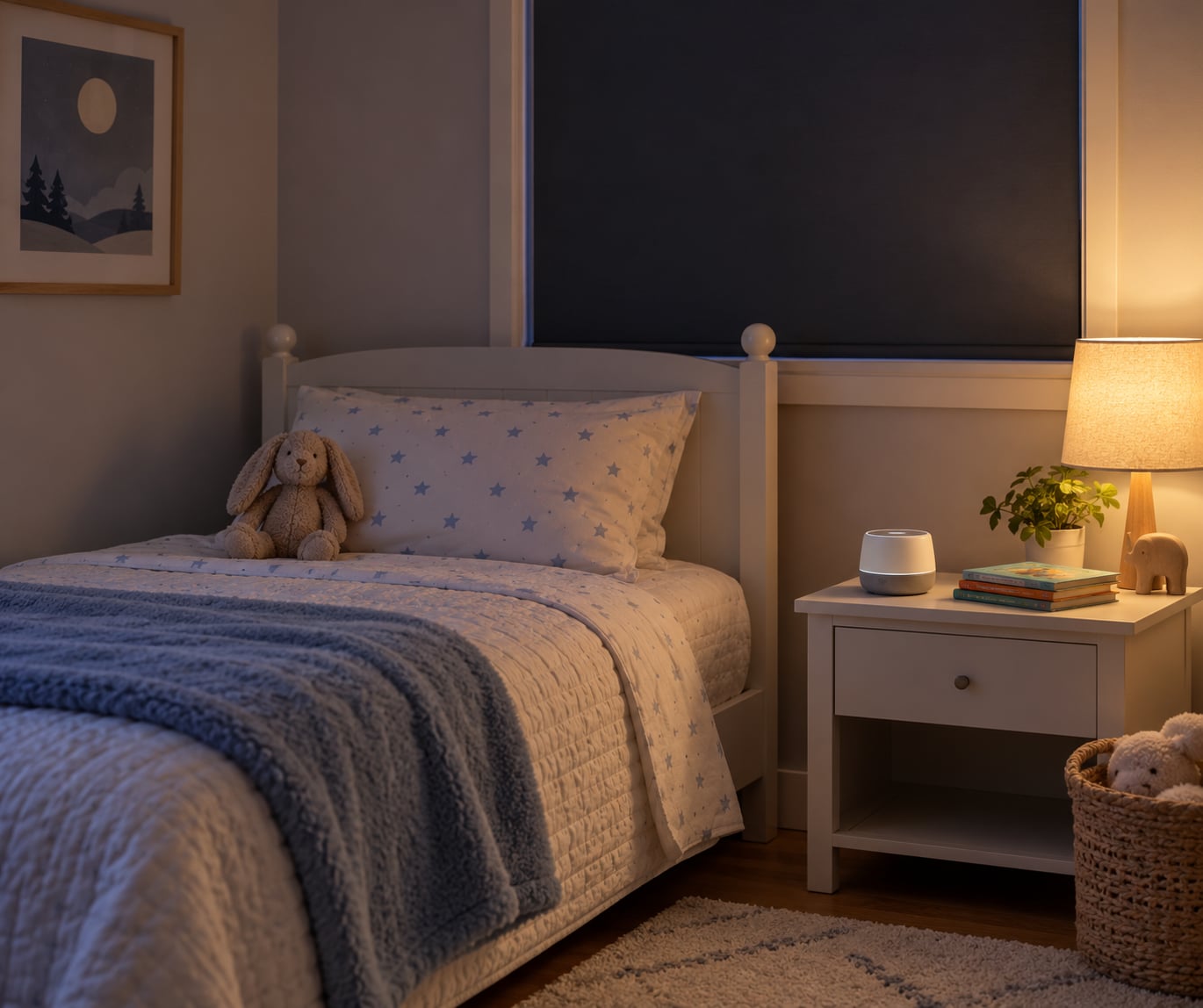
Light at night delays the melatonin signal that tells the body it is dark. Overhead lights and hallway spill are the usual culprits, and a single dim lamp in the room often replaces them completely.
For light-sensitive children, a light-blocking shade or blackout curtain makes an enormous difference, especially in summer when sunrise starts arriving earlier every week.
Noise is the other half. A house that is loud at 9 pm reads as a house that is not going to sleep, so move the dishwasher to a daytime cycle, close bedroom doors, and turn off screens that nobody is watching for sound.
4. Make the Bedroom Comfortable and Sleep-Friendly
Most pediatric sleep guidance points to a cool room, roughly 65 to 72 degrees Fahrenheit, along with darkness and quiet. A room that is too warm is a common reason children kick off covers and wake up grumpy at 3 am.
Keep the space uncluttered. Visual clutter competes with a tired brain, and a pile of toys on the floor is often the thing a child stares at instead of sleeping.
Bedding matters more than families expect, particularly for children with eczema or chemical sensitivities. If you are shopping, how to choose nontoxic bedding for kids walks through fiber types, dyes, and what to look for on a label.
For children with mobility needs, temperature control problems, or allergies, adjust the room first and work around the limitation. Supported positioning, breathable layers, and washable covers solve more problems than any device.
5. Use a White Noise Machine or Fan
Steady sound masks the unpredictable noises that pull a sleeping child partly awake, such as a car door, a dog, a sibling, or a neighbor’s TV through the wall. A fan often works just as well, especially for a child who has already grown used to one.
Place the device across the room rather than beside the bed, and keep the volume low enough that it sits just under the level of a quiet conversation at the same distance.
Check the manufacturer’s age and weight guidance before using anything near a baby’s crib or sleep surface, and ask your pediatrician if your child is under one. More on that in the questions below.
6. Try a Calming Sensory Wind-Down
Some children settle through their senses rather than through a story. Slow rocking, a weighted blanket, a tight squeeze, or a few wall push-ups before lights out can help a busy nervous system come down.
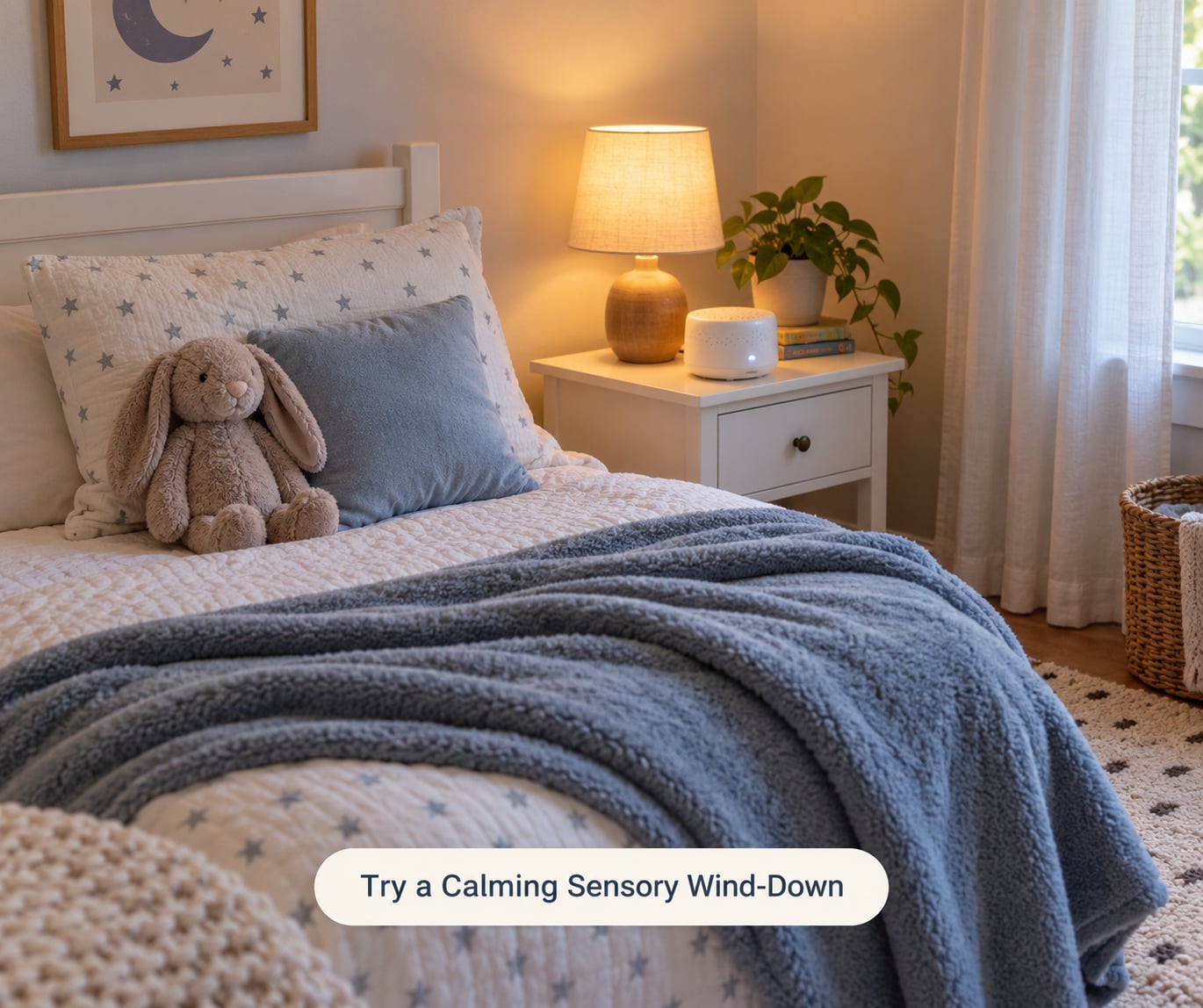
Use a weighted blanket only if the manufacturer lists your child’s age and weight, and check with your pediatrician first. Follow the same guidance for compression clothing and anything wrapped tightly around a child.
Ask before you assume. Some children seek deep pressure and others flinch at it, and a blanket that helps one sibling can make another more alert. These 10 easy proprioceptive activities for kids at home take ten minutes and can move earlier in the evening, before the bedtime routine begins.
7. Limit Caffeine and Stimulating Foods in the Evening
Caffeine is the obvious one, and it hides in cola, iced tea, energy drinks, chocolate, and some pain relievers. Preteens and teens are the group most likely to drink it without knowing.
Large or heavy meals land badly too. If dinner runs late, serve a lighter version rather than a bigger one, and keep an evening snack small.
Tart cherry juice, warm milk, banana, oatmeal, and a small handful of nuts are the snacks parents reach for most. They are simply food, so keep the portion normal and skip anything your child reacts to.
Herbal drinks such as chamomile come up constantly in parent forums. Check with your child’s pediatrician before any herbal product, since strengths vary widely and some interact with medications.
8. Encourage Daily Movement and Daylight
Morning daylight is the strongest natural anchor for the body clock. Thirty minutes outdoors soon after waking, ideally before the school bus or the first meeting, makes the evening wind-down noticeably easier for most children.
Physical activity during the day helps too, though not in the last hour before bed, when it can raise energy. Aim for daily movement that is age-appropriate and fun rather than a scheduled workout.
For children with mobility limitations, outdoor light still counts even from a porch, a wheelchair path, or an open window. Any movement they enjoy counts too, including swimming, adaptive play, and floor-based activities.
9. Use Comfort Items and Predictable Choices
A worn stuffed animal, a favorite blanket, or the same pair of pajamas becomes a cue for sleep. Keep a couple of options permanently in the bedroom so the child can choose without a negotiation at 8 pm.
Offering two or three acceptable choices, such as which book to read first or which pajamas tonight, returns a small amount of control to a child who feels like they have none.
As children get older, fade the extra items gradually. Bring the stuffed animal to the living room during the day so the bed holds sleep and not daytime comfort.
10. Keep Screens and Strong Stimulus Away at Bedtime
Screens delay melatonin, and fast-paced content keeps the brain alert long after the device is off. Most guidance suggests turning screens off at least an hour before bedtime, earlier if your child takes a long time to settle.
Give a specific replacement rather than a vague promise to be bored. A drawing pad, a simple puzzle, folding laundry together, or a flashlight book hunt all fill the same gap.
Autistic children and teens often use devices to self-regulate. Instead of a hard cutoff, swap to calmer content earlier in the evening and keep the last half hour of the wind-down screen-free. School devices should charge outside the bedroom, which also removes the temptation to check them in the dark.
11. Address Discomfort From Allergies, Pain, or Sensory Issues
Itchy skin, a blocked nose, reflux, constipation, growing pains, damp bedding, or a scratchy sheet will all break sleep. Before blaming the schedule, spend a few nights noticing whether your child is rubbing skin, coughing, shifting position, or waking in pain.
Uncomfortable bedding is a common culprit that costs nothing to fix. Wash sheets and mattress covers regularly, keep the room dry, and rule out anything new that recently touched your child’s skin.
Some signs belong with a clinician rather than a bedtime tweak. Loud snoring with pauses, breathing that stops during sleep, severe pain, or sleep that has changed sharply and stays changed all deserve a call to the pediatrician. Snoring with breathing pauses in children can point to sleep apnea, and it is treatable.
12. Track Sleep Patterns and Adjust Gradually
Two weeks of notes beats a year of guessing. Record bedtime, how long settling took, night wakings, wake time, and one daytime behavior such as appetite or mood.
A notebook works. Most phone apps also work, and the point is that it happens, not which tool you use.
Read the notes for patterns, then change one thing at a time. Late naps, a loud evening, or a screen that ran long usually show up within a week of tracking, and families who adjust two things at once never learn which one worked.
Keep going for at least two weeks before judging a change. Most routines need longer to click than parents expect, and most give up just before they do.
Frequently Asked Questions
How long should a child take to fall asleep after starting a bedtime routine?
Most children settle within 10 to 20 minutes of lights out, and that range is considered normal. A brand new routine often takes one to two weeks to click because the body is learning a new cue. Track it for two weeks before deciding it failed. If settling regularly takes over an hour, or the child seems distressed rather than simply awake, mention it to your pediatrician.
What natural helpers are safe for a child who wakes up during the night?
Keep the room dark, cool, and quiet so a waking child has as little as possible to wake up to. A night-light of the same color every night, a familiar comfort item in the bed, and a slow breathing exercise can help some children resettle on their own. Avoid anything that needs adult dosing at 2 am, and check with your pediatrician about supplements before using any.
How can parents help an autistic or sensory-sensitive child sleep?
Predictability usually matters more than any gadget. Use a visual bedtime schedule, cut clutter from the bedroom, offer deep-pressure input such as a weighted blanket only within the manufacturer age and weight limits, and keep the wind-down low arousal. Keep the same sequence every night and change one variable at a time, since adding several new things at once usually causes more bedtime resistance than it fixes.
When should I talk to a doctor about my child’s sleep problems?
Call your pediatrician if sleep has changed sharply and stays changed, if your child snores loudly or pauses breathing during sleep, if there is pain, or if poor sleep is affecting daytime mood and behavior. Always bring supplements, herbal products, and melatonin to the conversation so doses and interactions can be reviewed. Sleep changes alongside puberty, medication changes, or a new diagnosis are worth raising too.
Are white noise machines safe for babies and young children?
Used properly, a white noise machine can help mask household sound, but check the manufacturer age and weight guidance and ask your pediatrician before placing any device near an infant sleep surface. Keep the volume low, place the machine across the room rather than beside the crib, and never cover a sleep surface or a sound source with loose fabric. Corded models need to be well out of reach.
Can a bedtime routine help children who do not sleep at the same time every night?
Yes, and it is usually the first thing to try. Anchor wake time, including weekends, and hold bedtime steady rather than adjusting it to a late night. Keep the routine identical even when the schedule slips, because the repeated sequence is what signals the body to wind down. Give it two weeks before adding anything else, and change only one variable at a time.
If you only do one thing from this list of natural ways to help kids sleep better, set the wake time tomorrow morning and hold everything else steady for two weeks. Everything else here, from the wind-down sequence to the cool dark room, works better when the clock underneath it stops moving.
And before you reach for any supplement, herbal tea, or over-the-counter sleep product, take it to your child’s pediatrician. Changes that cost nothing are worth trying first, and if sleep is still off after a few weeks of consistent effort, that is a good reason to call rather than a reason to keep escalating.