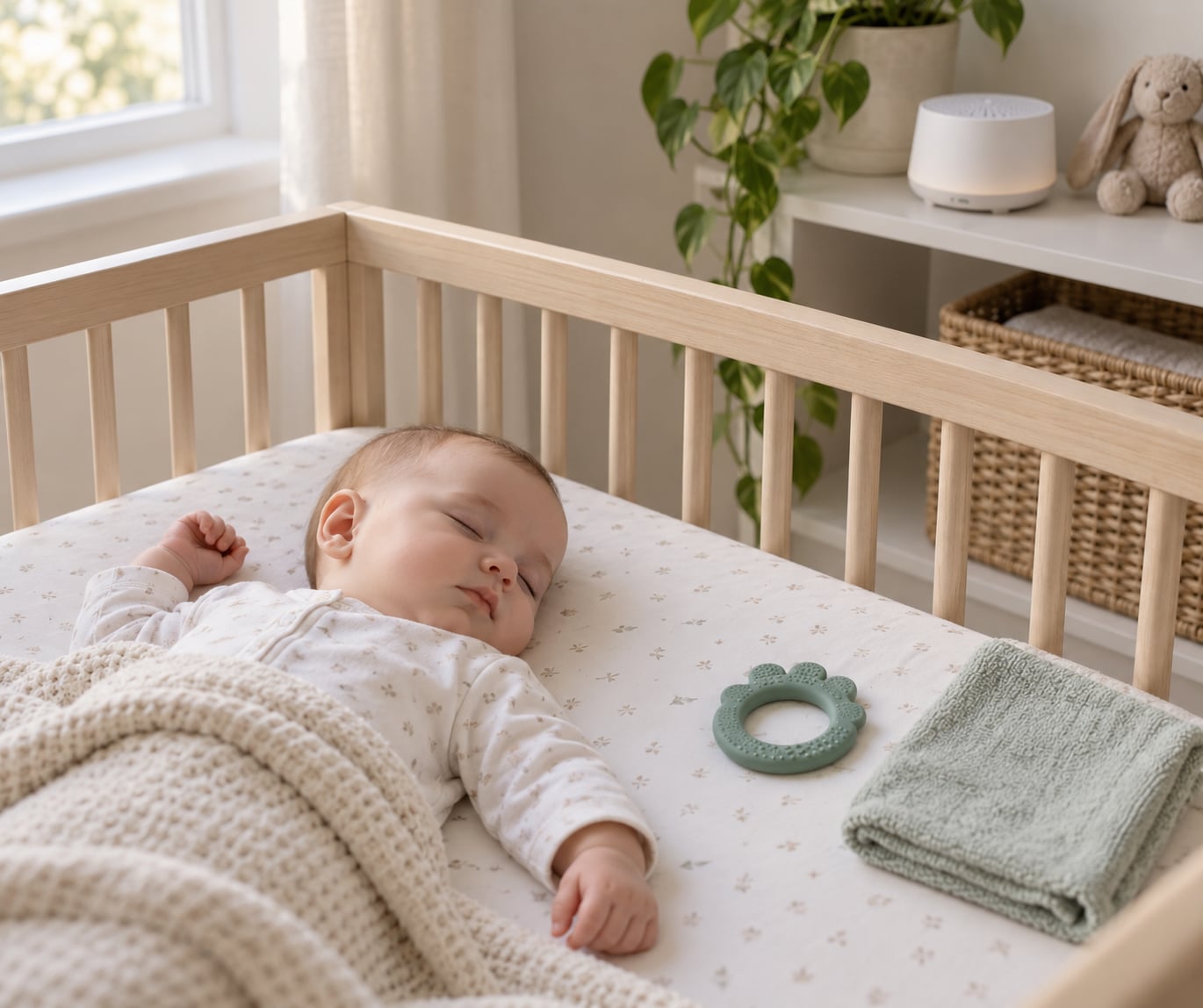
To help a teething baby sleep, keep the bedtime routine exactly as it is, give the gums something cold and firm to chew, use firm pressure on the sore spot, and put the baby down on their back in a bare, flat crib. Most disrupted nights tied to a single tooth last about a week, and the pain is usually worst in the 24 to 72 hours before the tooth actually shows.
Teething is the process of your baby’s primary teeth pushing through the gums, and it most often starts somewhere between 4 and 7 months. The swollen gum tissue is genuinely sore, and there is nothing to distract a baby at 2am, so pain that a distracted baby shrugs off at 4pm can wake them twice before sunrise.
Here is the honest version of the timeline: parents on r/Mommit describe sleep settling back roughly a week after a tooth has fully erupted, not the night it breaks through. Some babies sleep more during teething because they are burning through more energy, others sleep far less. Both are normal, and both settle once the tooth is through.
Six things help most, in the order most parents reach for them:
- Offer something cold but never frozen, like a chilled teething ring or a knotted washcloth from the fridge.
- Press firmly on the sore gum with a clean finger for a minute at a time.
- Keep the wind-down routine identical while adding extra cuddles and comfort.
- Use white noise and a cool, dark room to shorten the time it takes to resettle.
- Offer the usual number of feeds, spaced the same way as daytime, rather than adding night feeds.
- Skip numbing gels, frozen items, teething necklaces and any loose object in the crib.
Table of Contents
- What You Need
- Step-by-Step
- How to Create a Calm Bedtime Routine
- How to Soothe Gums Without Overstimulating
- How to Handle Nighttime Wakeups
- How to Protect Safe Sleep During Teething
- Common Mistakes
- Tips for Teething Sleep
- Frequently Asked Questions
- Can teething cause a baby not to sleep at night?
- How long do sleepless nights from teething last?
- Is it teething or a sleep regression?
- What helps babies sleep at night when teething?
- What can I relieve at night without a phone call?
- What should I avoid during teething?
- How to Help a Teething Baby Sleep: Start With the Basics
What You Need
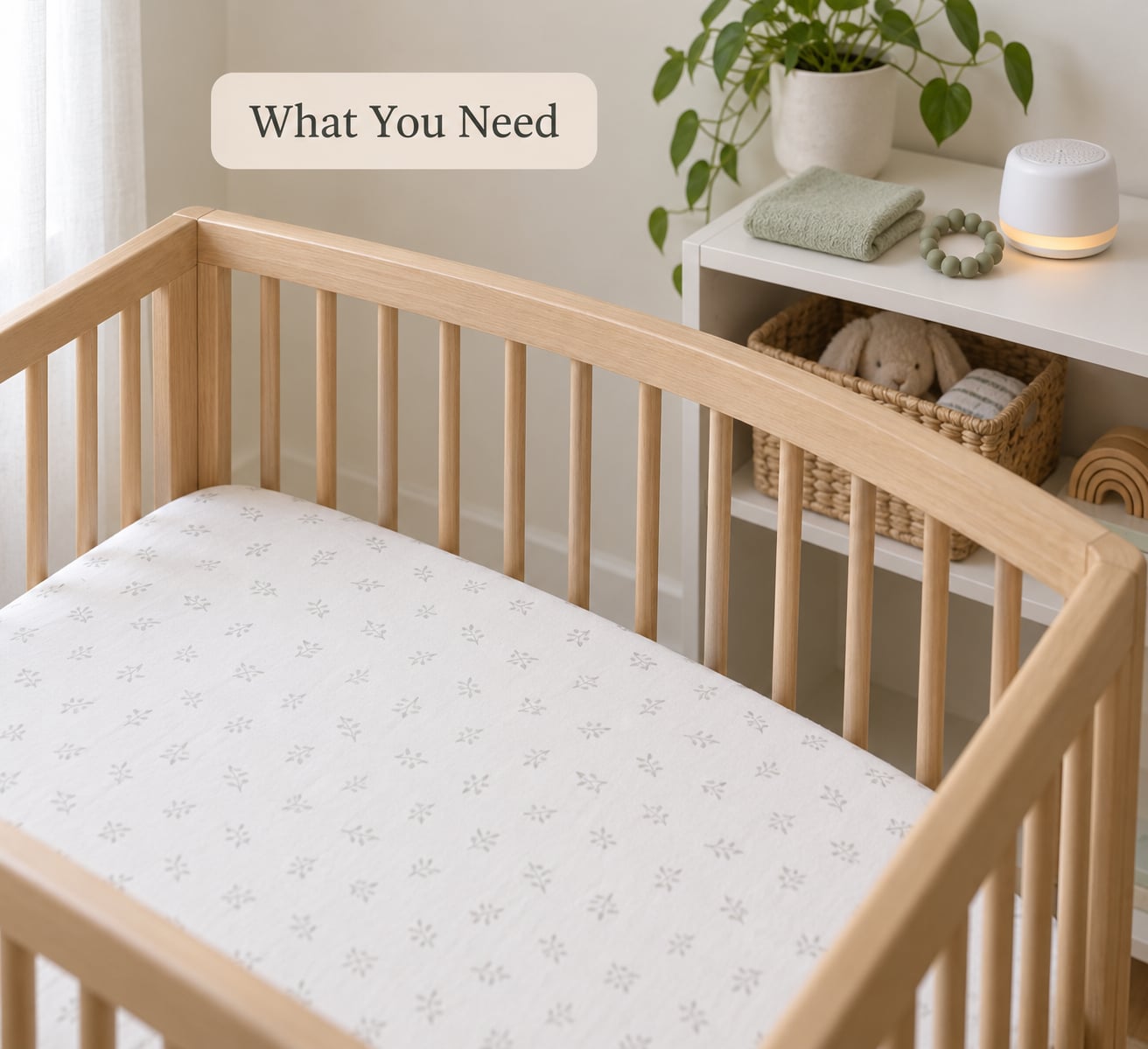
The sleep environment matters more than anything you buy for teething, because that is where you are not improvising at 2am.
- A firm, flat sleep surface with a fitted sheet. Nothing else in the crib or bassinet.
- A sleep sack or wearable blanket in breathable cotton, so you are not reaching in to add a blanket at night.
- Two or three chilled items waiting in the fridge, not the freezer: a silicone teething ring, a knotted washcloth or flannel, and a chilled spoon are the usual three.
- A white noise machine that runs continuously through the night.
- A digital thermometer, kept in the nursery rather than the bathroom, so you can check a temperature without turning the lights on.
- A soft muslin cloth for drool, plus a barrier cream you have already used on your baby’s chin.
- Any medicine your baby’s own pediatrician has approved, with the weight-based dose written on the label.
Gels, tablets and cold remedies are not part of this list on purpose. Choosing them, and any dose of a pain reliever, is a conversation with your baby’s clinician based on age, weight and health history, not something to decide at 3am.
Step-by-Step
How to Create a Calm Bedtime Routine
A teething baby does not need a new routine. They need the old one, done the same way, with a little more warmth in it. Keep the sequence, the order and the length of every step roughly where they were before the tooth started arriving.
Do the wind-down dimmer and slower than usual rather than longer. Twenty quiet minutes of the same bath, book, bottle and song, then a cooler room and a single goodnight transfer. You are looking for the baby to recognise the pattern, not to be entertained until they are exhausted.
You can add things that make contact without changing the sequence: an extra minute of holding upright after the last feed, a foot massage in the dark, one more song if the baby is fussy. What you hold constant is the order and the ending.
You know it worked when the baby starts protesting at the same point in the routine each night instead of escalating through it. That rhythm matters more than how quickly anyone fell asleep.
How to Soothe Gums Without Overstimulating
Cold numbs the gum and pressure relieves the ache. Everything else is a distraction, and distraction loses to pain after a while.
- Chill a teething ring, mitt or washcloth in the fridge for 20 minutes. Never the freezer, which can make the gum sore again and can damage skin if your baby chews a hard frozen edge.
- Press a clean fingertip firmly, not gently, along the gumline where you can feel the hard nub. Steady pressure works better than light dabbing.
- Try a chilled spoon or a rolled cold washcloth for a baby who spits out rings, particularly under six months.
- Offer a feed, which soothes with contact and warm milk while the sucking reflex gets going.
Wash your hands first and skip anything your baby cannot safely hold on to alone. Once your baby is calm enough that gnawing has slowed down, stop. More stimulation at that point tends to wind them up rather than settle them.
Two or three minutes of firm pressure is often enough to see the shoulders drop. If nothing has changed after a full cycle of cold item, pressure and a feed, the tooth is probably further along than the current phase, and the next stretch may be calmer.
How to Handle Nighttime Wakeups
Work the same short list every time, in the same order, so the check itself becomes predictable for you. Hunger, then a wet diaper, then room temperature, then gum discomfort, then whether something else is going on.
Respond with low light and a quiet voice. Soothe for a few minutes, then try to put the baby back down in the same position they woke in. If they are still awake after a short pause, repeat once and then give yourself a five to ten minute break before trying again.
Do not restart the entire bedtime routine for a 3am waking. That teaches the baby that waking up is the cue for a full bath and a story, and the middle-of-the-night wake-ups get longer and harder to end.
Call your pediatrician rather than treating it as teething if your baby has a temperature of 100.4 F or higher, vomiting, diarrhea, is pulling or rubbing at the ears, has a rash, is feeding poorly, or seems in pain that nothing relieves. Teething alone does not cause any of those, and no amount of guessing replaces an examination.
How to Protect Safe Sleep During Teething
This is the part that gets skipped in the middle of a hard night, so it is worth keeping fixed.
- Place your baby on their back for every sleep, including naps.
- Use a firm, flat, level surface with a fitted sheet. No adult bed, no couch, no armchair, even for a nap you only plan to last ten minutes.
- Keep the crib empty: no pillows, bumpers, blankets, positioners, weighted sleep sacks or loose toys.
- Take teethers, washcloths and dummies out of the sleep space once your baby is settled. A pacifier is the one item allowed in a crib.
- Never hang an amber or glass teething necklace on a sleeping baby. Those are strangulation hazards.
- Room-share rather than bed-share, especially on the worst nights. A parent who has been awake for eighteen hours is exactly the situation the safe-sleep rules exist for.
Comfort during teething is not the same as a different sleep position or a different bed. Hold your baby, massage the gums, sit up and rock if you need to, then return to back-on-a-flat-surface for sleep itself.
Common Mistakes
Most teething-sleep problems get worse after an avoidable mistake. These are the ones I see repeated.
- Using a numbing gel. Benzocaine and lidocaine products have caused serious reactions in young children and are not recommended for teething. Correct that by cooling an item instead of numbing the gum.
- Freezing something to use as a teether. Frozen rings and frozen spoons are hard enough to hurt tender gums and can tear the mouth. Chilled is the safe version.
- Relying on teething necklaces or bracelets. The beads are a choking hazard around the neck and the cord is a strangulation hazard. Neither belongs near a sleeping baby.
- Trying homeopathic teething tablets. Some have been linked to breathing problems and seizures in babies, and there is no reliable evidence that they work.
- Giving medicine without asking. Pain relievers are not routine sleep aids. Ask your baby’s clinician first, check the age guidance, and use the weight-based dose on the label.
- Moving into the adult bed. It solves the night and creates a much bigger risk. Bring the crib closer to your bed instead.
- Changing everything at once. A new routine, a new sleep sack and a new soothing item in the same week makes it impossible to tell what helped.
- Assuming teething explains everything. Illness often lands during a teething stretch. Keep the red-flag list from the wakeup checklist visible.
Tips for Teething Sleep
Adjust bedtime, not naps. During the roughest nights an earlier bedtime by 30 to 45 minutes usually buys more recovery than anything else, because a baby who starts overtired fights harder. Keep naps where they are.
Watch cluster feeding. Some babies eat much more for a few days and then eat less for a few days, which reads as a problem when it is just a rebound. Offer the same number of feeds on the same rough schedule rather than adding night feeds to chase sleep.
Treat the chin. A drool rash is itchy enough to wake a baby, and it is a secondary cause of night waking that gets missed. Pat the chin and neck dry at bedtime, air it out, and use a barrier cream your baby has already tolerated.
Phase the advice by age. Between 4 and 6 months, chilled washcloths and a clean finger work best and the first tooth is often the hardest night of the whole stretch. From 6 to 9 months, most babies can hold a teether themselves and sit up, which makes self-soothing far easier to encourage. From 9 to 12 months, several teeth often arrive together, so expect a longer stretch rather than a single bad night.
Keep your own sleep in the plan. If there is a second adult, split the night into blocks and take the first waking so one of you gets an unbroken stretch. Our guide to helping an autistic child sleep through the night covers some of the same mechanics of building a steady wind-down, whichever sleep problem you are working on.
Track wake times for a few days. Note how long your baby sleeps before waking, what you did, and how long it took to resettle. Patterns show up quickly and they take the guessing out of a night that is otherwise pure guesswork.
Start oral care the day the first tooth lands. A wiped or brushed tooth is a small nightly step, and getting that step easy now is worth it. Our piece on how to help a child tolerate tooth brushing has the longer version for when they are old enough to argue about it.
Frequently Asked Questions
Can teething cause a baby not to sleep at night?
Yes. Sore, swollen gums often hurt most at night because there is no distraction and the pain does not fade. Most babies settle easily and then wake a few hours later when the ache returns. This is temporary, usually easing once the tooth has fully broken through the gum.
How long do sleepless nights from teething last?
Expect roughly a week of disrupted sleep per tooth, with the worst nights arriving in the 24 to 72 hours before the tooth appears and sleep often settling about a week after it has fully erupted. When several teeth arrive close together, expect a longer stretch rather than a single rough night.
Is it teething or a sleep regression?
Look at the gums. Red, swollen tissue, a hard nub you can feel, heavy drooling and gnawing point to teething. A regression usually arrives with no new teeth, often alongside a nap change or a new sleep milestone. The two frequently overlap, especially around 8 to 10 months.
What helps babies sleep at night when teething?
Cold but never frozen items for chewing, firm pressure on the sore gum with a clean finger, extra cuddles inside an unchanged bedtime routine, continuous white noise, and a cool dark room. Keep the routine order the same and add comfort within it rather than replacing it with a new one.
What can I relieve at night without a phone call?
Cold items, gum pressure and comfort are the three options available without a clinician. Anything else, including acetaminophen or ibuprofen, should be discussed with your baby’s pediatrician in advance so you know the age guidance and the weight-based dose before you need it at 3am.
What should I avoid during teething?
Skip benzocaine and lidocaine numbing gels, frozen teethers, amber or glass teething necklaces, and homeopathic tablets. Also skip moving your baby into the adult bed or onto an adult mattress, and keep pillows, blankets and loose toys out of the crib. Put your baby on their back for every sleep.
How to Help a Teething Baby Sleep: Start With the Basics
Start tonight with four things. Keep the bedtime routine exactly as it was, check hunger and diaper before anything else when your baby wakes, reach for something cold and firm or firm finger pressure on the sore gum, and keep the sleep space bare and flat with your baby on their back.
Then give it about a week. If you are past that and still seeing rough nights, or if there is a temperature of 100.4 F or higher, vomiting, diarrhea or ear rubbing in the mix, stop treating it as teething and call your pediatrician.