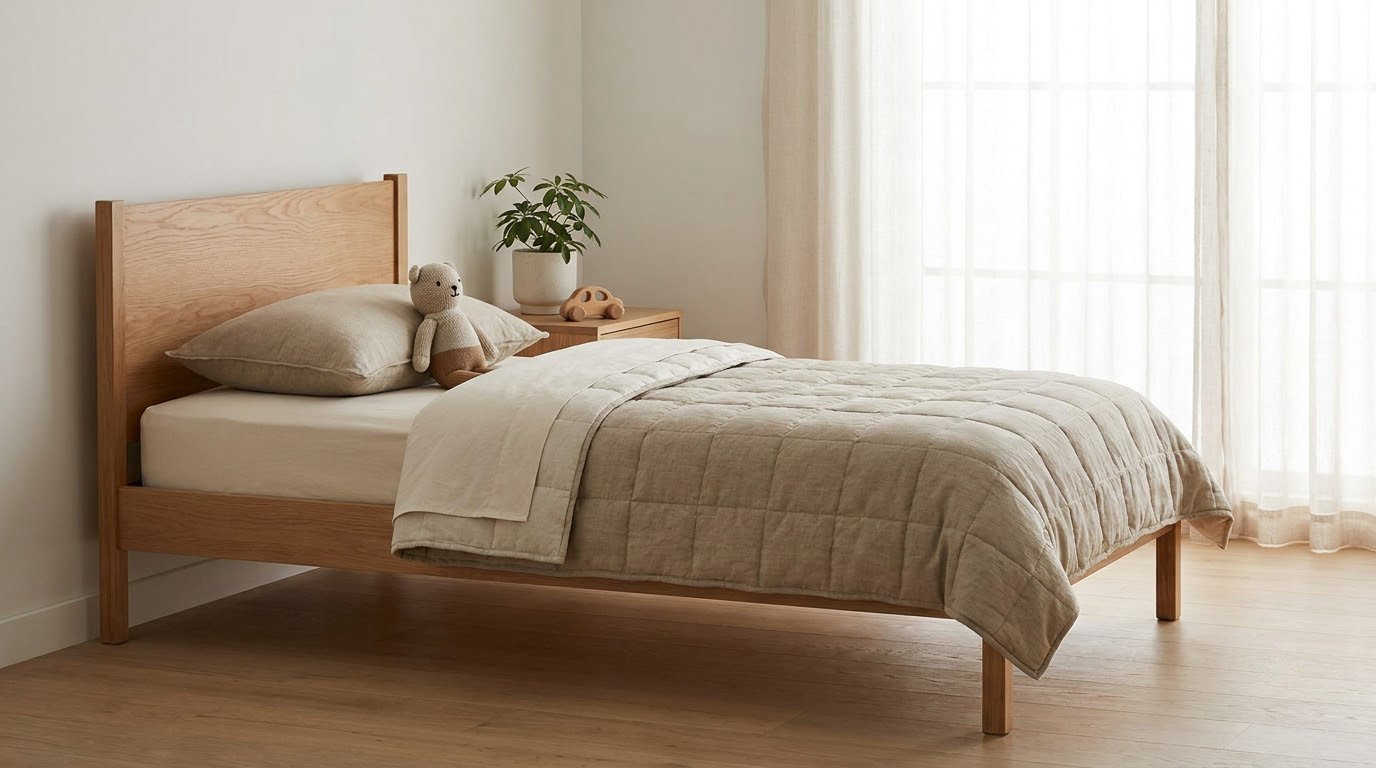
To choose nontoxic bedding for kids, you verify three things: what the fiber is, how it was grown and processed, and what finishes were applied afterward. Then you confirm the maker’s claims against a third-party certification rather than the word “natural” on the front of the box. Most of the work happens in a sixty-second label audit, not in the store aisle.
Here is the honest version: no bedding is risk-free, and “chemical-free” is not a regulated term you can verify. But the gap between a well-made, certified, washable set and a cheap one with undisclosed finishes is real, checkable, and worth a weekend of your attention.
This guide walks through the process the way I would for my own kid’s bed — starting with what to gather before you shop, then seven steps from defining your priorities to washing and testing a set before you commit to a full collection.
Table of Contents
- How to Choose Nontoxic Bedding for Kids: What You Need
- Step-by-Step: Choosing Bedding Children Can Sleep On Safely
- 1. Define What Nontoxic Means for Your Family
- 2. Start with Simple, Low-Risk Materials
- 3. Read the Entire Label, Not Just the Front of the Package
- 4. Verify Safety Standards and Third-Party Certifications
- 5. Consider Allergies, Skin Comfort, and Sleep Conditions
- 6. Compare Durability, Fit, and Real Care Needs
- 7. Test the Bedding Before Making It a Full Set
- Common Mistakes When Choosing Bedding for Kids
- Frequently Asked Questions
- What is the safest material for a child’s sheets and pillowcase?
- Is organic cotton bedding automatically nontoxic?
- How can I tell if a bedding certification is legitimate?
- Should I wash new kids bedding before the first use?
- What bedding claims should parents be especially cautious about?
- Conclusion
How to Choose Nontoxic Bedding for Kids: What You Need
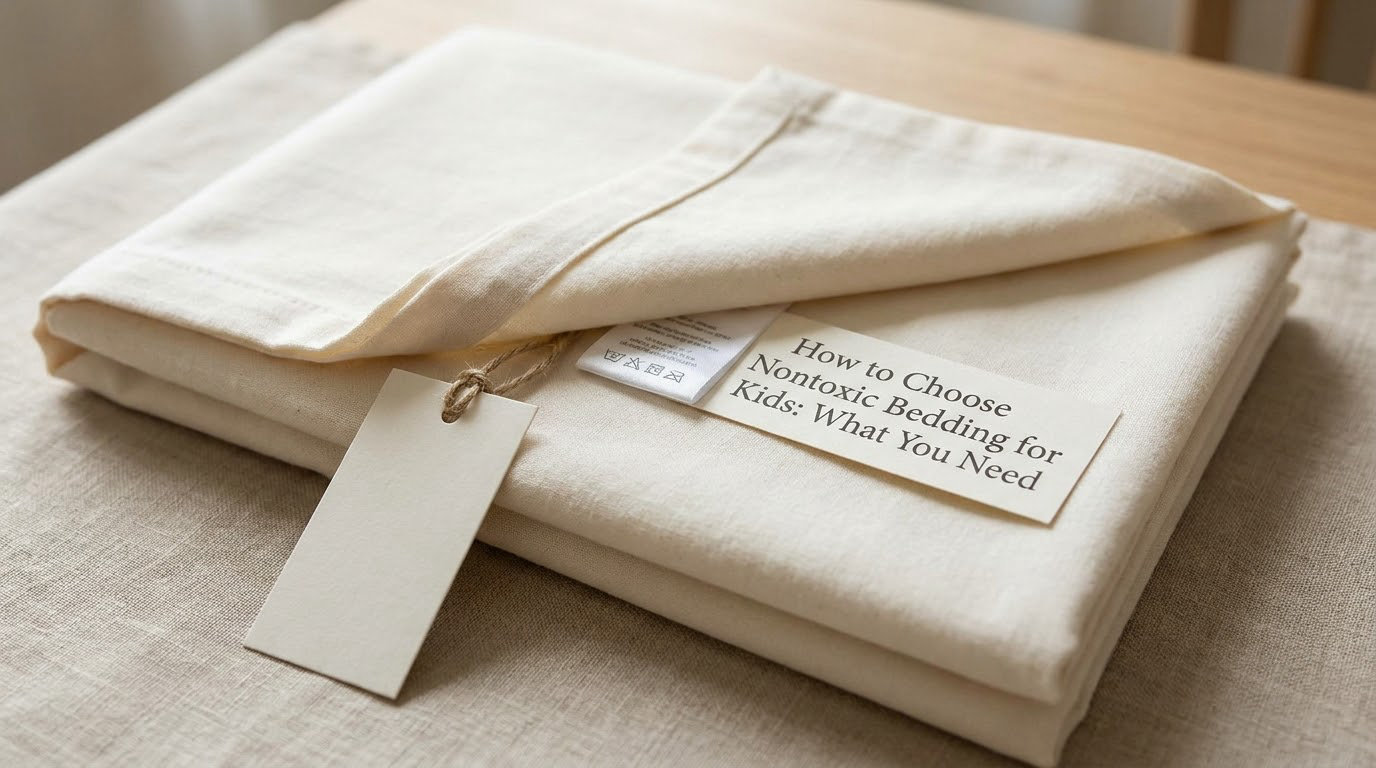
You do not need a toxic-substance testing kit. What you need is information, and most of it is free.
The care label and fiber content tag. Every finished bedding item carries a tag listing fiber percentages, country of origin, and care instructions. If a set has no fiber content tag at all, that is a reason to keep looking.
The certification record. A logo on the hangtag should come with a certificate number you can look up with the certifier. GOTS and OEKO-TEX both operate public label databases. If a brand will not give you a number, treat the logo as decoration.
The maker’s ingredient disclosure page. Reputable manufacturers publish a full materials disclosure listing every fiber, dye, and finish used in a product. This is the single most useful document for comparing two similar-looking sheets, and almost nobody asks for it.
Your child’s age, size and sensitivities. An infant’s sleep space has stricter rules than a seven-year-old’s bed. Eczema, asthma, dust-mite sensitivity, or a sensory-sensitive child changes the material ranking entirely.
Your mattress dimensions. Mattress depth and size decide whether a fitted sheet actually fits. A sheet that pops off in the middle of the night gets abandoned, and abandoned bedding gets used past the point it should be replaced.
A ten-minute budget of attention. The whole evaluation is slower than a coffee break. It just has to happen before checkout, not after a reaction.
Step-by-Step: Choosing Bedding Children Can Sleep On Safely
Seven steps, in the order that saves you money. Define what you are solving for, then narrow materials, audit the label, verify the certification, check comfort and allergies, compare durability, and finally test before you scale up.
1. Define What Nontoxic Means for Your Family
“Nontoxic” is a marketing word, not a regulated category. No federal rule defines what a product must contain to legally call itself nontoxic, chemical-free, or toxin-free on a bedding tag.
What you can verify is narrower and more useful. Hazardous substances are regulated — federal rules set limits for formaldehyde in textiles and children’s products, and the Consumer Product Safety Commission requires children’s bedding to meet flammability requirements without added flame retardant chemicals. Those rules describe a floor, not a guarantee.
So write down your actual priority before you shop. For one family that means a child with eczema who reacts to finishing resins. For another it is a baby with a brand-new mattress and an old, musty fitted sheet. For a third it is simply wanting fewer unknowns in a room where someone sleeps twelve hours a night.
Skip the words natural, clean, eco-friendly, and gentle. They tell you about marketing tone, not composition.
2. Start with Simple, Low-Risk Materials
Simple, minimally processed fibers have the smallest number of places for a problem to hide. That is the whole argument.
Organic cotton is the most widely available option and the easiest to buy in every size from crib to twin. The fiber is grown without synthetic pesticides and herbicides, and the fabric is typically woven and finished without formaldehyde wrinkle resins or added optical brighteners when a certification backs it up. Durability is good if you buy cotton with a moderate thread count and plain weave rather than a sateen that feels slick but pills.
Linen is flax, and flax needs far less chemical intervention than cotton. Linen is breathable, dries fast, and gets softer with every wash, which makes it a good match for a child who sleeps warm. The trade-offs are real: it wrinkles badly, feels stiff for the first few washes, and is more expensive than conventional cotton. Parents looking for durable year-round defaults often land on wool quilts and 100 percent cotton, and linen fits in that same camp.
Wool regulates temperature well and resists odor, which matters for a child who needs fewer blanket changes. Merino wool bedding is the usual entry point. Watch for scratchiness and for anyone with a wool sensitivity; a cotton or linen sheet under a wool blanket solves it.
Conventional cotton without certifications is not dangerous by default, but conventional cotton is the fiber most likely to carry pesticide residue, and conventional finishes are where wrinkle-resistant and stain-resistant chemicals live. Buy it when certified options are unavailable in your size.
Bamboo viscose requires a chemical argument. Bamboo cannot be mechanically spun into soft fabric. It is broken down into pulp and regenerated into viscose rayon using caustic chemicals, so the fiber’s origin does not carry through to the finished cloth. Bamboo is also easy to blend with polyester and still be marketed as bamboo. If you want bamboo, verify the finished product independently — not just the fiber.
Polyester and microfiber are where my own rule gets practical rather than pure. Sheds microplastics in the wash, holds odor longer, and is the most common carrier of PFAS-based stain repellents. But a child in diapers or one who wets the bed needs waterproofing, and most nontoxic options are not waterproof. A washable waterproof mattress protector under a washable cotton fitted sheet solves the real problem without dressing the whole bed in synthetic fleece.
Flannel is usually brushed polyester or cotton blended with synthetic fiber. Read the tag, and treat a “soft flannel” description with no fiber breakdown as a warning.
3. Read the Entire Label, Not Just the Front of the Package
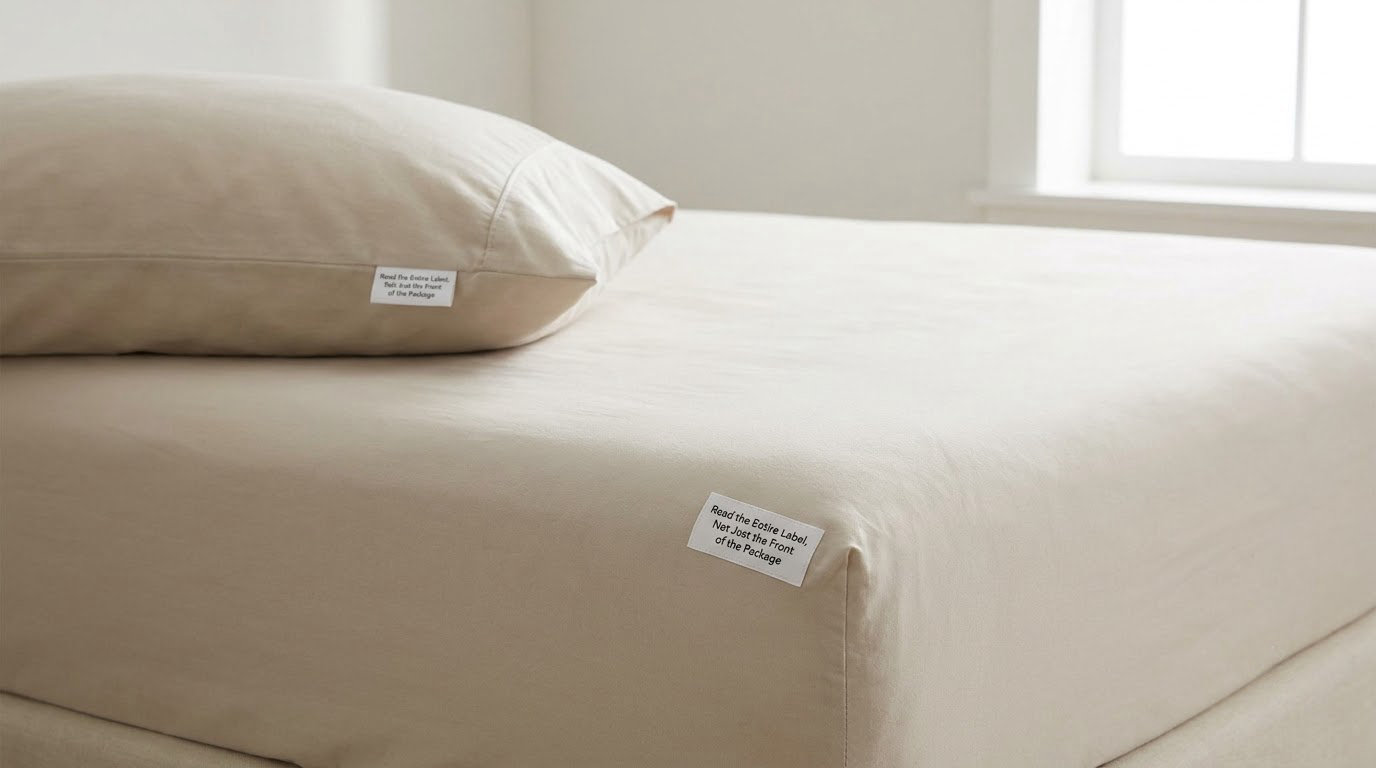
The front of the package is advertising. The bottom of the label is the product. This is how to choose nontoxic bedding for kids in about sixty seconds.
Look one: fiber content. Percentages must be listed, in descending order by weight. “Cotton” alone with no percentage is not a complete fiber declaration. A sheet reading 100 percent cotton tells you the fiber; it tells you nothing about the dye or the finish.
Look two: the finish language. This is where the useful signal hides. Wrinkle-resistant, easy-care, no-iron, stain-resistant, water-repellent, antimicrobial, anti-static, and odor-resistant all point to a chemical finish that a certification may not cover. Formaldehyde-releasing resins were historically the most common wrinkle-resistant chemistry in cotton. PFAS chemistry is the most common source of stain and water repellents. If the label or the product page describes a performance benefit without naming the chemistry, that is a question for the manufacturer.
Look three: country of origin and manufacturer contact. A physical address and a working support email tell you there is a company on the other end of a warranty. Country of manufacture is not a quality signal, but transparency about it is.
Look four: care instructions. Washability is a safety feature in a child’s bedroom, not a convenience. If a set must be dry-cleaned, it will not get washed often enough.
Look five: the warning and flammability statement. Children’s bedding sold in the US must meet federal flammability requirements, and the required language about compliance usually appears on the label. A flame-retardant additive is a different thing from meeting that standard, and some brands blur the two deliberately.
Look six: any certification logo, printed. Note the certifier name and the certificate number. A logo with no number is not something you can verify.
4. Verify Safety Standards and Third-Party Certifications
A logo tells you a third party tested something. It does not tell you everything. The useful habit is knowing which label answers which question.
GOTS (Global Organic Textile Standard) verifies the whole finished textile — fiber, processing, dyeing, and finishing — against both organic farming rules and a restricted chemical list. It is the strongest single label for sheets. On a bedding tag, GOTS normally appears on a green label.
OEKO-TEX Standard 100 verifies that the finished product contains no detectable amounts of a specific list of harmful substances at the time of testing. It tests the finished item, not the farming method, and it routinely appears alongside conventional cotton. Class 1 is the strictest class and covers items for babies and young children. On bedding, OEKO-TEX is normally a yellow label.
Greenguard Gold is an indoor air quality certification based on low chemical emissions testing. It is more common on mattresses, cribs, and furniture than on sheets, but when you are choosing a mattress topper or a sleep-surface product it is worth looking for.
GOLS (Global Organic Latex Standard) applies to latex, not sheets. It matters if you are buying a natural latex mattress or pillow for your child.
MADE SAFE is a third-party certification program with its own restricted substance list, aimed at products including infant bedding and mattresses.
UL Verified Formaldehyde Free verifies a single chemical claim. It is useful, and it is narrow — a formaldehyde-free product can still carry flame retardants or PFAS finishes.
Two cautions worth sitting with. First, “GOTS-certified cotton” on a listing can mean only the fiber was certified, not the finished sheet — the exact confusion parents hit most often. Second, no single label covers everything; a GOTS sheet in an OEKO-TEX pillowcase is a perfectly consistent setup, and mixing brands does not create a gap in safety.
Before you buy, spend two minutes in the certifier’s public database looking up the certificate number. If it does not resolve, ask the brand in writing. Brands that answer clearly are telling you something useful about the rest of their claims.
5. Consider Allergies, Skin Comfort, and Sleep Conditions
Material choice is also a comfort and health decision, and for some children that matters more than any chemical list.
Eczema and sensitive skin. Tight weaves and high thread counts feel smooth but trap heat and moisture against the skin. A medium thread count in a plain weave, washed once before first use to soften it, usually outperforms a high-end sateen for a child who itches. Fragrance-free is non-negotiable here, including fragrance-free detergent.
Dust-mite sensitivity and asthma. Dust mites live in bedding, which means washability matters more than fiber. Wash sheets weekly in hot water if the child’s care plan calls for it, and use a washable mattress protector. A nontoxic fabric that is never washed is a worse choice for this child than a conventional one that is.
Temperature regulation. A child who kicks off covers is usually too warm, not too cold. Breathable cotton and linen help more than heavier wool in a warm room.
Sensory preferences. For a sensory-sensitive child, the finish of the fabric matters as much as the fiber. Remove the sewn-in tags before the bedding goes on the bed. Choose smooth, plain weaves over textured or nubby fabrics. Some children strongly prefer a very light, cool sheet; others settle better with nothing loose on the bed at all. Consistency matters more than any brand decision — a familiar, predictable set does more for bedtime than a premium upgrade does.
Weighted products. If you are considering a weighted blanket for a child, talk to your pediatrician first. Safe weight and fit guidance varies by age and body size, and a blanket over a sleeping child carries its own risk regardless of what it is made from.
For any individual health concern, your child’s pediatrician or an allergist is the right person to ask. I can tell you what to look for on a tag; I cannot tell you whether your child’s rash is bedding-related.
6. Compare Durability, Fit, and Real Care Needs
Bedding fails on fit and washing long before it fails on chemicals. Check these before you commit.
Fitted sheet depth. Measure mattress height, not just length and width. Most fitted sheets accommodate roughly 12 to 16 inches; pocket depths differ. A too-shallow sheet works loose and stops being used.
Seam and elastic quality. Run your hand along the seams. Deep seams hold up to repeated washing better than a seam that is stitched once and thin. Reinforced elastic at the corners matters more than the elastic in the middle.
Shrink behavior. Look for a stated shrinkage allowance. Untreated cotton and linen shrink in the first wash, and a fitted sheet that shrinks below the mattress depth is now a pool on the floor.
Real care load. Plan for weekly washing, occasional bleach for an accident or illness, and a stain that sits overnight. Every one of those is easier on a washable natural fiber than on a delicate blend. If you cannot wash it, you probably will not.
Replacement cycles. Kids outgrow sizes fast, but a crib sheet can be cut down for a doll bed or a travel crib, and a twin flat sheet becomes a fitted sheet. Buy the size you need now and skip the expensive matching duvet cover if the budget is tight — a flat sheet and a washable blanket cover most of the safety benefit.
The cheapest set is often the wrong value if it cannot survive a year of weekly washing. Replaceability beats a big one-time purchase for a child who is still growing into sizes.
7. Test the Bedding Before Making It a Full Set
Buy the core pieces first — one fitted sheet, one flat sheet, one pillowcase. That is a single night’s sleep of data, and it takes a few weeks to collect.
Wash them according to the care instructions before the first use, then again a few times, which is how you learn what the fabric does. Watch for four things:
- Odor that will not leave. A strong chemical smell that survives a full wash cycle is a reason to return the set, not to air it out.
- Color transfer. Dye that runs onto a towel or pillowcase is unfinished or poorly fixed.
- Fabric reaction. Any new redness, itching, or rash on your child in the first days. Stop using the set and talk to your pediatrician.
- Shrinkage and pilling. Measure the fitted sheet depth after the second wash and rub a thumb along the surface under a bright light.
Sleep quality is part of the test too. If your child is kicking off covers, complaining about the texture, or waking more often, the material is wrong even if the certification is excellent.
Once a core piece survives a month of weekly washing, buy the matching set. Once the child outgrows the size, start the loop again — this is how to choose nontoxic bedding for kids without paying for a full collection three times.
Common Mistakes When Choosing Bedding for Kids
Most disappointing bedding decisions come down to one of these. Each has a straightforward fix.
1. Treating green marketing as evidence. Words like natural, eco-friendly, clean, and gentle are not regulated claims in US bedding labeling. The correction: verify a certification logo and a certificate number, or ask the manufacturer directly for the fiber, dye, and finish list.
2. Assuming organic means nontoxic. GOTS-certified organic cotton addresses both farming and processing, but an organic sheet can still carry a wrinkle-resistant finish. The correction: check whether the certification covers the finished product, then read the finish language.
3. Believing a fiber is safe because of where it grew. Bamboo is the classic case, because viscose regeneration is a chemical process. The correction: evaluate the finished fabric, not the plant.
4. Skipping the label audit. Parents spend more time reading mattress reviews than the fifty words on a sheet’s tag. The correction: do the sixty-second check in step 3 every time, including on gift sets.
5. Buying the whole set before testing. Sizing changes, textures surprise, and wash cycles shrink things. The correction: buy core pieces first, in the size the child is in this month.
6. Overlooking mattress fit. A fitted sheet at the wrong depth performs badly regardless of its fiber. The correction: measure mattress height with a tape before ordering, and add a few inches of depth headroom.
7. Confusing flame standards with flame retardant additives. US children’s bedding must meet federal flammability rules, which is not the same as being sprayed with a chemical retardant. Some brands describe a synthetic flame barrier as a safety feature. The correction: ask whether the product meets the standard without added flame retardant chemistry, and confirm it in writing.
8. Skipping laundering and ventilation. New bedding arrives with factory residues and packaging odor, and dust mites start immediately. The correction: wash before first use with fragrance-free detergent, skip fabric softener and dryer sheets entirely — they leave a coating that reduces absorbency and adds fragrance compounds — dry fully, and wash weekly. Air the room and keep the sleep space uncluttered so it dries out between uses.
Frequently Asked Questions
What is the safest material for a child’s sheets and pillowcase?
Untreated, undyed cotton with a third-party certification such as GOTS is the most widely available low-risk choice for a child’s sheets and pillowcase. Linen and wool are also minimally processed options. No material is risk-free, so look at the fiber, the finishes, and whether the piece is washable, rather than assuming the fiber name answers everything.
Is organic cotton bedding automatically nontoxic?
No. Organic describes how the fiber was grown, not how the fabric was finished. A conventionally grown cotton sheet with a wrinkle-resistant resin can carry more of the chemicals parents are trying to avoid than an organic sheet without one. GOTS covers the whole finished textile, which is why certification scope matters more than the word organic on the front of the package.
How can I tell if a bedding certification is legitimate?
Look for the certifier name and a certificate number, then look that number up in the certifier’s public database. GOTS and OEKO-TEX both publish searchable label records. Be cautious with logo-only listings, vague wording like certified by a third party, and any use of a standard number that does not correspond to a real program. If the brand cannot produce a number, the claim is not checkable.
Should I wash new kids bedding before the first use?
Yes. Washing before first use removes factory residues, finishes, and packaging odor, and it softens new fabric. Use fragrance-free detergent with no fabric softener or dryer sheets, dry the bedding fully, and wash it on a weekly schedule after that. For a child with eczema or allergies, the wash-and-dry step is one of the more useful things you can do for comfort.
What bedding claims should parents be especially cautious about?
Be cautious with chemical-free, toxin-free, and nontoxic, since none is a regulated term in US bedding labeling. Also watch for wrinkle-resistant, easy-care, no-iron, stain-resistant, and water-repellent, which usually indicate an added finish. Bamboo is worth a second look too, since viscose processing is chemical even though the plant is a grass.
Conclusion
Start with your child’s main sensitivities, because that decides the material ranking faster than any certification does. Then choose a washable fiber that fits the bed properly, read the whole label for finish language, verify the certification number, and test one core piece through several wash cycles before buying the matching set.
That is the whole method behind how to choose nontoxic bedding for kids. It takes about an hour the first time and ten minutes after that, and it leaves you with a set you can actually explain to anyone who asks.