
Disability is a neutral difference in how a body, brain, or senses work, and that is the whole idea a child needs. Learning how to talk to kids about disabilities is less about finding perfect words and more about being matter-of-fact, answering the question in front of you, and refusing to treat difference as something shameful. Most parents who search for this guidance are not worried about their child’s kindness. They are worried about their own reaction, in the ten seconds after their child points at someone and asks why.
Here is the honest answer: saying nothing is worse than saying it badly. Adults who shush, deflect, or reach for soft words teach children that disability is a topic too embarrassing to discuss. Adults who answer plainly, in age-appropriate language, teach the opposite. This guide gives you the actual phrases, the age bands, and the repair scripts, so you stop rehearsing it in the car and start saying it in the moment.
This is general parenting guidance, not medical advice. For anything about your own child’s diagnosis, development, or accommodations, talk with their pediatrician and their school team.
Table of Contents
- What You Need
- Step-by-Step: How to Talk to Kids About Disabilities
- Step 1: Choose the right time and setting
- Step 2: Start with the person, not a stereotype
- Step 3: Use clear, simple explanations when you explain disability to kids
- Step 4: Answer the question honestly
- Step 5: Explain different ways of communicating and learning
- Step 6: Practice inclusion and respectful language
- Step 7: Keep the conversation open
- Common Mistakes
- Frequently Asked Questions
- How do I explain autism to a child?
- How do I explain a physical disability or wheelchair to a young child?
- What is a better way to say learning disability?
- How do I explain a sibling’s diagnosis without making the other child jealous?
- Should I tell my child about my own disability or chronic illness?
- What should I do when my child points and stares at someone?
- Conclusion
What You Need
You need four things before the first conversation, and none of them cost money or take an afternoon to arrange.
A private setting beats a public one every time. A car ride, a walk around the block, or sitting on the floor with a picture book gives your child room to ask the follow-up question they were too embarrassed to ask in front of Aunt Karen. Public conversations are for later, once your child has heard the answer once and knows it is not a scandal.
An honest read on your child’s age and communication style. A two-year-old wants one sentence. A ten-year-old wants a paragraph and a follow-up. A teenager may only want the short version plus permission to come back later, which is its own kind of answer.
The words your family already uses. If your child says wheelchair, say wheelchair. If a family member says “autistic” rather than “has autism,” mirror that. The most respectful language in the world is the language the actual person chooses for themselves.
A rough sense of what your child needs right now. A child starting kindergarten does not need a full explanation of a relative’s chronic illness. They need enough to not be confused by what they will see. You can always add detail later, and Seattle Children’s and similar hospital resources are good places to check the specifics you are unsure about.
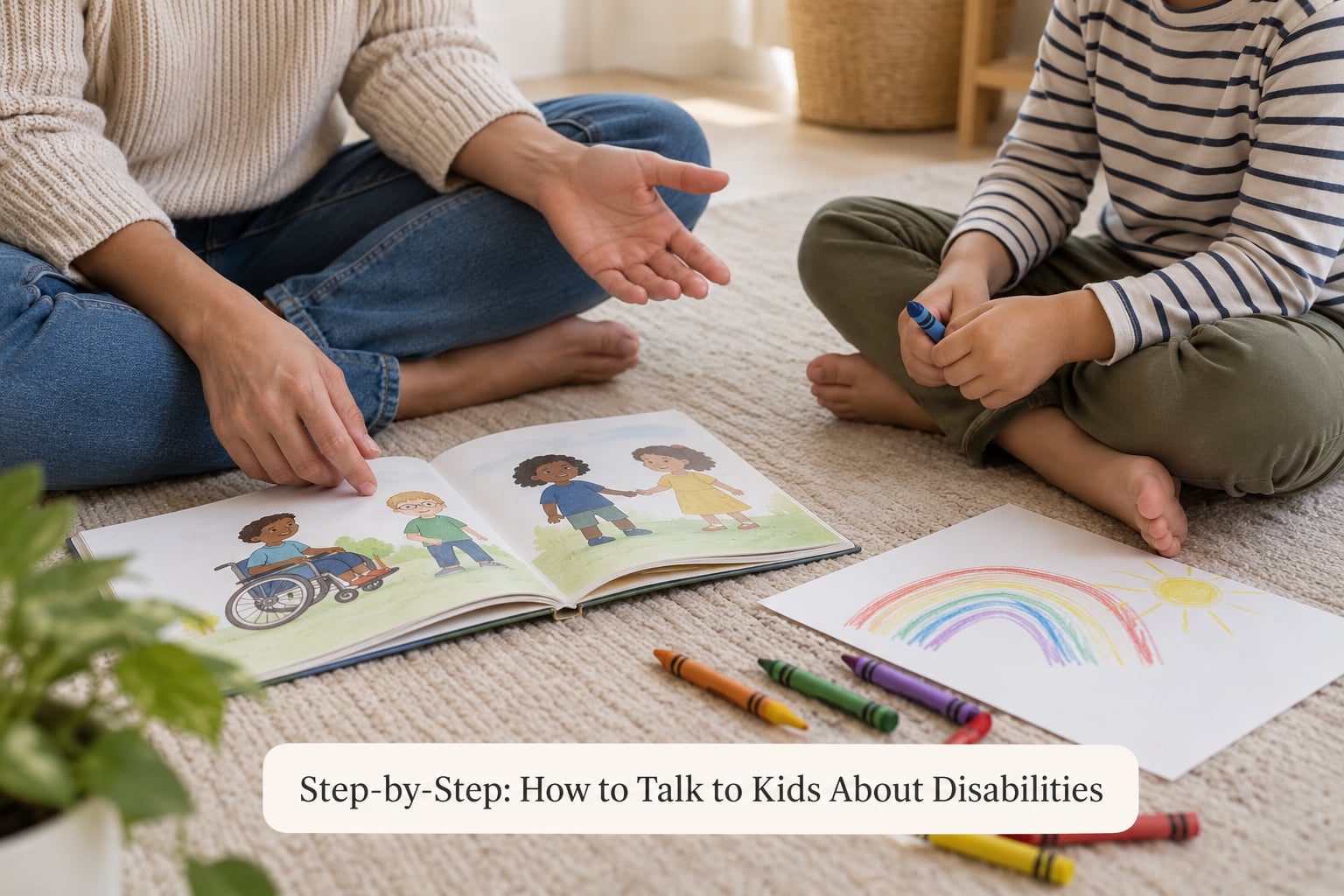
Step-by-Step: How to Talk to Kids About Disabilities
Step 1: Choose the right time and setting
Wait for a real moment rather than scheduling a lecture. Good openings arrive right after a question, right after a new diagnosis, right after a doctor appointment, or right after your child notices a difference in a daily routine, like a sibling who now takes a wheelchair to the park.
The sign that the moment is right is the question itself. If your child is asking, the conversation is already happening. Move it somewhere quieter and answer it there rather than ending it with “not now.”
Step 2: Start with the person, not a stereotype
Describe the person before you describe the disability. Your child’s aunt is a gardener who loves terrible reality TV and uses a wheelchair to get to the garden. That sentence does more work than three paragraphs about mobility.
Then follow that person’s lead on language. Person-first language, like “a child with autism,” treats the diagnosis as a separate thing. Identity-first language, like “an autistic child,” treats it as part of who someone is. Many autistic adults prefer identity-first, and plenty of adults with physical disabilities prefer person-first. When in doubt, mirror how the person describes themselves, and if your child is too young to know, ask.
Step 3: Use clear, simple explanations when you explain disability to kids
Name the thing. Say “she uses a wheelchair” or “he has autism” or “she has a learning disability.” Do not swap in euphemisms like “handy-capable,” “diffabled,” or “wheelchair-bound.” Softened words sound kind and land as dishonest, because the child can tell you avoided the actual subject.
Then connect it to something the child can see or notice. “A wheelchair helps her legs move so she can go places on her own.” “Autism means his brain works differently, and loud sounds feel really loud to him.” “A learning disability means reading takes more work for him, not that he is less smart.” Keep it short, and repeat it as often as the child asks.
Step 4: Answer the question honestly
Blunt questions are the normal case. “Why does he talk differently?” “Why is she in that chair?” “What’s wrong with that kid?” A calm answer beats a vague one, because vagueness teaches your child that you think the question was bad.
Answer what you actually know, and say so plainly when you do not know. “I don’t know, and I can look it up with you tonight” is a complete answer, and parents on disability forums say it works better than improvising. Nobody owes a stranger’s child a medical opinion, and your child does not owe a stranger’s child an explanation either. A simple “that’s private” said warmly is fine.
Step 5: Explain different ways of communicating and learning
Show that there are many ways to communicate and many ways to learn, because this is where most children need a picture. Some people talk in words. Some use sign language. Some point at pictures on a device, and for a child who is non-speaking that device is their voice.
Give concrete accommodations. Extra time on a quiz. A quiet room instead of a noisy cafeteria. Text instead of talking on the phone. Larger print or a reader for a novel. Hearing aids and glasses belong in the same category: tools that let someone do what everyone else does. Call them tools, not magic and not a burden. If your child is autistic and you are still working out which supports hold up on an ordinary Tuesday, our guide to screen time rules for autistic kids covers keeping that picture consistent.
Step 6: Practice inclusion and respectful language
Give your child phrases to use, because scripts beat improvising. “That is a different way of communicating.” “Let’s ask before helping.” “Want to come sit with us?” These are small, specific, and repeatable.
Then name what is not acceptable: nicknames built on a disability, imitating someone’s speech or walk to get laughs, leaving someone out of play, and assuming a person cannot do something before asking them. Your child will get this from watching you, more reliably than from hearing you. The ten seconds after you respond to a stranger’s staring child is the actual lesson.
If your child says something ableist, most often it came from somewhere they heard it. Wheels on a shopping cart get lifted back onto the table gently and without a lecture: “We don’t talk about bodies that way. Want to talk about why the rules are different?”
Step 7: Keep the conversation open
Check in later. Questions about disability often surface at bedtime, in the car, or a week later when a friend mentions something at school. Leave the door open by naming it yourself: “You can ask me anything about bodies, brains, and people being different, any time.”
Connect it to your child’s own life without turning them into a teaching tool. If your child uses an accommodation, let them explain it if they want to, and don’t volunteer their story for you. And when a question feels too big for you, route it to a trusted adult or to your child’s teacher, IEP team, or 504 team rather than leaving it hanging. The sibling version of this conversation tends to arrive months later, around appointments and plans, and how to talk to siblings about the future picks up where this one stops.
Common Mistakes
Most damage in these conversations comes from six habits, and every one of them has a straightforward fix.
Waiting until the child asks a devastating question in public. The fix is to answer the first small question quietly and early. Ten minutes of walking beats ten minutes of an audience.
Shushing a curious child. “Don’t stare, don’t point, don’t ask” teaches that disabled people are unspeakable. The fix is to model the answer yourself, calmly, and let your child see that a question is allowed.
Using pity. Words like poor, suffers from, and tragedy turn a person into a problem. The fix is neutral: has, uses, lives. Say it the way you would describe someone’s hair color.
Swinging to inspiration. Talking about how brave or inspiring someone is sounds generous and still objectifies them, because the story becomes about how admirable their disability is. The fix is to let the person be a person who also happens to be disabled.
Overloading the child with detail. A four-year-old does not need a definition of the social model of disability. The fix is one sentence, then let the follow-up questions tell you what comes next.
Giving a diagnosis the child did not ask for. “She has cerebral palsy” from a stranger is not helpful information. The fix is to name the visible need and stop.
A few follow-up habits carry the rest. Put books with disabled characters in the house and read them without commentary; titles like Wonder, Celine’s New Splints, The Amazing Erik, and Daniel Tiger give your child questions that are not about anyone in the family. If your child is the one being stared at, talk to them beforehand about what they might face and what they can say. And if a peer is being teased or left out, say to your child plainly that excluding someone is not something our family does, then tell the teacher. When the goal is a place where your child gets to move without being talked over, finding swim lessons for special needs kids covers what to ask a program before you sign up.
Watch for the signs that stigma is landing: your child retelling a disability story with the sad ending added, joking the way they heard adults joke, or quietly avoiding a classmate they used to sit with. Correct it the first time, out loud, and move on. The Haring Center’s inclusion modules and Scope’s End The Awkward campaign both offer age-specific material if you want something to hand a teacher.
Frequently Asked Questions
How do I explain autism to a child?
Describe it as a different way the brain and senses work, then connect it to something the child can notice. Some autistic children flap their hands, find loud rooms hard, or need a routine. Keep it neutral and short, and let the autistic person in the room correct you. Avoid framing autism as a tragedy or a gift.
How do I explain a physical disability or wheelchair to a young child?
Say the plain version once: that is a wheelchair, and it helps that person move. Then point out what the person is doing, not what is wrong with them. If your child asks to try the chair, say yes with conditions and stay in reach. The child learns most from the person treating the wheelchair as ordinary equipment.
What is a better way to say learning disability?
Say has a learning disability rather than suffers with one or is slow. A learning disability means reading, writing, spelling, or math take more effort, not that the child is less intelligent. Mention the accommodations alongside it, such as extra time or a reader, so the child hears a solution in the same breath as the label.
How do I explain a sibling’s diagnosis without making the other child jealous?
Tell them early, in plain terms, and give them real information rather than reassurance. Siblings are allowed to feel mixed about new appointments, less attention, or a parent being tired. Give them a job only if they ask for one, and make it clear the diagnosis is nobody’s fault, including theirs.
Should I tell my child about my own disability or chronic illness?
Yes, and you get to decide how much detail you share. Answer the actual question without a full medical history, and correct any belief that your condition means you are fragile or unreliable. Simple, matter-of-fact answers about your own body teach your child that health topics are ordinary ones to talk about.
What should I do when my child points and stares at someone?
Take the lead instead of pulling them away. Get down to their level, name what they noticed, and answer with the same calm voice you would use for anything else. Children who are dragged away from a wheelchair user learn that disabled people are something to avoid. Say, let us ask, and then let your child ask.
Conclusion
Start small. Pick a calm moment, use one plain sentence about one real person, answer the question in front of you without a detour, and tell your child they can ask you again tomorrow. That is the whole method for how to talk to kids about disabilities, and it works better than any script you memorize.
Follow the disabled person’s lead on language, correct ableist comments early and lightly, and keep the door open. For the specifics of your own child’s medical or developmental questions, start with their pediatrician and their IEP or 504 team, and bring any resource you find here to them.