To handle sibling rivalry in a family where a child has autism or another disability, work the problem in order: calm yourself first, separate the children if anyone is unsafe, hear each child without deciding who is right, and hold one clear boundary at a time. Then teach a short repair routine and adjust the environment so the same fight fires less often. Most families need a few weeks of consistent follow-through before they see change, and the effort is worth it.
This guide assumes at least one child in your home has a diagnosis, a developmental delay, or a significant sensory difference. That detail changes the work, because the triggers that set off a fight are not always the obvious ones. A typically developing sibling may be irritated by noise. The autistic sibling may not be able to articulate why, and may grab the same toy for the fourth time in an hour without meaning any harm.
If noise, crowds, or an unexpected change of plan is already pushing one of your kids past their limit, it helps to have a plan ready. Start with how to handle autism meltdowns at home and how to handle school refusal in an autistic child, then return here for the sibling layer.
Table of Contents
- What You Need
- A reset plan you can actually follow while upset
- Three family rules, written down
- A simple trigger record
- Age-appropriate language for each child
- A plan for undivided attention
- Step-by-Step: How to Handle Sibling Rivalry
- 1. Identify the trigger beneath the conflict
- 2. Pause before you respond
- 3. Hear each child without taking sides
- 4. Set one clear boundary at a time
- 5. Solve the problem together
- 6. Teach a simple repair routine
- 7. Prevent the next round of sibling rivalry
- Common Mistakes
- Frequently Asked Questions
- What age is sibling rivalry the worst?
- What is the root cause of sibling rivalry?
- What are the signs of unhealthy sibling rivalry?
- How do I handle sibling rivalry when one child has autism?
- Should I punish both children when they fight?
- When should I call a therapist or family counselor?
What You Need

You do not need a curriculum or a therapy workbook. You need five things you can set up in an afternoon.
A reset plan you can actually follow while upset
Decide now, in calm conditions, what you will do when a fight starts. Most parents plan a technique but not the physical steps. Write down the sequence in short order: move apart, one adult with each child if you have one, lower your voice, wait, then talk. If you have a spare room or a safe space a child can retreat to, pick it now rather than mid-argument.
Three family rules, written down
Keep the list short enough that everyone remembers it. Most special-needs households end up with something like: no hitting, no name-calling, no destroying someone else’s stuff, and ask an adult for help instead of grabbing. Post it where all the kids can see it, and use the same three every time. Rules that change week to week teach kids that rules are negotiable.
A simple trigger record
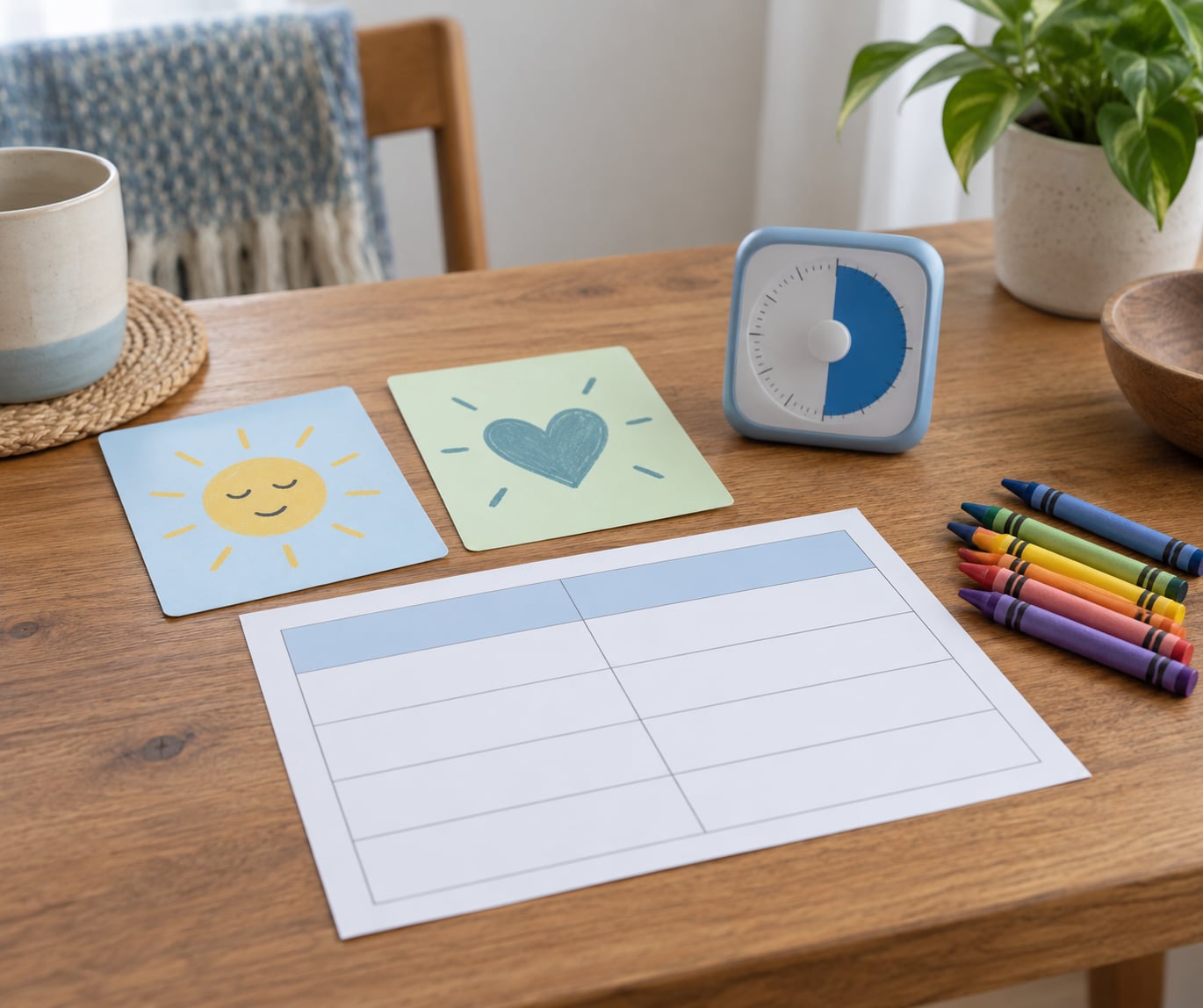
Three columns on paper or in your phone is enough: what happened just before, what each child did, and what finally helped. Three weeks of notes is plenty. This is the single most useful tool in this guide, because most parents are treating the symptom and never find the trigger that keeps firing.
Age-appropriate language for each child
Write one sentence you can use with each child. Your nonverbal child may need a picture card, a sign, or a single word. Your verbal school-age child can handle a full question. Using the wrong register is one reason a de-escalation attempt fails: a three-word prompt to a teenager feels sarcastic.
A plan for undivided attention
Ten to fifteen minutes a day of child-led time with each child, on a schedule that rotates, does more to reduce rivalry than most other tactics. Families with three or more children rotate a short special-time block weekly instead of daily. Put the schedule where you can see it, because the day you skip it is the day a fight is most likely.
Step-by-Step: How to Handle Sibling Rivalry
1. Identify the trigger beneath the conflict
Most sibling conflict is a need wearing a fight as a disguise. The common ones are competition for your attention, jealousy over a relationship, and a power struggle over who decides. In families with disabled or autistic children, add sensory overload, an interrupted activity they cannot let go of, a routine change with no warning, and communication that never got translated into words.
Use your trigger record to sort it out. Note what happened in the minute before, what each child actually did, and what helped. When the same trigger shows up three times, you have your answer and you can change the environment instead of the children.
2. Pause before you respond
Your regulation is the first intervention, because a flooded adult cannot reason with a flooded child. Take one slow breath that you can feel, drop your voice a little, and unclench your jaw. Then move anyone in danger apart, hands and voices low, no commentary about who started it.
If a child needs sensory input to come down, give it: a quieter room, a weighted item, water, or a movement break. Say out loud, in a neutral voice: “I will listen after everyone is safe.” That sentence buys you thirty seconds and models a limit you intend to keep.
3. Hear each child without taking sides
Ask neutral questions instead of “who started it.” Try “Tell me what happened” from each child separately, then “What did you need?” Validate the feeling without assigning blame: “You wanted the truck and it was in your hands. That is hard.” You can hold that both children wanted something and only one had it.
Adapt for communication differences. A child who is nonverbal or minimally verbal may point, gesture, hand you a card, or show you a video clip. Take that seriously as a full answer. If your child needs more processing time, wait fifteen seconds of silence before rephrasing, because filling the gap creates more escalation, not less.
4. Set one clear boundary at a time
Stop the behavior, not the child. “Hitting stops now. Hands stay on people gently” is a boundary. “You are a bad brother” is a label that teaches nothing and lands harder when the child is already sensitive to criticism.
Name what you are stopping, then offer a safer alternative they can actually do, then hold the same limit next time. One boundary at a time works better than three stacked consequences, because a dysregulated child cannot process a lecture and a consequence at once.
5. Solve the problem together
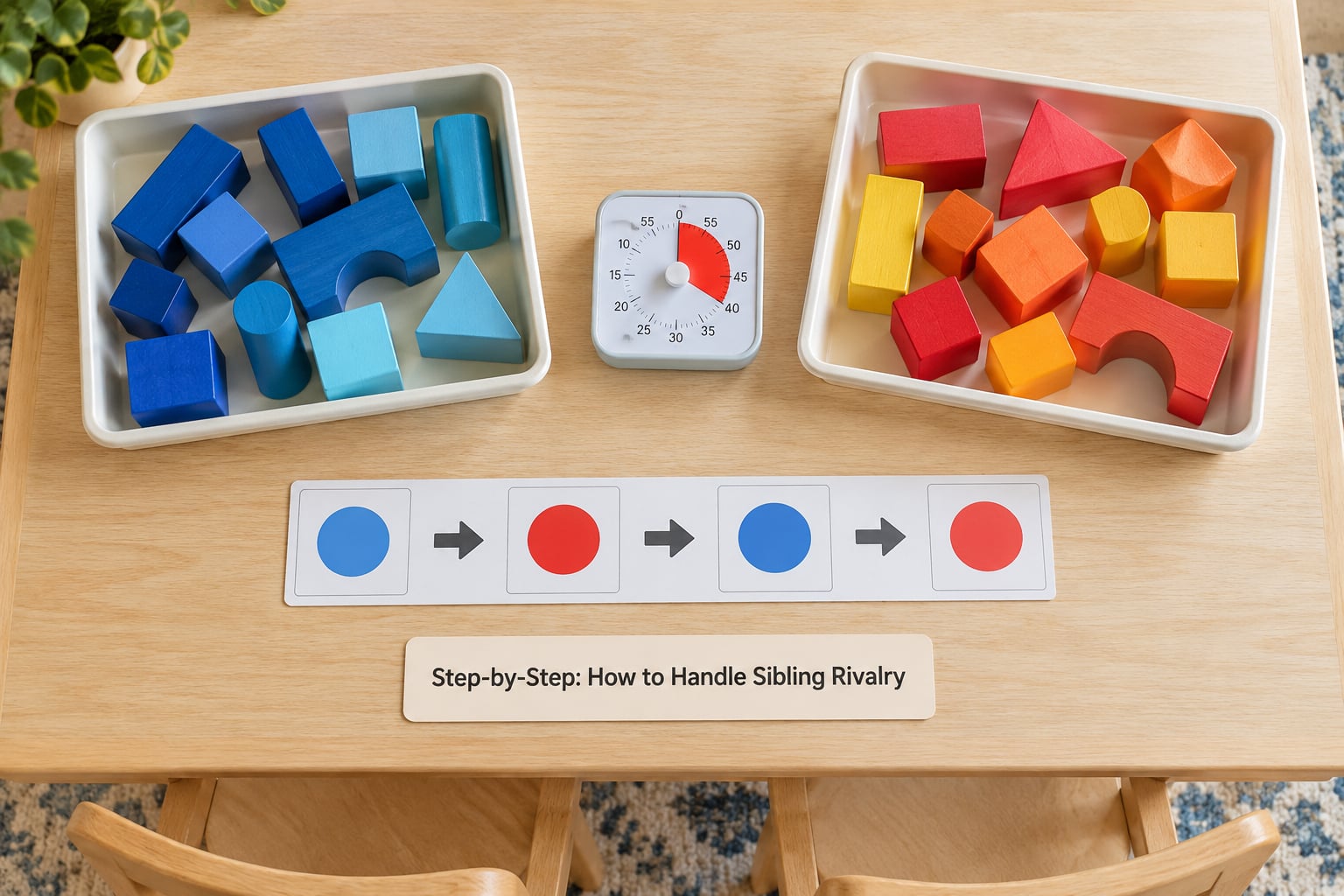
Once both children are calm, treat the fight as a problem to solve rather than a crime to punish. Ask what each of them needs and what could make the next hour easier. A small visual timer often ends toy arguments faster than a parent ruling, because the timer is not the one winning.
Build in whatever supports each child needs: a visual schedule for the transition, a warning before the plan changes, two duplicate sets of a favorite toy so there is no contested object, or a quiet space one child can use when play gets loud. Accommodations here are not spoiling anyone. They remove the exact conditions that trigger the flare.
6. Teach a simple repair routine
Keep repair short and concrete. Acknowledge what happened, replace or fix what was damaged when it matters, do something concrete that repairs, and return to normal activity. That last part is what stops a grudge: life moves on, and neither child is stuck in the moment.
Do not require an instant apology. “Say sorry” to a child who is still flooded produces a word with no meaning behind it. “Go get the markers and draw on the new paper” is a repair a young child can actually complete.
7. Prevent the next round of sibling rivalry
Prevention is the whole game, and it matters most in a family with sensory, developmental, or medical needs. Protect one-on-one time, warn before schedule changes, rotate your attention instead of pouring it into whoever is loudest, and give each child a role that is genuinely theirs at family meals or game time.
Then review your trigger record once a month. If the same fight keeps coming back, the answer is in the environment, not in your children’s characters. Change the trigger conditions before you try harder with the consequences.
Common Mistakes
Forcing instant sharing. “Share right now” teaches children that their wants are negotiable and that you enforce sharing by force. Offer two identical toys instead, or set a timer, and let the other child practice waiting.
Comparing siblings. “Why can’t you be more like your brother” hands both children a scoreboard and hands the older one a job he never signed up for. Comment on the specific thing you saw instead.
Punishing both children every time. Punishing the child who was hit teaches him that being touched is normal and that adults cannot tell the difference. Consequences belong to the behavior, and the behavior is rarely shared equally between a nine-year-old and a four-year-old.
Lecturing while either child is dysregulated. Words go nowhere in the middle of a fight. Wait, then talk. If you lose your own temper, repair it later in one plain sentence: “I raised my voice and that was not okay. I am sorry.” Children learn regulation partly by watching a parent do it imperfectly and come back.
Ignoring the disability-related trigger. If one child cannot yet say “the noise is too loud” or “I need a minute,” you have to read it and adjust the room. Treating a sensory need as bratty behavior removes the only lever you have.
Letting unsafe behavior pass without any boundary. Withdrawal works for bickering over blocks. It does not work for hitting, name-calling, or destroying property. Those three get a firm, calm, immediate stop every single time.
Frequently Asked Questions
What age is sibling rivalry the worst?
It usually peaks between ages two and five, and again in early adolescence around nine to thirteen. The toddler and preschool years bring physical grabs over toys and attention. The tween and teen years bring fights over privacy, screens, and who gets the last word. Expect a rough patch after a new baby arrives, and again when children start school or a new activity schedule begins.
What is the root cause of sibling rivalry?
Three things sit underneath most sibling conflict: competing for your attention, competing for companionship, and competing for control. Add in developmental gaps, temperament differences, and unmet sensory needs. The root cause is rarely that one child is simply worse. It is usually that two children want the same limited resource and neither can name what they need.
What are the signs of unhealthy sibling rivalry?
Watch for one child being named the problem most of the time, fear of being alone in a room with the other, threats or cruelty that go beyond the moment, physical harm that happens regularly, withdrawal or drop in school performance, and family members being asked to pick sides. Healthy conflict ends and resumes. Unhealthy rivalry tends to run in the background and follow the child outside the home.
How do I handle sibling rivalry when one child has autism?
Read the trigger instead of waiting for a complaint. Watch for the buildup: pacing, hand flapping, covering the ears, shutting down. Change the conditions early, move to a quieter space, keep a predictable schedule, warn before transitions, and set up duplicate items so the same toy is not contested. Give your nonverbal child a card or sign for requests so the need has a channel other than grabbing.
Should I punish both children when they fight?
No, not as a default. Consequences should follow behavior, and in a fight between a four-year-old and a nine-year-old the behavior is not equal. Punish both and you teach the younger child that being hit is normal, and you teach the older child that fairness does not exist. Stop the unsafe act, repair the damage, and let each child answer separately for what they did.
When should I call a therapist or family counselor?
Call when the fighting includes regular physical harm, threats, or cruelty, when a child withdraws from family life or school, when your own stress is climbing, or when nothing you try has changed the pattern in six to eight weeks. Start with a family counselor or child psychologist who works with neurodivergent children. Your child’s pediatrician can also point you to a referral and rule out pain or sleep as a trigger.
Start tonight with the trigger record, not with a new rule. Write down the three moments this week when a fight started and what came before it. Most parents find one recurring trigger they can remove, and the arguing drops faster than they expected. If sensory input is the trigger more often than not, our guide to trick or treating with sensory issues has planning steps you can adapt for playrooms and sibling time.