
The signs of ADHD in children fall into two main groups: inattention and hyperactivity-impulsivity. Attention-deficit/hyperactivity disorder is a neurodevelopmental condition, and these signs show up as a pattern over time rather than as one bad day. Only a qualified professional can assess a child and say whether what you are seeing is ADHD.
This guide walks through what the signs actually look like in real homes, how they shift with age, and what else can cause the same behaviours. Nothing here is a diagnosis, and nothing here is a substitute for your pediatrician.
Table of Contents
- What Are the Signs of ADHD in Children?
- Inattention Signs to Look For
- Hyperactivity and Impulsivity Signs
- How ADHD Signs May Differ by Age
- Signs of ADHD in children at preschool age, 3 to 5
- Signs of ADHD in children at school age, 6 to 12
- Teens
- Signs of ADHD in Children vs. Normal Developmental Differences
- When to Talk With a Pediatrician
- How Professionals Evaluate a Child for ADHD
- Signs of ADHD in Children with Autism or Other Disabilities
- How Parents Can Support a Child While Waiting for an Evaluation
- Frequently Asked Questions
- Can a child have ADHD without being hyperactive?
- At what age can a child be diagnosed with ADHD?
- How do I know if my child has ADHD or is just being naughty?
- What happens at an ADHD evaluation?
- Can hearing loss, poor sleep or anxiety look like ADHD?
- Is ADHD inherited from a parent?
What Are the Signs of ADHD in Children?
ADHD is a neurodevelopmental disorder, which means it comes from how the brain develops and functions rather than from anything a parent did or failed to do. It affects the systems the brain uses to manage attention, impulse control, working memory, organisation and emotional regulation, often called executive function.
That is why the signs rarely look like a fixed list of problems. They look like a child who can hold a whole LEGO castle in their head but cannot remember which jacket goes on, or who narrates a six-foot dinosaur with total focus and then cannot follow two instructions at dinner.
Clinicians describe ADHD by presentation rather than by a separate disorder. The three are predominantly inattentive, predominantly hyperactive-impulsive, and combined presentation. A child can move between presentations as they grow, and many parents tell me their child was one thing at six and something else at twelve.
Two things matter more than any single behaviour. First, the DSM-5 requires symptoms in two or more settings, such as home and school, so a child who is fine in your kitchen but struggles in every classroom is telling you something. Second, the signs have to be frequent, intense, long-lasting and disruptive enough to interfere with daily life, and they must be out of step with what is typical at that age.
One more term you will hear a lot: ADD. It is the older informal name for what is now called the predominantly inattentive presentation. Both are ADHD.
Inattention Signs to Look For
Inattention is about difficulty holding focus, following through, or organising, even when the child wants to do well. The DSM-5 lists nine criteria; here they are as parents actually see them.
- Trouble paying attention. Your child drifts during a story, loses the thread in conversation, or plays with a toy and leaves it half finished.
- Does not seem to listen. You ask twice, then three times, and they were not ignoring you, the words never landed.
- Careless mistakes. The same wrong answers in a workbook, a soup spill, a bike scraped against a fence.
- Does not follow through. They start the chore, switch to something else, and the chore is still there an hour later.
- Loses things. Backpack, library books, the permission slip you signed last night.
- Easily distracted. A bird outside the window, a conversation at the next table, their own wandering thoughts.
- Forgetful in daily activities. Morning routine, bath time, bringing a lunchbox to the table.
- Avoids sustained mental effort. Homework, reading, anything that does not move fast enough. Not a fear of it, just an avoidance of it.
- Disorganisation. Backpack, desk, bedroom, or a to-do list that lives only in their head.
Two subtler inattention signs often get missed. Daydreaming looks like a child who is zoned out during read-aloud time, then suddenly knows the answer. And mind-wandering during a task they enjoy is not the problem; it is mind-wandering during a task they find hard.
To separate an occasional bad day from a real pattern, count frequency, intensity, duration, and how much it gets in the way. One forgetful Tuesday is a seven-year-old. Forgetting the same thing most days for six months, in two settings, is the pattern clinicians look for.
Hyperactivity and Impulsivity Signs
Hyperactivity-impulsivity covers the body and the brakes at once: the engine runs high and the pause between wanting and doing is missing. Again, the DSM-5 lists nine criteria.
- Fidgets and squirms. Hands always busy, pen tapping, pencil breaking, rocking, spinning things.
- Leaves the seat. In a chair, at the table, in a waiting room.
- Runs or climbs at the wrong moment. In a library, a church hall, a restaurant.
- On the go, like a motor. Hard to pin down, even during quiet activities, as if they are running on the inside.
- Talks excessively. The chatterbox, the kid who narrates everything, the one who keeps talking after you have answered.
- Blurts out answers. The whole class knows the answer before the question is finished.
- Difficulty waiting their turn. Board games, sibling queues, cafeteria lines.
- Interrupts or intrudes. Mid-conversation, mid-game, mid-sentence.
- Acts without thinking. Grabbing a hot mug, running into traffic, announcing the plan before anyone agrees to it.
Many parents describe their child as hyperactive but lacking emotional regulation, and that second half is the part that exhausts them. Low frustration tolerance, quick mood shifts, and meltdowns that come out of nowhere over a stuck zip or a wrong cup sit alongside the movement.
The same excess shows up in sensory load. Too much noise, too many people, too many instructions at once, and the last thing anyone has is patience. I know parents who braced for a tantrum every time the fire truck came past.
How ADHD Signs May Differ by Age
ADHD in children does not announce itself with a single symptom. It surfaces differently depending on developmental stage and on how much the environment demands of them.
Signs of ADHD in children at preschool age, 3 to 5
Before school starts, the demands are small, so the signs look like regulation rather than academics. A toddler who is extraordinarily hard to soothe, who melts down more often than peers, who cannot sit through a short story, or who struggles with transitions and waiting turns may be showing early signs.
Parents on parenting forums often describe signs that go back much further than they expected: a baby with high tension, sensitivity to noise, trouble being soothed, an unusually hard potty training run, or a child who hated getting dirty or undressed. None of that proves anything on its own, and none of it is unusual enough on its own to worry a doctor.
Signs of ADHD in children at school age, 6 to 12
This is usually when parents start naming it, because school is the first place that asks a child to sit still, hold a pencil, wait in line and finish something they do not enjoy. Homework battles, missing assignments, lost belongings, a desk covered in scraps and a teacher asking why nothing seems to get done are the everyday faces of it.
Social demands climb at the same time. A child who interrupts, rushes, or cannot read the room gets pushed aside socially, often before the adults around them have connected the rejection to attention. Girls in this age group are the ones most often missed, because the hyperactive boy is noticed and the quiet drifting girl is called dreamy.
One question comes up constantly in parent groups: my child will play a video game for three hours but cannot manage ten minutes of homework, so it cannot be ADHD, right. It can. Games deliver constant novelty, immediate feedback and a reward every few seconds, and that is exactly the environment a struggling attention system can lock onto. Losing interest in a low-reward task is part of the picture, not evidence against it.
Teens
Teens often look less hyperactive and more inconsistent. Homework takes four hours and produces half a page. Rooms, backpacks and deadlines slide. Grades wobble for reasons that make no sense, and a parent starts hearing from a teacher that the student is bright but unfocused.
Two things get missed at this age. Emotional regulation, where frustration turns fast and hard into anger or shutdown, and the quiet inattentive presentation, where a teenager can sit in a quiet room looking busy while nothing is actually getting done. Both are common in girls, who are still diagnosed later and less often than boys.
It is worth saying plainly that a hyperactive child at three is far easier to recognise than a quiet one at thirteen. The quiet version is not milder, it is just quieter, and quiet is rarely what gets a child referred.
Signs of ADHD in Children vs. Normal Developmental Differences
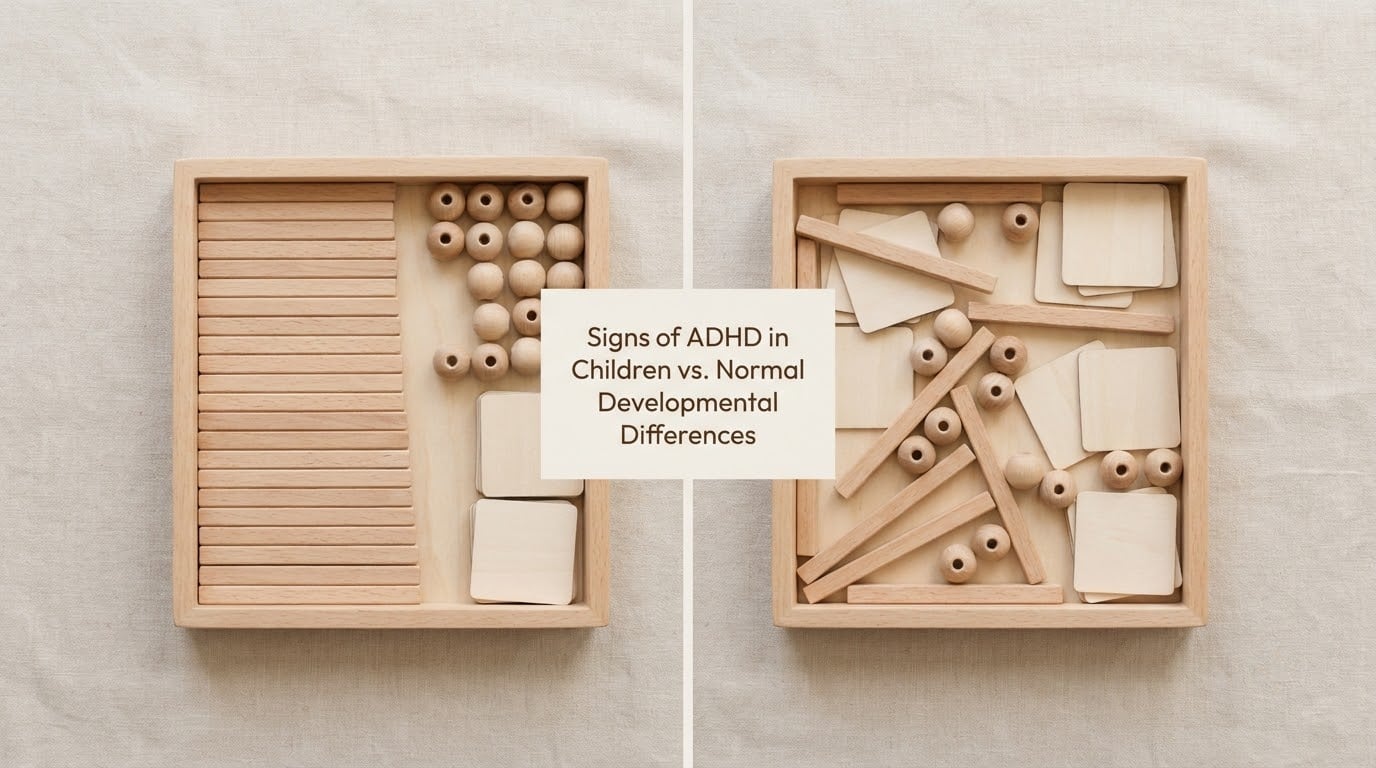
Every child has days when they cannot sit still or do not listen. Telling the signs of ADHD in children apart from normal developmental differences comes down to the pattern around the behaviour, not the behaviour itself.
| What you see | Typical development | Worth an evaluation |
|---|---|---|
| Inattention | Short bursts, especially when tired or the task is dull | Constant across settings, most days, for six months or more |
| Activity level | High at certain times, then settles | Elevated in nearly every setting, hard to modulate |
| Following instructions | Misses one or two, catches on after a repeat | Cannot hold a two-step instruction even with repetition |
| Emotion | Meltdowns that taper by age, recovery within minutes | Frequent, intense, slow to recover, out of proportion |
| Impulse control | Waits when motivated, with adult support | Acts before thinking even when consequences are clear |
| Impact | Annoying at times, no lasting effect | Schoolwork, friendships, sleep, or family life keeps suffering |
| Change over time | Gradual development, occasional slumps | Noticeable and different from how this child usually is |
Two questions help you sort it. Is this developmentally appropriate for their age, and is it a change from how this particular child usually behaves? A child who is suddenly unlike themselves deserves a conversation with the pediatrician, whatever the eventual explanation turns out to be.
When to Talk With a Pediatrician
Book an appointment when the same concerns are showing up in two settings, lasting six months or more, and getting in the way of something that matters: schoolwork, friendships, sleep, or a sibling relationship. Also book if you are instinctively worried and cannot explain why, because that instinct is data.
Before you go, write it down. Two weeks of notes beats a foggy recollection every time. Record the date, what happened, where it happened, how long it lasted, and what helped, however small.
Ask for a developmental or behavioural evaluation, and say the words ADHD out loud. Parents often tell me they softened everything to avoid sounding like they had read a website, and then the appointment ended with “let’s wait and see.” Naming the concern plainly gets a real answer.
You can also ask the school for written input. A teacher who sees your child forty hours a week holds evidence you do not, and that evidence carries weight with a clinician.
Seek urgent help for anything that puts your child at risk right now: a child who cannot be safely seated in a moving car, a child crossing the street without stopping, injury after injury from impulsive climbing, or a child who cannot function at all in a setting. If you are ever worried about immediate safety, use emergency services.
How Professionals Evaluate a Child for ADHD
There is no blood test or brain scan for ADHD. Diagnosis is a clinical process built on history, observation across settings, and ruling out what else could explain the same picture.
| DSM-5 requirement | What it means in practice |
|---|---|
| Six or more symptoms | Six or more from either the inattention or hyperactivity-impulsivity list, and some from both |
| Present for six months or more | A pattern, not a stretch of bad weeks |
| Several symptoms before age 12 | Early history matters even if the behaviour looks better now |
| Two or more settings | Home and school, usually, sometimes also activities |
| Clear interference | Something real is being harder than it should be |
| Not better explained by another condition | Learning, language, sleep, hearing, vision, anxiety and autism are considered |
A developmental-behavioural paediatrician or child psychiatrist usually leads. The appointment typically covers pregnancy and birth history, early milestones, family history, and a detailed description of behaviour at home and school, often using standardised rating scales such as the Vanderbilt, Conners, or the Behaviour Rating Inventory of Executive Function.
Clinicians will also look at hearing and vision, sleep, language and learning, mood and anxiety, and any sensory differences, because those overlap heavily. A child who is not sleeping well is not a mystery, they are tired, and tired looks a lot like unfocused.
Alongside an evaluation, families often learn that school supports exist. A Section 504 plan or an individualised education program can put things in writing, such as shorter work blocks, movement breaks, or permission to move. Your child’s school is where to start that conversation.
Signs of ADHD in Children with Autism or Other Disabilities
ADHD and autism can co-occur, and some of the same features show up in both, so an assessment matters even more when your child already has another diagnosis. Trouble with transitions, difficulty staying seated, emotional regulation, and executive function overlap across the two.
What tends to differ is the pattern around the behaviour. Autism often brings sensory differences, communication differences, and very focused interests that are unusually intense for their age, while ADHD is more about sustaining attention broadly and pausing before acting. Sensory needs, language delay and developmental coordination concerns can all add to the picture and complicate what looks like inattention.
This is where a child with an existing disability is best served by an individualised assessment rather than a checklist. If elopement or wandering is part of your concerns, we have a guide on how to prevent wandering in autistic children that is worth reading alongside this one.
How Parents Can Support a Child While Waiting for an Evaluation
The wait for an evaluation can be months. None of the following diagnoses or treats anything, and none of it replaces a professional assessment, but routines that are predictable and low-friction can make the waiting months easier for everyone in the house.
- One instruction at a time. Say it, pause, let it land. Long chains of instructions are hard for anyone and near-impossible for a child with attention differences.
- Make the routine visible. A picture checklist for mornings beats a verbal reminder, and it teaches independence without a fight.
- Shorten the runway. Break homework into ten-minute pieces with a real break between them, and stop while the child is still going rather than after the crash.
- Build in movement. Movement breaks help everyone, and they are not a reward for finishing work.
- Keep the ratio of praise high. Catch effort and follow-through rather than only correcting the loud moments.
- Keep a two-week observation log. Bring it to the appointment with the date, the setting, the behaviour, the duration, and what helped.
There is also a short list of things that quietly make everything harder. Telling a child to try harder treats a wiring difference as a character flaw. Public criticism in front of siblings lands harder on a child who already struggles with impulse control. And long, repeated lectures to a child whose working memory is already overloaded simply do not land, which is not defiance, it is a processing limit.
Tell your child that adults notice when things are hard, and that you are going to ask for help. You do not have to wait for a label to say that. Many parents describe the relief of hearing the same sentence from a teacher who has been quietly keeping their own notes.
If your child has a diagnosed disability or you are navigating services, our guide to Medicaid waivers for disabled children covers the support options that sit alongside a clinical process like this one.
Frequently Asked Questions
Can a child have ADHD without being hyperactive?
Yes. The predominantly inattentive presentation has no requirement for hyperactive or impulsive symptoms, which is why ADD was once used as a separate informal name. Many of these children are mistaken for well-behaved or shy because they are quiet rather than disruptive. The signs to watch for are daydreaming, drifting mid-task, forgetfulness, messy work and trouble finishing things. Girls are diagnosed later than boys for exactly this reason, since quiet inattention rarely gets flagged in a classroom.
At what age can a child be diagnosed with ADHD?
Diagnosis is not limited to a single age band, and it can happen as young as age four when symptoms are clear, persistent, severe and present in more than one setting. Some parents notice things much earlier, including high tension, noise sensitivity and difficulty being soothed as a baby, though those signs alone are common in many children. The DSM-5 requires several symptoms to have been present before age 12, so a diagnosis in the teen years is still valid when early history supports it.
How do I know if my child has ADHD or is just being naughty?
Look at pattern rather than behaviour. ADHD is consistent across settings, present most days for six months or more, out of proportion to the age, and it interferes with something real. Naughtiness tends to be situational, inconsistent, and responsive to consequences. A useful test is whether the difficulty shows up at school, at home and in activities. If it appears in two or more places, that is worth raising with a pediatrician along with two weeks of written notes.
What happens at an ADHD evaluation?
Expect a long conversation about your child’s history, milestones, family history and daily functioning, plus questions about behaviour at school. Clinicians often use standardised rating scales such as the Vanderbilt or Conners, and may ask the school to complete teacher forms. They will also check hearing, vision, sleep, learning, language, mood and any sensory differences, because those can look like inattention. There is no blood test or scan; the diagnosis is built from history, observation and ruling out other explanations.
Can hearing loss, poor sleep or anxiety look like ADHD?
All three can produce something very similar, and more than one can overlap in the same child. A child with hearing loss may seem not to listen or to misunderstand instructions. A child who is not getting enough sleep looks unfocused and irritable. Anxiety can look like avoidance, fidgeting and trouble concentrating. A competent evaluation checks for these, which is part of why an assessment takes time and why a checklist alone is not enough to tell you what is going on.
Is ADHD inherited from a parent?
ADHD tends to run in families, and having a close relative with ADHD does raise the likelihood that a child will have it too. But it is not a simple inheritance pattern, and having a parent with ADHD does not mean a child will be diagnosed. Genetics is one factor among many that shape how attention and impulse control develop. The practical takeaway for parents is that a family history is worth mentioning at the evaluation, and that recognising yourself in your child can make the search for answers faster and harder at the same time.
Start with a notebook, not a diagnosis. Two weeks of dated notes about the same concerns, across home and school, gives a pediatrician something concrete to work with, and it helps you see the pattern that a single frustrating evening never makes obvious. From there, ask for a developmental or behavioural evaluation and let a qualified clinician decide what the signs of ADHD in children mean for yours.