

To get an ADHD evaluation for a child, start with two tracks at once: schedule a visit with your child’s pediatrician and send a written request to the school asking them to consider their own evaluation. The pediatrician handles the medical side and can refer you to a child psychiatrist, psychologist or developmental-behavioral pediatrician, while the school decides eligibility for a 504 plan or an IEP. You do not need a diagnosis, a specific test, or a pile of paperwork before you make the first call. You need specific examples of what you are seeing and where.
That is usually where parents get stuck. A parent can describe a feeling (“she’s always in trouble”) but a clinician needs a record (“three or four times a week, since September, homework takes three hours and ends in tears”). This guide walks through what to gather, who to contact, what the appointment involves, and the questions worth asking about cost and wait times. It is general information, not medical advice, and your child’s own pediatrician should guide decisions about their care.
Table of Contents
- What You Need Before You Make the First Call
- How to Get an ADHD Evaluation for a Child, Step by Step
- Step 1: Document Your Concerns in Specific Examples
- Step 2: Discuss the Concerns With Your Pediatrician
- Step 3: Ask the School for an Evaluation
- Step 4: Contact the Right ADHD Evaluation Provider
- Why Both Tracks Matter
- Step 5: Prepare for the Evaluation
- Step 6: Ask About Cost, Wait Times, and Insurance
- Step 7: Review the Results and Plan the Next Steps
- Common Mistakes Parents Make
- Frequently Asked Questions
- What does an ADHD evaluation for a child usually include?
- Can my child get evaluated for ADHD through school?
- Should I take my child to a pediatrician, psychologist, or psychiatrist?
- How much does an ADHD evaluation cost, and will insurance cover it?
- How old does a child need to be for an ADHD evaluation?
- What to Do First
What You Need Before You Make the First Call
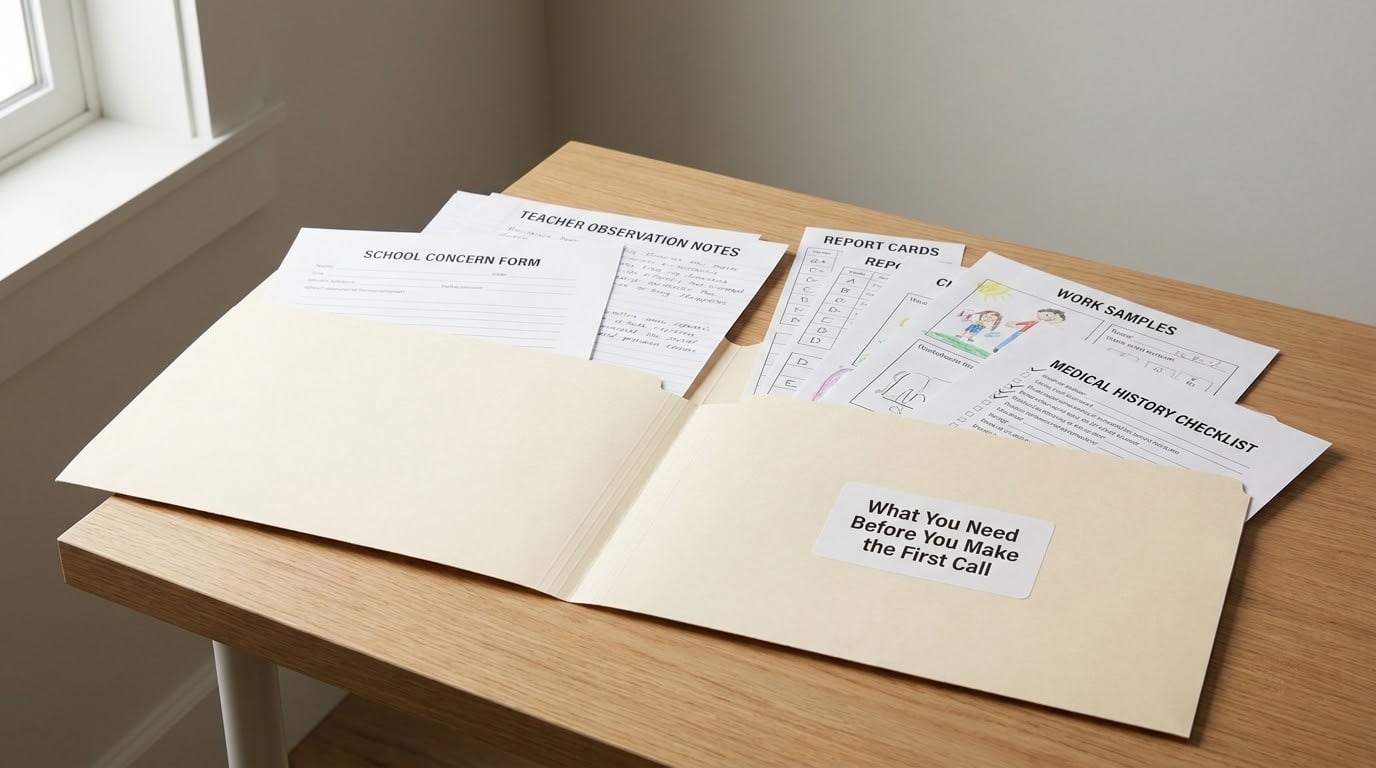
You need a written record, not a complete medical file. The single most useful thing you can bring to a first appointment is one page of specific, dated examples.
A completed school-concern form. Many pediatric offices have their own version, usually a short list of behaviors with space to mark how often and how severely they happen. Ask the office what they use before the visit so you fill in the right one.
Teacher observations. Ask the teacher for two or three written examples, not a global verdict. Recent graded work with teacher comments is often better evidence than a memory from October.
Work samples and report cards. Pull two or three pieces from different months. Compare them and you can often see the drift yourself, which is a useful thing to point out during the appointment.
Medical and developmental history. Include early milestones, any speech or language delay, ear infections and hearing concerns, current medications and supplements, allergies, and any previous evaluations or assessments your child has had.
Family history. Note whether you, a parent, or a sibling has ever been diagnosed with ADHD, anxiety, a learning disorder, or a mood condition. Clinicians ask because these run in families, and the question is asked more gently than parents expect.
Insurance details. Bring the member ID, the group number, and the phone number on the back of the card. Also write down the last time your child saw the doctor and the name of the practice.
A written list of your concerns. This is the document that keeps the appointment on track, because doctors are running behind and you may get ten focused minutes.
One thing parents hear often: you do not need every possible document before you ask for help, and you are not expected to diagnose your own child. Start with what you have and let the clinician tell you what is missing.
How to Get an ADHD Evaluation for a Child, Step by Step
Step 1: Document Your Concerns in Specific Examples
Write down what you actually see, in the situation, with a frequency. “Loses things” becomes “leaves her lunchbox, jacket and library books at home about four days a week.”
Cover attention, impulsivity, hyperactivity, organization, emotional regulation, sleep, schoolwork, and social situations. Not every family sees the same pattern, so write down what is true for your child rather than what fits a symptom list.
For each example, note how often it happens, how long it lasts, how intense it gets, and what it changes. Then describe the impact: lost homework, missing assignments, conflict at bedtime, a friendship that ended, a teacher calling weekly. Impact is what clinicians weigh most heavily, and it is the part parents often skip. When the pattern shows up at the homework table every evening, it is worth writing down the specifics of what happens there — our guide to helping a child with homework meltdowns has prompts that translate a meltdown into the kind of concrete observation a clinician can use.
Stay out of the diagnostic language. Write “interrupts constantly at dinner,” not “he has ADHD.” You are describing behavior, not making a claim you are not trained to make. If you use labels, note that the same behavior at home and at school carries far more weight than the same behavior in one place.
How you will know it worked: you end up with a short document a stranger could read and immediately understand the problem. If it reads like a worry, it needs more specifics.
Step 2: Discuss the Concerns With Your Pediatrician
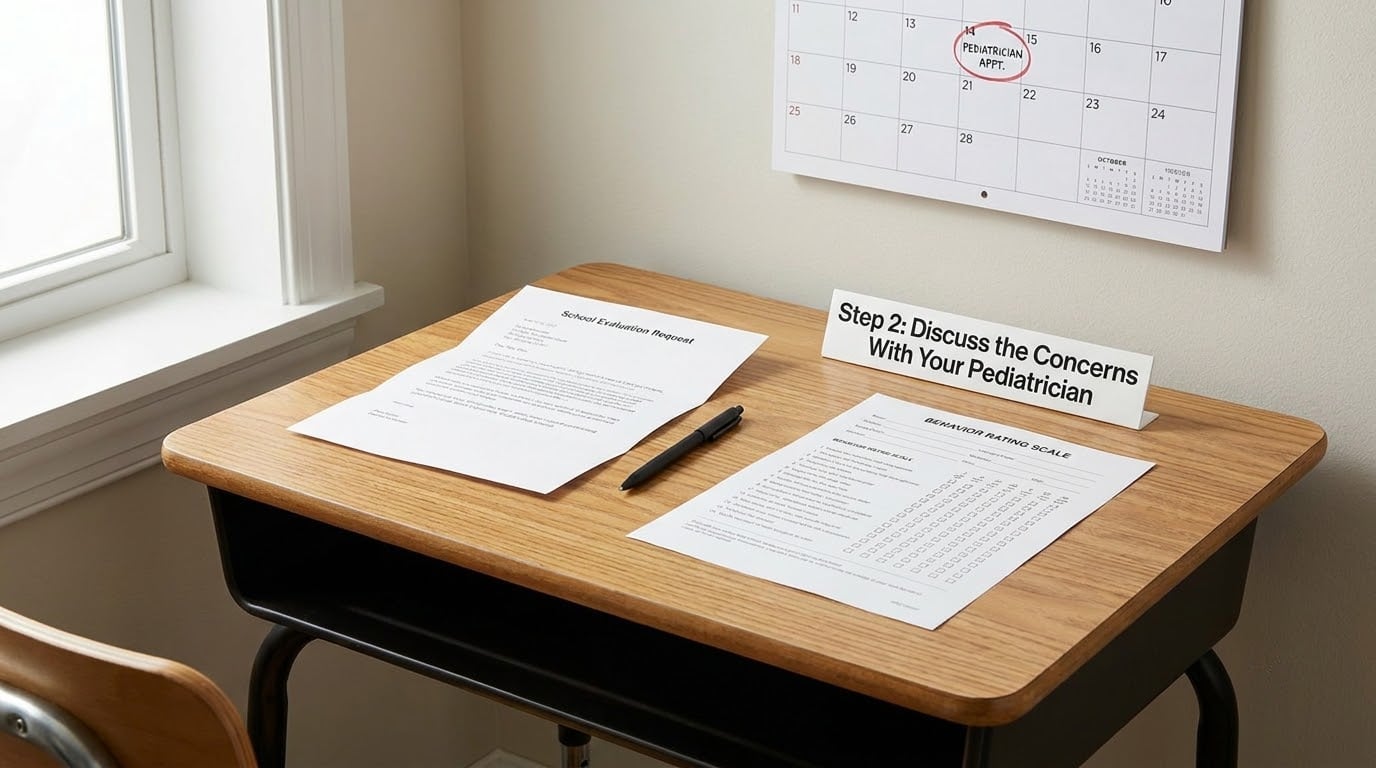
Call the office and ask for an appointment specifically about attention and behavior concerns, not a sick visit. A longer slot is worth requesting, and it helps to say upfront that you are gathering information for a possible evaluation.
Bring your written list. Pediatricians can discuss developmental concerns, review growth and development history, check hearing and vision when relevant, screen for sleep and anxiety issues, and share what they see in the office, which is a setting your child may find easier than a specialist’s office.
Cover the family history, sleep patterns, medications and supplements, and any prior evaluations. Mention school concerns and ask specifically what the school has already tested.
Then ask the direct question: can you diagnose and treat ADHD, or would you rather refer me? Plenty of pediatricians do both, particularly those with training in developmental-behavioral pediatrics or child development. Others prefer to send you to a specialist, and that is a normal outcome rather than a brush-off.
How you will know it worked: you leave with either a plan for assessment or a specific referral, plus a timeframe for hearing back. A referral with no name attached is not a referral.
Step 3: Ask the School for an Evaluation
Send a short written request to the teacher, school counselor, or special education lead, and copy the principal. Ask the school to consider evaluating your child under Section 504 or as a child suspected of having a disability, and ask in plain language for a decision on eligibility. Some families never get past email here, so send it and follow up by phone a week later.
Questions worth asking: what is the process and how long does it take, who conducts it, will it happen in school or off site, is it free, and can you get a written copy of the results. Also ask whether the school has academic or testing records on file, and request a copy of anything you do not have.
Classroom observation and academic records do real work in this step. A pattern across assignments, test scores, and work samples is harder to argue with than a single incident, and the same record matters when you are working out how to help a child keep pace with the classroom as assignments pile up. Our piece on helping a child keep up with classroom pace walks through the work-side of that.
Expect the school to take longer than you want. Many districts quote a window of roughly 60 business days, and some families report longer in practice. Start this track early, because it usually moves on its own clock and it is the piece that unlocks classroom support.
If the first response is a boilerplate letter declining the request, ask for the reason in writing, request the procedural safeguards information, and follow the district’s appeal steps. A written denial with a stated reason is far easier to challenge than a conversation that never happened.
How you will know it worked: you receive a decision letter and a date for any meeting, even if the decision is not what you hoped for. A decision gives you something to work with; silence gives you nothing.
Step 4: Contact the Right ADHD Evaluation Provider
You will run into several kinds of providers, and the differences matter more than most parents expect.
Pediatricians with developmental training handle many uncomplicated cases and can start treatment, but they vary widely in how much time they spend on assessment.
Child psychiatrists focus on diagnosis and medical treatment, including medication, and often see complex or overlapping concerns. Appointment slots are often the hardest to get in a large metro area.
Child psychologists run testing that measures attention, processing speed, and executive function, and can identify or rule out learning disorders. Some practices are not accepting new evaluations at all, so ask before you fill out paperwork.
Developmental-behavioral pediatricians specialize in developmental and behavioral issues and are a good fit when more than one concern is in play.
Licensed neuropsychologists do the most comprehensive psychoeducational testing, and parents say the written report is the part that pays off later for testing accommodations and school documentation.
Before booking, verify that the clinician is licensed in your state, regularly works with children your child’s age, and assesses ADHD and learning or developmental conditions routinely. Ask whether they are in network, whether they do the testing themselves or refer it out, and whether they provide a written report. If your child has other concerns, such as a suspected learning disorder, an autism evaluation, significant anxiety, or sleep problems, mention that when you call, because it changes who the right provider is. A comprehensive evaluation that can look in several directions saves you from doing three narrow ones.
How you will know it worked: the office tells you exactly what the visit involves, what it costs before you book, and how long the report takes.
Why Both Tracks Matter
Parents often treat the school request as a backup for a medical appointment, and then lose months. The two processes answer different questions. The clinical evaluation asks whether your child meets criteria for a neurodevelopmental disorder and what treatment fits. The school evaluation asks whether the child qualifies for services in the classroom. Either one can arrive first, and both are worth starting on day one.
Step 5: Prepare for the Evaluation
Organize your documents in one folder: your written examples, school records and teacher forms, medical and developmental history, family history, and insurance details. Bring the folder and a pen. Write your questions down beforehand, because appointments move fast.
An evaluation commonly includes a parent interview, a separate interview with your child, standardized behavior rating scales completed by parents and teachers, review of school and medical records, sometimes direct observation, and a look at learning and processing when the clinician thinks it is warranted. Hearing and vision screening is often included or recommended so those do not masquerade as attention problems.
Common tools include the Vanderbilt rating scales, which usually have a parent form and a teacher form, and the Conners rating scales. Providers also use interviews and classroom observations to understand executive function, the everyday management skills that cover organization, planning, impulse control, and working memory.
Tell your child what is happening in plain, calm terms. Something like “we are going to talk about how school and home go, and find out what helps you” works better than promising a diagnosis or describing the visit as a test. If possible, ask the office whether the child interview happens with a parent present at first, since younger children often do better with a familiar adult in the room.
Your child does not need to study, does not need to perform well, and will not be graded. Some children have a rough day and say so. Evaluators expect that, and it is part of what they are looking at.
How you will know it worked: you can answer any question about your child’s history and behavior without guessing, and your questions are written down before the clock starts.
Step 6: Ask About Cost, Wait Times, and Insurance
Costs and delays vary widely by provider, location, setting, and plan, so the only useful answer is a specific one from your own insurer and your own clinician. Bring the questions rather than hoping someone volunteers the information.
Ask for a written estimated cost before the first appointment, including what the initial visit costs and what the full evaluation costs. Ask whether prior authorization is required, and get the authorization number. Ask what portion your plan covers, what falls to you as a copay or coinsurance, and whether the behavioral rating scales, the testing, and the written report are each billed separately.
Coverage for a medical evaluation and coverage for a full psychoeducational evaluation are not the same thing. Parents report that psychiatric evaluations are often covered more reliably, while comprehensive testing is frequently the least covered part of the process. Full testing often runs into the thousands, which is exactly why you want the written estimate and the authorization conversation before the first visit rather than after.
Ask about wait times too, and get them in writing. Weeks for a new-patient appointment, then months for a report, is a common pattern and much easier to plan around when nobody is surprised. If the wait is long, ask whether the practice has a cancellation list and whether a shorter first appointment can start the process while you wait.
Ask the school directly whether its evaluation carries any cost. School evaluations are generally provided at no cost to families, which is a real advantage over private testing, though the timeline runs longer.
Rules and benefits vary by state and by plan, and they change, so check your own plan documents rather than relying on a general answer. If your child may qualify for supplemental security income based on a disability, ask your evaluator about that separate application, which has its own criteria and its own timeline — our step-by-step on how to apply for SSI for a disabled child covers that process.
How you will know it worked: you know the number, the timeline, and what your plan actually covers before the bill arrives.
Step 7: Review the Results and Plan the Next Steps
Ask for the written report, not just a summary conversation, and read it before the feedback appointment so your questions are specific.
Keep the distinction between screening and diagnosis clear. A completed rating scale, a positive screen on a questionnaire, or a teacher’s impression is not a diagnosis. A diagnosis comes from a qualified clinician’s clinical judgment based on the full picture, including history, multiple informants, and ruling out other explanations.
At the feedback appointment, ask what was ruled out and how, what the findings mean for school and home, what supports are recommended, and what the follow-up plan looks like. If your child has complex or overlapping concerns, ask which other evaluations or referrals are recommended now rather than later.
One evaluation is a starting point rather than an ending. It can confirm the picture, shift the picture, or raise new questions, and follow-up is normal. Ask when the next check-in should be and what would warrant calling sooner.
How you will know it worked: you can explain, in your own words, what was found, what happens next, and who to call with questions.
Common Mistakes Parents Make
Waiting for the school year to end. Waiting “until things settle” often means waiting a full year, because school evaluations are built around the academic calendar. The fix is to start the school request in the fall and the medical request as soon as the pattern is clear.
Describing only the worst days. If you lead with the worst week, you will hear that everyone has bad weeks. Bring examples from ordinary Tuesdays across several months instead.
Leaving out the hard parts. Parents sometimes hide concerns out of fear of a label or worry about how a report will follow their child. Understandable, and worth talking through with the clinician, because the report is a tool for getting help rather than a verdict.
Treating one online checklist as an answer. Screeners flag possible concerns. They do not diagnose. A checklist can tell you it is worth talking to someone, and nothing more.
Starting with the most expensive provider. Families sometimes begin with a full neuropsychological evaluation because it seems thorough. If the concern is attention with no learning or language issues, a medical evaluation may cover what you need at a fraction of the cost and with a shorter wait.
Waiting for a teacher form that never comes. This is the most common stall parents describe. Ask for the form in writing with a due date, offer to fill it in from your observations and have the teacher review it, and ask the school whether its own evaluation can collect teacher input instead.
Treating a denied request as the end of the story. Ask for the reason in writing, request the procedural safeguards information, and use the district appeal process. A written denial is a starting document, not an ending.
Two habits make the rest easier. Keep one shared record, either a notebook or a single file, that you can hand to any clinician or teacher. And advocate for an evaluation of your child’s needs rather than for a predetermined outcome, because calm, specific requests get answered far faster than arguments about what a child probably has.
Frequently Asked Questions
What does an ADHD evaluation for a child usually include?
A child ADHD evaluation usually includes a detailed interview with you about development and daily functioning, a separate conversation with your child, and standardized behavior rating scales completed by parents and teachers. Many providers also review school and medical records, observe the child, and test attention, processing and executive function when warranted. Hearing and vision screening is often included. The visit ends with feedback and a written report.
Can my child get evaluated for ADHD through school?
Yes, but the school is answering a different question. A school evaluation looks at whether your child qualifies for services under Section 504 or as a child suspected of having a disability, and it leads to a 504 plan or an IEP rather than a medical diagnosis. School evaluations are generally free and usually take longer, since districts often quote a window of around 60 business days. Many families run this alongside a medical evaluation.
Should I take my child to a pediatrician, psychologist, or psychiatrist?
Most families start with the pediatrician, who can review development, screen for sleep, hearing and anxiety issues, and either start the assessment or refer you on. Child psychiatrists focus on diagnosis and medical treatment, including medication. Child psychologists and neuropsychologists do testing that measures attention and processing and can identify or rule out learning disorders. If more than one concern is in play, ask for someone who can assess all of it.
How much does an ADHD evaluation cost, and will insurance cover it?
The amount varies widely by provider, location and plan, so ask for a written estimate before your first appointment and check your own benefits directly. Medical evaluations are often covered more reliably than full psychoeducational testing, which can run into the thousands and may be partly self-paid. Ask whether prior authorization is required, get the authorization number, and confirm what your copay will be. School evaluations generally carry no cost to families.
How old does a child need to be for an ADHD evaluation?
There is no single minimum, and parents can raise concerns with a pediatrician at any age. Diagnosis before age 4 is generally not made because behavior at that age is so variable, and a developmental-behavioral pediatrician is the right person to see. Most evaluations happen between ages 4 and 18. For children under 3, early intervention services in your state are free, require no doctor referral, and are worth contacting on your own.
What to Do First
Three actions this week, in this order.
First, write down four or five specific examples of what you are seeing, each with a frequency and an impact. Second, call your child’s pediatrician and ask for an appointment about attention and behavior concerns, bringing that list with you. Third, send a short written request to the school asking them to consider an evaluation for suspected disability, and ask how long their process takes.
Then keep both tracks moving: the medical evaluation answers what is going on and what may help, and the school evaluation answers what changes in the classroom. A child does not need to struggle in silence while a wait list runs. Start the paperwork now, and let the evaluations do their job.