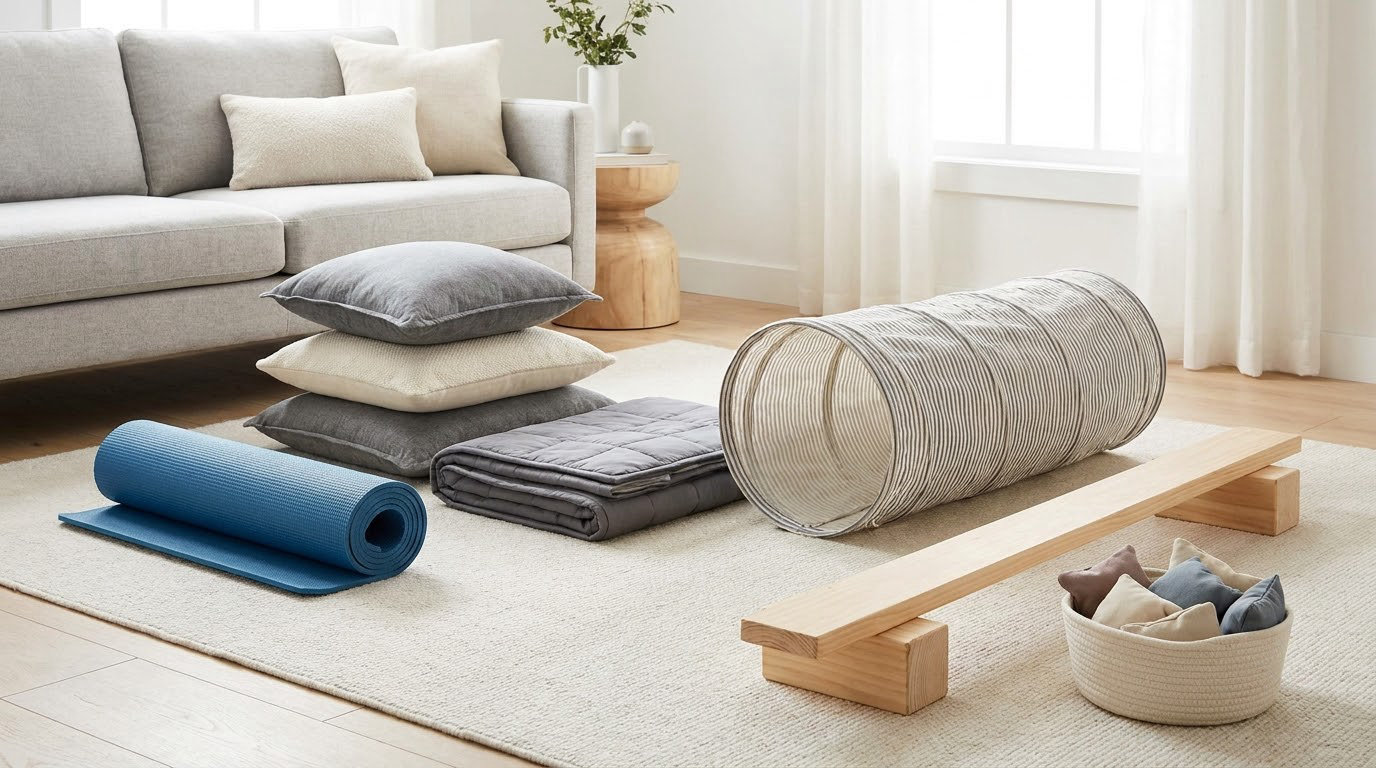
Proprioception is your child’s built-in sense of where their body is in space and how much pressure, force or movement their muscles and joints are producing. It is the sense that lets a toddler walk down the stairs without looking down. Proprioceptive activities for kids at home give that sense a workout, and the ten below use nothing you have to buy.
Most of them take under ten minutes and most of them work in a small living room. My rule after years of trial and error with my own kids is that an activity only counts if the child actually starts it without being dragged over. So these are ten things I have set up on a Tuesday evening in an ordinary apartment, with no gym and no sensory equipment.
Table of Contents
- Proprioceptive Activities for Kids at Home at a Glance
- 1. Pillow Obstacle Course
- 2. Heavy Work with Laundry Baskets
- 3. Wall Pushes and Crab Walks
- 4. Play-Dough or Clay Squishing
- 5. Balloon Wall Tennis
- 6. Kitchen Towel Resistance Games
- 7. Floor Time with Colored Tape
- 8. Blanket Fort and Tunnel Crawl
- 9. Container Pouring and Scooping
- 10. Household Chore Relay
- Frequently Asked Questions
- How often should children do proprioceptive activities at home?
- Can proprioceptive activities help a child with autism or sensory processing differences?
- What if my child refuses heavy work or does not seem to like proprioceptive input?
- What sensory materials are safest for a child who puts things in their mouth?
- When should a parent ask a pediatrician or occupational therapist about sensory concerns?
- How can I adapt proprioceptive activities for a child with limited mobility or low muscle strength?
- Conclusion
Proprioceptive Activities for Kids at Home at a Glance
Here is the whole list on one screen. The right-hand column matters most if you are choosing by what your child is struggling with rather than by what is fun.
| Activity | Main input | Materials | Difficulty | Best for |
|---|---|---|---|---|
| Pillow obstacle course | Heavy work, motor planning | Pillows, cushions, tape | Easy to build, medium to move through | Preschoolers and older |
| Laundry basket heavy work | Heavy work, resistance | Basket, towels, soft items | Easy | Any age, including walkers with support |
| Wall pushes and crab walks | Joint compression, strength | Clear wall | Easy | Children who push or climb constantly |
| Play-dough squishing | Hand resistance, fine motor | Dough or clay, table | Easy | Quiet indoor days, seated play |
| Balloon wall tennis | Targeted movement, tracking | One balloon, wall | Easy | Children who need output without crashing |
| Kitchen towel pull | Pulling resistance, bilateral use | Towel, adult partner | Easy with a partner | Two people, ages 3 and up |
| Painter’s tape paths | Balance, planning | Painter’s tape | Easy | Balance and motor planning work |
| Blanket fort crawl | Deep pressure, body awareness | Blankets, chairs | Medium to build | Children who like enclosed space |
| Pouring and scooping | Hand resistance, bilateral use | Containers, dry rice or beans | Easy, some tidying | Fine motor strength, seated play |
| Chore relay | Heavy work, independence | Cloth, basket, small broom | Easy | After-school energy release |
How to pick proprioceptive activities for kids at home that actually get used
Watch for one minute before you build anything. A child who drags furniture, climbs the bookcase or hangs off the kitchen cupboard is chasing strong input, and the pushing and carrying activities will hold their attention. A child who avoids bumps, flinches at the hairdryer or hates being touched does better with slow, predictable, seated options like the dough, the tape paths and the pouring bins.
Start with one that matches what you saw, keep the first session under ten minutes, and stop while it is still fun. Ending early is what makes it repeatable, and repeatable is the whole point.
On safety: clear the floor first, check for anything low hanging such as ceiling lights or shelf brackets, keep crashing and jumping on the ground rather than furniture, and stay close enough to catch a small child without hovering. Soft blocks absorb most falls, but nothing absorbs a wrist caught in a door hinge. If your child has an injury, recent surgery, or low muscle tone diagnosed by a clinician, check with a pediatrician before adding heavy work.
1. Pillow Obstacle Course
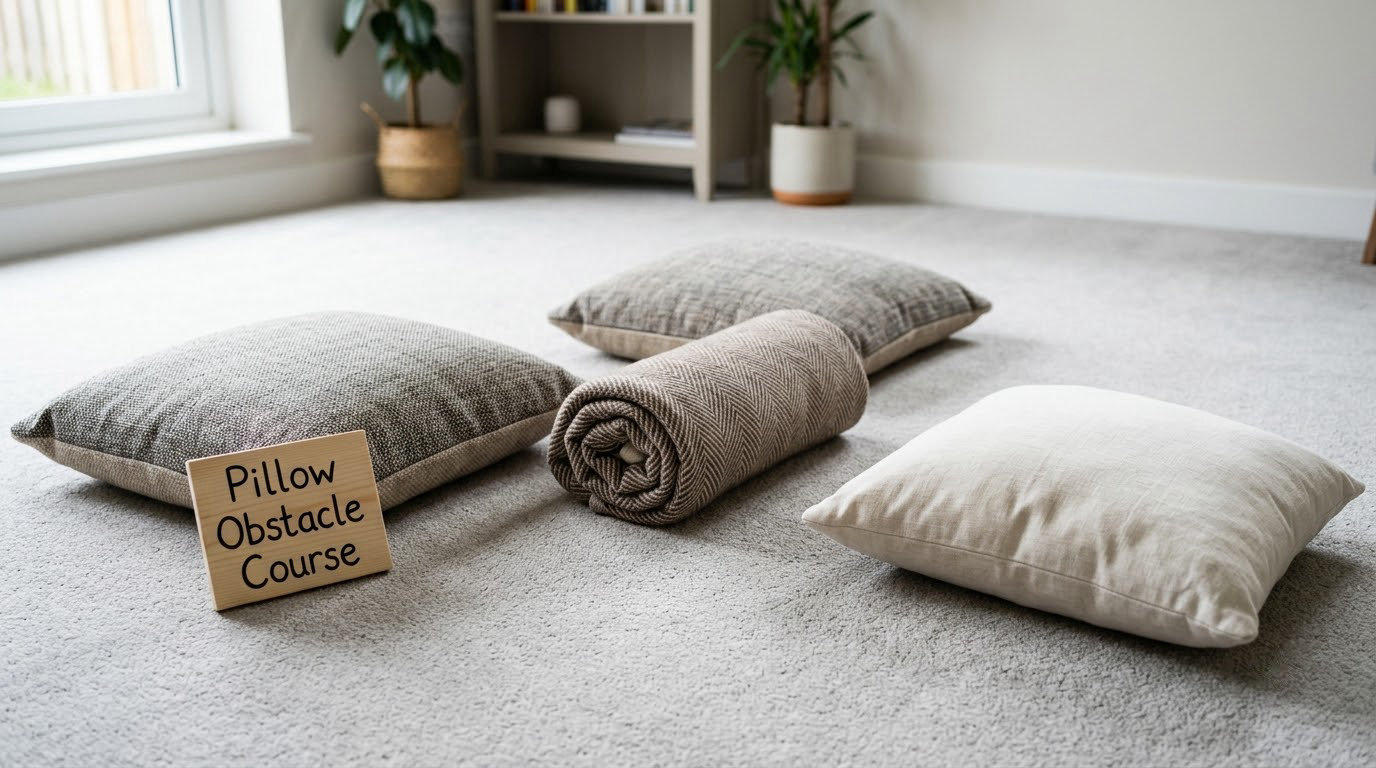
An obstacle course is the most flexible thing in this list because you rebuild it every time, and your child helps decide the route. This one gives heavy work through climbing and stepping plus joint compression through crawling.
Tape two or three lanes on the floor with painter’s tape so the course has boundaries. Put a firm floor pillow at the start as a step-up, a rolled blanket in the middle as something to crawl over or under, and a stack of sofa cushions at the end as a climb-down.
A complete example: start on the tape line, step up onto the flat pillow, walk along the rolled blanket while holding the sofa back for balance, duck under a chair draped with a blanket, then jump the last tape line onto the cushion stack. That is roughly a two-minute run, which is about right for a four-year-old.
Two things I always do. I keep everything at floor level, because a chair course becomes a climbing course and climbing is where broken wrists come from. And I check the route myself by walking it before the child does, which catches the rug edge that catches feet.
For a child with limited mobility, cut the course down to two stations and add a handrail. Pushing a laundry basket across the floor between two soft obstacles gives the same heavy-work feel without any jumping, and a child in a wheelchair can push a cushion pile from a seated position for joint compression through the arms.
2. Heavy Work with Laundry Baskets
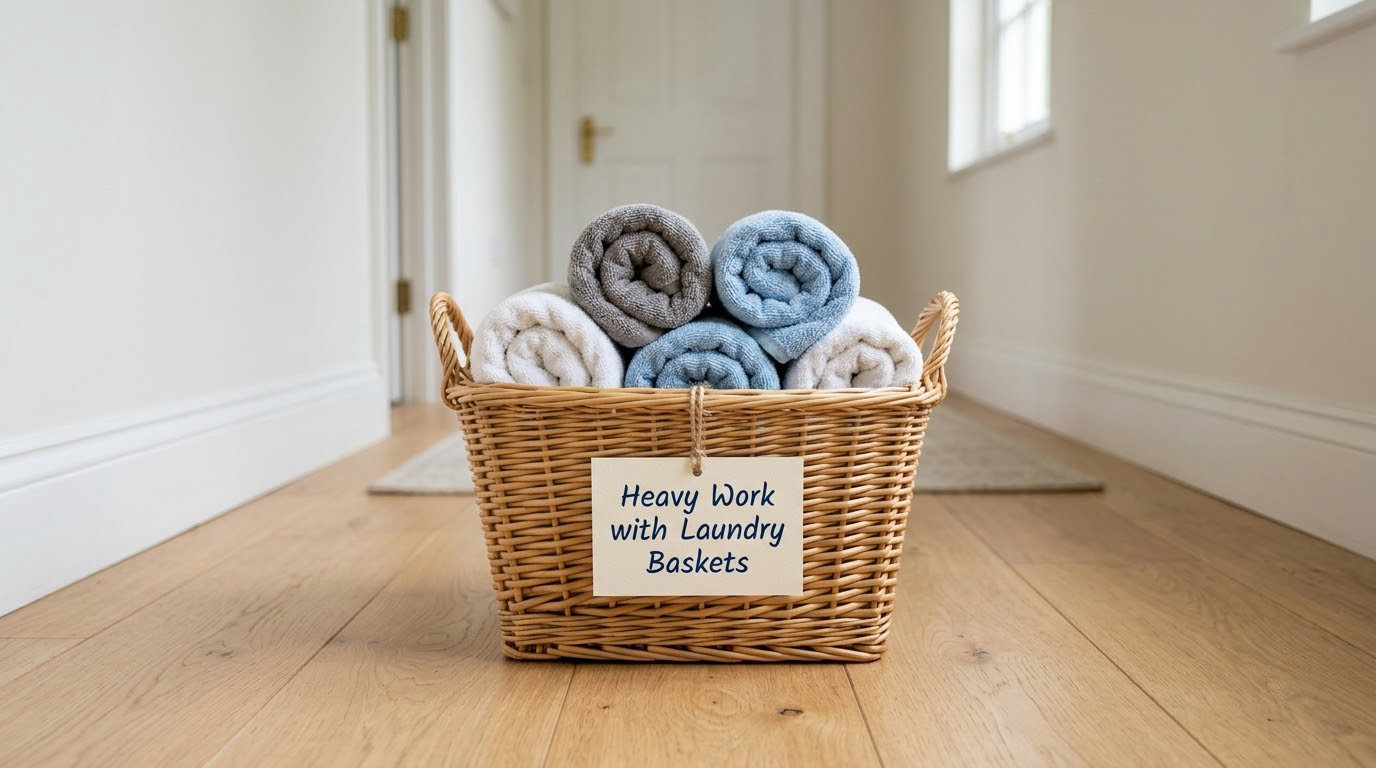
Heavy work means using muscles against resistance, and a basket of towels is the easiest resistance device in any home. The input is joint compression through the arms and trunk, plus planning for how to grip and lift.
Fill a basket with rolled towels, soft clothes or lightweight laundry. Ask the child to carry it from the laundry room to the bedroom, walk the length of a hallway five times carrying it, or push it slowly across the floor like a weighted sled.
On weight, fill it until your child can lift it with slightly rounded elbows and a neutral back, not until it is a struggle. Small children often manage five or six pounds of towels. If the basket drags when lifted, the basket is too full, which is easier to fix than a tweaked back.
Say the lifting words out loud and have your child repeat them: bend the knees, hold it close, stand up straight, walk. Ten repetitions of a safety habit beats ten trips carrying an awkward load.
To make it heavier, add cans of food or a bag of dry beans rather than books, since a dense item teaches better grip than a bulky one. To make it lighter, use a small basket or a pillowcase of soft items, and hand over one end for children who tire quickly or who should not be twisting while loaded.
3. Wall Pushes and Crab Walks
Wall pushes put direct pressure through the shoulders, arms and hands, which is joint compression delivered without any equipment. Crab walks and bear-crawl positions along the base of a wall work the same feedback loop with more core strength involved.
For wall pushes, have your child plant both palms on a clear wall at shoulder height, walk their feet back until their body is in a straight line, then push and hold for five counts. Ten slow repetitions is plenty. For crab walks, ask them to sit on the floor with hands behind them and hips lifted, then travel sideways along the wall a few feet and back.
Cover any hooks, light switches or hanging cords at child height before you start, and pick a wall without furniture in front of it. Bare feet or grip socks make a big difference on smooth floors.
When to stop a pushing or compression activity
Stop if your child grimaces, holds their shoulder, complains of headache or dizziness, or cannot hold the position for the same length of time at the end as at the start. Also stop the session entirely if the room has just had a fight, the child is already flushed and revved up, or you are working to a deadline. Compression on an overloaded nervous system adds fuel rather than taking it out, and in my experience that is the one mistake that makes parents think the activity does not work.
4. Play-Dough or Clay Squishing
Play dough is resistance for the hands, and hand resistance is the quieter half of proprioceptive work. The movement is small and controlled, which makes this the activity for indoor days when noise is not allowed.
Give a ball of dough or modeling clay and a flat surface, then ask for specific actions rather than free play. Roll it into a snake, flatten it with both palms, push a thumb straight through the middle, cut it with a plastic knife, and roll it back into a ball. Five minutes of that sequence gives the hands more work than twenty minutes of shaping a lump.
A good fine-motor session, about six minutes: two minutes rolling balls the size of marbles, two minutes flattening and poking, one minute cutting with a plastic knife, one minute tearing a sheet in half. Small hands tire quickly, so shorten rather than push.
If dough is sticky or crumbly for your child, mix resistance dough at home, which takes a cup of flour, half a cup of salt and about two-thirds cup of warm water, kneaded together and left to set for an hour. For a child who needs the table to stay steady, clip a sheet of card stock to the table edge or use a non-slip shelf liner underneath.
5. Balloon Wall Tennis
A balloon gives a child real movement and real aiming without real impact. This targets planning, tracking with the eyes and controlled force, which is why it works when crashing onto the sofa is not allowed.
Stand about three feet from a wall and bat the balloon back and forth with the palms. Start with a rule of just keeping it up, then add a rule that it must touch the floor between hits, then move further back.
Skip the chasing game, which is where I have seen this turn into chaos. If your child is chasing the balloon around the room, bring the wall closer and make the rule stiffer rather than looser.
For a child who prefers predictable play, put a small piece of tape on the wall as a target, use a count instead of a rally limit, and let the balloon drop to five counts on the floor before retrieving it. The structure is the fun part for some kids.
6. Kitchen Towel Resistance Games
Pulling on a towel gives sustained resistance to both arms at once, which is exactly the input children who struggle with pencil grip or handwriting tend to need. It also needs a partner, so it works well as a five-minute end to a sibling pairing.
Both of you take one end of a dish towel and pull gently while sitting or standing across from each other. Pull, count to five, relax. Ten rounds. The pulling is a small fraction of your strength, which is the point, since the resistance has to feel steady rather than like a wrestling match.
Agree the hand position first: thumbs wrapped over, fingers closed, shoulders down. Say stop the moment anyone feels pain in the wrist, shoulder or back, and drop the towel immediately rather than negotiating. Other options are pulling a towel wrapped around a sturdy container to drag it across the floor, or tying a long towel to a chair leg for light resistance work in a circle.
If a tug of war turns competitive fast, switch to cooperative versions where you both pull the same towel in the same direction to move a cushion across the room, or hand over the towel on a count of ten. Nobody wins, the resistance is the same.
7. Floor Time with Colored Tape
Tape on the floor creates movement paths that ask a child to look before moving, which trains motor planning and balance. It is also the cheapest activity here, since a roll of painter’s tape lasts for months.
Press four strips of tape into long parallel lines about a foot apart, then add handprints, zigzags and hop spots across them. Make a rainbow path for a first run: red for walking, orange for tiptoe, yellow for big steps, green for slow walking, blue for standing still and counting to ten. Two or three colors per strip is plenty.
To make it harder, shrink the spacing to one foot, add arrows for direction, or tape shapes that have to be crossed in a set order. To make it easier, widen the lines to two feet or build a path directly along a hallway so there is no choice involved.
For visual sensitivities, tape on carpet or on a neutral floor is kinder than tape on a busy patterned rug, and single-color paths are less busy than rainbow ones. This one also scales from a two-year-old stepping between two strips to an eight-year-old walking a heel-to-toe line without falling.
8. Blanket Fort and Tunnel Crawl
A fort or cushion tunnel supplies deep pressure and enclosed-space input, and it doubles as a den for the rest of the afternoon. Children who like being squeezed tend to love this one, and children who hate being trapped tend to hate it, which is worth knowing early.
Throw a blanket over two dining chairs set back about three feet apart, weigh the corners with books, and check that the chairs cannot tip. For a tunnel, line up three or four firm cushions in a row and drape a blanket over the top.
On hazards: keep the floor clear underneath so nobody crawls into a foot or a dropped toy, keep the exits at both ends so a child can come out at any time, and never leave a child alone inside who is asleep or upset. Check that the blanket is not near a heater or a light bulb, and open a window or leave a flap open so the space breathes.
Ask before you touch. A hand on the back during a crawl is helpful to one child and distressing to another, so say what you are doing out loud and wait for a nod. For a child who will not go in the tunnel, the fort still works from outside, and lying under a weighted blanket on the sofa gives much of the same deep pressure without the enclosure.
9. Container Pouring and Scooping
Pouring and scooping look simple and are not. They combine bilateral coordination, hand strength, grip adjustment and wrist control in one quiet activity, and they are endlessly repeatable at a table while something cooks.
Set out two containers, a cup or small pitcher, and a scoop. Fill one container with dry rice, dried beans or kinetic sand and let the child pour back and forth, or fill two and ask them to fill the empty one. Around ten small scoops is a good session, and small scoops with a wide mouth are easier for weaker hands than a jug.
For a child who mouths things, skip the loose grains and use kinetic sand, a thick rice pudding, water beads, or simply water with a funnel. Anything small enough to swallow is choking risk, which means beans and dried pasta stay off the list for children under three and out of reach for everyone else. A few dropped grains on the floor are a vacuum away, so put a sheet under the table and count that as tidying your child does rather than tidying you do.
To adjust for hand strength, widen the grip with a chunky handled scoop, lower the container to table height so there is less to lift, or stick a play dough handle onto a plastic cup for a child who cannot manage a taper. Wet materials clean up more easily and hold attention longer, though they do get the floor wet.
10. Household Chore Relay
A chore relay turns the everyday jobs your child already needs doing into heavy work, and it is the activity most likely to keep going because it has a real purpose. A child who will not fold laundry for money will often fold it to see who can stack the most towels in a minute.
Build a short circuit of three or four safe jobs: wiping a low table with a damp cloth, sorting laundry into two piles, carrying soft items from the dryer to a basket, or sweeping one small section of floor with a child-sized brush. Set a timer for five minutes, do one job each in turn, and stop when the timer goes off whether or not everything is finished.
Keep it child-led. Let your child pick the first job and the order, and let them decide how a job counts as done. Children who are pushed through chores with a deadline tend to push back harder the next day.
Watch for the pressure point. A chore circuit that becomes a nightly demand with an adult hovering is just extra work, not play. If the circuit turns into an argument, drop the timer, do one job together instead, and try again in a few days. When it works, the child is doing real things with real consequences, and independence grows quietly out of that.
Frequently Asked Questions
How often should children do proprioceptive activities at home?
Most children do well with ten to fifteen minutes of proprioceptive input once or twice a day, and many parents build it into the after-school or bedtime routine. Short and frequent usually beats one long session. Watch your child’s cues: alert and engaged means the timing worked, while flat, tired or cranky means the input was too much or the day was already too full.
Can proprioceptive activities help a child with autism or sensory processing differences?
Heavy, predictable input is widely used in occupational therapy for children with autism and sensory processing differences, since it gives clear internal feedback about body position and effort. Some children seek it and some avoid it, so the same activity does not suit everyone. An occupational therapist can tell you which type of input your child is actually looking for before you build a routine around it.
What if my child refuses heavy work or does not seem to like proprioceptive input?
Refusal is information, not defiance. Your child may be getting that input elsewhere, may find the load too heavy, or may not have the coordination for the version you set up. Start smaller, join in yourself, and offer a choice between two activities rather than one. Moving back to heavy work tends to take weeks, not days, so keep offering it without pressure.
What sensory materials are safest for a child who puts things in their mouth?
Skip loose dry rice, beans and small dried pasta entirely, since these are choking risks. Kinetic sand, water beads, a thick rice pudding or plain water with a funnel all give the same hand resistance and are much easier to manage. Supervise constantly, keep the container in front of you, and check your pediatrician about mouthing patterns that are frequent or new.
When should a parent ask a pediatrician or occupational therapist about sensory concerns?
Ask when sensory behaviour interferes with daily life: constant seeking that risks injury, avoidance that narrows what your child will eat or wear, or a noticeable difference between settings such as home versus school. Also raise it if motor skills, coordination or tone concern you, or after any head injury. An occupational therapist evaluation gives you a plan rather than a guess, and it can cut down on what you try at home.
How can I adapt proprioceptive activities for a child with limited mobility or low muscle strength?
Add resistance at the point where the child can still move. Put a ball between their back and the wall and ask for slow presses, offer a large-ball push instead of carrying, build the obstacle course at floor level with handholds, and use a chunky handled scoop for pouring. Heavy work keeps its value even when the load looks small, and a clinician can set the right amount for your child.
Conclusion
Start with one activity and one short session. The pillow course or a basket of towels will cover most families, and both are ready in under two minutes.
Follow your child’s cues rather than the timer, adjust the load instead of pushing through a refusal, and stop while it is still enjoyable. These activities work best as one supporting routine alongside whatever your pediatrician or occupational therapist already recommends, not as a replacement for that guidance.
If sensory behaviour is causing injury, limiting what your child will eat or wear, or causing daily battles at bedtime, that is the point to book an evaluation rather than keep experimenting at home. Once you know which system your child is actually short on, these ten get a lot easier to use.