
If a child is in immediate danger, call 911. In the US you can also call the Childhelp National Child Abuse Hotline at 1-800-4-A-CHILD (1-800-422-4453) at any hour, and the call can be anonymous.
How to protect a child with special needs from abuse comes down to a small number of concrete habits: fewer adults around your child that nobody has vetted, more supervision that other people can actually see, body-safety teaching built around how your child communicates, and a written plan for what you do the moment something feels wrong. That last piece is where most families get stuck, so this guide walks through the steps in order, from first warning signs to the report itself.
It takes a few hours to write the plan and a few weeks to put the safeguards in place, and the effort does not stop once it is done. It becomes part of how the household runs.
Children with intellectual and developmental disabilities are abused at several times the rate of their peers, and the person responsible is usually someone the family already knows. Risk concentrates in predictable places: the bathroom, the school bus, the therapy room, the dentist’s office, and the house where the respite worker is sitting. Most of those places you cannot control outright, but you can change what happens inside them.
Table of Contents
- What You Need Before You Start: A Written Safety Plan, Contacts, and Documentation
- Step-by-Step: From Warning Signs to a Report
- How to Protect a Child With Special Needs From Abuse by Identifying Early Warning Signs
- How to Protect a Child With Special Needs From Abuse by Creating a Personal Safety Plan
- How to Protect a Child With Special Needs From Abuse by Teaching Boundaries and Safety Skills
- How to Protect a Child With Special Needs From Abuse by Strengthening Adult Safeguards
- How to Protect a Child With Special Needs From Abuse by Documenting and Reporting Concerns
- How to Protect a Child With Special Needs From Abuse After a Disclosure or Concern
- Common Mistakes That Undermine Protection (and the Fix)
- Frequently Asked Questions
- Can a non-verbal or autistic child report abuse?
- What should I document after a suspected abuse incident?
- When should I call 911 instead of a hotline?
- How do I involve the school and medical providers in safety planning?
- What if the person I suspect is my child’s parent or main caregiver?
- Will reporting abuse put me under investigation for abusing my own child?
- How to Protect a Child With Special Needs From Abuse: Start With One Safety Step
What You Need Before You Start: A Written Safety Plan, Contacts, and Documentation
You need one page that anyone caring for your child could pick up and act on. Not a mental list, an actual written page with names and numbers on it.
Start with emergency contacts: your pediatrician, a back-up pediatrician, the closest emergency department, and two family members who are not the suspected risk. Then add the reporting contacts for where you live, which is where a lot of parents freeze up.
- Emergency services number for immediate danger or a medical emergency.
- Childhelp National Child Abuse Hotline at 1-800-4-A-CHILD (1-800-422-4453), 24 hours a day, and you can stay anonymous.
- Your local child protective services agency and the RAINN National Domestic Violence Hotline if the concern involves a partner or family member.
- The school safeguarding lead or special education team, with the direct name, not just the front office.
- A disability rights advocate such as The Arc, Autism Speaks, or the Autistic Self Advocacy Network, for the questions that fall outside child protection.
Next, gather the medical and developmental information that makes a report actionable. Diagnosis, current medications, seizure plan, communication method, sensory triggers, and the baseline behaviours that are normal for your child. A child who is non-verbal cannot tell a caseworker what is normal for them. You can.
Then collect documentation you already have: the current IEP or 504 plan, therapy reports, medical records, and a list of everyone with regular access to your child. If your child wanders or cannot reliably answer a question, a medical ID bracelet and a go bag for a child with medical needs are worth having ready.
One caution. Laws, reporting duties, agency names, and definitions of abuse change from state to state and country to country. Confirm your local reporting route, mandated reporter rules, and any disability-specific safeguarding process with a qualified attorney, your child protection agency, or a disability advocacy organization before you need them, not during a crisis.
Step-by-Step: From Warning Signs to a Report
How to Protect a Child With Special Needs From Abuse by Identifying Early Warning Signs
Abuse can be physical, sexual, emotional, medical, or neglect, and it often shows up as a change in behaviour long before it shows up on skin. One sign on its own does not prove anything. What matters is a pattern, a change from your child’s own baseline, and a timing that lines up with a person or a setting.
Children with disabilities are more exposed to many forms of harm because they depend on adults for bathing, dressing, toileting, transportation, medical care, and communication. Dependence is normal care most of the time, which is exactly what makes it hard to see.
Changes to watch for:
- New avoidance of a specific person, place, or routine, such as panic before therapy or hiding when the aide arrives.
- Regression in skills that were stable, including speech, toileting, and self-feeding.
- Unexplained injuries, or injuries on parts of the body usually covered by clothing.
- Fear of specific rooms, cars, or times of day.
- Withdrawal and self-soothing instead of anger, which parent groups often describe as the silent crier pattern.
- Changes in sleep, eating, or toileting that do not track with illness or medication changes.
- Distress during personal care that was not there before, or distress that appears in a specific adult’s presence only.
- A sudden interest in or fear of certain body parts, or new sexualised behaviour.
- Unusual secretive behaviour, hiding notes, or a sudden insistence on a closed door.
Here is the distinction that causes the most confusion. A nonverbal child who becomes distressed by loud noise, melts down after a schedule change, or bolts from a crowded room is showing sensory and regulation behaviour. Abuse indicators show up in a person’s presence, trigger on a specific kind of touch, or appear with no obvious explanation. Sensory overload often has a clear antecedent. When you cannot tell, treat the change as worth documenting rather than worth explaining away.
How you know the plan is working: you can state your child’s baseline out loud in one sentence, and you have a dated record that shows when the change started. Parents tell us the water-safety and elopement planning work turned into the habit of watching transitions closely, and that same attention catches changes in sleep, mood, and routine. You can see more of the water safety planning for a child with autism as a model for that kind of visibility.
How to Protect a Child With Special Needs From Abuse by Creating a Personal Safety Plan
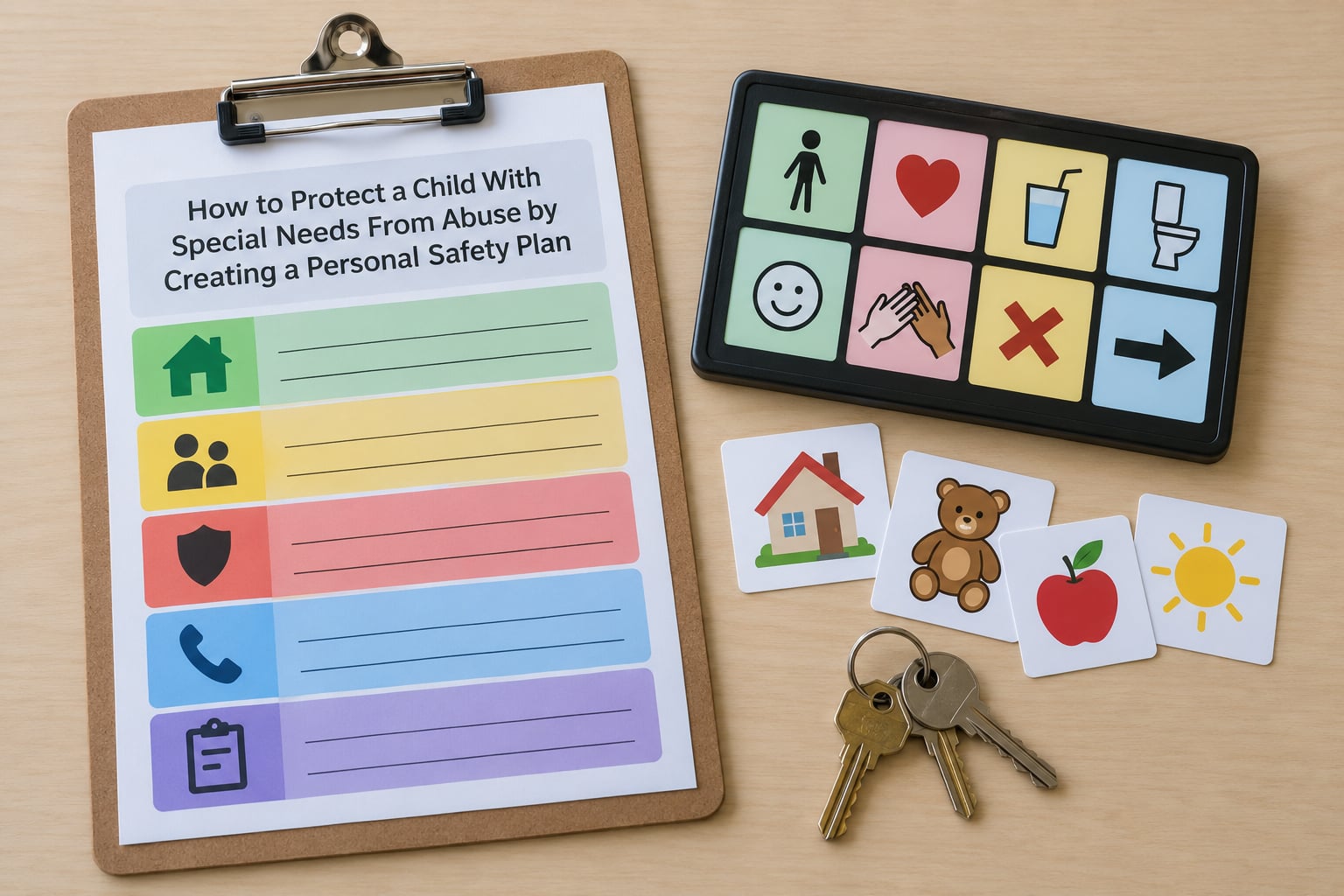
A personal safety plan is a one-page document that names the safe people, the safe places, the private routines, and the communication method for your specific child. It works because the adults around your child can follow it without guessing.
Write these lines for your child:
- Safe adults, named specifically, with how your child shows you that person is safe.
- Safe places that are not the usual room, such as a neighbour’s kitchen or a library with staff who know your child.
- Private versus public routines, spelled out. Public changing at a pool means anyone can watch. Being alone with an adult in a car or a bedroom is the setting to rule out.
- How your child says no and how they say stop, in whatever system they use.
- How to get help when your child cannot leave, including what a nearby adult should do if they hear distress.
- Transport boundaries, including who may ride along, who may not, and what happens when the plan changes at the last minute.
- Privacy during personal care, stated in plain words that the caregiver can follow.
- What to do if your child separates from a trusted caregiver, so a staff member knows who to call first.
Put the communication method in the plan in writing. If your child uses an AAC device, a communication book, sign language, or a switch, write what that device is, where it lives, and that it is never taken away as a consequence. Many families take devices away as a behaviour consequence, which quietly removes the one tool the child had for reporting a problem.
Families worry that handing over a device means giving up speech forever. It does not. Our piece on why AAC will not stop your child from talking covers that in more detail, and the short version matters here: a device is a reporting tool, not a replacement for words.
Include your child according to their age and capacity. Even a child who cannot speak can choose between two safe adults, choose which safe place to go to, and decide who helps with personal care. Letting your child make those choices is the earliest form of self-advocacy, and self-advocacy is the strongest protection a young person can carry into adulthood.
How you know it is working: a relative or a new aide can read the page and tell you, in their own words, who is safe and who to call. That is the test.
How to Protect a Child With Special Needs From Abuse by Teaching Boundaries and Safety Skills
Body-safety teaching works when it is rehearsed, concrete, and repeated. For children who cannot process an abstract lecture, that rules out the usual advice. Practice beats explanation.
Cover these ideas in order, using your child’s communication system throughout:
- Private body parts and the bathroom rule. A clear, short rule that the body parts covered by a swimsuit are private, and adults only touch them for health or safety.
- Consent, meaning your child can say yes, say no, and change their mind.
- Safe touch versus unsafe touch, described by how the touch feels and what the adult is doing, not by who the adult is.
- The right to refuse, practised out loud with a script they can use with an adult.
- Getting help, including the exact words or gesture for help and the names of two safe adults.
- What to do when a rule is broken, so your child knows that telling someone is not the problem.
The script matters more than the rule. Practise short, fixed lines: “No. I don’t like that.” “Stop.” “That is my private part.” “I need to leave.” “Help me.” Practise them until they come out automatically, then practise what an adult might say in response, including the wrong answer, so your child knows that being told to keep a secret is a red flag.
Use social stories, picture cards, video modelling, and role-play, with sensory supports in place. Keep sessions short. Ten minutes of repetition across a week beats a single long lesson.
For children who use AAC, add explicit body and anatomy images to the communication vocabulary, alongside the refusal and help symbols. Parent communities credit this with the moment a non-speaking child first communicated about harm. The symbols have to already be in the child’s everyday vocabulary, not introduced during a scary conversation.
One thing to be clear about: never teach your child that they must fight, run, or physically resist an adult. Many children cannot, and telling them they should have is a second harm. Teach disclosure, escape when possible, and reporting. Those three are the ones that work for a child who freezes, cannot speak, or is physically much smaller than the adult.
Add a no-secrets rule, and mean it. If an adult says don’t tell, your child comes to you and you respond. Write that promise down somewhere your child sees it.
How to Protect a Child With Special Needs From Abuse by Strengthening Adult Safeguards
Most abuse happens one on one, and most of it happens with someone the family chose. So the strongest lever you have is controlling who gets unsupervised time with your child and making that time visible.
Apply these to every adult who regularly sees your child, including family:
- Background checks on anyone hired directly, and asking agencies what screening their staff have had.
- Licensure and credential verification for therapists, aides, and in-home care, checked against the issuing body rather than taken on trust.
- Two-adult practice for personal care, appointments, and transport, and an explicit rule against one-on-one closed-door time.
- Open-door and visible-space rules for in-home care and respite, with drop-in visits you actually make.
- Written consent for personal care, photos, social media, and outings, naming who may do what.
- Unscheduled drop-ins so your child is never expecting a visit on a schedule only the caregiver controls.
- Written incident reports required from every provider, with a copy sent to you.
Ask directly, every time: who else has access to my child, who is in the room during personal care, and what is your policy for reporting concerns to me. A provider who cannot answer those plainly is telling you something.
Extend the same vetting to the settings you do not control. Ask the school about their safeguarding policy, whether aides are trained on your child’s specific risks, and what happens during the fifteen minutes between classes when nobody is assigned. Bus and transport gaps are the least questioned window in most districts, and they are worth a direct conversation with the transportation office.
Review access rather than just access. Who has your child’s medication, your online family account, your location sharing, your therapy notes, your door code. Caregiver access to routines is access to the child, and access to digital accounts is access to where the child is.
Watch the adults too. A caregiver under severe strain is a safeguarding risk, and it is a risk in both directions, toward your child and toward the caregiver themselves. Build in respite and backup before the strain becomes visible, and know the signs of caregiver burnout worth acting on.
How to Protect a Child With Special Needs From Abuse by Documenting and Reporting Concerns
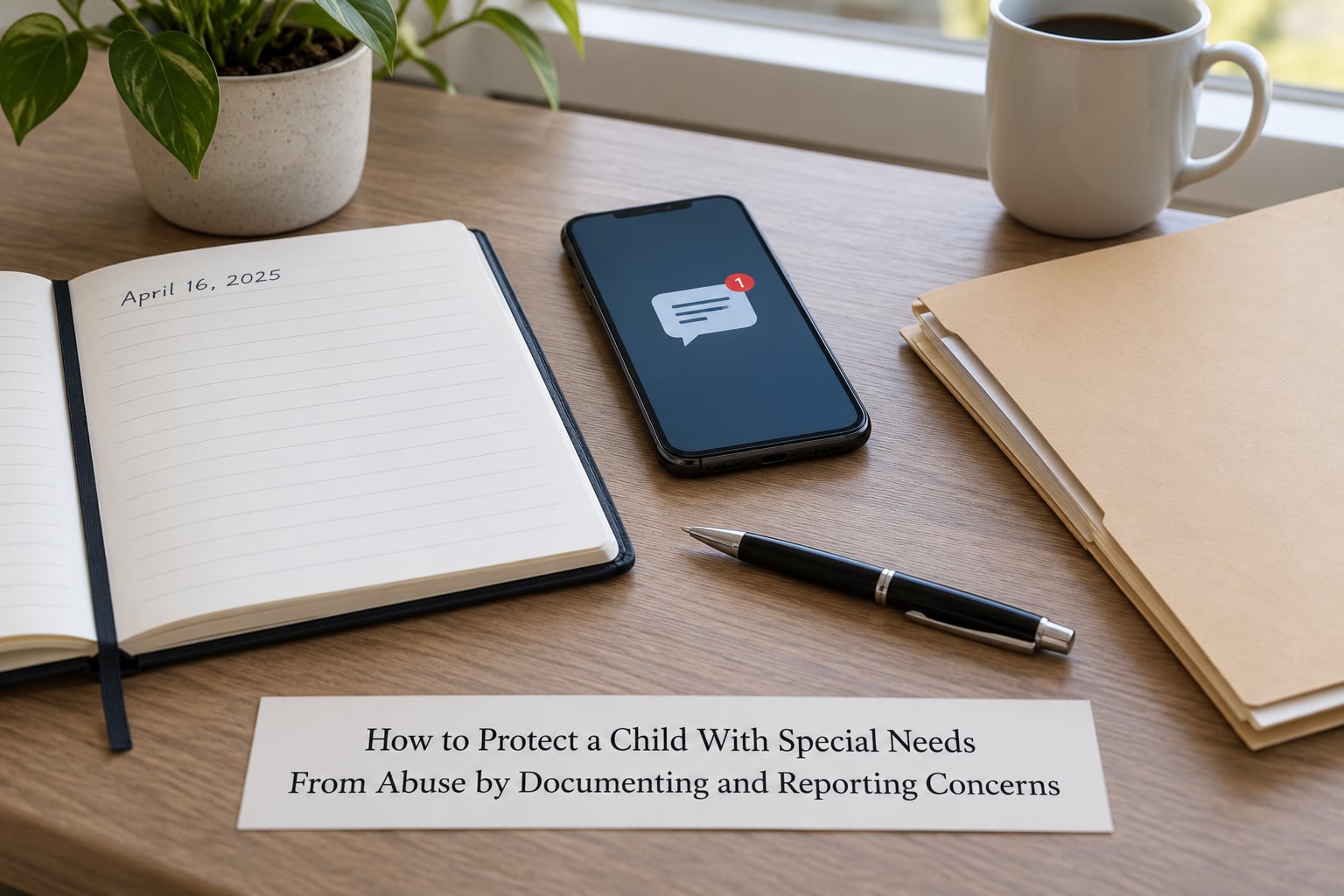
Documentation is what turns a worry into something an agency can act on. Record it while it is fresh, keep the original, and assume the suspected abuser may one day have access to the device or notebook where you keep it.
For each entry, capture the date and time, the location, who was present, exactly what you saw or what words were said, any injury with a photo, any witness, and what you did about it. Preserve original messages, voicemails, and text threads rather than screenshots alone when you can. Keep notes factual. Describe what you observed and leave conclusions to the investigation.
Send documentation in more than one place. Email a copy to an address only you control, keep a paper log somewhere locked, and do not keep the only copy on a shared tablet or a vehicle.
On reporting, use this general US framework and confirm your local numbers:
- Immediate danger or a medical emergency goes to 911 first. Then notify the agency.
- Suspected abuse, no emergency goes to the Childhelp National Child Abuse Hotline at 1-800-4-A-CHILD (1-800-422-4453), which is staffed around the clock and can be anonymous.
- Your local child protective services agency takes reports directly and is the route that opens an investigation.
- School or program reporting goes to the safeguarding lead, and in most states teachers and many other professionals are mandated reporters who must report on their own.
- Law enforcement makes sense when there is an immediate threat, a weapon, or a crime in progress.
- Legal advice from an attorney experienced in special education or disability law can help when you need an IEP safety goal, a court order, or a response from a school that is not protecting your child.
- Advocacy support from organizations such as The Arc, the Justice Center for the Protection of People With Special Needs, or Kidpower International can help you prepare and follow up.
Do not confront a suspected abuser alone, and do not run your own investigation. Get medical and legal guidance first, and let the agency handle contact with the person you are worried about. Confrontation can escalate the risk to your child and can cost you the documentation you have gathered.
How you know it worked: you have a report number, a date, and the name of the contact at the agency. Save all three together.
How to Protect a Child With Special Needs From Abuse After a Disclosure or Concern
Stay calm and keep it short. A child who tells you something hard is testing whether you are safe, and your reaction teaches them what happens next time.
Listen without interviewing. Thank them for telling you. Tell them it is not their fault. Do not ask the same question twice, do not ask leading questions like did Uncle Ray touch you, and do not promise secrecy, because a promise of secrecy teaches them that you will keep it too.
Then increase supervision and take action. Contact the appropriate hotline, agency, or emergency service, and follow medical guidance, since injuries and sexual harm may need assessment even when nothing is visible.
Account for how disclosure actually arrives. It is often gradual, over months, and frequently behavioural rather than verbal. A nonverbal child may show it through changes in routine, through their communication system, through drawings, through a new fear of a specific adult, or through a sudden behavioural shift that reads as regression. A lack of words is not evidence that nothing happened.
Expect the follow-up. Investigations involve interviews, and agencies look at the whole picture, including your own records. Keeping the documentation habit from step five is what makes the process faster and clearer for your child.
Common Mistakes That Undermine Protection (and the Fix)
Most families are not failing through ignorance. They are failing through normal human responses under pressure, and every one of these mistakes has a straightforward correction.
Dismissing the concern because the child cannot explain it. This is the most common and the most damaging. A non-verbal child can still show distress, refuse a person, or change behaviour around one adult, and behaviour is evidence. Fix: document the change in the same way you would document any medical symptom.
Waiting for a verbal account that will never come. Parents often assume nothing can be proven without words. It can be investigated without them. Fix: report based on the change and the pattern, and let the agency decide what it can establish.
Asking leading or repeated questions. You contaminate the account and you pressure a child who is already overwhelmed. Fix: ask open, simple questions once, then stop.
Promising confidentiality. It is the kindest lie in child protection and it teaches the wrong lesson. Fix: say that you will tell the right people so the child can be safe, and then actually do it.
Confronting the suspected person yourself. Fix: go through the agency or an attorney, and get a safety assessment before any contact.
Changing routines without explaining what changed. Removing the aide, the bus, or the daycare without naming the reason leaves your child with no framework and gives the message that the change is their fault. Fix: say what happened, in age-appropriate words, in the communication system your child uses, and repeat it often.
Depending on one person for everything. The person you cannot afford to lose is also the person you cannot afford to suspect. Fix: name at least three safe adults, and rotate them.
Keeping records where the suspected person can see them. Fix: two copies, one location you control, dated.
Confusing regression with abuse, or abuse with regression. A clear baseline document, written before anything changes, is the tool that separates the two. Fix: write down what normal looks like in a short paragraph and keep it current.
Forced physical contact with a sensory-sensitive child. Hand-holding, hugging, back-patting, and forced high-fives are common in well-meaning settings and are a safeguarding problem for a child with sensory processing differences. Fix: write a no-unwanted-touch rule into the safety plan and hand it to every provider.
Fear of reporting keeps you silent. The fear of a child welfare investigation of yourself is real and widespread in this community. It is the single biggest reason concerns go unreported. Ask about the process before you need it.
Frequently Asked Questions
Can a non-verbal or autistic child report abuse?
Yes, though it rarely looks like a verbal account. Disclosure comes through behaviour: new distress around one person, refusal of a routine that used to be fine, regression, withdrawal, sleep or eating changes, or new fear of a specific place. A child using AAC can report through their device or communication book, through drawings, or by pointing. Many parents add explicit body and boundary symbols to the everyday vocabulary so reporting is possible without a new lesson in the moment.
What should I document after a suspected abuse incident?
Write down the date, time, location, who was present, exactly what you observed or what was said, any injury and a photo of it, any witness, and what action you took. Keep it factual and leave conclusions out. Preserve original messages and voicemails rather than screenshots alone. Store copies in two places you control, since the person you are worried about may have access to your tablet, car, or shared cloud account.
When should I call 911 instead of a hotline?
Call 911 when there is immediate danger, an injury that needs medical attention, a crime in progress, or a situation you cannot control until a caseworker responds. For suspected abuse with no emergency, call the Childhelp National Child Abuse Hotline at 1-800-4-A-CHILD (1-800-422-4453), which is answered around the clock and allows anonymous calls. If you are unsure which applies, use 911 and then notify the child protection agency.
How do I involve the school and medical providers in safety planning?
Ask the special education team for a written safety goal in the IEP or 504 plan, a named safeguarding lead you can reach directly, and clear rules on one-on-one time, bathroom supervision, and transition periods. Give your pediatrician your baseline behaviour notes and ask them what documentation they need to record an injury. Providers who see your child regularly are often the first to notice a change you missed.
What if the person I suspect is my child’s parent or main caregiver?
This is the hardest version of the problem, and it is the one most families face quietly. Document exactly as you would for anyone else, and report through the hotline or the agency rather than waiting for certainty. Do not confront the person alone, because your child’s daily care may depend on them and the response can escalate. A family attorney experienced in disability and special education law, or a domestic violence advocate, can help you plan the practical safety of the next few days.
Will reporting abuse put me under investigation for abusing my own child?
A report is about what was observed, not about who is most likely to have done it, and agencies are required to look at safety rather than punish. What slows investigations down is thin documentation and unclear baselines, so keep dated notes on injuries, routines, and normal behaviour. Keeping your own records accurate is the best protection against being misread. Your local child protection agency can walk you through exactly what its screening process involves before you file.
How to Protect a Child With Special Needs From Abuse: Start With One Safety Step
Pick one page and one afternoon. Write down the name of one adult who is safe for your child, one place outside the usual routine that is safe, the one way your child communicates, and the number you would call if you were worried. Put all four on a sheet of paper and give a copy to your child’s teacher, your aide, and your co-parent.
That is the whole starting point. Everything else in this guide, the vetting, the scripts, the documentation habit, the reporting route, grows out of those four lines.
If you already suspect something today, call the Childhelp National Child Abuse Hotline at 1-800-4-A-CHILD (1-800-422-4453) or 911 if it is happening now, then start the dated notes. You do not need proof. You need a record and a phone call.
Last updated October 2026. This article is general information, not legal or medical advice. Local laws, reporting duties, and agency procedures vary, so confirm your local route with a qualified attorney, your child protection agency, or a disability advocacy organization.