

To create a sleep schedule for toddlers, you need three things: one fixed wake time, one predictable nap, and one bedtime, repeated the same way every day. Most families see the schedule click into place within 10 to 14 days, and the work up front takes about 20 minutes a day. This plan walks through the whole process, from tracking patterns to handling the week after a skipped nap.
The reason it works is that toddlers learn to anticipate sleep. When the cues arrive in the same order at roughly the same times, the body clock starts doing the work for you, and bedtime stops being a negotiation.
Table of Contents
- What You Need
- Step-by-Step: Build Your Toddler’s Sleep Schedule
- 1. Record Your Toddler’s Current Sleep Patterns
- 2. Choose a Consistent Morning Wake Time
- 3. Work Backward to Set Bedtime
- 4. Plan Naps Without Making Them Last All Day
- 5. Create a Predictable Bedtime Routine
- 6. Test the Schedule Gradually and Make Small Adjustments
- Common Mistakes to Avoid
- Frequently Asked Questions
- How many hours of sleep does a toddler need each day?
- What time should a toddler go to bed?
- What should I do if my toddler skips a nap?
- How can I fix early morning waking?
- Should a toddler have the same bedtime on weekends?
- What is the 5-3-3 rule or the 3-3-3 rule for sleep?
- Start With One Consistent Wake Time
What You Need
You do not need much to get started, but you do need a few things in place before you set a single clock time.
- Age guidance to work from. The American Academy of Sleep Medicine and the American Academy of Pediatrics recommend 11 to 14 hours of sleep per 24 hours for children 1 to 2 years old, and 10 to 13 hours for children 3 to 5 years old, naps included.
- A sleep log. A notebook, a notes app, or a printed sleep log chart. You need somewhere to write down naps, wake-ups, bedtime and morning wake time.
- A wake time you can commit to. Pick the time that works on the most days of your week, including the days you work weekends or share custody.
- A safe sleep space. A firm, flat surface with the right fit for your child’s size, away from loose bedding and cords, and on a smoke-free floor if they are under one.
- A bedtime routine you can repeat. The same four or five steps, in the same order, every night.
- Any accommodations. If your child is sensory-sensitive, autistic, on a special diet, or managing a medical condition, note the adjustments that make settling easier before you build the schedule around them.
If sleep is being disrupted by snoring, pauses in breathing, pain, reflux or medication changes, raise that with your pediatrician first. A schedule cannot fix a physical problem.
Step-by-Step: Build Your Toddler’s Sleep Schedule
Here is the sequence that works. Do them in order, and give each one a few days before moving to the next.
1. Record Your Toddler’s Current Sleep Patterns
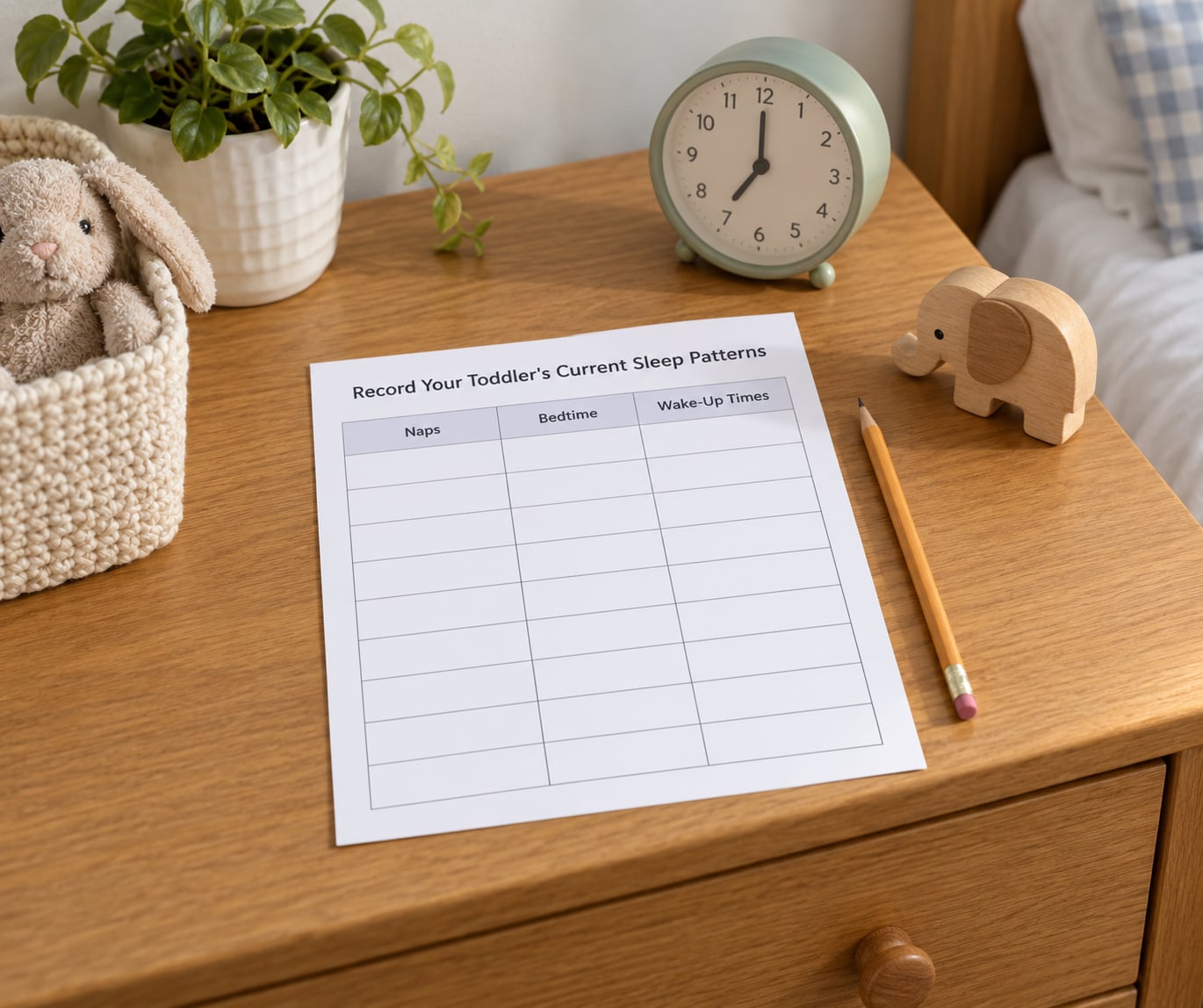
For five to seven days, write down when each nap started and ended, how many night wakings there were, what time bed was, and what time your toddler woke up. Do not change anything during that week. You are collecting the baseline, not grading it.
Then total it up. Night sleep plus naps should land somewhere near the recommended range for their age. The number that matters most is the gap between waking and the first nap, and the gap between the last nap and bedtime. Those two gaps are your wake windows, and they tell you where the schedule has to flex.
What you are looking for is a realistic starting point, not a perfect one. A week that includes a skipped nap and one early wake is more useful data than a week where everything went well, because it shows you how the schedule behaves under pressure.
2. Choose a Consistent Morning Wake Time
Anchor the whole day on wake time, not bedtime. It sounds backwards, but bedtime is the number you calculate later, while wake time is the number you control.
Choose a time that is realistic, not aspirational. If the earliest your child can reasonably be up and dressed is 6:45 on school days, that is your wake time. Trying to hit 6:00 to buy an extra hour at night is the single most common reason schedules fall apart by week three.
Keep weekends within about an hour of the weekday wake time. A late Saturday morning looks harmless, but it shifts the nap, shifts bedtime, and by Sunday night your toddler is overtired and the whole week restarts.
When your real life will not cooperate, protect the nap instead. An early or short wake time with the daytime nap kept in place does far less damage than a late wake time that pushes the nap past its window.
3. Work Backward to Set Bedtime
Bedtime is arithmetic, not guesswork. Take the morning wake time and subtract the final wake window for your toddler’s age.
| Age | Total sleep per 24 hours | Last wake window before bed | Typical bedtime for a 6:30 to 7:00 am wake |
|---|---|---|---|
| 12 to 15 months (two naps) | 12 to 16 hours | 4.5 to 5.5 hours | 6:15 to 6:45 pm |
| 16 to 18 months (transitioning) | 12 to 16 hours | 5 to 6 hours | 6:30 to 7:00 pm |
| 18 to 24 months (one nap) | 11 to 14 hours | 5 to 5.5 hours | 6:30 to 7:15 pm |
| 2 to 3 years | 11 to 14 hours | 5 to 6 hours | 7:00 to 7:45 pm |
| 3 to 4 years | 10 to 13 hours | 5 to 6.5 hours | 7:00 to 8:00 pm |
So if your toddler wakes at 6:30 and is in the 5 to 6 hour range for that final window, bedtime falls somewhere between 6:30 and 7:30 pm. That range is wide, and that is the point. Give yourself a 30-minute window and aim for the middle of it.
Two common questions land here. If a 2 year old is still awake at 8:30 pm, that is late for most toddlers on a one-nap schedule, and it usually means the day is stretched too long or the nap ran too late. And 6:30 pm is not too early for a 3 year old who naps only 30 minutes. For many preschool-age children that is exactly the right bedtime.
If your pediatrician has given you different numbers for your child, follow them. Age tables are averages, and the goal is a well-rested child, not a spreadsheet.
4. Plan Naps Without Making Them Last All Day
The nap is the piece most schedules get wrong. An early nap plus a late nap pushes bedtime later, which pushes wake time later, which repeats the cycle.
Keep one nap, start it at the same time most days, and cap it. The most commonly successful approach from parent reports is a single nap of roughly 60 to 90 minutes starting around 12:30 to 1:00 pm. Cap the end time rather than trying to wake a sleeping child early every day. If they are still asleep when the cap hits, let it run 10 to 15 minutes and start pulling the cap earlier next week.
A nap that ends after 3:30 pm is the usual reason bedtime collapses. If your child is taking a second nap in the late afternoon, that is usually an overtired sign, not extra rest, and the fix is an earlier bedtime that week rather than letting the nap run.
Around 15 to 18 months, most toddlers move from two naps to one. Drop the morning nap first, keep the midday nap for a few more weeks, and expect the transition to take a couple of weeks with the occasional rescue catnap. Families who move faster usually end up with a child who falls asleep at 4:45 pm and wakes at 5 am.
For children still on two naps, the pattern is usually a morning nap around 9:30 lasting 30 to 45 minutes and an afternoon nap around 1:30 lasting 60 to 90 minutes. Same idea, shorter blocks, and the same wake time every morning underneath it.
5. Create a Predictable Bedtime Routine
The routine is the part that makes the schedule hold, and it should run 20 to 30 minutes. Same steps, same order, low stimulation, every night. Most families use a version of this sequence:
- Dim the lights as bedtime approaches.
- Warm bath or wash-up, then pyjamas and a fresh diaper.
- Brush teeth.
- Two or three bedtime stories, chosen in advance.
- A short cuddle, a song, or a comfort item.
- Lights out, same words every time.
Keep screens out of the last hour and treat white noise, a night-light and a blackout curtain as constants rather than variables. What matters is that the room and the sequence look the same on Sunday as they did on Tuesday.
For sensory-sensitive and neurodivergent toddlers, the routine needs more structure, not less. Preview what happens next with a visual schedule, offer the same three books in the same order rather than a surprise choice, and keep the wind-down short and predictable instead of stretching it to fill extra time. If night waking is the bigger challenge, how to help an autistic child sleep through the night covers that in more detail.
6. Test the Schedule Gradually and Make Small Adjustments

Now install it, slowly. Hold bedtime steady for three to four days before changing it, because a rough night or two is normal and usually reflects the transition, not a broken plan. Make one change at a time and wait another three or four days to see it.
Move bedtime in 15-minute increments rather than an hour. A 45-minute shift in one evening reads as a completely new schedule, and a toddler will object to it. Small moves are much harder to notice.
Consistency across caregivers matters more than anything else you can control. Sit down with your partner, your child’s daycare teacher and any grandparent who does bedtime, and agree on wake time, nap window, bedtime and the order of the routine. Write it down and share it. The families that struggle most are usually the ones where the schedule lives in one parent’s head.
If the schedule breaks, recover it in 15-minute steps rather than resetting. After illness, travel, holidays or the clocks changing, hold the routine first and move wake time by 15 minutes every two or three days toward the target. Daycare naps count, so share the nap window with whoever supervises them.
Expect one rough week roughly every three months. Toddlers go through growth spurts, separation wobbles and new skills, and sleep gets messy while their brains practise something new. That is normal development, not a schedule you built wrong.
Common Mistakes to Avoid
Most failed toddler sleep schedules come down to five recurring habits, and each one has a straightforward fix.
- Moving bedtime every few nights. Changing bedtime based on how the previous night went means your child never learns the pattern. Fix: hold the time for at least four days and let the schedule catch up with the child.
- Starting bedtime too late. A late bedtime looks like it buys you a calmer evening, but it usually ends in an overtired surge and a wake-up at 5 am. Fix: pull the whole evening forward by 30 minutes for a week.
- Skipping the routine when you are tired. The night you go straight from dinner to lights out is usually the night that goes wrong. Fix: keep the routine shorter rather than skipping it.
- Reading hunger or discomfort as stubbornness. If bedtime resistance appears suddenly, check for teething pain, illness, hunger, or an overloaded or underfull nappy before treating it as a routine problem.
- Expecting compliance. A toddler does not need to like the schedule, only to experience it repeatedly. Fix: lower your standards for the first two weeks and judge the plan on week three.
A few flexible-scheduling habits that make the whole thing more durable:
- Anchor on wake time and bedtime, and let the middle of the day move by up to an hour.
- Hold a floor and a ceiling for bedtime rather than one exact minute.
- Protect the nap even when the day goes sideways, since the nap holds bedtime together.
- Keep one weekend day fully protected and treat the other as an extension.
- Write the plan where everyone who puts your child to bed can see it.
Frequently Asked Questions
How many hours of sleep does a toddler need each day?
The American Academy of Sleep Medicine and the American Academy of Pediatrics recommend 11 to 14 hours per 24 hours for toddlers 1 to 2 years old, and 10 to 13 hours for children 3 to 5 years old. Those totals include daytime naps. Most toddlers on a one-nap schedule sleep roughly 10 to 12 hours overnight plus 1 to 2 hours in the afternoon. Ask your pediatrician for a specific target if you are unsure whether your child is meeting their needs.
What time should a toddler go to bed?
Work backward from morning wake time instead of picking a popular clock time. Subtract your child’s final wake window, which is usually 5 to 6 hours. A toddler waking at 6:30 am lands somewhere between 6:30 and 7:30 pm. A 3 year old waking at 7:00 am often needs 7:00 to 8:00 pm. Give yourself a 30-minute range and aim for the middle of it.
What should I do if my toddler skips a nap?
Keep bedtime the same for that night and expect the child to be tired. If a short nap happens before 2:00 pm, let them sleep and go to bed at the usual time. If no nap happens at all, bring bedtime forward by 30 to 60 minutes and skip nothing else. Do not let a skipped nap turn into a nap at 5 pm, because that trades one bad night for a 5 am wake-up the next day.
How can I fix early morning waking?
Early waking usually means the schedule is running too late, not too early. Bring bedtime forward by 15 to 30 minutes for a week and keep the wake time fixed, since morning light sets the body clock. Check for hunger, discomfort, a room that is too light or too cold, and a schedule where the final wake window is too long. If waking happens consistently before 6 am with no other explanation, mention it to your pediatrician.
Should a toddler have the same bedtime on weekends?
Within about an hour, yes. The weekend wake time drives everything else, so a late Saturday morning shifts the nap and then the bedtime. Staying close keeps the body clock steady and means Sunday night is not a reset. If a special occasion runs late, keep the routine short and the wake time normal the next morning rather than shifting everything forward.
What is the 5-3-3 rule or the 3-3-3 rule for sleep?
Both are models for newborns, not toddlers. The 5-3-3 rule refers to five hours of nighttime sleep, three hours between wakings, and three naps a day. The 3-3-3 rule describes a newborn pattern of three-hour cycles of feeding or sleep, three times a day. Once your child passes the first year, wake windows and total daily hours are far more useful than either rule.
Start With One Consistent Wake Time
If you only do one thing this week, pick the morning wake time and hold it. Everything else can be calculated around it.
Here is your starting order: track the current pattern for five to seven days, choose a realistic wake time, work backward to set bedtime, cap the nap so it ends before 3:30 pm, run the same 20-minute routine every night, and adjust in 15-minute steps only after three or four stable days. Write the whole plan down and put it where every caregiver can see it, because consistency across adults is what makes any of this hold.
It takes a couple of weeks, not overnight. Most families get noticeably better sleep once the wake time and the routine stop moving, and the rest sorts itself out from there.