
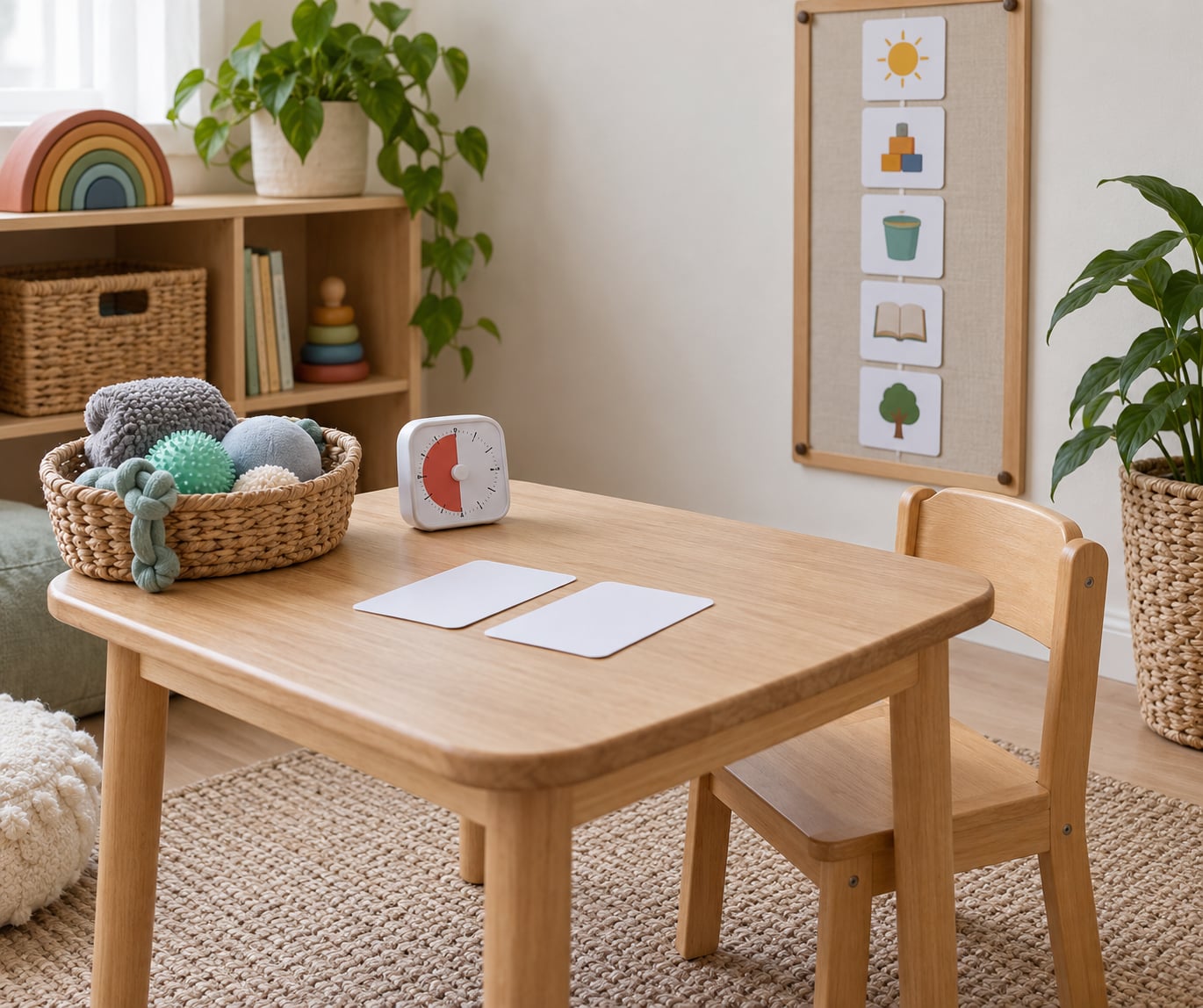
The short answer: stay calm, name the feeling, hold one clear limit, offer two acceptable choices, and then wait. That sequence works because a strong-willed child is not misbehaving on purpose — their pushback is practice for independence. Most of the work happens before the argument starts: adjusting the environment so there are fewer battles to win.
It also helps to name what this is not. Willfulness is not caused by bad parenting, and it is not a character flaw to correct. A child who argues, delays, and needs the last word is exercising a drive for control that every healthy child has. The goal is not to produce a child who never says no. It is a child who can say no, stay in relationship with you, and eventually handle a boundary without falling apart.
Table of Contents
- What You Need
- Step-by-Step: How to Deal With a Strong Willed Child
- Step 1: Look for Triggers Before the Meltdown
- Step 2: Set One Clear Limit and Offer Two Choices
- Step 3: Use Fewer Words and a Calm Voice
- Step 4: Follow Through With a Predictable Consequence
- Step 5: Teach the Child How to Reset
- Step 6: Reconnect and Prevent the Next Power Struggle
- Common Mistakes
- Frequently Asked Questions
- Why is my child so strong-willed?
- How do I discipline a very strong-willed child without shouting?
- What do I do when my child ignores me completely?
- Is my child strong-willed, or is something else going on?
- What to do when your child is mean to you or hits?
- A Calm Place to Begin
What You Need
You do not need a parenting program or a special reward system. You need a few practical things:
- A calm moment. If you are already shouting, red-faced, or rushing to leave, deal with the room first. The next ten minutes matter more than winning the current one.
- One limit, stated in under ten words. Not three rules, not a speech.
- Two choices you can genuinely live with. Both acceptable, both inside the boundary.
- A consequence you have already decided on. Related to the behavior, brief, and non-negotiable.
- A way to record patterns. A notes app, a paper on the fridge, a few minutes of memory after bedtime.
- A break plan for yourself. Who watches the child while you breathe in another room.
Adapt all of it for your child. A two-year-old cannot hold a two-part instruction, so shorten it. An autistic child who uses AAC or sign needs the same words in the same order every time, plus extra processing time before you repeat anything. A child with sensory processing differences may need movement or noise-cancelled headphones before they can hear a limit at all. If your child already has a support plan from a care team, the ideas here sit alongside it rather than replacing it.
Step-by-Step: How to Deal With a Strong Willed Child
Step 1: Look for Triggers Before the Meltdown
Power struggles cluster around predictable moments. Fatigue, hunger, a rushed transition, an unclear instruction, a demand past what your child can actually manage right now — these are the usual suspects.
Keep a short log for one week. Four columns is enough: time and trigger, warning signs, what the adult did, what happened. Parents who do this usually find the pattern fast. Two of my kids’ worst fights happened in the twenty minutes after school, which is when everyone is hungry and nobody has processed the day yet. That twenty minutes now has a snack and ten minutes of quiet before any asking begins.
You will also learn your child’s early warning signs. Some go still and quiet. Some get louder and louder before they drop. Some escalate so fast that a five-minute warning would never be enough, and that is useful information too.
Step 2: Set One Clear Limit and Offer Two Choices
Replace the vague command with one concrete limit, then two options that both fit inside it. “Put your shoes on” becomes “Shoes first, or socks first?” “We’re leaving now” becomes “Leave with the truck, or leave after you say goodbye to the slide?”
The wording that works is: limit, choice, pause. “We’re going to the car. Shoes or socks first?” Then stop talking. Filling the silence is your job to resist.
Offering choices is not giving away adult responsibilities. You are still deciding when to leave, and your child is deciding how it happens. That distinction is what keeps the exchange from turning into a negotiation.
Step 3: Use Fewer Words and a Calm Voice
Long explanations, repeated demands, shouting, and mid-argument bargaining all raise the temperature. When a child is flooded, extra words do not land — they become noise to argue against.
Short phrases that work: “Stop. Safe hands.” “You can be angry, but not hit.” “I will wait with you.” “That was a no. Try again.” Say it once, at normal volume, close enough to be heard.
Match your wording to how your child communicates. A child who signs or uses an AAC device needs to see the same phrase on the device as on your lips. A child who processes slowly needs ten seconds of quiet before you repeat yourself. Extra processing time is not defiance — repeating the demand four times in eight seconds usually produces resistance.
Step 4: Follow Through With a Predictable Consequence
A consequence should be related to the behavior, brief, easy to explain, and decided before it happens. After a safety issue at the playground, the consequence is leaving early. After hitting, it is a few minutes in a calm space away from others. After breaking a glass on purpose, it is helping clean up the pieces.
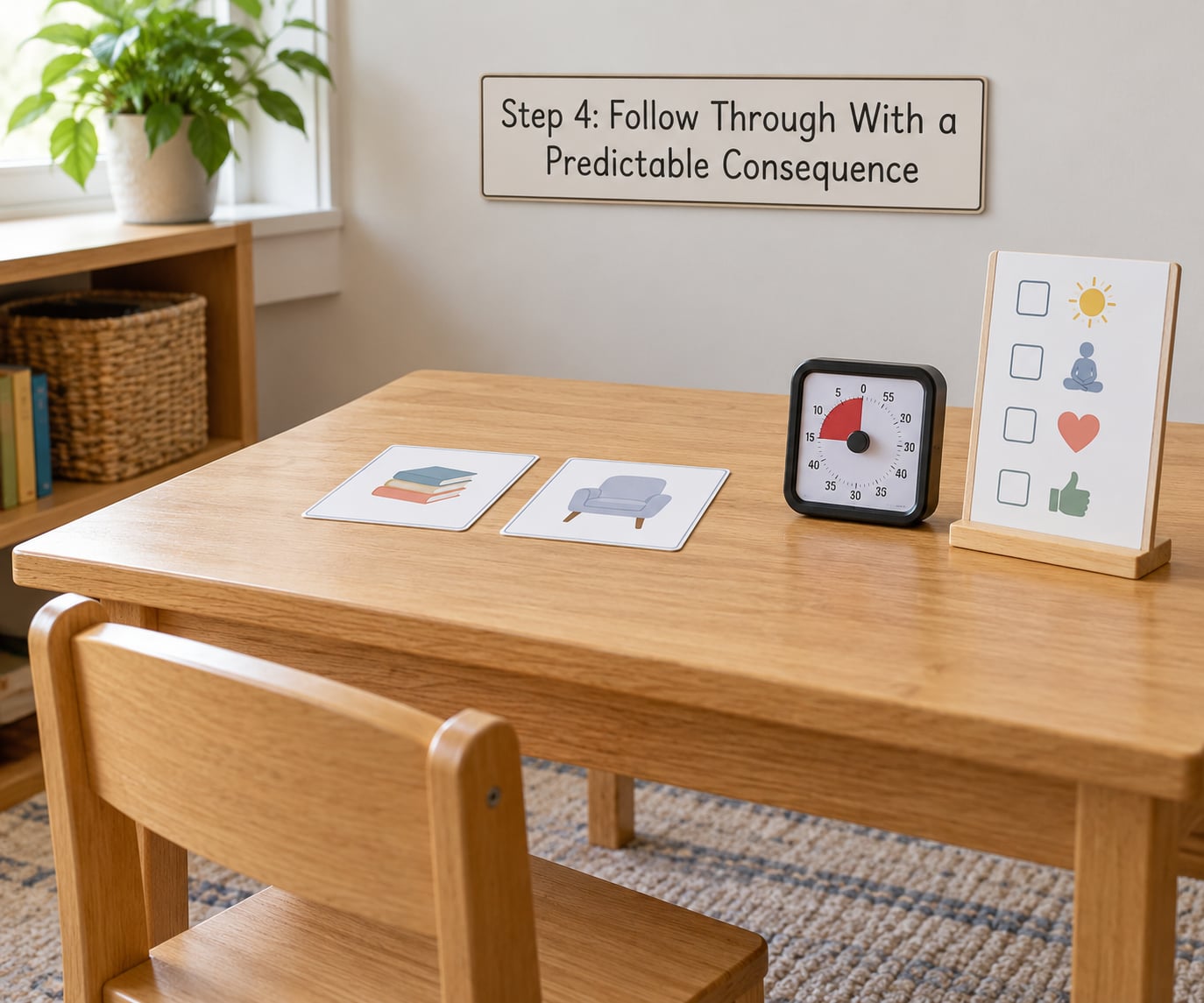
Say the consequence at the moment you set the limit, not after the rule is broken. “If you hit, we go to the quiet corner for three minutes, then you can pick the game.” A surprise consequence feels arbitrary to a child, and arbitrary feels unfair.
Keep it brief. A week-long loss of privileges stops working because the child forgets why, and because they stop caring. Three quiet minutes, one evening without screens, a shorter bedtime the next night — small and connected to the moment. Nothing harsh, nothing isolating, nothing that removes food, sleep, or love. Those are punishment, not discipline, and they teach that you are dangerous rather than that the behavior had a cost.
If consequences seem to land for two minutes and then vanish, the usual reasons are that they are too long, too delayed, or inconsistent between adults and co-parents. Pick one smaller thing and follow it every single time.
Step 5: Teach the Child How to Reset
Once the intensity drops, help your child return to baseline. Water, four slow breaths, a push against the wall, a quiet corner, or ten minutes of drawing. For many children, movement beats talking when they are still activated.
Then do a small repair. Wipe the table together. Say “I’m sorry I hit. I can be angry and keep safe hands.” Let them pick the words if they have language for it. Repair is short and concrete, never a lecture about why their behaviour made you sad.
A forced apology teaches nothing. A real repair, done with your hands next to theirs, teaches something.
Step 6: Reconnect and Prevent the Next Power Struggle
End the interaction with connection, not continued punishment. Sit close for the rest of the transition. Say what you noticed: “You kept your hands safe even when you were really angry.” Then, privately and briefly, restate the limit so the child knows it did not evaporate.
Track progress over a week, not an afternoon. Most children show a small change first — shorter arguments, fewer repeated requests, a quicker reset — and that is the actual signal to keep going. Regression around a bad day or a change in routine is normal, not evidence that the approach failed.
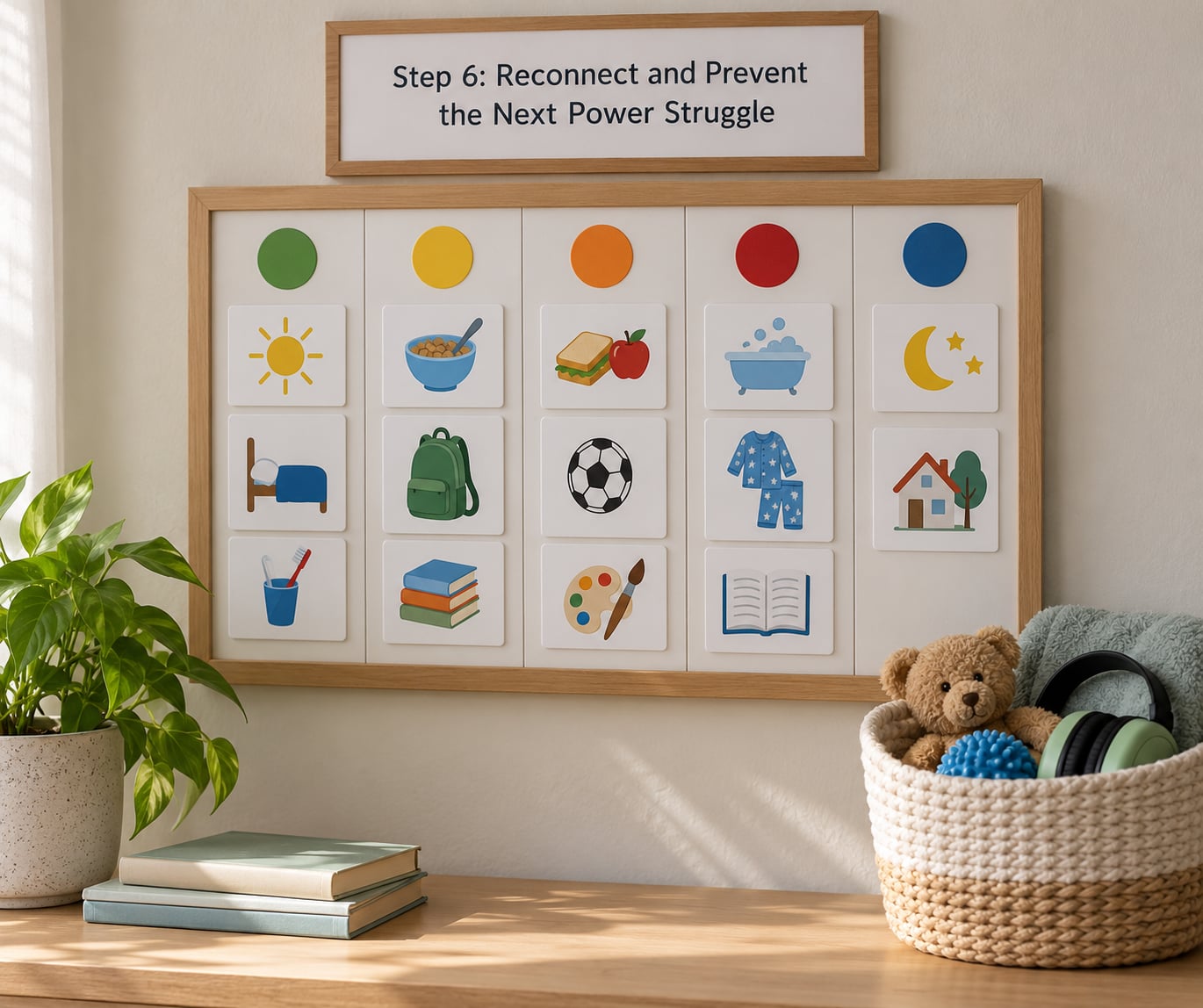
For the daily battles specifically — mornings, homework, errands — a visual schedule with picture cards and a simple timer usually buys you more cooperation than another reminder. Our homework meltdown guide covers the after-school version of this, and grocery shopping with a child who has meltdowns covers the public version, where strangers watching adds a whole extra layer to your own stress.
Common Mistakes
Giving too many choices. Three or four options turns a simple decision into an exhausting negotiation. Fix: two options, every time, and the same two.
Repeating threats you never carry out. Once “we’ll go home” becomes a thing you say ten times a day, it stops meaning anything. Fix: say it once, and if you said it, do it.
Arguing during escalation. A dysregulated child cannot process reasons, and neither can you. Fix: pause the conversation entirely and pick it up after the reset.
Inconsistent consequences between adults. When one caregiver gives in after the other holds the line, the child learns to wait for the softer one. Fix: agree in advance on the two or three limits that matter to both of you, and let go of the rest.
Praising only compliance. “Good job, you listened” rewards obedience and nothing else. Fix: praise the skill — waiting, asking, resetting, using words.
Debating while they refuse. Explaining why the rule is fair, over and over, teaches that if they argue hard enough, the rule moves. Fix: “The answer is still no,” then stop talking.
For children with communication, sensory, or executive-function differences, add two adjustments. Give instructions one at a time and confirm understanding by having them show or say it back, rather than asking “do you understand?” And expect less verbal reasoning in the moment than you would from a neurotypical peer — the goal is the behavior supported, not a debate won.
Chores are a good test case for this. Our guide to teaching chores to an autistic child breaks it into one visible task with a finished marker, which suits a strong-willed kid better than a general instruction.
Frequently Asked Questions
Why is my child so strong-willed?
Two things combine: an inborn temperament with intensity and persistence, often partly inherited, and a developing need for autonomy. Strong-willed children test limits because they are building a sense of control over their own world. Pushing back is healthy practice, so the more control you force, the harder they resist. It is temperament and development, not a sign you did something wrong.
How do I discipline a very strong-willed child without shouting?
Pick two or three limits and state them calmly, then follow through the first time they are broken. Offer a choice inside each limit rather than a choice about the limit. Acknowledge the feeling before correcting the behavior. Keep consequences short and related, and never discipline from the middle of a meltdown, because nothing said in the heat is retained afterwards.
What do I do when my child ignores me completely?
Stop repeating yourself. Check the basics first: are they hungry, tired, overloaded, or does the instruction genuinely make no sense to them. Lower the demand to one step, pair it with a visual or gesture, and wait in silence. Repeated commands escalate resistance. If they are still stuck after simplifying, change the activity, then return to the request once they are calm and rested.
Is my child strong-willed, or is something else going on?
Strong-willed behavior shows up in specific situations and eases when the environment changes. Ask your pediatrician if it is constant across settings, lasts beyond a few weeks, is accompanied by sensory distress, sleep problems, or intense difficulty with transitions, or if it is affecting school and friendships. Sensory processing differences, anxiety, ADHD, and autism can all look like defiance, and they have supports that willfulness does not.
What to do when your child is mean to you or hits?
Stop the behavior immediately and briefly, without a lecture: you can be angry, hands stay safe. Move to a calm space apart for a few minutes, then return and name the feeling together, along with any unmet need like frustration, hunger, or sensory overload. Repair what can be repaired, and check for the pattern behind it. Hitting that appears suddenly and often deserves a conversation with your pediatrician.
A Calm Place to Begin
Start with the next battle, not the whole relationship. Pause until you are steady. Name what you see. State one limit. Offer two choices. Then wait, and reconnect when it is over.
That is the whole method, and it is genuinely hard at the end of a long day. The measure of whether it is working is not whether your child complies — it is whether they can push back and still feel safe with you. Hold the boundary without needing to win, do the repair, and give it a week before you judge it. A strong-willed child who grows up feeling safe saying no is exactly the outcome you want.