Age appropriate chores for kids are routine household tasks matched to what a child can actually do at their stage, not what their birthday says they should manage. Matched well, they build independence, time management and the sense of being someone who contributes to the family rather than only consumes.
Most families get this wrong in one of two directions. Either the first chore is too hard and ends in tears, or it stays too easy for years and the child learns nothing new. The sweet spot moves on two axes at once: complexity and independence.
A three-year-old can carry one soft toy to a bin. A ten-year-old should be loading the dishwasher and making their own breakfast without being asked twice. A fifteen-year-old runs a whole job end to end, including the parts nobody thinks about. This guide walks through ten age appropriate chores for kids in order, with the safety limits for each age and the visual and sensory adaptations that make a chore land with autistic children or kids with ADHD.
Two things worth saying up front. Every child is different, so treat these ages as a starting point rather than a rulebook, and the standard of clean should be set in advance rather than argued about after the fact. Parents whose kids were five and fifteen at the same time found it much easier to assign an area for the week than a task, since that ends most sibling arguments before they start.
Table of Contents
- Age Appropriate Chores for Kids at a Glance
- 1. Put Toys Away for Ages 2-3
- Safety at this age
- 2. Match Laundry for Ages 4-5
- 3. Wipe a Low Table for Ages 5-6
- Safety at this age
- 4. Set or Clear the Table for Ages 6-7
- 5. Sort Recycling for Ages 7-8
- Safety at this age
- 6. Make the Bed for Ages 8-9
- 7. Sweep One Small Area for Ages 9-10
- 8. Fold Simple Laundry for Ages 10-11
- 9. Care for a Pet or Help With Feedings for Ages 11-12
- 10. Take Ownership of a Weekly Family Chore for Ages 13+
- Frequently Asked Questions
- What age should children start doing chores?
- How do I motivate an autistic child to do chores?
- Should children be paid for doing chores?
- What chores can a child with limited mobility do safely?
- How do I handle a child who refuses to do chores?
- Start With One Chorable Task
Age Appropriate Chores for Kids at a Glance
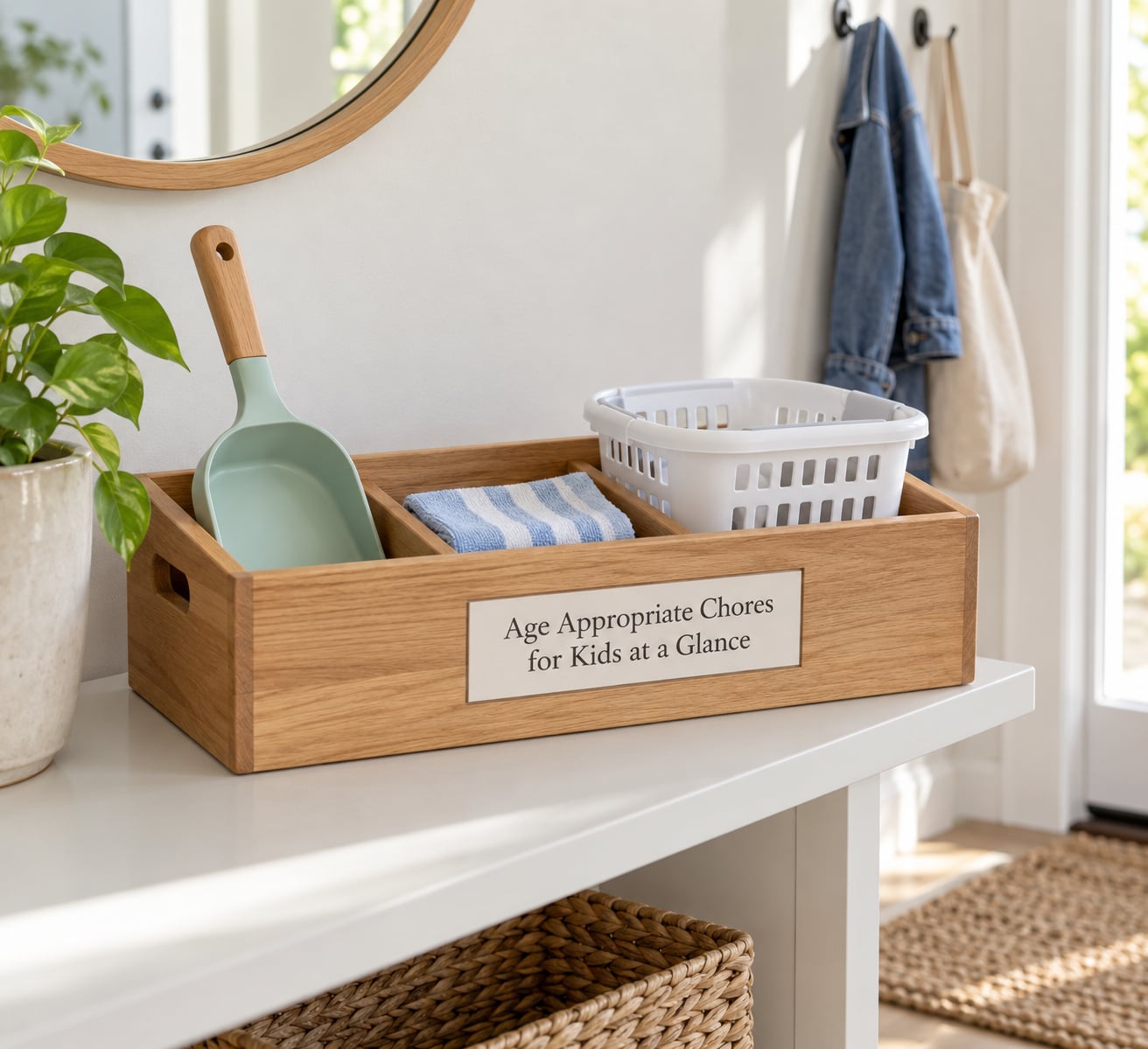
Here is the whole progression on one page. Use it as a reference, not a checklist to complete in order, because most families move back and forth between bands depending on maturity rather than age alone.
| Chore | Typical ages | Independence level | Best way to teach it |
|---|---|---|---|
| Put toys away | 2-3 | One step | Two labeled bins and a picture strip |
| Match laundry | 4-5 | One step | Three clear piles, count out loud |
| Wipe a low table | 5-6 | Two steps | Demonstrate the damp cloth once |
| Set or clear the table | 6-7 | Two steps | Place settings laid out as a template |
| Sort recycling | 7-8 | Two to three steps | Check local rules together first |
| Make the bed | 8-9 | Three steps | Written sequence on the wall |
| Sweep a small area | 9-10 | Four steps | One defined zone, child-size brush |
| Fold simple laundry | 10-11 | Four steps | One clothing type at a time |
| Pet care or mealtime help | 11-12 | Five steps | Written checklist with a measuring step |
| Own a weekly family job | 13+ | Whole task | Choose it, then track it, then stop checking |
A general rule that holds across every band: a toddler manages one step, a school-age child manages two or three, and a teenager manages the full sequence including the planning and the troubleshooting. Grown-up support fades on a schedule you set, not one the child negotiates.
1. Put Toys Away for Ages 2-3
Toy cleanup is the first real chore most children get, and it works because it has a visible start and a visible finish. The mistake is asking a two-year-old to tidy a whole room. Ask for one basket instead.
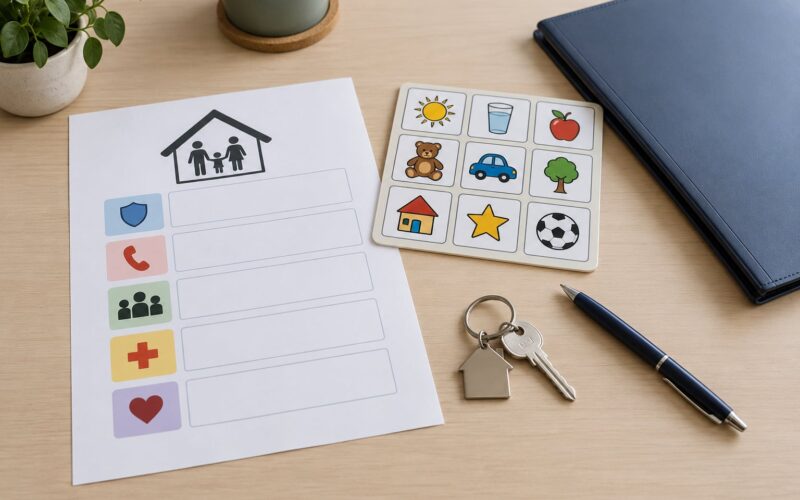
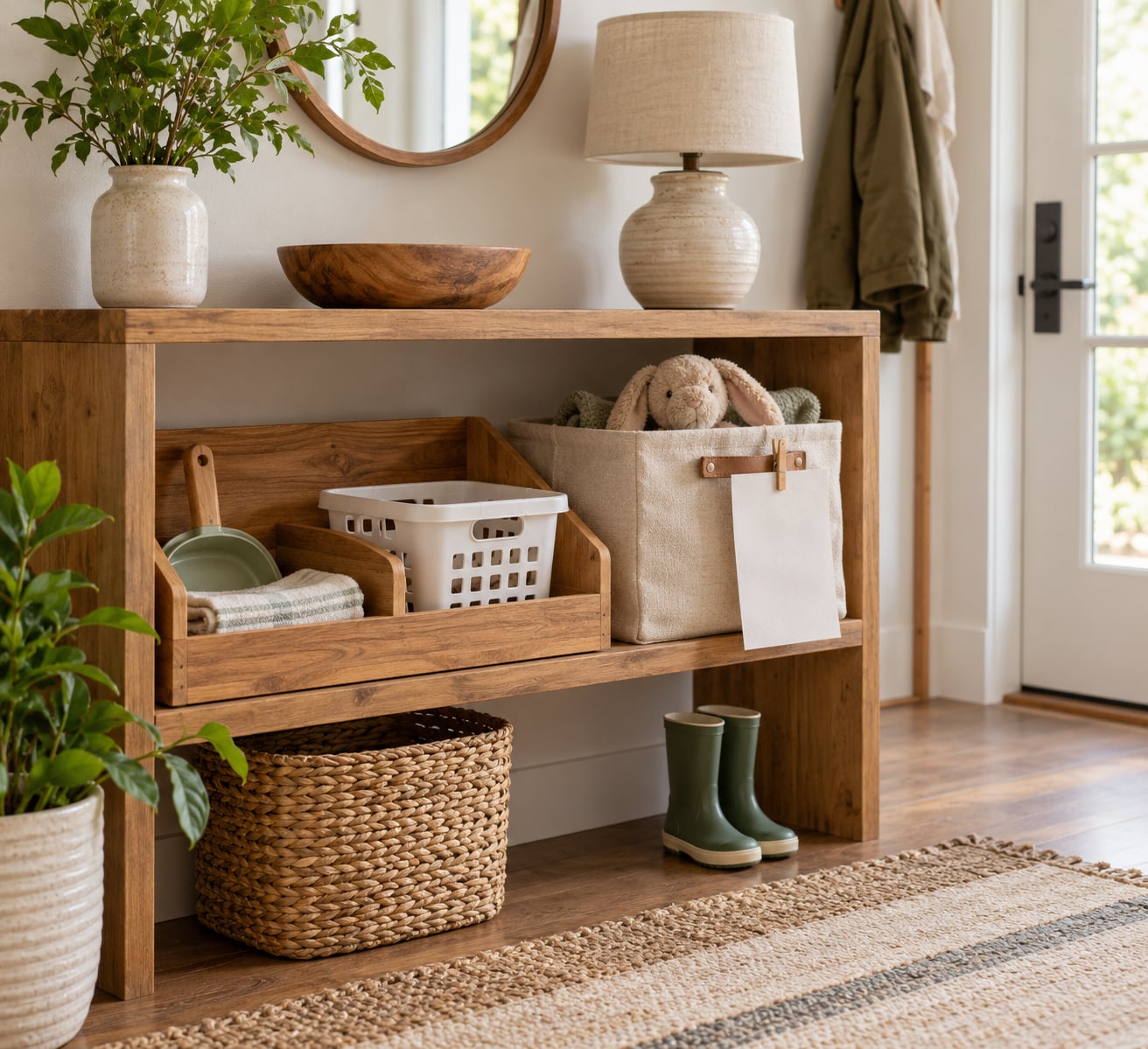
Keep it to two categories, not twelve. Soft toys go in the fabric bin, hard toys go in the plastic bin, and the labels can be pictures rather than words. A picture-card sequence taped inside the basket handle (pick up, carry, drop) works better than reminders, because toddlers cannot reliably hold an instruction in working memory while their hands are busy.
Parents of preschoolers in the forum threads we drew on report that counting turns chores into play: you are holding two cars, can you put three blocks in the basket. It takes about a minute to set up and it turns a struggle into a game.
Safety at this age
Skip anything small enough to swallow, and never stack more than one basket on a child. If a child is still walking unsteadily, carry the toy over and let them do the drop, which is the part that teaches the motor pattern anyway.
2. Match Laundry for Ages 4-5
A four-year-old can absolutely have chores, as long as the chore is matching, not folding. Sorting clean laundry into defined piles is a genuine contribution and it takes about four minutes.
Three categories is plenty: shirts, pants, towels. Give the child a wide clear floor space and a basket per category, then let them carry each stack to the right room. Preschoolers are still building categorization skills, so they thrive on work that makes those skills concrete.
For a child who struggles with sorting by color or with transitions, keep the categories fixed and unchanged for months. Same three piles, same spot on the floor, same time of day. A child who cannot sort visually can still sort by type, and the routine does the remembering for them.
3. Wipe a Low Table for Ages 5-6
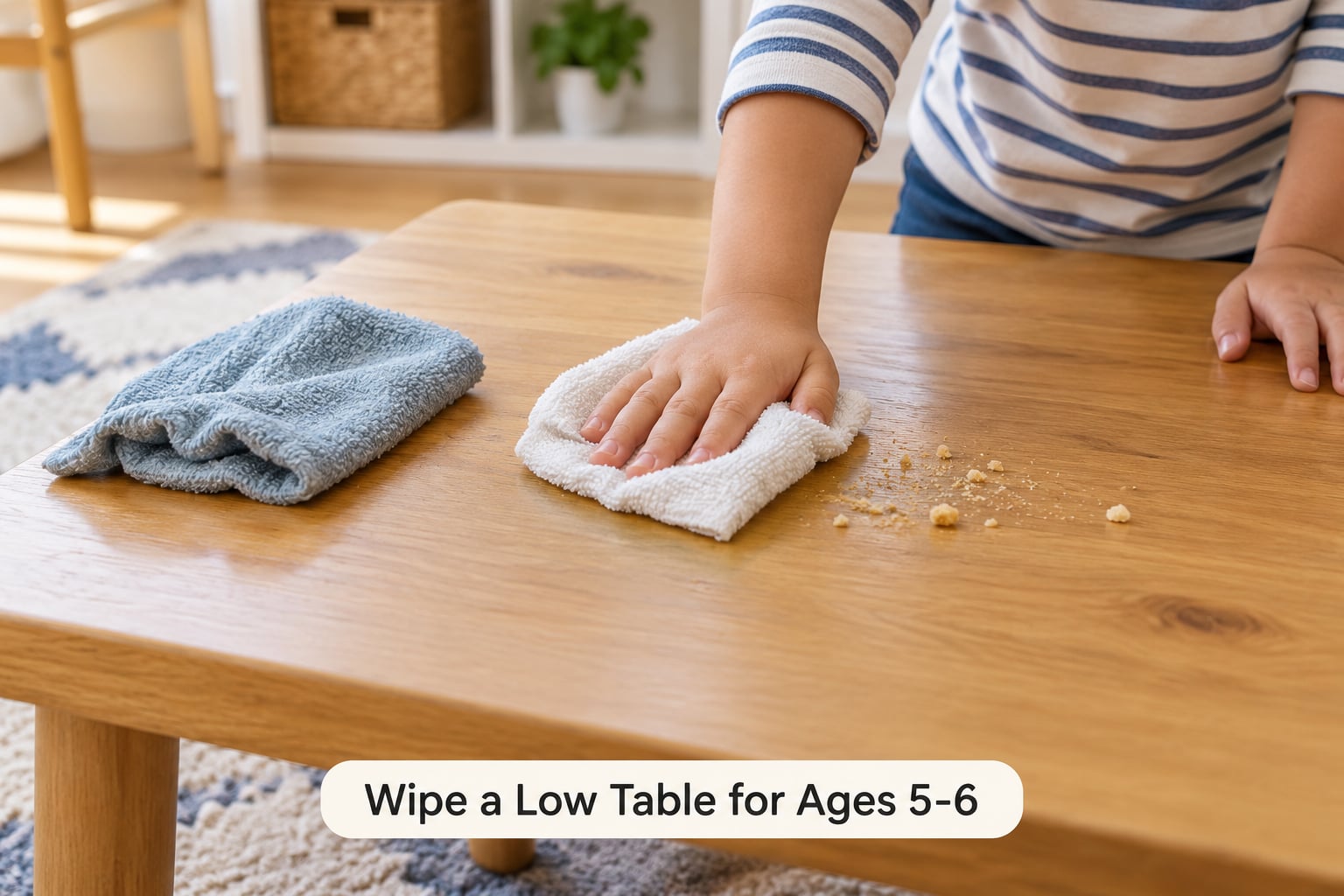
Wiping a table is the first chore that has a real before and after, which makes it easy for a child to see the result of the work. Dampen the cloth, wipe in one direction, return the cloth to its spot.
Keep the steps short and physical: take the cloth, dampen it, wipe the crumbs, put it back. At this age the goal is not a spotless surface, it is completing a sequence that ends where it started, which is a real executive functioning skill.
For the products, a damp cloth with a drop of plain dish soap and warm water is enough. Skip bleach, ammonia sprays and anything fragranced, because aerosol scent is a common trigger for sensory-sensitive children and adults alike. Kingdom First makes the same recommendation, and it is a good one.
Safety at this age
Store cleaning products in a locked cabinet, always, and hand the child a cloth you dampened yourself. No child under about eight should be deciding what goes on the cloth.
4. Set or Clear the Table for Ages 6-7
Table work is a good chore at six or seven because it has a defined finish line (everyone is seated) and a visible payoff. Split it into carry tasks first: napkins, forks, cups, then plates last.
For a family of four, one child can carry the stack of placemats, one carries four napkins and forks, one carries the cups, and the plates go last because they are the easiest to drop. Clearing is easier than setting, so start there if the child is nervous.
A child who needs written steps or predictable placement gets more out of a template than out of a lecture. Set out one complete place setting they can copy, or photograph it and print it. When noise and movement are the hard part, do this chore before dinner rather than during the rush.
5. Sort Recycling for Ages 7-8
Sorting recycling works well at seven or eight because the sorting rules are concrete and the job is endless in small doses, which suits attention spans that dip in the late afternoon.
Sit down together and check your local recycling rules first, because they genuinely vary by area and a child who sorts by rules from another region will be mixing items your collector will not accept. Then label the bins with pictures of what goes in each one, and start with three categories rather than eight.
If a material is uncertain, the rule is simple: ask an adult. That sentence is worth teaching on purpose, because the alternative is a confident guess into the wrong bin.
Safety at this age
No broken glass, no cans with sharp edges, no batteries, and no chemicals or motor oil, ever. A child sorting recycling should never be the one emptying a bottle that held something unknown.
6. Make the Bed for Ages 8-9
Bed making at eight or nine is mostly about sequence rather than effort: pull the sheet flat, pull up the comforter, place the pillows. Three steps, done in the same order every morning, become automatic after a couple of weeks.
That automatic quality matters for neurodivergent children especially. A written sequence taped near the bed, or three picture cards, removes the need to recall the steps each morning, and recall is where a lot of morning battles actually come from.
If a child has limited strength or motor skills, a fitted sheet is a frustrating starting point. Start with the top sheet and the comforter, and let the fitted sheet stay an adult job for another season. Children with rigid routines often do better making the bed last on the way out of the room than first thing in the morning.
7. Sweep One Small Area for Ages 9-10
A ten-year-old can sweep, as long as the area is small and defined. Start with one corner of the kitchen, roughly the size of a rug, and leave everything else alone.
The full sequence is four steps: sweep the pile into the dustpan, walk it to the bin, empty it, return both tools to the same spot. A child-size hand brush and a short dustpan make this far more doable than a full-size broom, which is really an adult tool at that height.
Sweeping under furniture and along baseboards needs an adult hand and a different tool. Keep the chore to the flat area, and expand the zone once your child is reliably finishing the first one.
8. Fold Simple Laundry for Ages 10-11
Folding is the chore most parents hand over too early, because it looks teachable and it is actually a fine motor skill that takes weeks. Towels are the right first item: a rectangle folded in half, then in half again, done.
Work up one clothing type at a time, and only add the next when the first one is boring. T-shirts after towels, fitted sheets last, and pillows or socks either never or with an adult. Set up a clean-and-folded area, because laundry that gets picked up and put down halfway is the usual reason folding stalls.
A child with motor delays can still do half of this well. Rolling socks into balls removes the trickiest part of the fold, and shirts can be hung rather than folded. Whatever version the child can finish is the version that teaches the finish-it-and-put-it-away part, which is the actual skill.
9. Care for a Pet or Help With Feedings for Ages 11-12
At eleven or twelve, a chore can have real stakes in it. Pet care means filling a scoop to a measured line, refreshing water, and gathering supplies before an adult uses anything sharp or medicated.
Keep the measuring step visible. A marked scoop or a written line on the food container turns a vague instruction into a clear target, and an eleven-year-old with ADHD will thank you for removing the judgment call. Anything involving medication, grooming clippers or a full bath stays an adult job.
At the table, the useful tasks are carrying approved items, passing the salt and setting glasses, and clearing their own plate to the sink. Older children can begin prepping cold parts of a meal. Texture matters more than novelty for some kids, so if your child avoids certain foods, let them choose a role in preparing something they already eat rather than pushing a new one. If that reasoning sounds familiar, we wrote about it in why food texture matters more than taste for some kids.
Keep hot pans, knives and appliances firmly in adult hands at this age, no matter how capable the child is with everything else.
10. Take Ownership of a Weekly Family Chore for Ages 13+
Teenagers respond to ownership and wilt under oversight. Let your teen pick the job from a short list, learn the whole process, and track it without being checked on daily.
Good candidates: taking bins out and back, doing a load of laundry start to finish, vacuuming one room, washing dishes, or restocking a pantry shelf. Each has a real learning component, since the hidden parts of every household job are planning, noticing when you are out of something, and fixing a problem you did not expect.
Set the expectation that some jobs need division of labor. A teen doing laundry for a large family is not going to do it alone, and saying so in advance beats a mid-task argument. A weekly ten-minute check-in is plenty of contact; after that, missed jobs are handled with consequences the teen agreed to when they chose it.
Frequently Asked Questions
What age should children start doing chores?
Children can start contributing at two or three with a one-step task like putting soft toys in a bin. Nothing about chores at that age is about productivity; it is about learning that a routine ends, that things have a place, and that effort is what adults do. Most families find a meaningful chore set appears somewhere around four or five.
How do I motivate an autistic child to do chores?
Picture cues, a written checklist and a fixed schedule do more for an autistic child than rewards do. Break the task into the smallest visible steps, mark them off one at a time, and give a transition warning before the routine changes. Many autistic children also do far better with a first-then board: sweep the kitchen, then video games.
Should children be paid for doing chores?
There is no single right answer, and the two camps disagree for good reasons. Money for family contributions can crowd out the reason to do them, and a fixed allowance attached to chores leaves a child without money on a bad week. A middle ground that works well: pay regular allowance for being part of the family, and pay extra for jobs above and beyond, like washing a car or deep cleaning.
What chores can a child with limited mobility do safely?
Focus on tasks that can be done seated or from a stable position: folding laundry, matching and sorting socks, wiping a nearby surface from a chair, organizing a shelf, sorting recycling into bins within reach, and helping sort mail. Skip anything requiring climbing, lifting heavy loads, or reaching overhead for long periods. An occupational therapist can suggest tools and modifications specific to your child.
How do I handle a child who refuses to do chores?
Expect refusal and plan for it, because arguing turns a chore into a nightly negotiation. Pick your battles: agree which two jobs are non-negotiable, let the child choose everything else, and use a natural consequence you set up in advance. Avoid the daily reminder cycle, and avoid doing the chore for them unless they are genuinely unwell or genuinely unable that day.
Start With One Chorable Task
Pick the single chore closest to your child’s age in the list above. Demonstrate it once, slowly, then let them do it with you standing nearby rather than working alongside them, because the fastest way to make a habit stick is doing the first five times together.
Put the steps on a visual checklist where the work happens, not on a chart in another room. Agree on what done looks like before they start, then leave their version alone. Rewarding a good enough result teaches persistence; redoing it teaches that the work does not count.
If your child is autistic or has ADHD, the visual system matters more than the motivation system, and there is a lot more detail in our step-by-step guide to teaching chores to an autistic child. And if chores are tangled up with a toilet training relapse right now, handle that first: regression usually resets routines, and the regression guide covers rebuilding the schedule without adding pressure.
Consistency beats perfection. A job done imperfectly every day for a month teaches more than a perfect job done once.