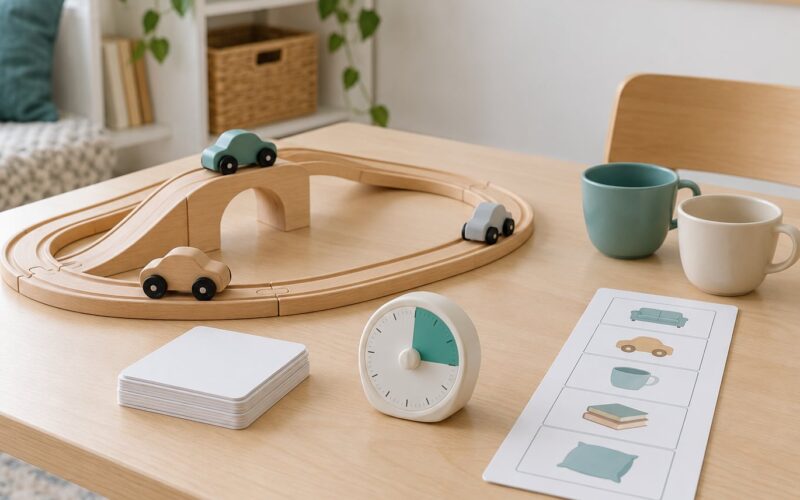
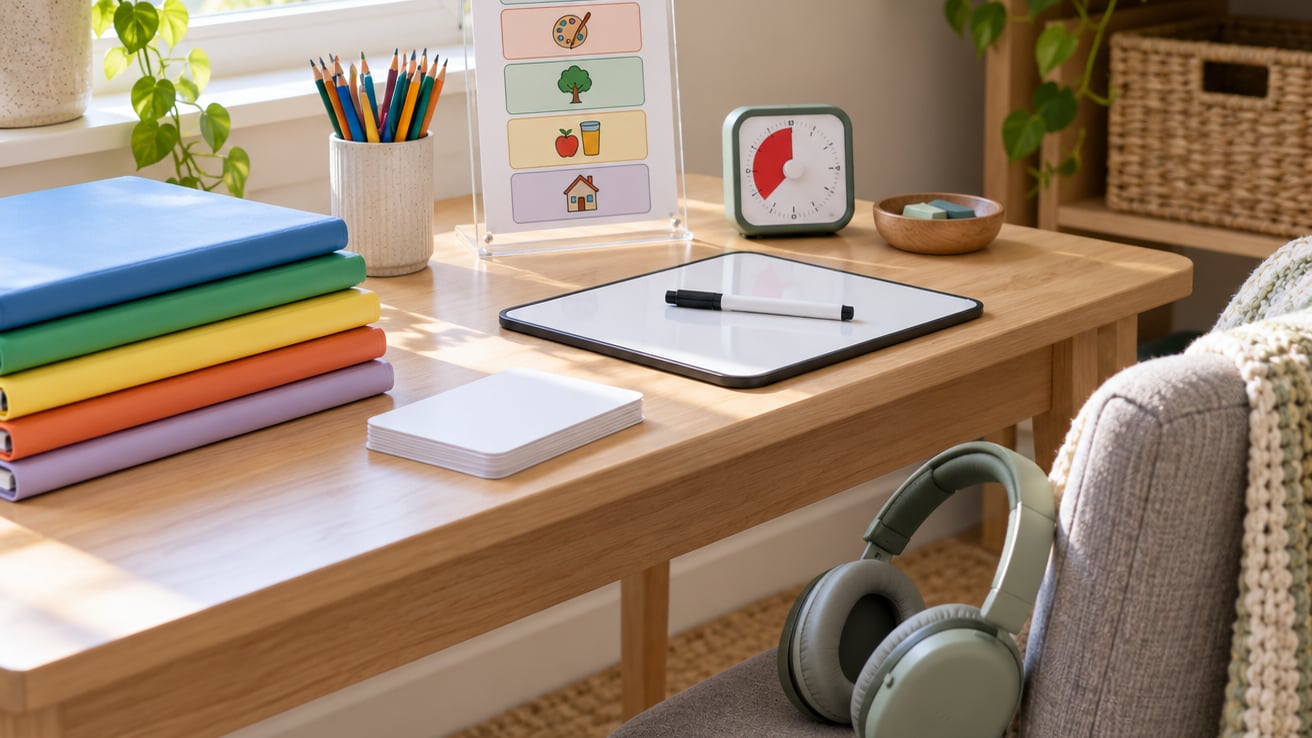
Yes, you can homeschool a child with autism. The most workable approach is a predictable daily routine with visual supports, a curriculum matched to your child’s reading level and attention span rather than their age, short work blocks with movement breaks, and a simple weekly record of what actually happened.
Most families who make this switch are not trying to recreate a classroom at the kitchen table. They are trying to remove the sensory load and the social pressure that were wearing their child out, then build a smaller, steadier day around what their child can actually do right now.
This guide walks through what to gather first, then a seven-step process you can follow this week. It is written for US parents, and homeschool rules differ in every state, so check yours before you file anything.
Table of Contents
- What You Need
- Paperwork and records
- Visual tools
- Sensory supports
- Curriculum and assessment materials
- How to Homeschool a Child With Autism Step by Step
- Set Clear Goals Around Your Child’s Needs
- Choose a Curriculum That Matches Your Child
- Build a Predictable but Flexible Daily Routine
- Adapt Lessons for Sensory and Executive-Function Needs
- Teach One Skill at a Time With Repetition
- Use Interest-Led Learning Without Losing Core Subjects
- Track Progress With Simple Records
- Common Mistakes
- Frequently Asked Questions
- Is homeschooling legally allowed for every child with autism?
- How much structure does an autistic child need when homeschooling?
- Can an autistic child use an online homeschool curriculum?
- How can I teach social skills while homeschooling my child?
- Do homeschooling parents need an IEP or special-education services?
- What if my child refuses to participate in homeschool lessons?
- Start With One Successful Routine
What You Need
You need very little to start. Most of it is paper, a few supports, and a decision about what your child should be working on this term.
Paperwork and records
Homeschooling is regulated at the state level, not the federal level. Your state education department will tell you whether you need to file a homeschool notification form or a declaration of intent, whether you have to keep a portfolio, and whether any testing is required. Some states ask for a parent statement of competence or a list of subjects and hours.
Pull every existing document into one folder before you decide anything: prior evaluations, teacher observations, therapy reports, and any IEP or 504 plan. Even if you never use them formally, they tell you where your child started, which is the only honest baseline you have. Two national organizations answer legal questions for members: HSLDA, the Homeschool Legal Defense Association, and TACA, The Autism Community in Action.
Visual tools
Buy or print a picture-based routine card for the day. Laminating a few cards and arranging them in order takes fifteen minutes and saves you from narrating every transition out loud. You will also want a first-then board, a small visual timer, and dry-erase cards for directions your child can reread without asking you.
Sensory supports
Stock the learning spot with whatever your child already reaches for: noise-cancelling headphones, a wobble cushion or chair, a fidget tool, movement bands under the desk, a weighted lap pad, and a small bin of hands-on manipulatives. Keep a “regulation basket” nearby for the reverse case, when a child needs less input rather than more.
Curriculum and assessment materials
Start with what your child can do independently for ten minutes, not with what a grade-level box promises. If you already own a reading curriculum, a math program, or a spelling system, use them and adjust. Many parents borrow from the public library, buy used, or use free national-standard resources rather than buying a full new program in week one.
How to Homeschool a Child With Autism Step by Step
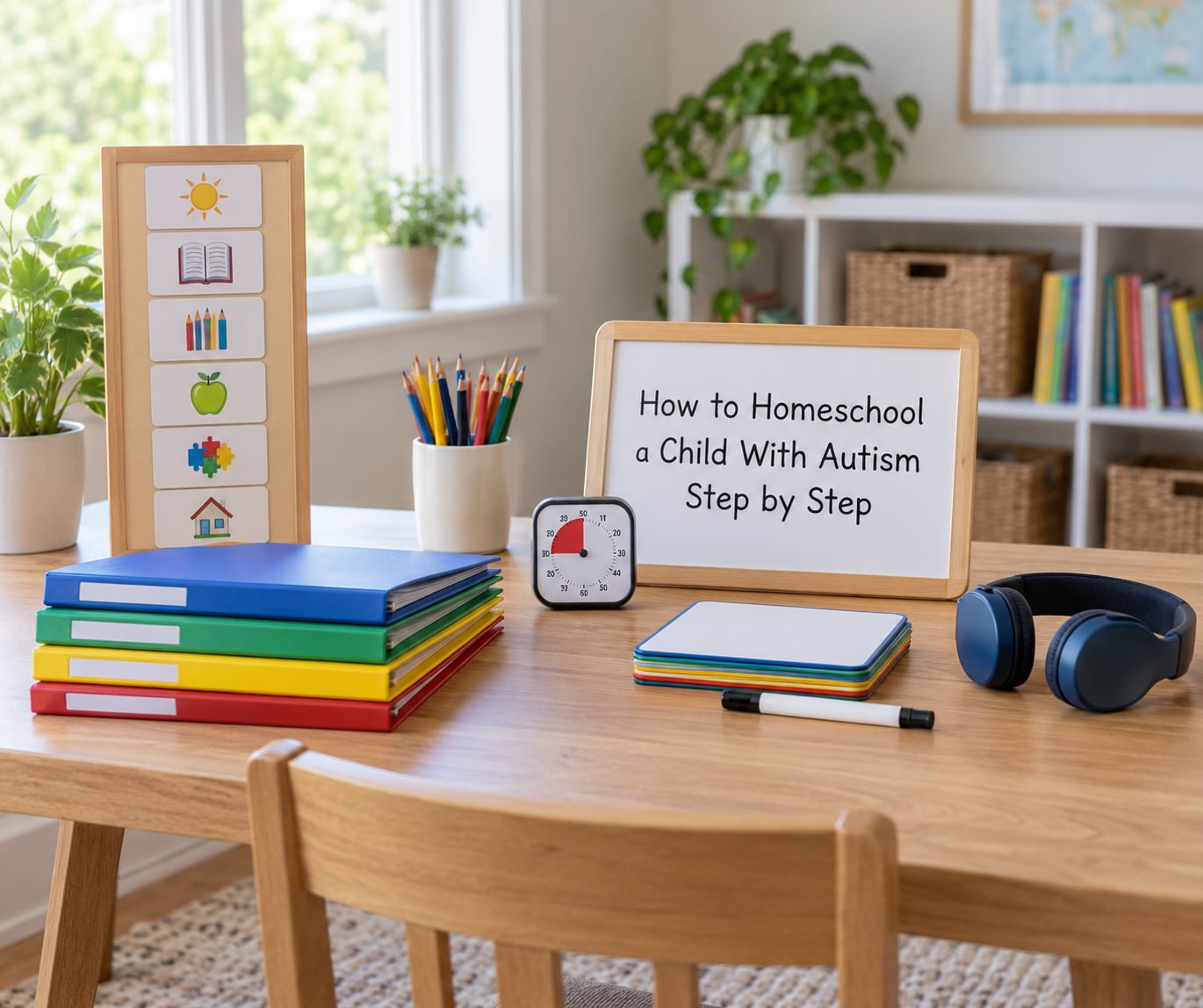
Parents who write down their goals, keep the routine visible, and track what happened get further than parents who simply reorder a textbook. Work through these seven steps in order, and expect to revisit the first three every few weeks.
Set Clear Goals Around Your Child’s Needs
Pick one academic goal, one communication goal, and one daily-living or social goal for the term, then write a success criterion for each that someone else could observe.
“Improve reading” is not a goal. “Reads a 20-word passage with no more than three errors and can retell it in three sentences” is. Academic goals, functional communication, self-care, transitions, and sensory regulation all count as legitimate targets. Autism-focused homeschool families lean on exactly the same goal-writing discipline that a public school team uses in an IEP, and there is no reason to throw it away.
Mine your child’s existing evaluations and therapy reports for the language they already use, and add two things the paperwork misses: what your child lights up about, and what actually works on a good day. That becomes your raw material.
Choose a Curriculum That Matches Your Child
Match the curriculum to reading level, required schoolwork, communication demands, motor demands, and attention span. Age is the least useful number on the page.
There are four families of approach, and plenty of parents borrow from more than one. Structured programs give you a sequence and a workbook per subject, which suits a child who thrives on clear steps and dislikes surprises. Eclectic approaches mix a structured spine with hands-on projects. Interest-led approaches route most subjects through a favorite topic, and they work beautifully when a child’s special interest is strong. Unschooling removes the schedule almost entirely, which is the hardest fit for a child who depends on predictability.
Two questions narrow the field fast. Can your child start and finish a task with minimal help? Does the program require a lot of handwriting, reading aloud, or sitting still? If the answer is no on both counts, wait on that program regardless of how well it fits on paper.
Build a Predictable but Flexible Daily Routine
Autistic children do best when the shape of the day never moves, even when the content has to. Put the routine on the wall, keep the order identical, and change the length of a block rather than its position.
A sample weekday looks like this:
- 8:30 Visual schedule check and first-then board. The child checks off each card as it is finished.
- 8:45 Reading, 20 minutes. An audiobook or decodable text alongside, headphones for noise.
- 9:05 Movement break, 10 to 15 minutes. Wobble cushion, a walk outside, or fine-motor play.
- 9:20 Math, 20 minutes. Manipulatives and a dry-erase surface instead of worksheets.
- 9:40 Snack and free choice. The child picks between two options on the board.
- 9:55 Interest-led writing or science. Topic chosen by the child, dictation allowed.
- 10:30 Life skills block. Laundry, money, cooking, or community practice.
- Afternoon Therapy appointments, then free time. Nothing academic scheduled after a hard appointment.
The 20-minute work block with a 10-to-15-minute movement break is the pattern many parents land on, and it comes from families who kept it simple enough to repeat daily.
On a sensory-overload day, a meltdown, or a week of poor sleep, shrink the schedule instead of abandoning it. Do one 20-minute reading block and one math block, then stop for the day. Keeping the sequence intact protects the routine even on the worst days, which is the whole point of a visual schedule.
Adapt Lessons for Sensory and Executive-Function Needs
Reduce sensory demands before you add motivational ones. Work in chunks of 10 to 20 minutes, give directions out loud and on a card, and always present them in the same order: what we are doing, how long, then what comes next.
Mix verbal and visual directions so nothing depends on working memory alone. Offer movement on purpose rather than as a consequence, and allow a controlled choice inside the task: which of three word problems first, which pencil, which table. Use headphones when noise is the problem, and hand over the work in a finished form when handwriting or typing speed is the bottleneck.
These are learning supports, not treatments. If a child’s regulation is a medical concern, that conversation belongs with their pediatrician or occupational therapist, not with a curriculum decision.
Teach One Skill at a Time With Repetition
A simple cycle works: model the skill, have the child practice with you for two or three tries, then wait silently for about five seconds before helping. Praise the specific thing you saw, and review the same skill again the next day.
In reading, that might be modeling how to sound out one word, then trying it together four times, then reading it in a short book. In math, it is one type of problem, five reps, and a matching game the next morning. For communication, model the request, prompt once, wait, then reinforce whatever the child said, including a gesture, sign, or sound. Self-care works the same way: wash one cup, together, every morning after breakfast.
One skill at a time keeps the session short enough to finish, which is what keeps it worth repeating.
Use Interest-Led Learning Without Losing Core Subjects
Take the thing your child talks about without being asked and use it as the entry point to required work. Counting goes into a game about whatever the child is currently fixated on. Spelling becomes a hunt for words inside the topic. Science observation turns into recording something in a notebook for three weeks.
State requirements still apply to whatever you deliver, so check that the age-appropriate reading level, math scope, history, and science content in your state are still covered. Interest-led does not mean exempt; it means the same requirement taught through a door your child will actually open.
Handwriting often becomes the sticking point. If your child hates it, teach the skill without the pencil first, then pick up the writing load in small pieces rather than a full page. Our guide to teaching handwriting to a child who hates it has the slower version of that plan.
Track Progress With Simple Records
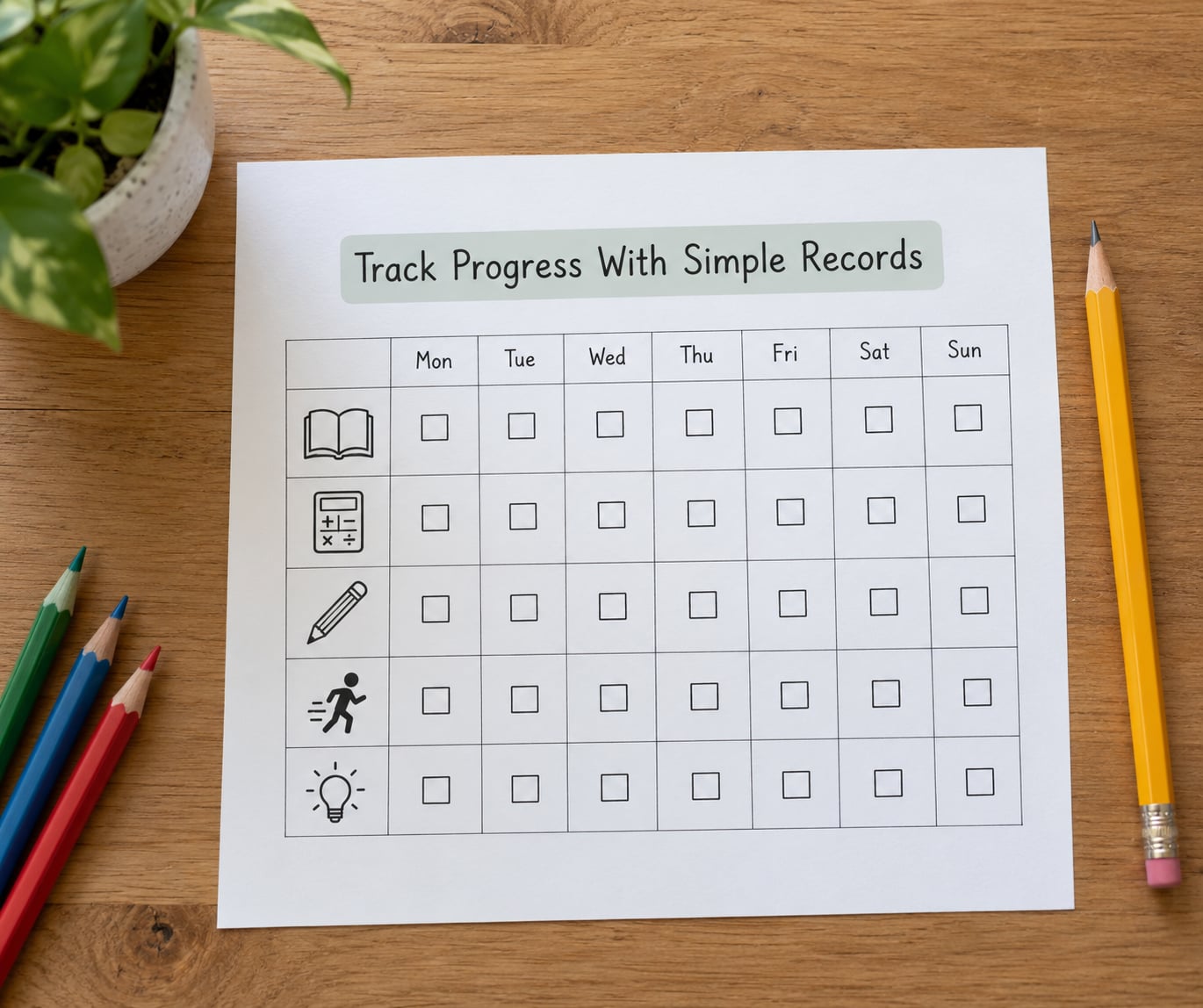
Keep one page per week: attendance, skills attempted, how many prompts it took, what went well, what broke down, and what you will change next week. That is enough to satisfy most states’ portfolio expectations and to show you a pattern you cannot see from a single day.
Date your samples. Photograph work you want to compare later, and note the prompt level, because “read 12 words” means something different when it took two prompts and something different when it took none. At the end of every six to eight weeks, read the sheet rather than the child’s mood and ask whether the goal still makes sense.
If mornings are collapsing, how to help a child with homework meltdowns covers the reset. And if you are weighing a return to a classroom, our piece on helping a child keep up with classroom pace is a useful counterweight.
Common Mistakes
Nearly every struggle I hear about comes from one of these seven, and each one has a plain correction.
Copying a full public school day. Six graded subjects before lunch will not survive contact with a child who needs movement every twenty minutes. Start with two subjects and one life-skills block, then add.
Choosing materials by age or grade level. A grade-4 textbook for a child reading at a first-grade level is a wall, not a lesson. Check the actual reading level, required work, and how much independent sitting it demands.
Swapping curriculum every few weeks. Novelty is not engagement, and starting over costs your child the repetition that makes a skill stick. Commit to one term before you judge anything, and change one program at a time.
Ignoring the special interest. The favorite topic is the strongest motivation you have. Use it as the bridge to reading, math, and writing rather than treating it as a break from learning.
Using behavior charts as punishment. A chart that rewards compliance, and takes the reward away when a child shuts down, teaches a child to hide distress rather than regulate it. Track skills and routines instead, and treat regulation as a support need. If behavior is a medical concern, bring in your child’s team.
Leaving socialization to chance. You are now the only social model in the room all day, so make it deliberate: one interest-based club, one co-op class, one weekly peer activity, and one regular playdate with a child close in age. Put those on the calendar the same way you schedule math.
Skipping the legal check. Notification forms, attendance records, required subjects, and testing rules are set by your state and they change. Check your state education department’s site, or ask HSLDA, before your first day rather than after.
The sustainability tip is simple: protect your own capacity. Teaching, therapy scheduling, and running a household will burn you out faster than any curriculum will, and a burned-out parent is the fastest way to a plan that collapses. Keep one block a day for your own work, and call in a co-parent or grandparent for one afternoon a week.
Frequently Asked Questions
Is homeschooling legally allowed for every child with autism?
In most US states, yes. Autism does not block families from homeschooling, and the rules come from state law rather than federal disability law. You may need to file a notification form, keep attendance and portfolio records, and teach the required subjects. Rules differ in every state, so confirm yours with your state education department or a homeschool legal support organization before you start.
How much structure does an autistic child need when homeschooling?
More than most neurotypical children, and in a visible form. Put the day on a picture schedule, keep the order identical, warn before every transition, and use a first-then board for the harder blocks. Change the length of a block on a hard day rather than the order of the day, because the predictable sequence is what makes a visual schedule work.
Can an autistic child use an online homeschool curriculum?
Yes, if they can manage the screen demands. Online programs work well for reading and math when your child tolerates screens, and less well when noise, motion, or sustained attention is the barrier. Test one free lesson at the same time of day you would use it in your routine before you pay for a year, and pair it with printed or hands-on work every session.
How can I teach social skills while homeschooling my child?
Plan it deliberately, because you are the only social model in the room. Schedule one recurring peer activity each week: an interest-based club, a co-op class, a library story time, or a playdate with a child close in age. Then generalize what happens there, by talking about the visit afterward and practicing the same greeting or turn-taking at home.
Do homeschooling parents need an IEP or special-education services?
Once you homeschool, the public school IEP no longer applies, and related services delivered at school usually stop. That does not mean you should abandon the goals in it. Keep the current IEP as your written blueprint, carry its goals and accommodations into your own records, and consider private OT, speech, or ABA if you want to continue those services. Your child’s team can tell you what they recommend.
What if my child refuses to participate in homeschool lessons?
Shrink the task before you change the approach. Cut the block to five minutes, switch to something hands-on, or let your child dictate the answer instead of writing it. If nothing lands for several days, check whether the demand, the sensory load, or the schedule is the problem before treating it as refusal, and ask your child’s therapist whether something has shifted. Persistence beats force here.
Start With One Successful Routine
If you only do one thing this week, make it small. Choose one goal and one subject, build a visual routine you can repeat five days in a row, teach one skill for a few minutes, and write down what happened.
A week of that beats a month of a perfect plan you never started. Adjust the routine with your child rather than for them, check your state’s requirements once so it is not hanging over you, and add the second subject when the first one stops being a fight.