How to teach a child with autism to ride a bike comes down to one move most families skip: take the pedals off. With no pedals, the only job left is balance and steering, which is the part autistic children find hardest. Once gliding with feet off the ground feels ordinary, you put the pedals back on and pedaling almost takes care of itself.
That staging is not a trick I invented. It is what parents on r/Autism_Parenting report working again and again, and it works because it turns one giant unpredictable thing into a chain of small predictable things. Balance first. Steering second. Braking third. Pedaling last. Roads and traffic rules only after all of that is boring.
A realistic warning before we start: this is rarely a one-weekend project. Some children glide within days, others practice for months, and a few never ride two wheels at all. That last outcome is not a failure, and this guide covers the adaptive cycles families turn to instead.
Here is the quick start if you want to begin this week:
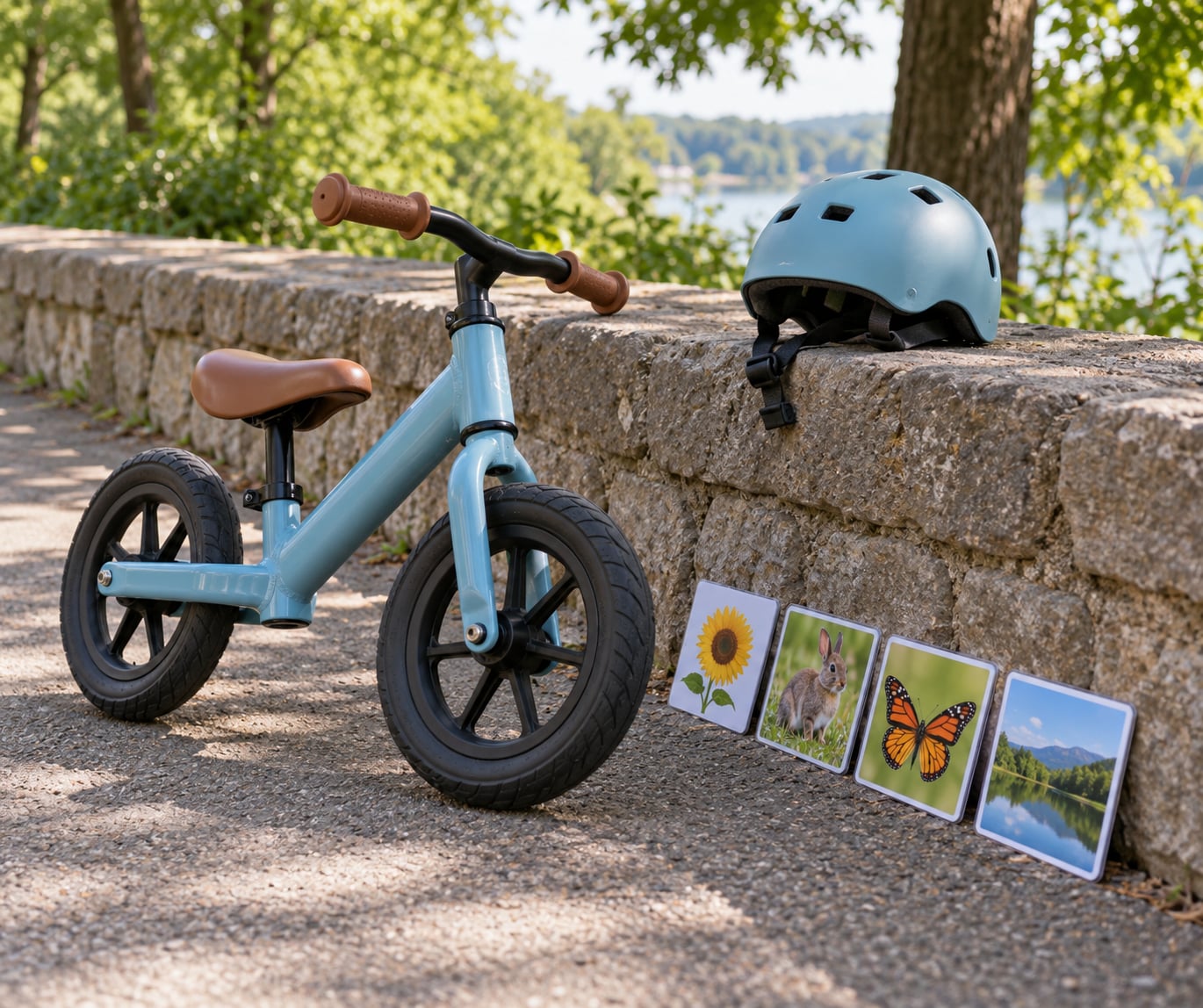
- Find a bike your child can sit on with feet flat and both hands on the bars.
- Remove the pedals (or start on a balance bike) so the first job is balance.
- Pick a wide, flat, traffic-free surface you can drive to every time.
- Let your child choose the helmet, and practice wearing it indoors first.
- Practice 5 to 10 minutes, then stop while it is still going well.
Nothing in that list costs money or takes a whole afternoon, and every item is a prerequisite rather than a suggestion. Skipping the helmet fit or choosing a cracked parking lot is where most practice sessions go wrong.
Table of Contents
- What You Need
- The bike has to fit before anything else
- Gear the child chooses and accepts
- A practice space that stays the same
- Visual supports and a reset plan
- Your starting point, compared
- Step-by-Step: How to Teach a Child With Autism to Ride a Bike
- 1. Check Readiness and Choose the Right Bike
- 2. Build Familiarity With the Bike
- 3. Practice Sitting, Balancing, and Steering
- 4. Introduce Pedaling in Short Sessions
- 5. Practice Braking and Safe Stops
- 6. Add Distance, Roads, and Real-World Practice
- Common Mistakes
- Frequently Asked Questions
- What kind of bike is best for a child with autism?
- Should an autistic child use training wheels?
- What if my child refuses to wear a helmet?
- At what age should a child with autism start learning to ride a bike?
- How long does it take an autistic child to learn to ride a bike?
- When should I ask a pediatrician, OT, or physical therapist for help?
- Conclusion
What You Need
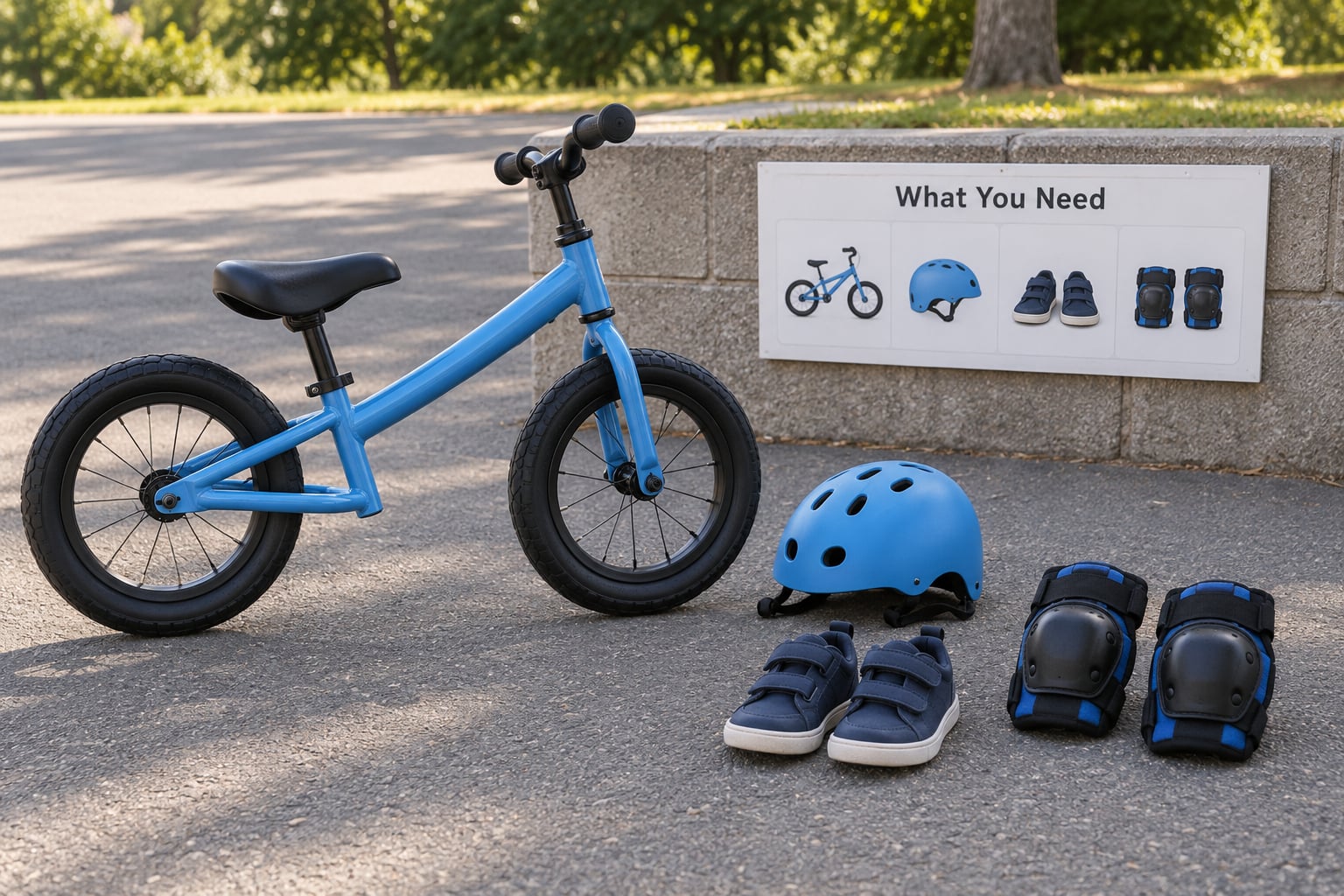
You need a bike that fits, protective gear your child has agreed to wear, and a practice space that never changes. Everything else is optional, and none of it should be rushed.
The bike has to fit before anything else
Sit your child on the seat and check that both feet can touch the ground flat while the knees stay slightly bent. That single position decides whether the bike feels manageable or enormous, and parents in autism parenting forums describe the wrong size as the trigger for the whole thing falling apart. A bike that feels too big is a bike that feels unsafe, and no amount of encouragement fixes that.
Light weight matters just as much as size. A bike your child can lift and turn over by themselves is a bike they can get out of trouble with. That matters more for a child who freezes mid-ride than any other spec on the list.
Gear the child chooses and accepts
A certified helmet that sits level, two fingers above the eyebrows, and stays put after five seconds. Pads for elbows and knees, because a wobble is coming. Closed-toe shoes with a flat sole, because bare feet and flip-flops make pedaling feel unstable.
Let your child pick the helmet color or model from two or three options. It costs you five minutes and it turns the helmet from something being put on them into something they own. Wear it indoors, on the sofa, in the bath, for a few minutes a day, until the putting-on part stops being the hard part. This is the single most common roadblock parents report, and it is almost never about safety awareness.
A practice space that stays the same
Wide, flat, smooth, and away from cars. An empty parking lot after hours, a quiet cul-de-sac, a park path on a calm morning, or a long hallway or gym if the weather is against you. Parents report that any crack or lip in the pavement forces a push on training wheels, which is the opposite of what you are teaching, so surface smoothness is a real teaching tool.
Keep the same spot for weeks. Familiarity with the ground is worth as much as familiarity with the bike.
Visual supports and a reset plan
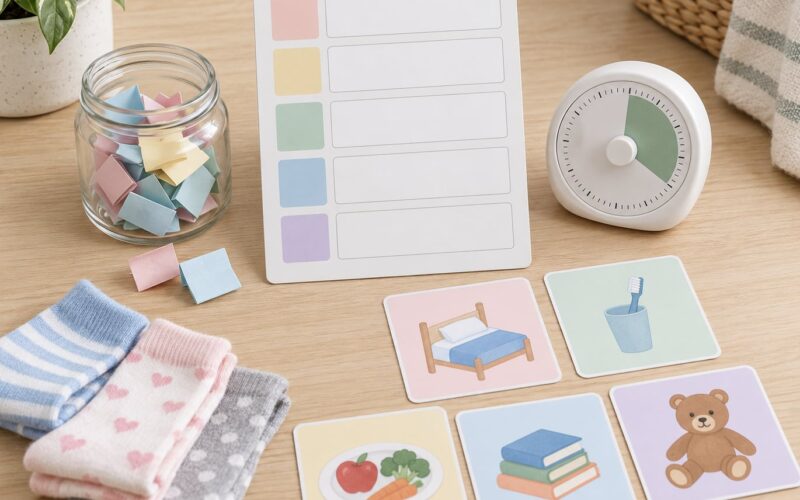
A short picture schedule of what practice looks like: helmet, bike, ride, stop, done. It can be four laminated cards on the fridge. A social story for helmet time, written in plain first-person sentences, is another option and often works better with older children who can read about their own feelings. You also want a planned stopping point so that stopping feels like the plan rather than a punishment.
Your starting point, compared
| Option | Best for | Watch out for | Typical age |
|---|---|---|---|
| Balance bike (no pedals at all) | Younger children, and any child who freezes the moment a foot cannot reach the ground | Outgrowing it does not automatically transfer to a bigger bike; many families stall right at that transition | 2 to 5 |
| Pedal-less two-wheeler (pedals removed from a normal bike) | School-age children and teens who already understand the parts of a bike | Looks unfinished to some children, so explain why the pedals are off | 4 to 15+ |
| Training wheels | Building confidence while balance is still forming | Often delays the balance work; leaving them on too long makes removing them a battle | 4 to 9 |
| Adaptive tricycle, trailer, or tandem | Children with limited core control, or any child who deserves to ride with the family today | None that matter, once you stop treating it as a lesser option | Any |
If the honest answer is that two wheels are not where your child is headed this year, a tricycle with a five-point harness or a bike trailer changes the conversation entirely. Families ride together, the child gets wind and speed and noise, and nobody is falling over. That is a real outcome, not a consolation prize.
Step-by-Step: How to Teach a Child With Autism to Ride a Bike
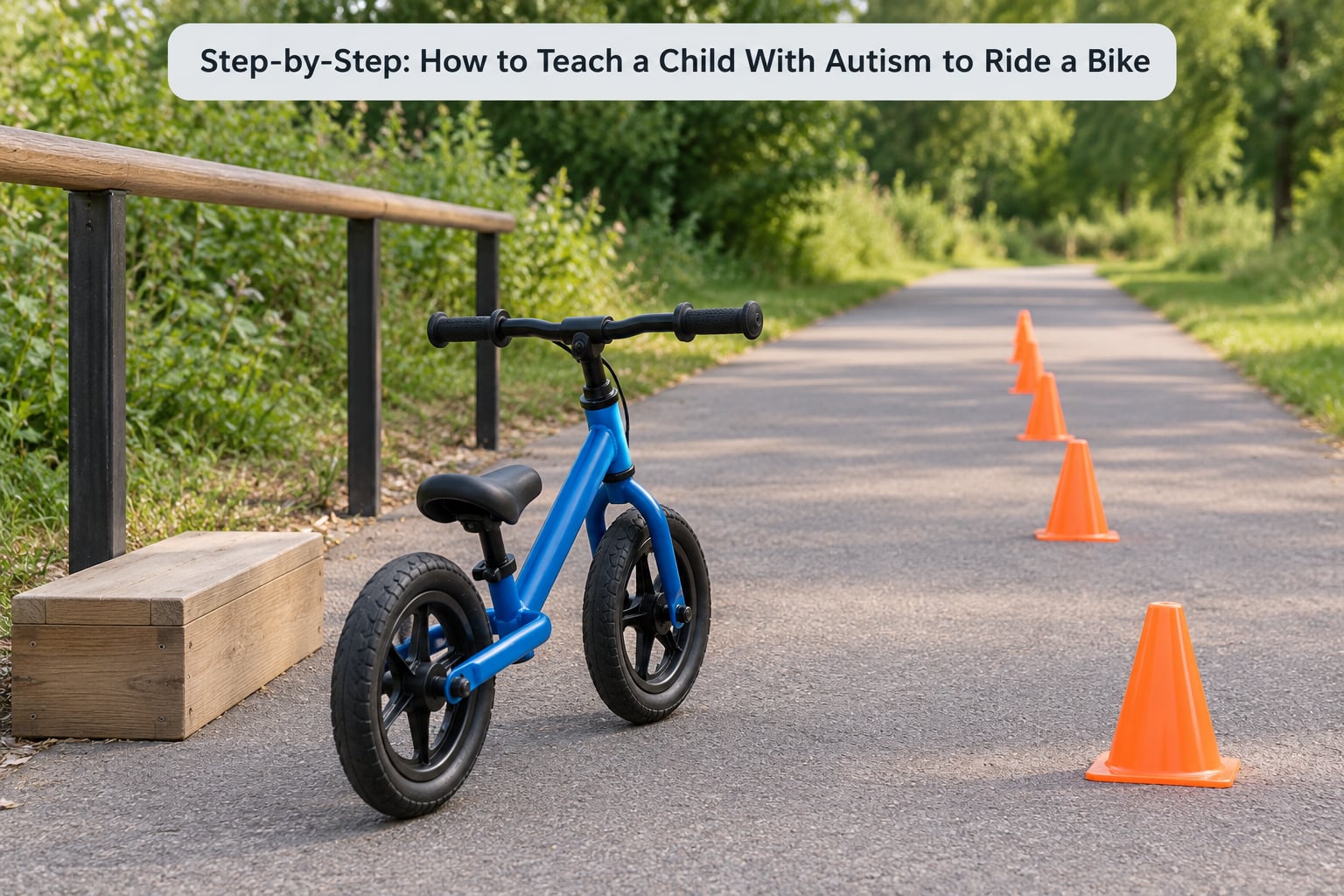
The plan below assumes you can change one thing at a time and can stop any session without it turning into a fight. Work through it in order, and do not let impatience skip ahead.
1. Check Readiness and Choose the Right Bike
Readiness is not an age and it is not a milestone chart. It is behavioral: does your child show interest in the bike without being asked, do they tolerate wearing the helmet for a few minutes, and can they sit on a bike and hold the bars while an adult steadies the seat?
If the answer is yes to the first two and shaky on the third, you are ready to start. Plenty of families begin with a bike that is slightly too large and spend weeks fighting the size before the skill ever comes up.
Branch by age, because the starting point differs a lot. A toddler or preschooler usually gets a balance bike with a low seat and no pedals. A school-age child often does best with the pedals taken off a bike that otherwise looks like a real bike, since the familiar shape reduces anxiety. A teenager who has never tried deserves the same staged method with fewer words, not a different standard. Several parents have told me a child who mastered a balance bike easily at four then stalled for years, and the stall was the transition to the next size rather than balance itself.
2. Build Familiarity With the Bike
For the first visit, there is no riding. Your child touches the seat, the handlebars, the pedals or pedal holes, the brake, the helmet. They push it around the practice space. They sit on it while you hold the seat. Five minutes, then done.
Offer choices rather than instructions: helmet on or helmet in your hand first, sit on the bike or push it, wear the pads or carry them. Autistic children do much better with a narrow field of decisions, and every choice you hand over is one fewer demand stacked on a day that is already heavy.
Repeat the same short visit several times before you add anything. You are building the association between the bike and a predictable, boring routine, which is the opposite of how a first attempt often goes.
3. Practice Sitting, Balancing, and Steering
Sit your child on the seat, both feet on the ground, hands on the grips. Hold the seat from behind with one hand and a flat palm on their back, or stand behind the bike holding the seat and the back of the saddle. Say nothing for the first few seconds and let them feel the bike hold their weight.
Then the first real skill: lift the feet. Just one second, push off gently with the toes, feet up, put them back down. The goal this week is not gliding, it is a child who discovers that both feet leaving the ground does not mean falling.
Glide next, with you running or scooting behind holding the seat. Once a few seconds of feet-up gliding is boring, start steering: follow a chalk line, go around a cone, aim at a target on a fence. Look-ahead is a skill, so ask for a glance forward between turns. Colored stickers on the handlebars or a bright mark on the pedals give the eyes something to track.
You know the step is done when your child can hold the bars, coast a short distance with feet up, and steer around one obstacle without you steering for them.
4. Introduce Pedaling in Short Sessions
Only when feet-up gliding is automatic does pedaling go back on. Start seated and stationary: place both feet on the pedals, ask for one push, then stop. Then add a count or a simple visual cue, and let the child roll a few feet. The first pedaling session should end in under ten minutes.
Sessions of five to ten minutes, most days, beat one long Saturday afternoon every time. Cap it deliberately: say the number of practice tries out loud and stop when you reach it, so the child learns that riding ends predictably and is not something you take away.
Expect the classic failure mode. As speed builds, the feet drop off the pedals within two or three seconds. That is not defiance and it is not forgetting what you taught. It is the balance part catching up with the speed, so slow the environment rather than repeating the instruction. Use a longer, flatter space, a lower gear, or a slight downhill, and go back to feet-up coasting if the drops keep happening.
5. Practice Braking and Safe Stops
Teach the stop before you teach speed. Many autistic children will pedal a straight line with total focus and have no idea how to halt, which turns every loose object into a hazard. Work on the same patch of ground, on purpose, every session.
Signal it the same way every time: a raised hand, a phrase such as “stop now”, or a card. When the child stops, celebrate the stop rather than the riding. A stop that gets enthusiastic praise becomes something they want to practice.
Then build up in stages: stopping at a cone, stopping at a fence line, stopping while turning, stopping from a faster roll. Hold the seat lightly at first and fade the help. If your child can signal a stop, respond to it, and come to a full halt in a chosen spot, the skill is there.
6. Add Distance, Roads, and Real-World Practice
Two wheels and reliable stops open a second curriculum, the one that has nothing to do with balance. This is the hidden curriculum of riding, and it is where a lot of confident riders get into trouble: signalling a turn, ringing a bell, riding on the correct side, stopping at a curb, yielding, and understanding that a car in a driveway outranks them.
Teach it as its own set of steps, one per session, on the same familiar path before you introduce a new route. Practice a stop at a driveway. Practice looking both ways at an empty street. Practice riding behind you at a set distance. Keep the routes short and repeatable, and add a backup adult or a scooter for catching a fast child, which is a worry parents raise constantly and a sensible one to plan for rather than dismiss.
Build sensory breaks into longer rides, especially for children who cover sound or movement. A planned stop every few minutes at a known spot is much easier than an unplanned shutdown on a road you cannot leave quickly. Riding with another child or a familiar adult ahead also helps, because it turns the ride into a following task rather than a memory test.
And when a session collapses, reset rather than push. Move to the car, reduce language to one sentence, offer water, and let the session end. A short ride that ends well is worth more than a long one that ends in a meltdown, because the next ride is the one that teaches.
Common Mistakes
Almost every struggle I hear about in parent groups comes down to one of these, and each has a straightforward correction.
Starting with pedals. A child who cannot yet coast with feet up has no way to feel what balance is, and the pedals let them fail repeatedly. Take them off.
Comparing the child to peers. Parents describe watching other kids ride past and feeling the comparison land on their own expectations. It changes the practice from learning to performing. Set the goal for this week, not this year.
Practicing too long. Long sessions end in overload and the next session starts already uphill. Ten focused minutes repeated beats an hour once.
Teaching several skills at once. Pedaling, steering, signals and traffic rules cannot be absorbed in the same week. One new thing per session.
Ignoring sensory load. A heavy bike, a tight helmet, a noisy street or a vibrating handlebar can end a session before skill becomes the issue. Adjust the environment first, the expectation second.
Moving to a real road too soon. A child who cannot stop predictably on a flat path does not need traffic. Mastery on quiet ground, then a sidewalk route, then a street.
| Problem | Likely cause | What to change |
|---|---|---|
| Cries and freezes at the helmet | Tactile defensiveness or an association with something unpleasant | Let your child choose the helmet, practice indoors for five minutes a day, use a social story |
| Feet slam to the ground within seconds | Balance has not caught up with speed | Longer flat space, slower rolling, more feet-up coasting before pedaling |
| Steers toward obstacles or walls | Weak spatial awareness or looking at the front wheel | Chalk line targets, cones to weave, look-ahead cue |
| Will not let go of the wall or railing | Confidence in support, not a balance deficit | Fade support in small steps, reward coasting distances, never pull away mid-ride |
| Refuses to start after a bad session | The last memory is a fall or a meltdown | Reset away from the bike, restart with a non-riding visit, keep the setting identical |
| Meltdown at the practice spot | Environment mismatch or accumulated sensory load | Change the location, shorten the session, then rebuild the routine |
A few habits help more than any single technique. Use the same visual schedule every time and mark off what got done. Praise the specific effort, such as “you stopped exactly at the cone”, rather than “good job”. Keep a short written record of what worked so that bad weeks do not convince you nothing is changing. And plan the practice time like an appointment, because a spontaneous session usually loses to whatever else the day held.
Expectation management is the unglamorous part that helps most parents. Waiting months is common, and a child who rides at twelve after years of trying is not late. Some children do learn at a camp in a few days, using roller bikes and volunteers, and that is worth knowing about. Programs such as iCan Shine run cycling camps specifically for children with disabilities, and an adaptive cycling specialist can advise on equipment fitted to a particular child’s posture and control.
Frequently Asked Questions
What kind of bike is best for a child with autism?
A pedal-less bike, either a balance bike or a normal bike with the pedals removed, is the most useful starting point because the only job is balance and steering. Choose one the child can sit on with both feet flat and both hands on the bars, and keep it light enough for them to lift. If core control is limited, a tricycle with a harness is a legitimate starting bike too.
Should an autistic child use training wheels?
Training wheels are fine for building confidence, but they let a child coast while leaning, which delays the balance work you actually need. Many families skip them and remove the pedals instead. If you do use them, set a clear criterion for taking them off, such as coasting feet-up around a cone without leaning, and plan that step in advance so it is not a surprise.
What if my child refuses to wear a helmet?
Do not force it during practice. Let your child choose between two or three helmets, practice putting it on indoors for five minutes a day, and use a social story or picture schedule about helmet time. Start riding without riding, just sitting in the helmet, so the helmet is linked to something calm. Riding without a helmet outdoors is not safe, so treat that as a boundary you hold firmly and kindly.
At what age should a child with autism start learning to ride a bike?
There is no correct age, and readiness matters more than a number. Many children start on a balance bike around two or three, while a teenager who has never tried can absolutely learn with the same staged method. Look for interest in the bike, tolerance of the helmet, and the ability to sit and hold the bars while an adult steadies the seat. Then choose a bike that fits that child today.
How long does it take an autistic child to learn to ride a bike?
Expect weeks to months, not days, and treat any timeline as a rough guide rather than a deadline. Children who are already comfortable on a balance bike may glide within a few sessions. Others need months of short daily practice before pedaling feels safe. Some children, often those with significant core control or sensory needs, go straight to an adaptive cycle, which lets them ride with the family without waiting.
When should I ask a pediatrician, OT, or physical therapist for help?
Ask when balance concerns persist despite consistent practice, when your child cannot hold a seated position, when pain or falls are frequent, or when sensory avoidance is blocking all progress. An occupational therapist can work on body awareness, motor planning, and regulation around the bike, and a physical therapist can address core strength and coordination. A camp or adaptive cycling specialist is also worth exploring for equipment advice.
For the same predictable, step-by-step approach applied to a different worry, see how to teach water safety to a child with autism. If practice sessions at home are already ending in shutdowns, our guide to helping a child with homework meltdowns covers the reset patterns that carry over well, and how to teach chores to an autistic child works through the same visual-schedule method.
Conclusion
Start here: pick a bike your child can put both feet flat on, take the pedals off, and spend the next five sessions on one skill only, gliding with feet up on a flat familiar surface. That single change removes the hardest part of the puzzle, which is trying to balance and pedal at the same time.
Then follow the child’s cues rather than a calendar. Watch for the feet dropping off the pedals, the freezing, the sensory shutdown, and treat each one as information about the next session instead of a verdict on your child. Celebrate the small, specific wins, since a stop at a cone is real progress even on a day when nothing else went to plan.
And if two wheels never happen, that is not the end of riding. A tricycle, trailer, tandem, or a week at a cycling camp gives your child wind, speed, noise, and their place in the family ride right now. If motor, sensory, or safety concerns keep recurring despite steady practice, a conversation with your pediatrician, an occupational or physical therapist, or an adaptive cycling specialist is worth booking.