Sensory play is any activity that deliberately feeds a toddler’s senses: sight, sound, smell, touch, taste, plus the movement and body-awareness senses that tell a child where their body is in space. Good sensory activities for toddlers at home give your child something to pour, squeeze, tear, shake, stack and listen to, using things you already own.
These twelve ideas each name the sensory need they support, the setup, and the safety rule that matters most. Every one takes under five minutes of setup and works with a plastic bin, a tray and cupboard ingredients.
One rule before you start: toddlers do not play with sensory materials unsupervised, ever. Rice goes in the mouth within seconds. Stay within arm’s reach the whole time.
Table of Contents
- Sensory Activities for Toddlers at Home at a Glance
- 1. Play-Dough Squish Tray
- 2. Dry Rice Bin
- 3. Oobleck Splash and Pour Station
- 4. Paper Tear-and-Create Collage
- 5. Kitchen-Stuffing Sensory Bags
- 6. Pouring Practice with Cups and Funnels
- 7. Texture Walk with Everyday Fabrics
- 8. Balloon Squish and Drop
- 9. Dancing and Stop Game
- 10. Bubble Popping Play
- 11. Scribble, Smear, and Stomp Art
- 12. Hide-and-Seek Sound Hunt
- Frequently Asked Questions
- What are good sensory activities for toddlers who do not like messy play?
- How long should a sensory play activity last for a toddler?
- How can I adapt sensory activities when my toddler loses interest quickly?
- Are sensory activities beneficial for toddlers without autism or other developmental differences?
- What sensory materials should I avoid because they may be unsafe?
- When should I ask a pediatrician or occupational therapist about my toddler’s sensory behavior?
- Start with What Your Toddler Enjoys
Sensory Activities for Toddlers at Home at a Glance
The table below sorts all twelve activities by sensory benefit, setup time and age fit so you can pick one before your toddler gets restless.
| Activity | Sensory benefit | Prep | Difficulty | Best age | Setup |
|---|---|---|---|---|---|
| 1. Play-dough squish tray | Touch, fine motor | 1 min | Easy | 12 months+ | Tray or tablecloth |
| 2. Dry rice bin | Touch, hand strength | 3 min | Easy | 18 months+ | Deep bin on a sheet |
| 3. Oobleck station | Touch, proprioception | 5 min | Medium | 18 months+ | Tray or shallow tub |
| 4. Paper collage | Touch, pincer grip | 3 min | Easy | 12 months+ | Paper and glue sticks |
| 5. Sensory bags | Sight, touch | 5 min | Easy | 18 months+ | Sealed zip bags |
| 6. Pouring cups and funnels | Hand strength, coordination | 2 min | Easy | 12 months+ | Tray and bowl |
| 7. Fabric texture walk | Touch, language | 3 min | Easy | 15 months+ | Basket of swatches |
| 8. Balloon squish and drop | Body awareness | 1 min | Easy | 12 months+ | Clear floor space |
| 9. Dancing and stop game | Balance, movement | 0 min | Easy | 18 months+ | Open floor |
| 10. Bubble popping | Vision, gross motor | 1 min | Easy | 12 months+ | Wipe floor after |
| 11. Scribble, smear and stomp art | Touch, body awareness | 4 min | Easy | 15 months+ | Washable surface |
| 12. Sound hunt | Hearing, language | 5 min | Medium | 18 months+ | Objects hidden in room |
Set your station up once and the rotation stays cheap: a deep plastic bin, an old shower curtain or sheet underneath, a few scoops and cups, a funnel, and a tray that fits inside a lap desk.
1. Play-Dough Squish Tray
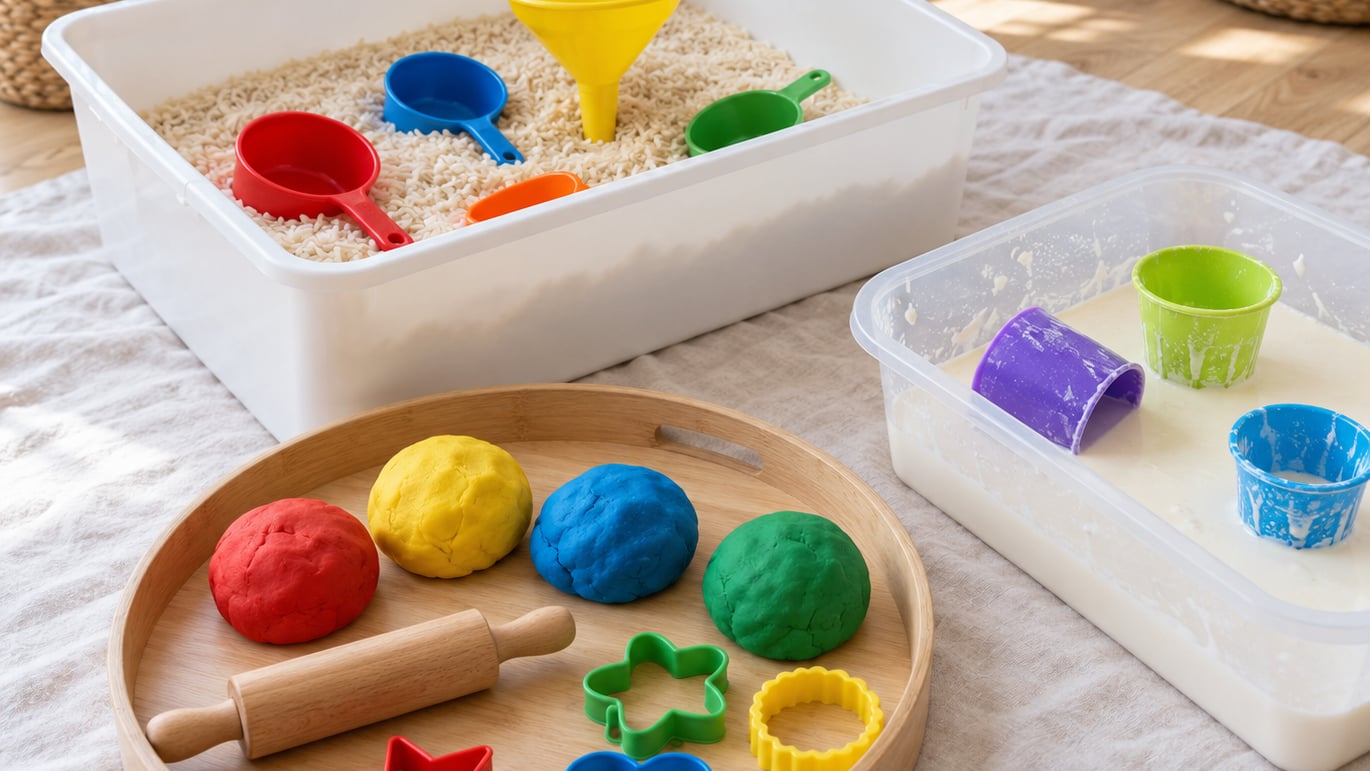
A tray of plain modeling dough is the easiest place to start, because the material cannot stain, scatter or break. Put out a small rolling pin, a few cookie cutters and a plastic cup, then let your toddler press, roll, cut and squish.
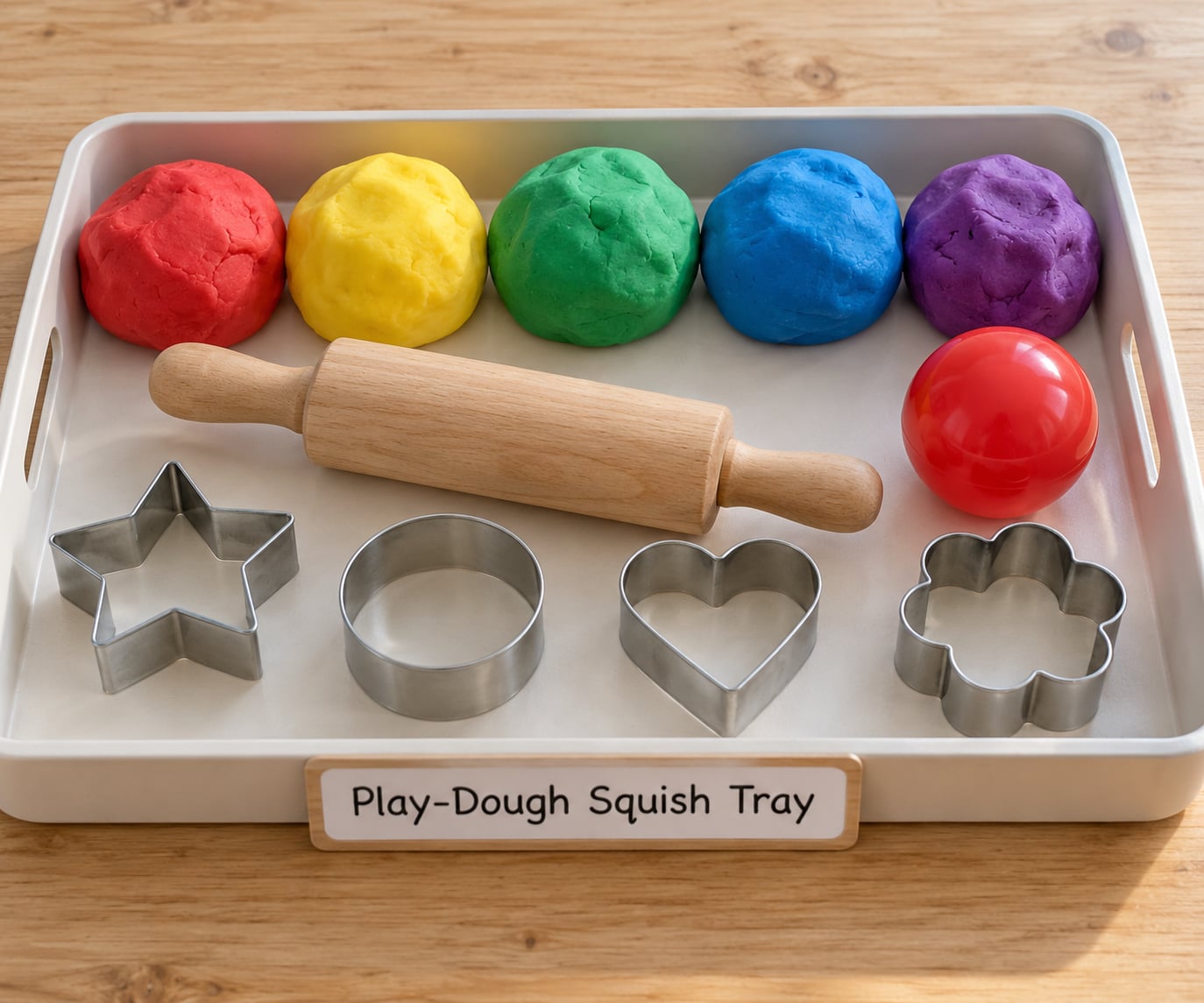
The value is in the repetition of the same five actions, not the mess. Flattening the dough works the palms, pinching a small piece builds a tripod grasp, and cutting a shape gives the hands a two-handed task.
To make it last longer, hide three cutters under the dough at the start and let your toddler find them.
2. Dry Rice Bin
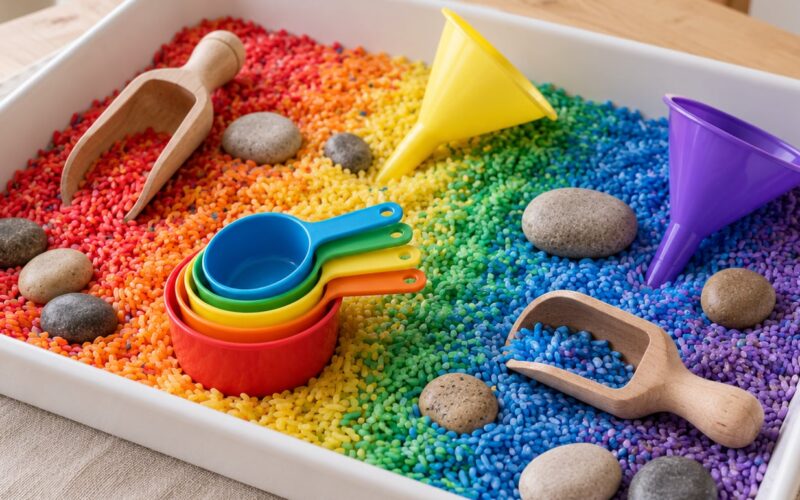
A dry rice bin gives a toddler a contained place to pour, scoop and sift, and most of the spill stays inside a deep storage tote. Fill it two-thirds full with rice, then add child-sized scoops, plastic cups and a funnel.
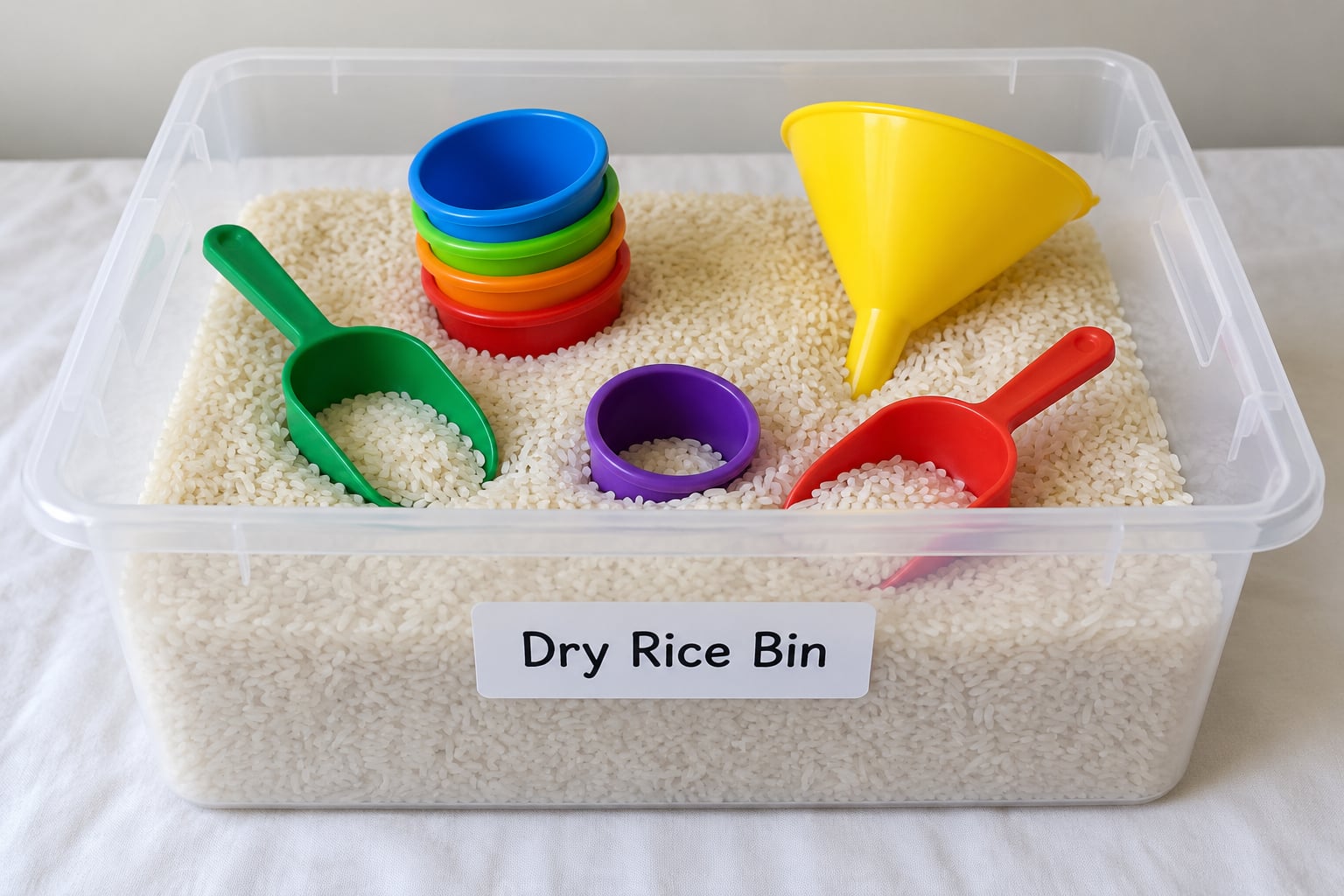
Dry fillers like rice, rolled oats and dried lentils get used for months rather than one afternoon, which is why they beat loose snacks for a bin. Quick oats pour well and carry less risk than hard grains if a handful ends up in a mouth. If mouthing is constant right now, work through oral sensory activities for chewing and mouthing alongside the bin rather than instead of it.
Put an old sheet under the bin, keep the bin on the floor rather than a table, and stay close. Sweeping scattered rice out of a toddler’s hair is a real chore, which is why the sheet matters.
3. Oobleck Splash and Pour Station
Oobleck is cornstarch mixed with water until it holds a shape and then runs. It feels solid under a fingertip and liquid a second later, and that surprise is the whole appeal for a toddler.
Spread it in a shallow tub or on a tray with a sheet underneath and set out plastic droppers, small cups and a squeeze bottle for pouring. Children discover that squeezing hard produces a fountain and squeezing gently produces a slow drip.
Skip water beads, magnet tiles and anything small enough to swallow outright. Cornstarch and water clean up with a dry cloth if you catch it early; if it dries, a damp cloth and patience.
4. Paper Tear-and-Create Collage
Tearing paper is one of the first fine-motor skills a toddler masters independently, and it does not require any dexterity most two-year-olds cannot manage. Offer torn tissue paper, construction paper halves and thick glue sticks on a washable surface.
Ripping develops a pincer grip because the fingers have to line up and pull. Layering and sticking pieces down forces both hands to work at once, which is the bilateral coordination that later shows up in dressing and cutting.
Save your good paper. A toddler who learns that tearing is a game will tear the mail.
5. Kitchen-Stuffing Sensory Bags
A sealed zip bag turns loose dry materials into safe sensory play. Fill bags with cut fabric scraps, dry pasta, rice or laminated paper shapes, press out the air and close the zip completely.
Your toddler can point out red pieces, count them, mash them with a thumb and move the shapes from one side to the other without ever opening the bag. Bags travel well and clean up in seconds, which makes them a good car or stroller activity.
Use two or three bags rather than ten. Cut fabric into pieces larger than a coin and keep staples and bag clips far out of reach.
6. Pouring Practice with Cups and Funnels
Pouring is a quiet, absorbing way to build hand strength, and it works well before a child can control a spoon. Set nested plastic cups, a funnel, a small pitcher and a bowl on a tray.
The motion is the point. Filling a cup, tipping it and watching material travel down a funnel teaches wrist control, hand-eye coordination and cause and effect all at once.
Because it is quiet and self-paced, this is one of the rare sensory activities that occupies your toddler rather than you. Put it on the floor beside you while you cook.
7. Texture Walk with Everyday Fabrics
Cut clean, washable fabric into small squares and gather a mix: cotton, denim, felt, corduroy, a piece of satin, a sock, a scrap of fleece. Put them in a basket and let your toddler touch, sort and stack.
Name what they feel like as they go: soft, rough, smooth, fuzzy, stretchy. This is one of the quietest ways to build descriptive language from something your child is already holding.
Skip anything frayed, beaded or trimmed with loose threads, and check for allergic reactions to unfamiliar fabrics if your child has sensitive skin.
8. Balloon Squish and Drop
A balloon is heavy work without any equipment: your toddler holds it, squeezes it against their chest, rolls it along the floor and watches it bob back up. The resistance gives real proprioceptive input through the arms and shoulders.
Dropping it from a low height teaches cause and effect, since release equals bounce. Keep the release point low and well away from other people.
Never throw a balloon toward a face. Pop one only where a toddler cannot be startled by the bang, and pick up every fragment immediately.
9. Dancing and Stop Game
Put on three familiar songs and give simple directions: dance, stop, clap your hands, reach up, squat down. The stopping is the useful part, because holding still and starting again on cue practices listening and motor planning.
Spinning, swaying and heavy stomping supply vestibular input, which helps many toddlers settle afterwards. Children who cannot sit still for a bin generally get more out of this one.
Skip it entirely if your child is already overstimulated, such as during a meltdown. Movement adds input, and some children need less at that moment. A corner with soft lighting and a few heavy items gives them the opposite kind, and how to make a calm down corner at home covers the setup.
10. Bubble Popping Play
Bubbles are about the highest ratio of engagement to effort in this whole list. Blow them across a room and let your toddler chase, clap, pop them or try to catch them with open hands.
Chasing bubbles trains visual tracking, reaching and whole-body movement, and the sound of popping is genuinely calming for a lot of toddlers. Start with big slow bubbles from a wand, not a bubble machine with a motor.
Wipe the floor afterwards. Bubble residue turns into a slip hazard fast once it is mixed with dust.
11. Scribble, Smear, and Stomp Art
Put washable tempera paint, chunky brushes, broad crayons or washable markers on paper taped to a table, or on a reusable sheet on the floor. Smearing is just as valid as staying inside the lines.
Once the paper runs out, taped floor paper turns it into a full-body activity: stomp, step, drag a foot through the paint and walk across it. That combination is where toddlers connect what they see with where their body is.
Use washable tempera only, and keep it away from upholstery and carpets you care about.
12. Hide-and-Seek Sound Hunt
Hide five or six household objects that each make a distinct sound: a spoon in a mug, a wooden spoon tapping a pot, a sealed jar with rice inside, a set of keys, a crinkly bag of tissue paper. Then ask your toddler to find the noise.
When they find it, make the sound together and match it to the object. This trains auditory discrimination and problem-solving, and it works indoors on a day when moving around is not an option.
Check drawers and cupboards before you start, and keep keys and small objects out of reach once the hunt ends.
Frequently Asked Questions
What are good sensory activities for toddlers who do not like messy play?
Try contained or dry versions: sealed sensory bags with dry pasta, a play-dough tray, fabric texture sorting, the sound hunt, dancing and stop, or balloon squishing. These deliver touch and movement input without loose material on the floor. If a toddler pulls away from textures, start with the materials they already accept and add one new texture alongside familiar ones, never instead of them.
How long should a sensory play activity last for a toddler?
Follow your child’s attention rather than the clock. Most toddlers concentrate well for about five to fifteen minutes, then move on, and that is a normal finish rather than a failure. Ending while they are still enjoying it means the next session starts fresh. If they keep returning to the same activity over several days, that is a good sign of engagement.
How can I adapt sensory activities when my toddler loses interest quickly?
Change one variable at a time rather than the whole activity. Add a tool, shrink the portion size, move the setup to a new spot, or swap the material for something familiar in a new colour. You can also step back and let them lead, which often pulls attention in. If the same activity works twice and then dies, put it away and bring it out next month.
Are sensory activities beneficial for toddlers without autism or other developmental differences?
Yes. Sensory play supports fine motor skills, balance, coordination, language and early math for every child, and toddlers absorb more through their senses than through explanation. There is nothing about it that is specific to autism. For a sensory-sensitive child the plan inverts somewhat, favouring calming and heavy-work input and plenty of breaks rather than more stimulation.
What sensory materials should I avoid because they may be unsafe?
Avoid anything small enough to swallow, including water beads, loose buttons, dried whole beans and peas for younger toddlers, and unbreakable small pieces. Steer clear of kinetic sand, slime made with borax, water beads and homemade or unlabelled liquids, since children lick them. Skip loose water play without an adult within arm’s reach, and check any material for allergens your child reacts to.
When should I ask a pediatrician or occupational therapist about my toddler’s sensory behavior?
Speak with your pediatrician if a child consistently avoids or reacts strongly to textures, sound, light or movement, seems unusually floppy or unusually rigid, loses skills they had, or if sensory reactions interfere with eating, dressing, sleep or playing. For a child with autism or a suspected developmental difference, an occupational therapist can map which input the child seeks or avoids. Seek advice sooner rather than waiting it out.
Start with What Your Toddler Enjoys
Pick the one activity on this list your toddler already gravitates toward and run it again. Repetition is what toddlers actually want, not novelty.
Watch which input they seek out and which they avoid: the child who keeps returning to the heavy, squashing activities is telling you something, and so is the one who refuses every bin. Follow that signal, stop when interest fades, and introduce a variation only after the familiar version has gone stale. If you want to plan input across a whole day rather than one session, how to build a sensory diet for your child lays out the heavy-work, calm and alert parts.