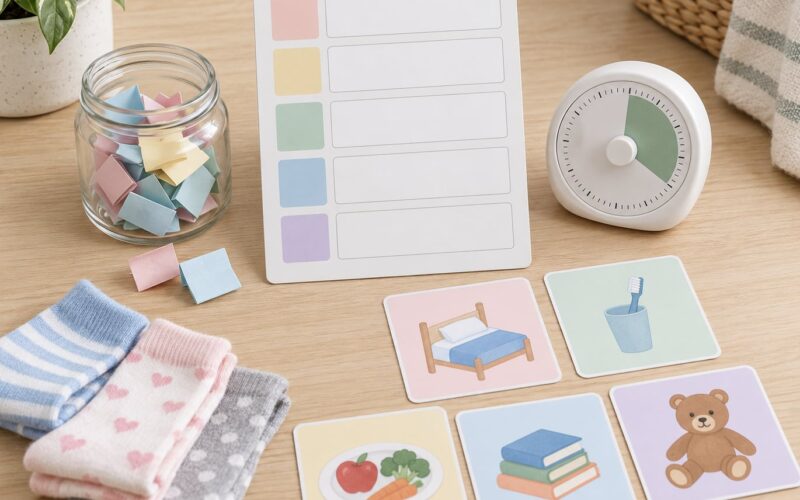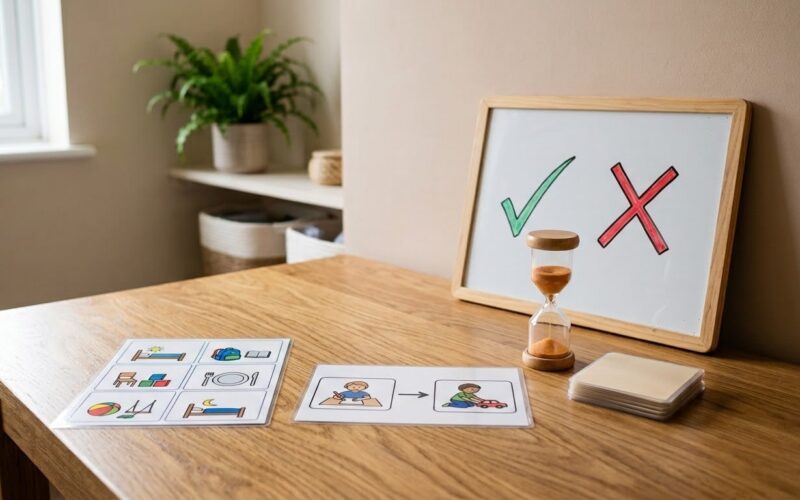
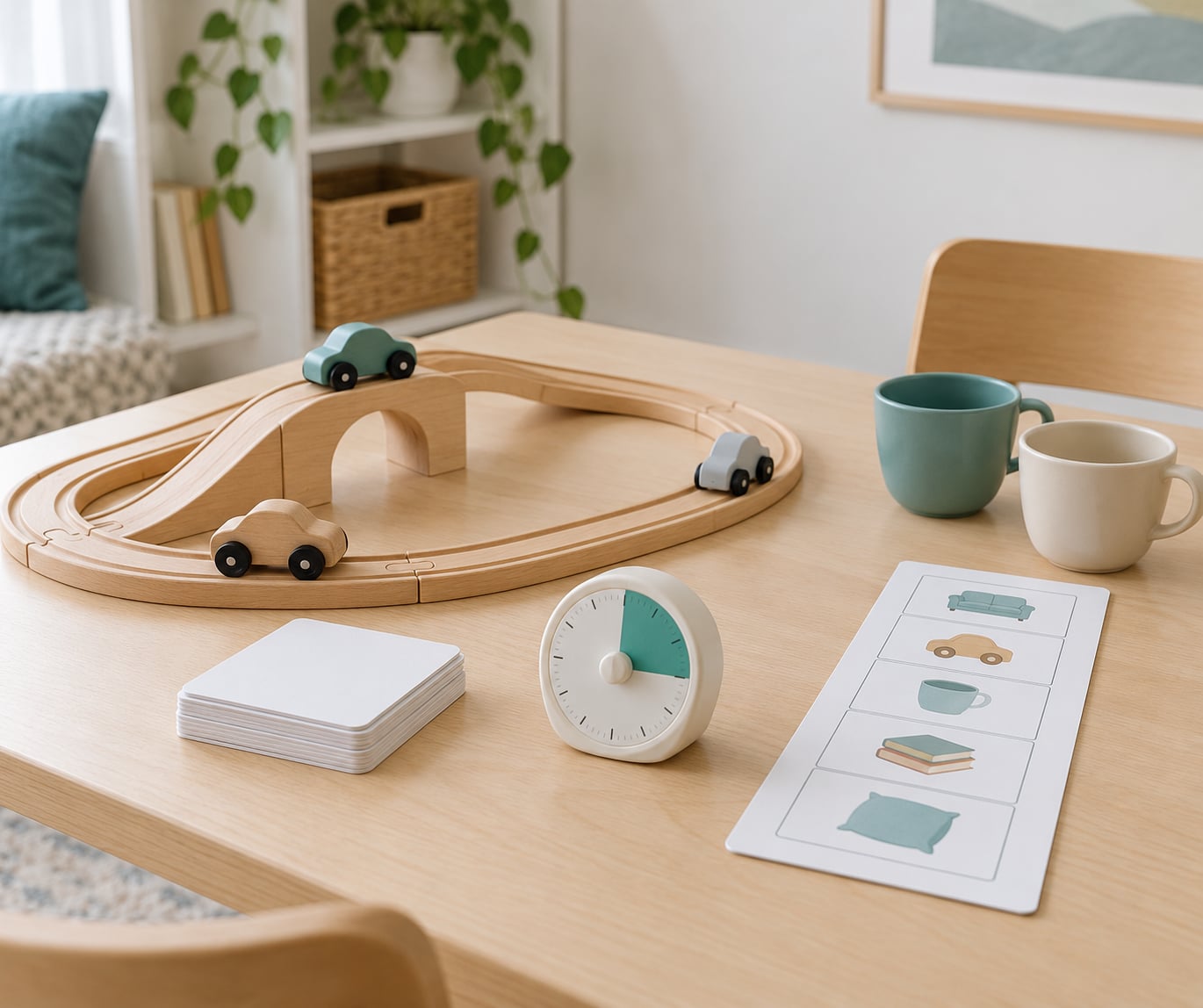
Social skills activities for kids work best when they are short, repetitive, and folded into play your child already tolerates. For autistic children, that usually means rehearsing one skill at a time, with a visual support, no audience, and no penalty for getting it wrong. Nothing here needs a purchased kit. Everything runs on household items and about ten minutes.
This list covers twelve activities a parent or caregiver can start this week, from turn-taking with toy cars to greeting practice and pretend-play scenarios. Each one names the skill it targets, the setting where it fits best, and what to change when your child is overwhelmed, not yet verbal, or moving faster than the game can keep up with.
Nothing on this list is a therapy program, and nothing replaces the work your child’s speech-language pathologist, occupational therapist, or behavioral team is already doing. Treat these as extra reps between sessions. If you are not sure where to start, pick activity three and do it four times this week.
Table of Contents
- 12 Social Skills Activities for Kids at a Glance
- 1. Practice Taking Turns With a Toy Car Game
- 2. Play a Simple Board Game With Visual Turn Cards
- 3. Practice Greetings With a Home Role-Play Station
- 4. Make a Social Skills Scavenger Hunt
- 5. Use Dolls to Practice Joining a Playgroup
- 6. Build a Feelings-Matching Game
- 7. Practice Conversation With a Question-Answer Carousel
- 8. Do a Cooperative Cleanup Challenge
- 9. Role-Play Asking for Help
- 10. Practice Sharing and Trading With Play Materials
- 11. Pretend to Solve a Social Problem
- 12. Hold a Simple Family Connection Time
- Frequently Asked Questions
- At what age should I start social skills activities with my autistic child?
- Do social skills activities really work for autistic children?
- Should I make my autistic child make eye contact during greetings?
- How often should we practice, and how long should each session be?
- What if my child refuses to participate?
- When should I talk to my child’s therapist or pediatrician?
- Conclusion
12 Social Skills Activities for Kids at a Glance
The table below sorts all twelve activities by the skill they practice, where they work best, and how to adjust them for different communication and sensory needs.
| Activity | Target skill | Best setting | Adaptation for communication and sensory needs |
|---|---|---|---|
| Toy car turn game | Turn-taking, waiting | Floor play, indoors | Use a wide track or two hands on one car; skip talking, keep only the wait |
| Board game with turn cards | Waiting, following directions, losing | Table, after snack | Point instead of speaking; offer an all-win version so nobody loses |
| Greeting role-play station | Hello, goodbye, personal info | Hallway or door, daily | Replace eye contact with a wave, hug, or shared object; script can be a picture |
| Scavenger hunt | Requesting, responding, staying with an adult | Home or yard, moving | Offer movement and heavy work first; use a checklist of three items only |
| Doll playgroup practice | Asking to join, inviting, negotiating | Small-world play, calm room | Let the child direct the dolls; you voice the characters slowly |
| Feelings-matching game | Emotion vocabulary, body cues, perspective-taking | Table or floor, 8 to 10 minutes | Match to real photos first; let your child point and you name |
| Question-answer carousel | Asking, answering, following a topic | Car, table, waiting time | Three fixed questions on a card; AAC users can point to the answer |
| Cooperative cleanup challenge | Giving directions, accepting help, feedback | Bedroom, kitchen, after play | Give one direction per step; pair the child with a helper rather than a boss |
| Asking-for-help role-play | Self-advocacy, clear requests | Anywhere, rehearsed | Practice the no-thanks response too; use a break card as the request |
| Sharing and trading practice | Sharing, refusing, compromising | Play materials, table | Trade one item at a time; a refusal script protects the child from pressure |
| Social problem pretend play | Conflict resolution, reading cues | Floor play or car | One scenario per sitting; stop before distress and re-run it calmly later |
| Family connection time | Conversation, gratitude, joint choice | Same spot, same time daily | Keep it to five minutes and let passes be allowed |
1. Practice Taking Turns With a Toy Car Game
Turn-taking is the skill most autistic children find hardest, and the easiest one to rehearse without making it a fight. Two cars, a track made from painter’s tape on the floor, and a clear visual of who moves when.
Run it like this: one car each, say “your turn” and move, hand over the visual marker, say “my turn,” and move. That is the whole activity. Do ten exchanges, not fifty.
What to say: “My turn.” Pause. “Your turn.” Pause. “We each have a turn.” The words are short and identical every time, which is the point.
If fine-motor skills get in the way, tape two cars to a board and slide them instead, or push a single car back and forth between you. If your child cannot yet wait for words, hand over the marker without speaking. The rhythm matters more than the language.
Skills practiced: turn-taking, waiting, requesting another turn, self-advocacy.
2. Play a Simple Board Game With Visual Turn Cards
A board game teaches waiting, following directions, and what to do when someone else wins. Visual turn cards make the waiting visible, which removes most of the arguing for children who cannot yet track time.
Use a short game, five to ten turns long. Give each player a stack of colored cards and move a card to the board on every turn so your child can see how many are left. Narrate one step at a time: “Roll. Move two. Your turn.”
Losing is the hard part. Most autistic children take a competitive game harder than the game itself, so keep an all-win version ready: in cooperative games every player wins or the whole table wins together. Nothing is lost, and the child still practices waiting their turn.
Skills practiced: waiting, following directions, coping with losing, handling fairness.
3. Practice Greetings With a Home Role-Play Station
Greetings are a script, and scripts get easier with repetition. Set up a station that takes thirty seconds: two spots at the door, a picture of the greeting you are working on, and a marker for “done.”
Practice hello and goodbye three to five times. Let your child use any version that works: a wave, a hug, a fist bump, holding up a picture, or walking away after the wave. Forced eye contact is not the goal, and asking for it can cost a child more than the greeting is worth.
Keep the words constant. “Hi, I’m Maya” today, “Hi, I’m Maya” tomorrow, even if nobody is there to hear it. Then take the same script to the door when a real person arrives.
For a repeatable way to show the skill before it happens, our guide on how to use video modeling to teach life skills walks through filming yourself doing the routine and replaying it together.
Skills practiced: greeting, personal information, routine and predictability.
4. Make a Social Skills Scavenger Hunt
A scavenger hunt turns requesting and responding into movement, which is often the strongest way to reach an autistic child. Pick three items only, write them on a checklist with pictures if you have them, and go.
Model the request yourself once, out loud and slightly exaggerated: “I need the blue cup. Can you bring it?” Then wait. When your child brings something, say exactly what happened: “You asked me. I brought it.”
Movement comes first for many autistic children. If starting is hard, ten minutes of proprioceptive activities at home before the hunt changes how the whole evening goes. Three items is a session. Five is a different day.
Skills practiced: requesting, responding, following a sequence, staying with an adult.
5. Use Dolls to Practice Joining a Playgroup
Asking to join play is a hard skill to say out loud, so say it for a doll first. Two or three dolls and a small scene, such as a table with cups, give your child somewhere to stand outside the interaction.
Set the problem up in one sentence: “Two kids are playing. Your doll wants to play too.” Then let your child move the dolls. You voice the new kid, slowly and simply: “Can I play?” Your child can answer with a doll, a gesture, or you can supply the line while their doll moves toward the group.
Keep a rejection version ready too. What does the doll do when someone says no? Practicing the no as well as the ask is what makes the ask feel safe enough to try for real.
Skills practiced: asking to join, inviting, negotiating, coping with a no.
6. Build a Feelings-Matching Game
Emotion vocabulary builds empathy and self-advocacy at the same time. Once a child has words for feelings, they can tell you when they are overwhelmed instead of melting down.
Use six to eight faces. Free apps and printables work, but hand-drawn faces on index cards work fine. Match three things: the face, the body cue, and the situation. “His eyebrows are pulled up and together. His voice got loud.”
Point at yourself and at your child while you match, so the game does not stay about the cards. Ask one question at the end: “What do we do when our body feels like that?” Practice one coping step, like a water break or a quiet corner, and stop there.
Skills practiced: naming and expressing emotion, reading facial expressions and body language, perspective-taking.
7. Practice Conversation With a Question-Answer Carousel
Most autistic children can answer more easily than they can start, so build from the answer side. Write three fixed questions on a card, ask them in the same order every time, and let the child answer however they answer.
Three is enough for a start: “What’s your favorite?” “What was fun today?” “What should we do next?” After your child answers, hand the turn back with a modeled follow-up. “You said the park. Would you go again?”
This works well in the car or anywhere with a wait built in. Keep the order identical so the child knows what is coming, and let a pass be a valid answer. If your child uses AAC, let them point to the answer; that counts as the answer.
Skills practiced: conversation skills, active listening, following a topic, asking a question back.
8. Do a Cooperative Cleanup Challenge
Real routines are where skills generalize, and cleanup is a routine you already have. Give one direction at a time, then accept help when it is offered.
“Put the blocks in the bin.” When your child does it, say what you saw: “You put the blocks in the bin.” Next time, hand them a basket they cannot reach alone, so asking for help has a natural reason to happen.
Positive feedback works better than correction here. When your child hands you a block without being asked, name it out loud: “You helped without me asking.” Making transitions easier between activities is its own skill, and our post on making transitions between activities easier covers the warning-and-countdown approach that fits well at the end of a cleanup.
Skills practiced: following directions, accepting help, giving help, positive feedback.
9. Role-Play Asking for Help
Self-advocacy means asking in a way another person can actually answer. Practice both halves of it, because the second half is the one autistic children rarely get to rehearse.
Start with a clear request: “I need help.” Then add the specific part: “I can’t open this. Can you open it?” When help comes, thank the person and try the next one yourself.
Then practice the harder version. “Wait,” you say, then help after a beat. “You will have to wait about ten more seconds.” Your child is learning that a request can be heard and still not acted on immediately, which is a large part of how school and appointments work.
Give them a break card to hand over as the request. For many children that card is easier than the words, and it works in the real world too.
Skills practiced: self-advocacy, asking for help, tolerating a wait, polite language.
10. Practice Sharing and Trading With Play Materials
Sharing is a negotiation, not a virtue, so give it structure. Put two preferred items on the table and trade one at a time, with a clear rule you say out loud: “One item each, then we trade.”
Model the sentence and wait: “Can I have the blue block?” “Sure.” “Thank you.” Keep trading even when your child does not want to let go. The refusal matters as much as the share, so script that too: “No thank you. I am using it.” That sentence protects your child from pressure without any lecture attached.
Sharing is the activity that most often turns into a fight in real homes, so slow it down. Trade one item rather than five, keep sessions under five minutes, and stop while it is still going well.
Skills practiced: sharing, requesting, refusing, compromise, using manners.
11. Pretend to Solve a Social Problem
Pick one situation your child actually experiences, such as a sibling taking a toy, someone pushing in line, or a classmate saying no. Keep it to one problem per sitting.
Set the scene, ask what happened, then ask what could happen next. Offer two options rather than an open question: “Should we ask again, or walk away?” Choose together, act it out once, and stop.
Short, specific scenarios like this work better than broad ones. If the scenario upsets your child, narrate the calm version instead of living it: “Everyone kept their hands to themselves.” Then do the same scenario another day, slower.
Skills practiced: conflict resolution, reading social cues, problem-solving, self-regulation.
12. Hold a Simple Family Connection Time
The most reliable practice is the kind that happens every day without anyone deciding to have it. Five minutes at the same spot, same time, with the same three moves.
Each family member shares one win from the day, then answers one question, then says one thing they appreciated about another person. The last step is a joint choice: what the family does after dinner. Predictability is doing most of the work here, because nothing is negotiable and nothing is a surprise.
Let a pass be allowed. A child who says nothing for a week and then answers one question has not failed. Keep the ritual going through a hard week, and if the day is already past capacity, cut it to the joint choice and nothing else.
Skills practiced: conversation, gratitude, listening, making a choice together, family routine.
Frequently Asked Questions
At what age should I start social skills activities with my autistic child?
Start as soon as your child shows interest in other people, which for many autistic children is earlier than parents expect. There is no waiting period and no need to buy materials. Toddlers benefit from one-step directions during play, and everything on this list can be slowed down to match attention span.
Do social skills activities really work for autistic children?
Practice helps, but slowly and unevenly, and that is normal. Autistic children often learn a skill accurately with an adult, then lose it in a noisy setting until the skill generalizes. Repetition in several settings over months is what moves a skill into real life, and a speech-language pathologist can tell you which skills to prioritize.
Should I make my autistic child make eye contact during greetings?
Not as the goal. Many autistic children find direct eye contact uncomfortable or painful, and demanding it can make them avoid people rather than engage with them. Offer alternatives they control: a wave, a hug, looking at your shoulder, or looking at a shared object. What matters is that the greeting happens at all.
How often should we practice, and how long should each session be?
Short and frequent beats long and occasional. Aim for five to ten minutes, once or twice a day, and stop while the child is still engaged rather than when they are frustrated. The same activity repeated four or five times in a week teaches far more than a new activity every day.
What if my child refuses to participate?
Stop the activity and do not push through it. Refusal usually means the demand is too hard, the session is too long, or the child is already overloaded, not that the skill is unimportant. Lower the difficulty by one step, add a visual, or change the setting, then try again another day with no commentary about the refusal.
When should I talk to my child’s therapist or pediatrician?
Bring it up if your child consistently avoids other children, does not seek help when stuck, loses skills they once had, or shows no interest in people at all. Your pediatrician can refer you to a speech-language pathologist or occupational therapist for an evaluation. Home practice fits alongside that work and should not replace it.
Conclusion
Pick one activity your child already tolerates and run it four times this week. Ten minutes, the same words each time, no quiz at the end.
Track one small thing, like whether the greeting happened without a prompt, rather than a score. Bring what you have noticed to your child’s therapy team, and let their priorities set the schedule when your views differ.