Motor planning activities for kids are play-based challenges where a child has to work out how to move before they move: crawl under the table, walk around the chair legs, carry the cup without spilling. It sounds simple, but planning a movement and then doing it well is a three-part job, and kids practise it far more when it feels like a game than when it feels like a drill. Every activity below uses things you already have at home.
Occupational therapists describe that three-part job as ideation, organisation and execution. Ideation is looking at the task and understanding what it asks. Organisation is working out the order of movements. Execution is doing them. A child who plans beautifully but trips over their own feet is showing an execution gap; a child who freezes at the obstacle course has an organisation gap; a child who wanders off mid-task may be stuck at ideation.
Knowing which stage is wobbling changes what you practise. That’s why each idea below names what it builds, not just what it is.
A quick note before you start: this is general educational information, not medical advice or a diagnosis. If your child is struggling across many settings, talk to their pediatrician about a referral to a pediatric occupational therapist.
Table of Contents
- Motor Planning Activities for Kids at a Glance
- 1. Bubble-Popping Obstacle Course
- 2. Build a Tower Challenge
- 3. Stop-and-Go Movement Game
- 4. Pouring Water Between Containers
- 5. Puzzle Relay
- 6. Balloon Keep-Up
- 7. Scissor Snipping Paper Shapes
- 8. Treasure Map Walk
- 9. Dress a Teddy Bear
- 10. Animal Movement Sequence
- 11. Thread the Pattern Board
- 12. DIY Obstacle Navigation Course
- How to actually run one of these
- Frequently Asked Questions
- What are common motor planning activities?
- What are some good visual motor activities for kids?
- What are some good fine motor activities for a 5-year-old?
- What are some activities that help build gross motor skills in toddlers?
- How long should motor planning activities be, and how often?
- What does poor motor planning look like, and when should I see an occupational therapist?
- Conclusion
Motor Planning Activities for Kids at a Glance
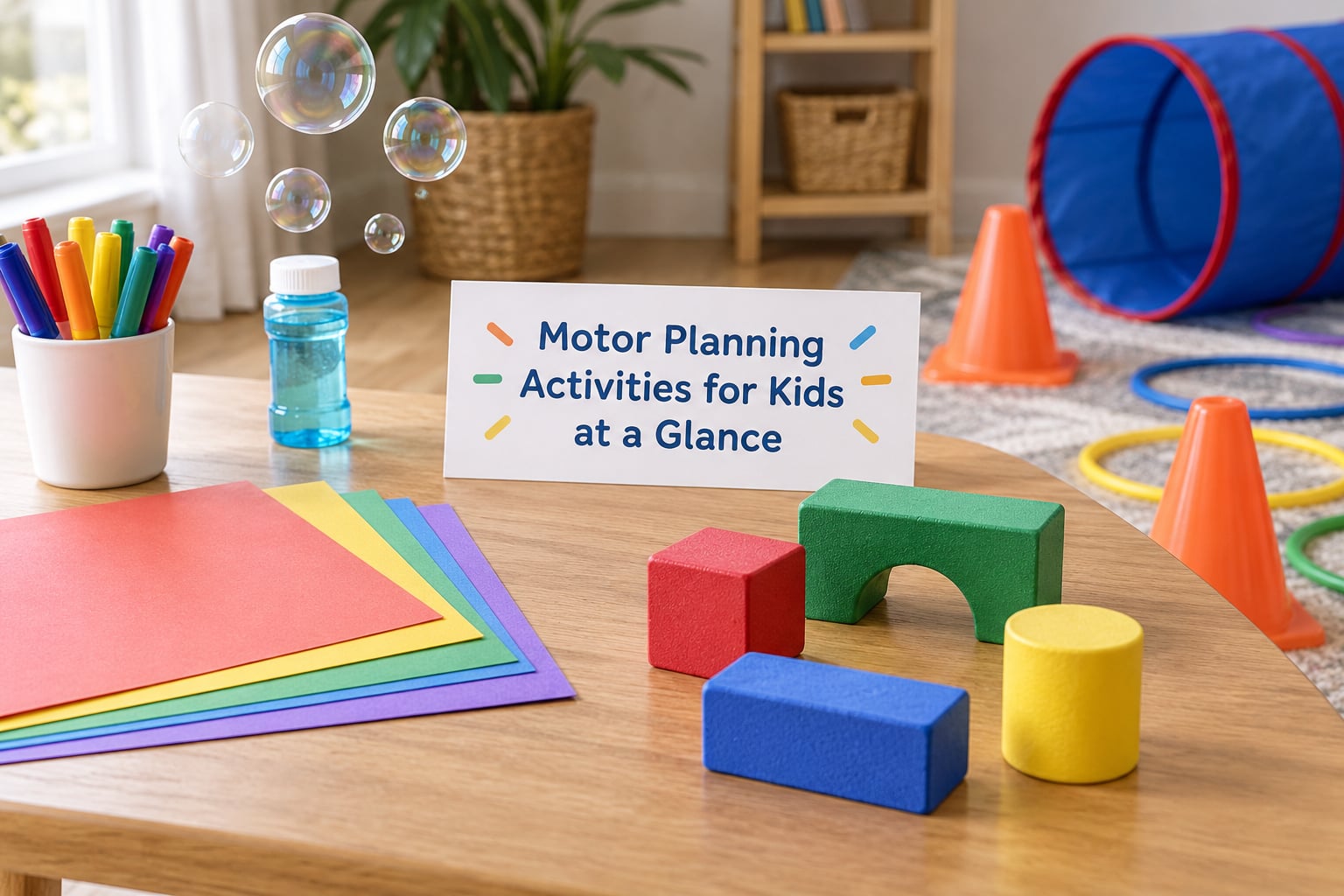
| Activity | Main planning skill | Materials | Best setting | Easy adaptation |
|---|---|---|---|---|
| Bubble-popping obstacle course | Sequencing and inhibition | Cones, cups, bubbles | Hallway or yard | Shorten to two steps |
| Build a tower challenge | Force grading | Blocks or boxes | Floor or table | Big boxes only |
| Stop-and-go movement game | Motor inhibition | None | Anywhere | Walk instead of run |
| Pouring water between containers | Hand planning and bilateral coordination | Cups, sponge | Sink or tray | Use a spout cup |
| Puzzle relay | Visual planning with transitions | 4-piece puzzle | Floor | Three pieces |
| Balloon keep-up | Tracking and graded force | One balloon | Open room | Seated with a bat |
| Scissor snipping | Grip control and hand strength | Paper, child scissors | Table | Tear instead of snip |
| Treasure map walk | Spatial planning and memory | Paper, markers | Home or park | Two turns only |
| Dress a teddy bear | Task breakdown and sequencing | Teddy, loose clothes | Floor or table | Socks only |
| Animal movement sequence | Motor imitation | None | Anywhere | Two animals |
| Thread the pattern board | Bilateral coordination and attention | Lacing card or pasta | Table | Chunky lacing card |
| DIY navigation course | Full-body planning | Cushions, tape | Living room | Add one element weekly |
Read that table as a menu rather than a checklist. Two per week is plenty. Most of these also double as sensory play, so if your child seeks heavy input, the proprioceptive ones will hold their attention longer than the quiet ones will.
1. Bubble-Popping Obstacle Course
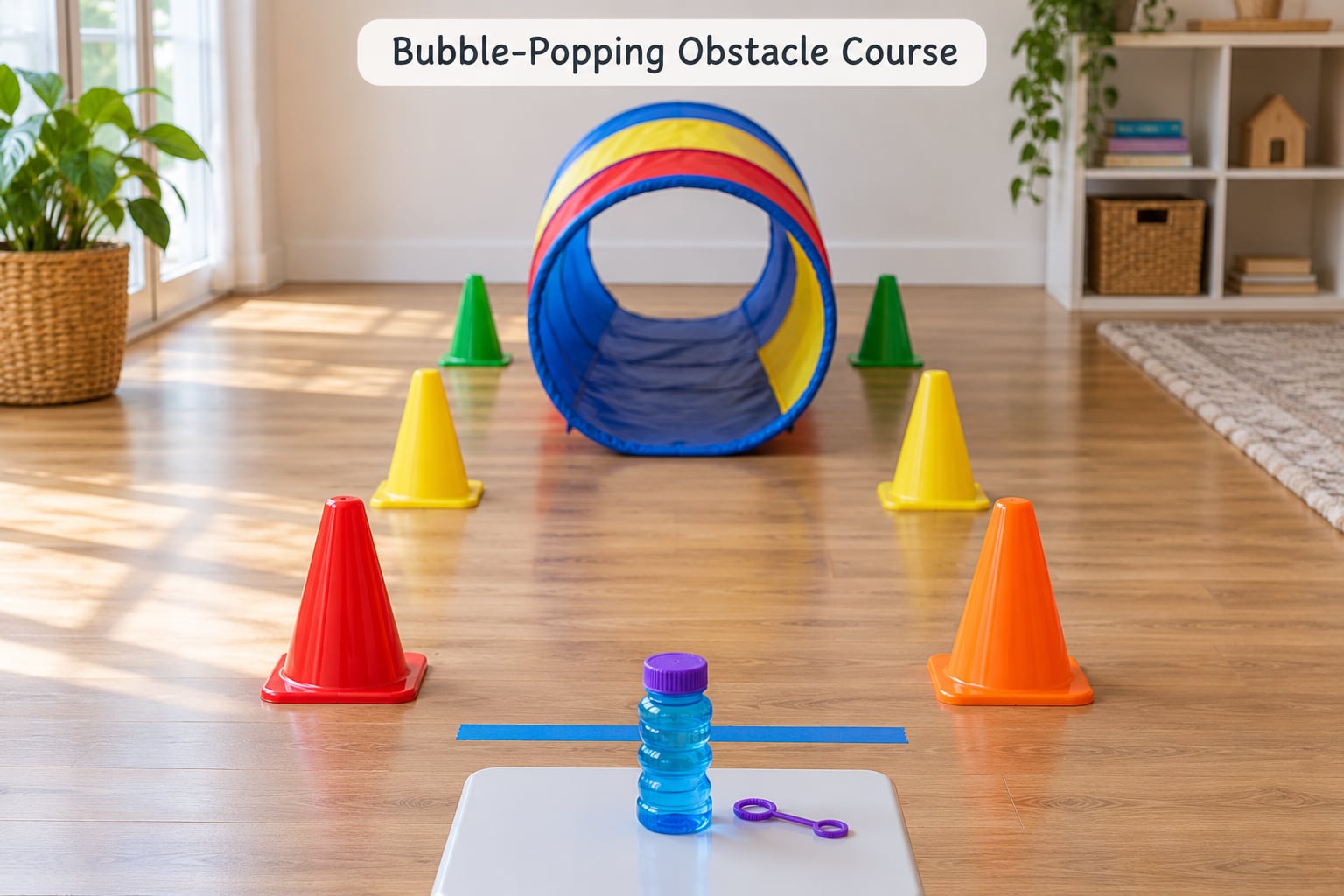
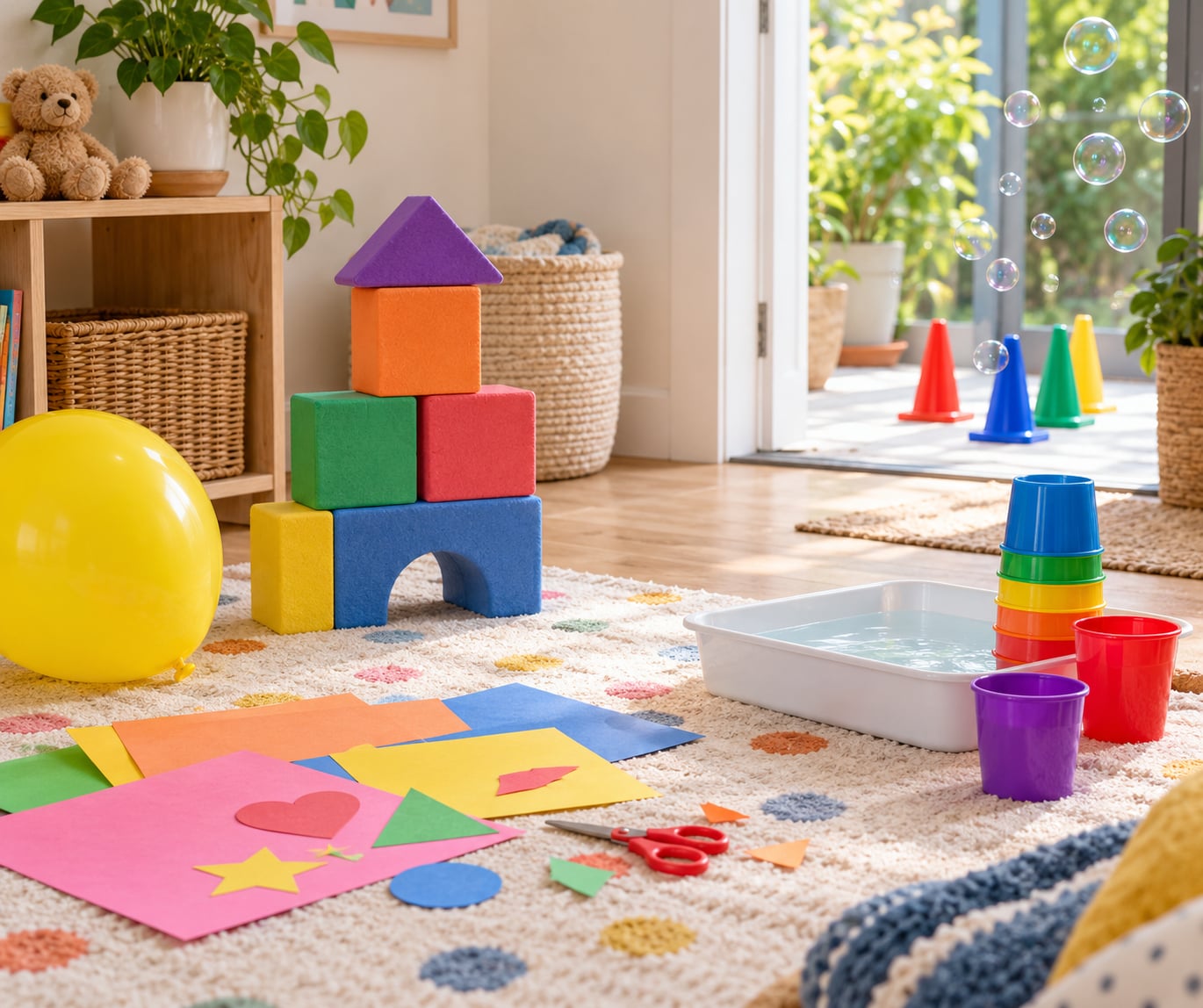
Set out four or five stations in a line: walk around a cone, crawl under a chair, step over a rolled towel, spin once, then pop the bubble target at the end. The child plans the whole route before they take a step.
Say the sequence out loud as you build it, then ask them to say it back before starting. “First we walk around the cone, then we crawl under the chair, last we pop the bubbles.” That narration is doing real work, because motor planning and language use the same sequencing machinery.
For a child who freezes mid-course, cut it to two stations. Finishing two steps well beats struggling through five and ending up on the floor crying.
2. Build a Tower Challenge
Give your child a target height and a stack of blocks, cardboard boxes or empty cereal boxes, then step back. The planning happens silently: how many blocks, which face goes down, how hard to press before it slides.
Use household boxes for a bigger challenge. Boxes are unpredictable in weight, so the child has to adjust pressure mid-build rather than applying one consistent force, which is exactly the executive function motor planning asks for.
Celebrate the attempt, not the tower. A structure that fell at nine blocks is a child who tried nine blocks.
3. Stop-and-Go Movement Game
Call “go” and let them move any way they like through the space. Call “stop” and they freeze mid-stride, mid-spin, mid-hop. Then “back up” and they reverse direction.
That freeze is the whole exercise. Inhibition, holding a still position on command, is a planning skill, and most children need far more practice at it than at moving.
Turn it into traffic. Red light, green light, with a stop sign they have to physically hold. Kids who enjoy pretend play usually stay with it far longer than kids doing obedience drills.
4. Pouring Water Between Containers
Three containers of different heights and widths, a cup or a squeeze bottle, and a tray underneath. The child has to predict which cup will hold more and steady the tilt to match the two rims.
Use a sponge for a heavier, more proprioceptive version. Squeezing a soaked sponge takes real effort through both hands at once, which is bilateral coordination you can feel working. If your child chases that heavy input, our list of 10 easy proprioceptive activities for kids at home leans into it with bigger movements.
Supervise closely and expect spills. The spill is the lesson: you planned the tilt, it was too steep, now you adjust. Wiping up the puddle is fine motor practice too.
5. Puzzle Relay
Put a four-piece puzzle on one side of the room and a small pile of soft objects on the other. Match a piece, then carry it to the pile, then come back for the next one. The child has to plan a sequence that alternates between two locations.
The alternation is the point. Holding one thing while remembering to return for the second is the same demand as remembering your reading book at lunch, and it is far more fun than asking for it directly.
Keep the puzzle small enough to finish in about five minutes. A jigsaw with a hundred pieces teaches stubbornness, not planning.
6. Balloon Keep-Up
One balloon, no hands, keep it in the air. Because the balloon moves slowly and unpredictably, the child gets far more planning attempts per minute than with a ball, which is exactly why therapists hand these out.
Add a rule once it becomes easy: one tap with the knee, one with the elbow, one with the shoulder. Now they are planning a specific body part in advance rather than reacting to whatever works.
A seated version works well too. Roll the balloon off a boardwalk ramp with a hand, which turns the same activity into a reaching and aiming task.
7. Scissor Snipping Paper Shapes
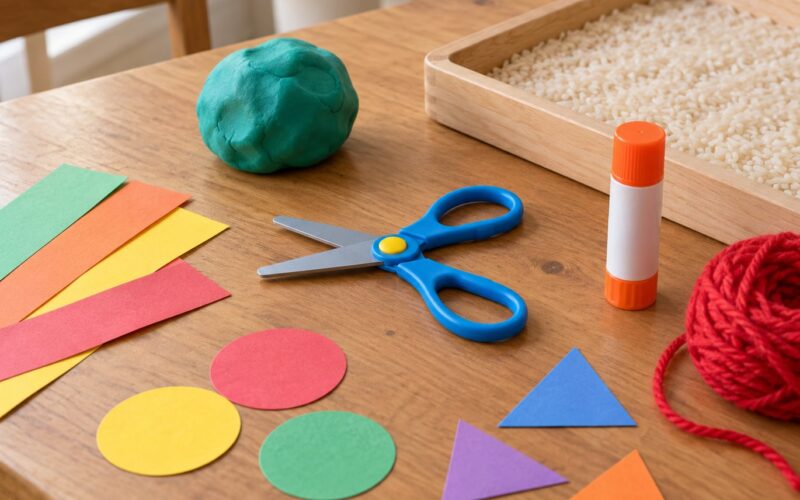
Snipping a continuous line around a printed shape builds grip strength, hand planning and visual-motor tracking in one small task. Sit beside your child, not across from them, and keep your own hands visible.
Go slowly. Open and close the blades with control rather than speed, and let quality beat quantity every time. A neat short cut is harder than a fast ragged one.
Supervise closely throughout, since scissors are the sharpest tool in this list. If your child bites or chews tools, skip this one and use play dough tearing instead. For a child with a very hard grip, closing clothespins on a small box is a safer stand-in.
8. Treasure Map Walk
Draw a simple map of your hallway or local park with three or four landmarks and clear turn arrows. The child carries the map, checks the next symbol, and decides which way to go.
Have them read the map to you as they walk. Reading it aloud keeps language in the loop and makes a wrong turn recoverable rather than a failure.
Two symbols is enough for a young child. Three or more turns works well once the first version feels easy, and adding a turn mid-walk is a good spontaneous challenge.
9. Dress a Teddy Bear
Set out one teddy, a sock, a shirt and a pair of shorts. Ask your child to get the bear dressed. Now you are testing task breakdown, because nobody told them the order and there is a right order.
Talk through the decisions. “Which arm does the sleeve go on first?” This is where a child who struggles to sequence a real morning routine gets a safe place to practise it, without a deadline or a frustration attached.
Easier version: just socks and a hat. Harder: add a buttoned shirt and ask for the buttons to be done last.
10. Animal Movement Sequence
Bear crawl, crab walk, frog jump, rabbit hop. Do three in a row, then invite your child to take the turn and show you which one comes next.
Imitation is the workload here, and it takes more planning than copying a single movement because they have to watch, remember, decide, and then reproduce the idea with their own body.
Keep it to two animals for a child who tires easily. Repetition matters more here than variety, and no equipment is needed at all.
11. Thread the Pattern Board
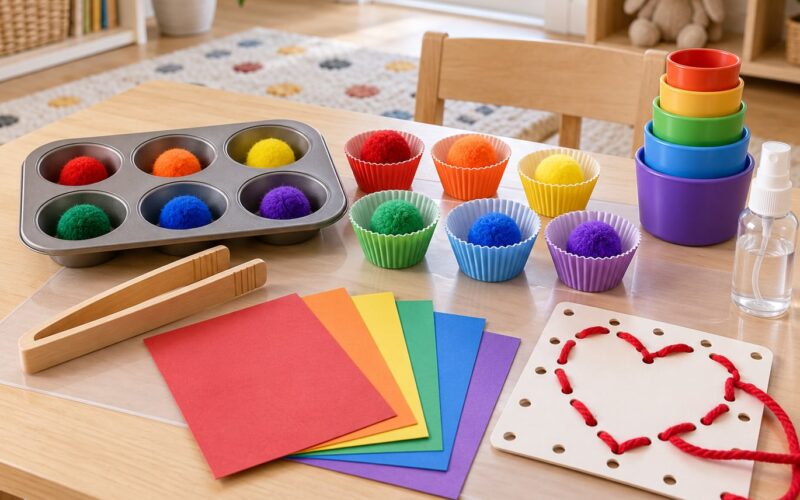
A lacing card, large buttons, a hole punch, or dry pasta and a rigatoni noodle. The child threads in a pattern, and the sequence has to be held in the head while the hands work.
Pattern work adds a planning layer that plain threading lacks. Red, blue, red, blue is a rule the child has to carry forward one repetition at a time.
For a child who finds threading frustrating, a plastic needle and stiff yarn through a shoebox lid with holes punched by you takes a few seconds and works much better.
12. DIY Obstacle Navigation Course
Cushions for stepping, a blanket tunnel, painter’s tape lines on the floor, a chair to weave around. Build it with your child rather than for them, so they hold the plan in their head while they build it. If you want more stations to borrow from, our guide to building gross motor skills indoors has seven variations that work in a living room.
This is the activity that grows with them. Add one element a week and the child re-plans a route they thought they already knew, which is a genuine experience of self-correction.
Clear the floor first. Most injuries on these courses come from a trailing rug, not from the challenge itself, so tape the lines down and move the furniture.
How to actually run one of these
Most parents find the activity itself is the easy part. The delivery is what changes whether a child practises or shuts down.
Narrate the steps as you set up, then let your child retell them before starting. Break anything longer than three steps into smaller chunks. Demonstrate visually rather than describing verbally, since a verbal description of a route is far harder for most children to hold than watching it once.
Aim for five to ten minutes, one gross and one fine activity per session, and let the child lead the pace. When they lose interest, that is information: the challenge is too hard, or the praise is about the product rather than the effort. Grade the task down instead of pushing through. Switching from one activity to the next is its own skill, and our tips on making transitions between activities easier cover that part.
Frequently Asked Questions
What are common motor planning activities?
The most common ones are obstacle courses, Simon Says style imitation games, animal walks, stop-and-go movement games, ball play, stacking towers, pouring and scooping, lacing and threading, cutting with scissors, dressing a doll, and simple puzzles. They all share one feature: the child has to work out the order of movements before starting. Practised, familiar tasks like a well-known song’s motions do not build planning the way unfamiliar ones do.
What are some good visual motor activities for kids?
Visual motor activities link what the eyes take in to what the hands do. Threading pasta onto a noodle, clipping clothespins to a small box, cutting along a drawn line, pouring between cups, sorting buttons by colour into different containers, completing a two-piece puzzle, and rolling a ball to knock down a target all work well. For a child who struggles, cutting along a bold line is easier than cutting a shape, and clothing pegs are easier than pasta.
What are some good fine motor activities for a 5-year-old?
At age five, real tasks beat synthetic ones. Buttoning a shirt, zipping a jacket, using a fork and spoon at dinner, cutting shapes with child scissors, tearing paper along a line, drawing with a fat crayon, threading large beads, and folding towels all work. Practising during a routine your child already does, like getting dressed, means you are not adding a task to the day. Cut the shapes ahead if frustration shows up quickly.
What are some activities that help build gross motor skills in toddlers?
Toddlers learn through imitation, so keep it to one or two movements at a time. Climb over a cushion, crawl through a blanket tunnel, push a laundry basket full of soft toys, walk a tape line on the floor, stand up and sit down without using hands, and copy an animal walk are all good. Around 18 months, copying you matters more than the accuracy of the movement. Stop while it is still fun; short and repeated beats long and abandoned.
How long should motor planning activities be, and how often?
Five to ten minutes a day is a realistic amount, and three or four times a week is plenty. Pick one gross and one fine activity in a session, rotate them across the week, and keep the same two or three games in rotation rather than constantly introducing new ones. Repetition is what lets a child internalise a planned sequence, so a familiar activity practised often beats a new one tried once.
What does poor motor planning look like, and when should I see an occupational therapist?
Watch for difficulty with unfamiliar tasks rather than practised ones, trouble sequencing three or more steps, frequent trips and bumps, difficulty with buttons, zips, cutlery or handwriting, a weak or unusual pencil grip, and avoiding playground equipment. Clumsiness on its own is not a diagnosis. If these difficulties show across home, school and play, mention them to your pediatrician and ask about a pediatric occupational therapy referral.
Conclusion
Pick one activity from this list today. Not the most impressive one, the one your child will actually agree to start.
Say the steps out loud, let them say them back, shorten anything longer than three steps, and stop while it is still going well. Five good minutes of a familiar game repeated this week will beat a brand new obstacle course that gets abandoned in four minutes.
And if the same things are hard across home, school and play, that is worth a conversation with your pediatrician about occupational therapy. Motor planning activities for kids are a useful practice for everyone, but they work best alongside whatever a therapist has already recommended.