

A homework meltdown is a stress response, not defiance. When a child cries, shouts, freezes, drops to the floor or refuses to move over schoolwork, their nervous system has hit its limit and the words coming out of your mouth are no longer landing. Knowing how to help a child with homework meltdowns is mostly about lowering the demand before it peaks, and about what you do in the ten minutes after it does.
Most of these evenings are not caused by one hard worksheet. They come from a depleted child meeting a task their brain cannot start, hold in working memory or tolerate sensorily, usually at the exact hour when everyone else is tired too. The steps below cover what to set up beforehand, what to do in the middle of the crisis, and how to repair afterwards so the next night is different.
This guide is written for caregivers of autistic and disabled children, though the framework works for any child who melts down over homework. If your child is under five and melting down over everything rather than schoolwork specifically, start with the routines further down and expect a slower pace.
Table of Contents
- What You Need
- A workspace that does not add load
- A visual schedule, not a verbal reminder
- A break plan you wrote down before the meltdown
- Clarity about what the assignment actually is
- A realistic sense of how long homework should take
- A regulated adult
- Step-by-Step: How to Help a Child With Homework Meltdowns
- Step 1: Notice Early Warning Signs
- Step 2: Lower the Homework Demand
- Step 3: Support Regulation Before Refocusing
- Step 4: Reconnect After the Meltdown and Rebuild the Routine
- Step 5: Adapt the Homework Plan
- Step 6: Seek Additional Support When Needed
- Common Mistakes
- Arguing about the homework itself
- Adding demands during the meltdown
- Rushing a shutdown
- Treating a break as a consequence
- Demanding eye contact and an apology mid-crisis
- Assuming yesterday’s method works tonight
- Frequently Asked Questions
- How do I know if my child’s homework refusal is a meltdown or just frustration?
- What should I do during a homework meltdown when my child will not respond?
- How can I help a child with autism finish homework without making it easier to avoid?
- Should I give my child a break when they are having homework meltdowns?
- When should I talk to a teacher or healthcare professional about homework distress?
- How can I reduce homework sensory overload at home?
What You Need
Calm homework support depends on preparation, and most of it is free. None of this requires a specific product or a specialist; it requires you to have decided some things in advance, while your child is still regulated and you are not standing in the middle of a crisis at 5pm.
A workspace that does not add load
One consistent table, chair and light. Fluorescent overhead lighting, a hard dining chair and background television each add sensory load that most adults tune out and many children do not.
Headphones, a lap desk or a movement option nearby are worth having ready. Noise-cancelling headphones and a small sensory kit — a fidget, a chew tube, a resistance band under the feet — usually help more than another worksheet strategy.
A visual schedule, not a verbal reminder
Photographs or simple drawings of the after-school sequence work better than telling a child what is coming. A first-then board that shows the work, the break and the end of the evening removes the guessing, and guessing is where a lot of the friction starts.
A break plan you wrote down before the meltdown
Decide in advance how long a break lasts, what happens on it, and that nobody loses anything by taking it. If the break only exists when the child demands it, it will be negotiated like a reward. A timer makes it arguable in a way a parent arguing at volume is not.
Clarity about what the assignment actually is
Do the red page, finish the packet, show your work — these instructions land differently on different brains. Ask the teacher for the specific page numbers, or write the child one instruction at a time on a card. Ambiguity causes shutdowns before any work begins.
A realistic sense of how long homework should take
The National Education Association and the PTA commonly suggest roughly ten minutes of homework per grade level per night. If a first-grader’s stack is forty minutes of work, the evening was set up to fail before you sat down, and that is a conversation with the school rather than a discipline problem at the kitchen table.
A regulated adult
This is the item parents skip, and it is the one with the biggest effect on the outcome. If you are already at your limit, ask someone else to sit nearby, take the break with your child rather than supervising it, or simply move the work to a calmer part of the evening. A tired adult cannot co-regulate.
Step-by-Step: How to Help a Child With Homework Meltdowns
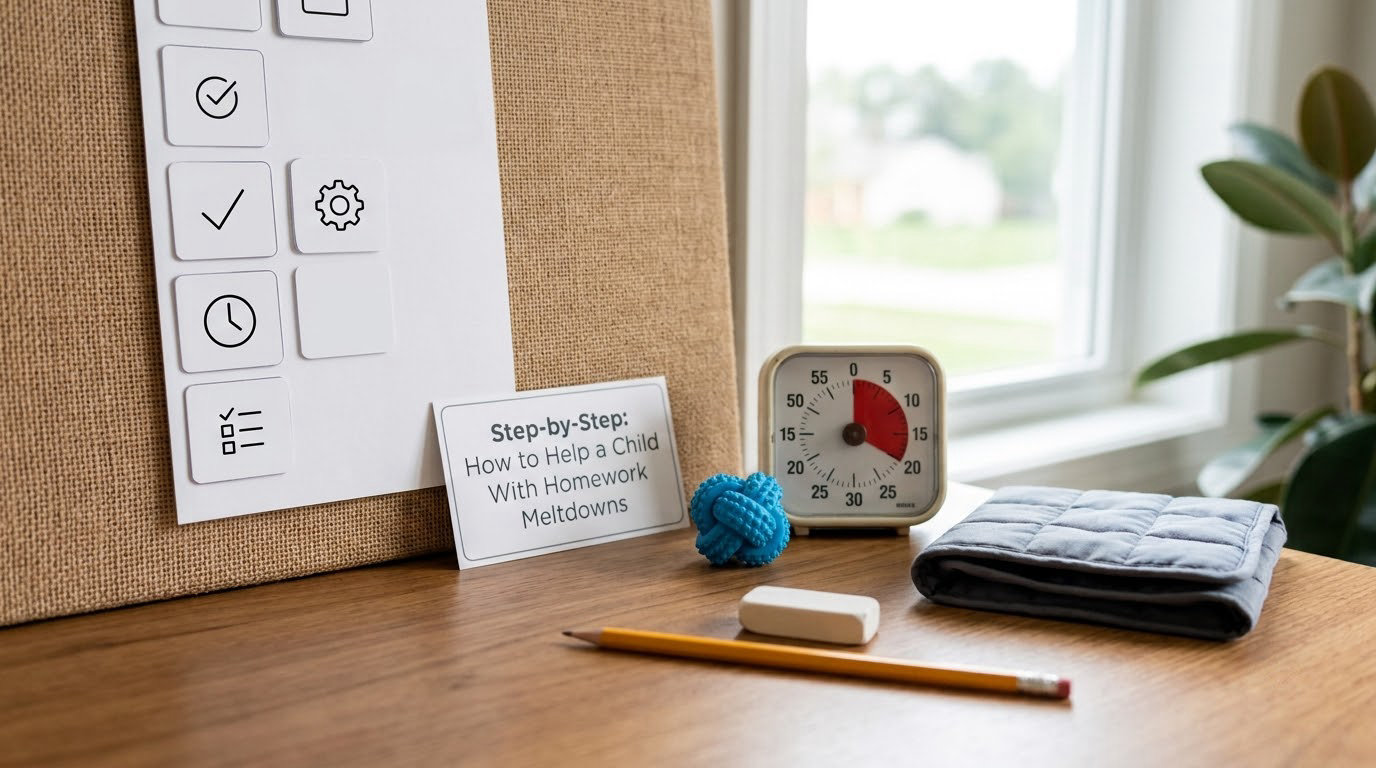
Six steps, in order, and they are meant to be used in order. Steps one and two are prevention, steps three and four are what you do in the middle, step five changes tomorrow, and step six tells you when the difficulty is bigger than a home routine.
Step 1: Notice Early Warning Signs
Early signs of a homework meltdown show up in the body and the pacing long before crying does. Catching the first one is usually the difference between a two-minute pause and a forty-minute recovery.
Watch for a change in voice, a repetition of the same question, slower or faster work, hands going still on the pencil, staring, heavier breathing, rocking or repeated questions about whether it is finished. Refusal to start, and the sudden flat affect of a shutdown, count as early signs too — a child who has gone quiet has usually already left the conversation.
| What you see | What it usually means | What it needs |
|---|---|---|
| Meltdown | Nervous system overwhelmed, past the point of reasoning | Less demand, lower sensory load, no reasoning, quiet space |
| Tantrum | Frustration at a specific obstacle, usually still responsive | Validation, connection, a simple clear limit, one idea at a time |
| Shutdown | Frozen, silent, withdrawn, minimal response | No questions, low light, warmth nearby, no demands at all |
| Refusal | Consistent, deliberate resistance, often before distress appears | Short predictable routine, two choices, follow-through without argument |
Parents in autism and ADHD groups often describe the same split that table makes: a child saying I can’t has a skill gap, and a child saying I won’t has a different problem. Both are worth taking seriously, and only one of them needs new instruction.
Step 2: Lower the Homework Demand
Most homework meltdowns are solved before they start by making the task smaller. If you reduce any one of the three ingredients — the demand, the sensory load, or the child’s depleted capacity — the odds of an evening blow-out drop sharply.
Shrink the pile. Do one problem, one word, one row, and then build up from there. The point is not to finish the worksheet in the smallest possible number of pieces; the point is to get the work started, because the first completed item changes the child’s relationship with the page.
Offer two choices instead of an open question. Should we do the red page or the blue one is manageable. Would you like to do maths or reading is too much to weigh at 5pm, and a question like that is also an exit ramp, because a question can always be answered with no.
Cut the work period. Five or ten focused minutes on a visual timer, then a real break, repeated three times, often beats forty minutes of hovering. Sitting nearby in silence works well; sitting over a shoulder correcting does not.
Give directions one at a time and model one item. Read the first question aloud, or do the first line together, then hand the pencil over. For handwriting, an alternative counts as the work: typing, speech-to-text, photos of work typed by an adult, or an oral answer the child gives while you write it.
Step 3: Support Regulation Before Refocusing
Once a child is dysregulated, nothing you say about the assignment will be heard. Stop the demand first, and treat the break as part of the routine rather than a consequence for bad behaviour.
Lower your voice, shorten your sentences and cut the number of people speaking to one. Turn off the overhead light if glare is a trigger, move somewhere quieter, and reduce words. An instruction delivered at full volume during a meltdown adds another demand to a system that has none to spare.
Then let the body do the work. Slow exhales that are longer than the inhales, wall pushes, a walk around the room, or a quiet corner with headphones all lower the physiological load. Ask nothing, correct nothing and keep the company calm and undemanding during this window.
There is a fuller breakdown of these regulation techniques in our guide to how to handle autism meltdowns at home — worth reading once, before you need it at 5pm.
If your child will not respond at all, stay nearby and keep talking about something else, in an ordinary tone. A shutdown usually ends with a restart, and being mid-conversation about the dog is a gentler landing than being asked directly whether they are ready.
Step 4: Reconnect After the Meltdown and Rebuild the Routine
The repair is what makes the next attempt possible. A child who was screamed at during homework is now dreading homework for reasons that have nothing to do with maths, and skipping that repair guarantees next week goes worse.
Return to a regulated child, not mid-meltdown. A short apology works better late than never, and it needs to name the behaviour rather than the child’s character: I raised my voice and that was not okay, is a sentence a child can actually hear.
Keep the boundary and drop the volume. Sorry is not the same as the work no longer happening. What usually works is a very small target — three questions, or one line of a paragraph — with a clear finish line so the child can see the end.
Then close the evening deliberately. Mark what got done, pack the folder for tomorrow, and let the last two minutes be something other than work. A child who ends the night feeling capable is easier to start tomorrow than one who ends it feeling behind.
Step 5: Adapt the Homework Plan
Change one variable at a time, because if you change five you will not know which one helped. Keep a one-week note of the time the meltdown started, what the task was, and what happened just before — three columns, no more than two minutes of writing a day.
Adjust the schedule first. Moving homework to earlier, or to a weekend morning, sometimes solves a problem that no amount of technique will. Some children do better with no homework on a hard day at all, and trading a night for another day keeps the follow-through intact.
Adjust the load and the medium next. Ask the teacher to cut the packet, accept an oral answer, or photograph the work. If the writing is the trigger rather than the thinking, changing the input is a real accommodation, not a shortcut.
Adjust the environment last, because it is the easiest to overlook and often the most dramatic: different chair, different room, music on, screens off, headphones on. Our guide to handling meltdowns at home covers how to build a calm-down space that works outside homework too.
Whatever you change, make it predictable. A new routine that appears without warning reads as another change, and children with sensory and transition sensitivity need the new thing shown before it is used.
Step 6: Seek Additional Support When Needed
Seek help when the pattern is frequent, when distress lasts most nights, or when homework distress is showing up in eating, sleep, school refusal or the child’s sense of being able to learn. Document what you have observed for a few weeks before the appointment — frequency, triggers, duration, what helped — because that record is more useful than memory.
Start with the teacher and then widen the circle. A homework folder problem, unclear instructions or an unreasonable amount assigned all sit with the school first. If the child has an IEP or a 504, ask specifically for accommodations around written output, reduced copying, extra time or a reduced assignment load, and ask how progress would be measured without them.
Beyond the school, a school psychologist or educational psychologist can assess the executive function and processing-speed load of the work, an occupational therapist can advise on the handwriting and sensory side, and a tutor can carry the task initiation you are currently doing by arguing. For a pediatrician, raise it alongside any other concerns about mood, sleep or anxiety — homework distress on its own is a common reason children are referred and rarely the whole picture.
None of this is a last resort, and none of it means you have failed at the routine. A child who cannot start the task is telling you the task does not fit, and that is information worth passing to someone who can change it.
Common Mistakes

These are the six moves I see most often in the evening, and the correction for each. Most parents are not doing them out of anger — they are doing them because the routine is not working and the alternatives feel worse.
Arguing about the homework itself
Arguing about the page gives a dysregulated child a debate to win and keeps the demand in the room. Correction: one neutral sentence about the boundary, then a break. You are not required to win the conversation, only to stay calm and keep the routine predictable.
Adding demands during the meltdown
Just one more, and then we are done, adds a second problem to a child who is already overloaded with the first. Correction: every demand out of your mouth during dysregulation is a new antecedent. Pause, reduce to nothing, and reconnect first.
Rushing a shutdown
Asking a withdrawn child whether they are ready, offering solutions and switching the light on will all read as pressure. Correction: sit nearby, keep the room quiet, resume an ordinary topic, and wait. A shutdown ends on its own schedule.
Treating a break as a consequence
When the break is something the child had to win, the next one gets negotiated or escalated. Correction: put breaks on the visual schedule in advance, so they belong to the routine instead of to the fight.
Demanding eye contact and an apology mid-crisis
Sorry is not a condition of recovery, and forced eye contact is often a sensory event in itself. Correction: the apology happens later, from a regulated adult, in plain words. Accept a repaired evening rather than a completed one.
Assuming yesterday’s method works tonight
What worked on a good Tuesday fails on a bad Thursday, and parents read the failure as a character problem rather than a capacity problem. Correction: keep your one-week trigger note and change one variable each time instead of judging the method or the child.
| Instead of | Try saying |
|---|---|
| Why won’t you just do it? | That is a lot of work. Do you want to do one row with me or on your own? |
| You are being lazy. | Your brain is out of room right now. Ten minutes, then we stop. |
| I do not care if it takes all night. | Here is the small piece. Tell me when you are ready for the next one. |
| Calm down. | You are safe. I am here. The pencil can wait a minute. |
| Stop crying, you are not that upset. | That was hard. Take your time. |
| If you do not finish, no screen tomorrow. | Finish this piece, then ten minutes of your choice. |
Two more things that quietly help: specific praise instead of general approval — not good job, but you read those three word problems without needing me twice — and sitting nearby in silence rather than monitoring every pencil stroke. Attention at the table is another demand, even when it is friendly attention.
None of the six fixes above work the same night for the same child twice, which is why people searching for how to help a child with homework meltdowns end up with a folder of tips rather than a routine. Pick one correction, run it for a week, and judge it on the evenings it prevents.
Frequently Asked Questions
How do I know if my child’s homework refusal is a meltdown or just frustration?
A meltdown shows up in the body: crying, screaming, dropping, aggression, or a sudden frozen silence that does not respond to your voice. Frustration usually stays verbal and responsive, and the child can still hear you and negotiate. Refusal sits in between, because it is consistent and deliberate rather than sudden. Watch what happens when you lower the demand: if the distress drops quickly, it was overload. If it stays flat, the child is telling you something about the task itself, which is a different conversation.
What should I do during a homework meltdown when my child will not respond?
Stop all homework talk. Turn down the lights and the volume, cut the number of adults talking to one, and stay in the room without asking questions. Keep mentioning ordinary things out loud, at a normal volume, so the child rejoins a conversation rather than a demand. Do not introduce a consequence, an apology request or an ultimatum during the shutdown. Once there is eye contact, a nod or a response, go straight back to a very small piece of work, or stop for the night.
How can I help a child with autism finish homework without making it easier to avoid?
Shrink the work until avoidance stops being the easiest option, then build back up over several days. One problem, then three, then half the page, is a well-established way to get a child moving. Keep the finish line visible with a visual timer and a checklist, and praise the specific behaviour of starting rather than the result. Changing the medium — typing, speech-to-text, or an answer the child gives you verbally — removes a sensory barrier rather than lowering an expectation.
Should I give my child a break when they are having homework meltdowns?
Yes, and put the break on the routine before it is needed so it does not become something the child has to win. Five or ten minutes on a visual timer, with a clear signal for returning, is usually enough. A break is not a reward and not a punishment, so keep it neutral in tone. If your child only accepts ever-longer breaks, shorten the work period instead of arguing about the break, and track what is happening so you can see whether the pattern is changing.
When should I talk to a teacher or healthcare professional about homework distress?
Talk to the teacher first when the workload looks unrealistic, instructions are unclear, or the child is missing schoolwork regularly, since those are school-side problems. Bring a professional in — school psychologist, educational psychologist, occupational therapist or pediatrician — when distress happens most nights, when sleep or eating changes, or when the child says things like I am stupid. Write down frequency, triggers and what helped for a few weeks first. A record of patterns is far more useful in the appointment than a description of one bad evening.
How can I reduce homework sensory overload at home?
Change the input, not the child. Swap fluorescent light for a lamp, move from a hard chair to a cushion or a lap desk, add noise-cancelling headphones, and turn off the television during the session. If handwriting is the trigger, offer typing, speech-to-text or an answer the child dictates while you write. Keep the table clear of everything that is not the task, and give directions one at a time. Sensory supports belong in the plan before the meltdown, not offered as a rescue afterwards.
If you do one thing tonight, shrink the work. Take the worksheet and put a sticky note on all but the first three questions, set a ten-minute timer, and turn the overhead light off. Do the same thing at the same time tomorrow, and change one variable at a time from there.
Homework meltdowns are hard because the evening repeats every single day. Most caregivers who search for how to help a child with homework meltdowns find that a predictable space, a smaller task, a break that belongs to the routine and a low-voice response to distress will not fix everything, but they change the odds more than almost anything else you can do from the kitchen table.