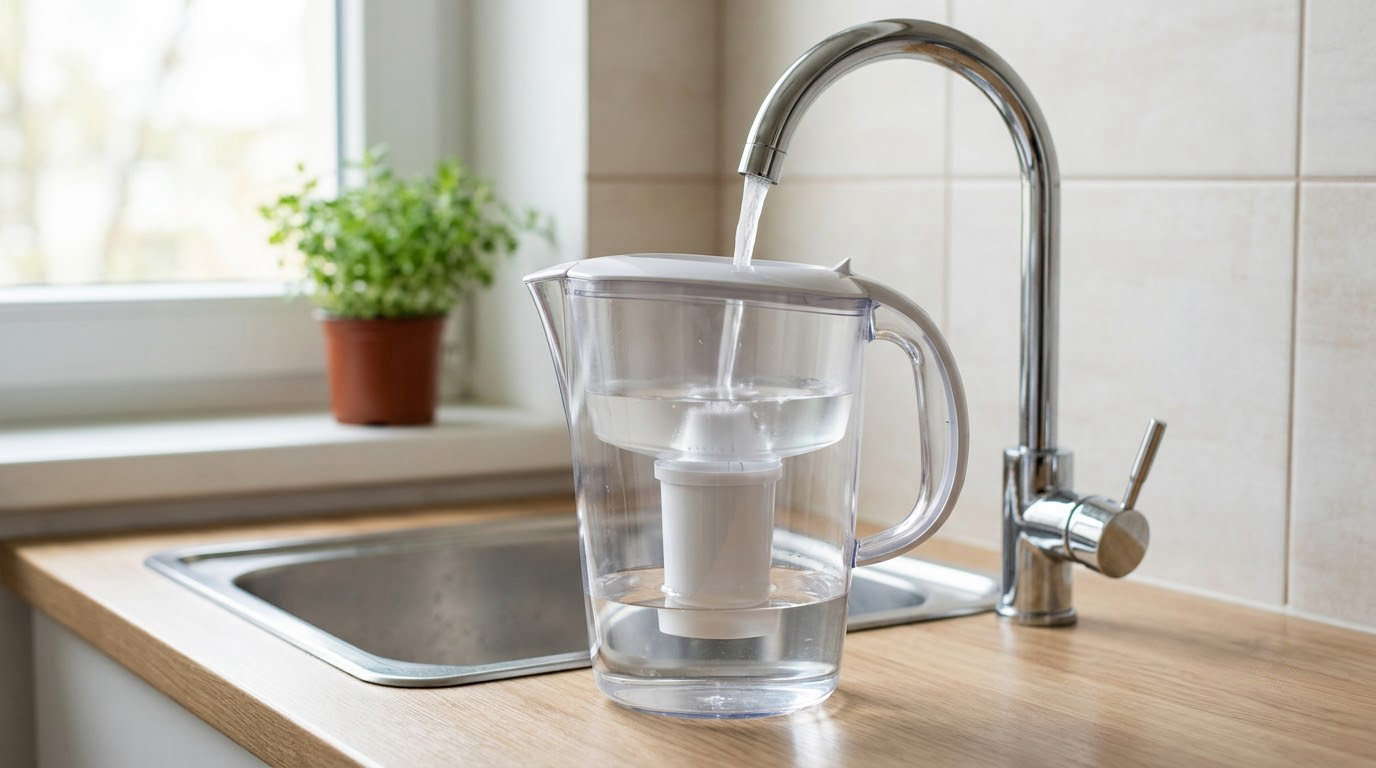
The fastest way to filter tap water at home is a screw-on carbon filter at the kitchen tap, and it takes about five minutes with no tools. But that’s only the right answer if the problem is chlorine taste or sediment. Lead, PFAS, nitrates and hard water each need a different filter, so the real process starts with your utility’s water report, not with a product page.
Here’s how I’d do it: read the report, name the contaminant, buy a filter certified for that contaminant, install it according to the manual, flush it, then keep a replacement date on the calendar. Whole thing, most homes, under an hour plus a plumber visit if you own the plumbing side of it.
I’m not a plumber or a water chemist. This is the general process that matches EPA and CDC guidance on household water treatment, with the honest limits spelled out.
Table of Contents
- What You Need
- Step-by-Step: How to Filter Tap Water at Home
- 1. Identify What You Want to Remove
- 2. Check Your Water Report and Plumbing
- 3. Choose a Filter That Matches the Problem
- 4. Install It Without Bypassing the Plumbing
- 5. Flush and Test the Filtered Water
- 6. Maintain a Schedule for Filtering Tap Water at Home
- Common Mistakes
- Frequently Asked Questions
- Is it better to use a pitcher filter or an under-sink filter?
- Do I need to filter tap water if my city water is generally safe?
- How often should I replace a home water filter cartridge?
- Does a carbon filter remove lead from tap water?
- Can a home water filter remove PFAS?
- When should I call a plumber or my water utility instead of installing a filter?
- Conclusion
What You Need
Most people start shopping before they know what their water contains. That’s backwards, because the cheap filter that solves nothing and the expensive system you never needed both start with the same ignorance. Gather these five things first.
Your utility’s annual water quality report. Clean water systems publish an annual Consumer Confidence Report, usually online and usually a PDF with a wall of tables. Search your city or water district name plus “water quality report” or “consumer confidence report.”
The material and age of your supply pipe. Find out whether the line coming into the house is lead, galvanized steel, copper or PVC, and how old it is. If the pipe material is unknown, the utility’s service line replacement records are usually the fastest place to check. On a private well, nobody publishes a report for you, so testing is the only way in.
Your actual problem. Write down one sentence describing what’s wrong. Chlorine smell, orange staining in the bathtub, cloudiness after rain, a metallic taste, a linty smell at the tap, or a specific worry about lead.
Certification numbers. NSF/ANSI 42 for taste, odor and sediment, NSF/ANSI 53 for health-related contaminants like lead and cysts, NSF/ANSI 58 for reverse osmosis. WQA certification serves the same role. A marketing adjective is not a certification.
Space and cost of ownership. Under-sink systems need vertical clearance under the sink and a small hole in the cold water line. Then look up the replacement cartridge price and its rated life in months or gallons, and multiply.
Step-by-Step: How to Filter Tap Water at Home
1. Identify What You Want to Remove
Different contaminants need different technologies, and one filter rarely handles everything. This table maps the common concerns to what actually reduces them.
| Contaminant or concern | Activated carbon | Sediment filter | Ion exchange (softener) | UV | Reverse osmosis |
|---|---|---|---|---|---|
| Chlorine taste and odor | Reduces | No | No | No | Reduces |
| Chloramine | Partial | No | No | No | Reduces |
| Sediment, rust, sand | Partial | Reduces | No | No | Reduces |
| Hard water (calcium, magnesium) | No | No | Reduces | No | Reduces |
| Lead and other heavy metals | Partial | No | No | No | Reduces |
| PFAS | Partial | No | No | No | Reduces |
| Nitrates, fluoride | No | No | No | No | Reduces |
| Bacteria and viruses | No | No | No | Reduces | Reduces |
| Cryptosporidium cysts | No | Partial | No | Reduces | Reduces |
Two honest limits belong right here. No home filter removes viruses in the main supply line reliably unless it is UV or RO, and no gravity or carbon filter makes unsafe water safe after a boil-water advisory. If your utility has issued an advisory, follow the advisory, not a filter.
Boiling is a different mechanism than filtering, which is why the two are not interchangeable. Boiling kills germs and leaves dissolved metals, salts, PFAS and nitrates in the water, and it concentrates them slightly as water evaporates. Filtering physically removes particles and many dissolved substances but does nothing to bacteria unless the filter is certified for cysts or has a UV stage.
2. Check Your Water Report and Plumbing
Open the utility’s report and search for your address or neighborhood. Systems that use chloramine say so explicitly, and that single fact changes which carbon filter you need. Chloramine is more durable than free chlorine, and some carbon cartridges designed for chlorine will not clear it.
Then check whether the utility has an active notice, boil-water advisory or lead service line replacement program in your area. Those notices live on a different part of the utility’s website than the annual report.
Find a cold water shutoff valve under the nearest sink and turn it on and off. If it doesn’t move freely, or there’s no valve, that’s a plumber job, not a DIY job. Also look at the space below the sink: an under-sink housing needs a few inches of vertical clearance and room for the tubing to bend without kinking.
3. Choose a Filter That Matches the Problem
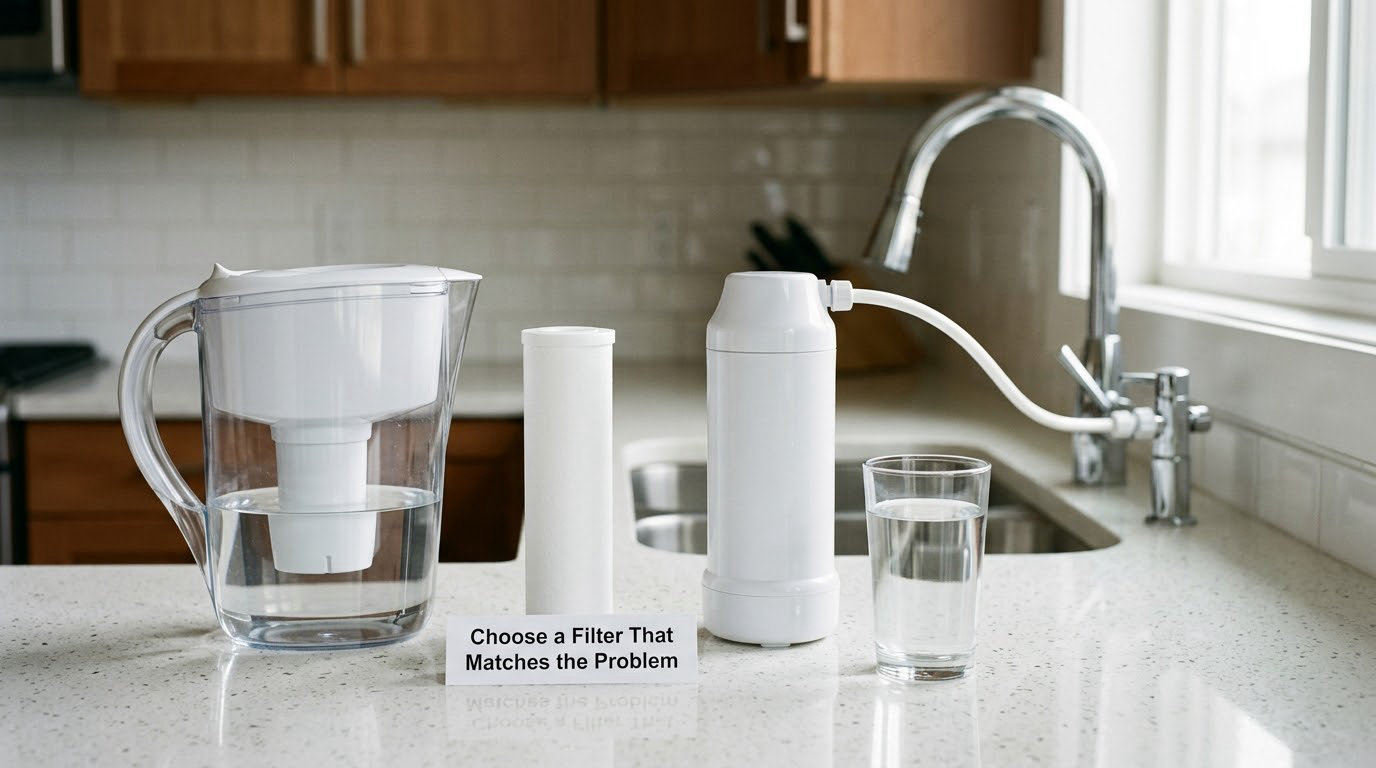
Match the technology to the row you care about in that table, then match the format to your household. Here is the short version of each format.
| Format | Best for | Install | Watch out for |
|---|---|---|---|
| Pitcher | Taste and odor, renting, easy testing | Fill it | Small capacity, frequent refills |
| Faucet-mounted | Chlorine taste in a single tap | Screw on, about 5 minutes | Not every faucet has a matching adapter |
| Under-sink carbon | Taste, odor, sediment, dedicated faucet | One hole in the cold line, 20-40 minutes | Space below the sink |
| Countertop | High flow without plumbing | Plug in, 5 minutes | Counter space, requires draining for storage |
| Reverse osmosis | Dissolved metals, PFAS, nitrates, fluoride, TDS | Under-sink, tank and faucet, 60+ minutes | Mineral stripping, waste water, more parts |
| Whole house (point-of-entry) | Well water, sediment and scale for the whole home | Plumber, main shutoff | Needs a professional and real planning |
Only RO meaningfully reduces dissolved metals like lead and PFAS at the levels that matter, and it needs a post-filter or remineralization cartridge because the membrane strips out much of the calcium and magnesium too. Mineral drops do the same job more cheaply, and the DIY version of the idea is a pinch of unrefined sea salt in a glass of RO water for taste.
Renters can stop at the pitcher, faucet-mount or countertop stage without putting a deposit at risk. Owners with known lead plumbing or a private well should talk to a plumber and to their health department before buying, and consider the point-of-entry and point-of-use split: one whole-house sediment stage to protect everything, then a dedicated drinking filter at the kitchen sink.
4. Install It Without Bypassing the Plumbing
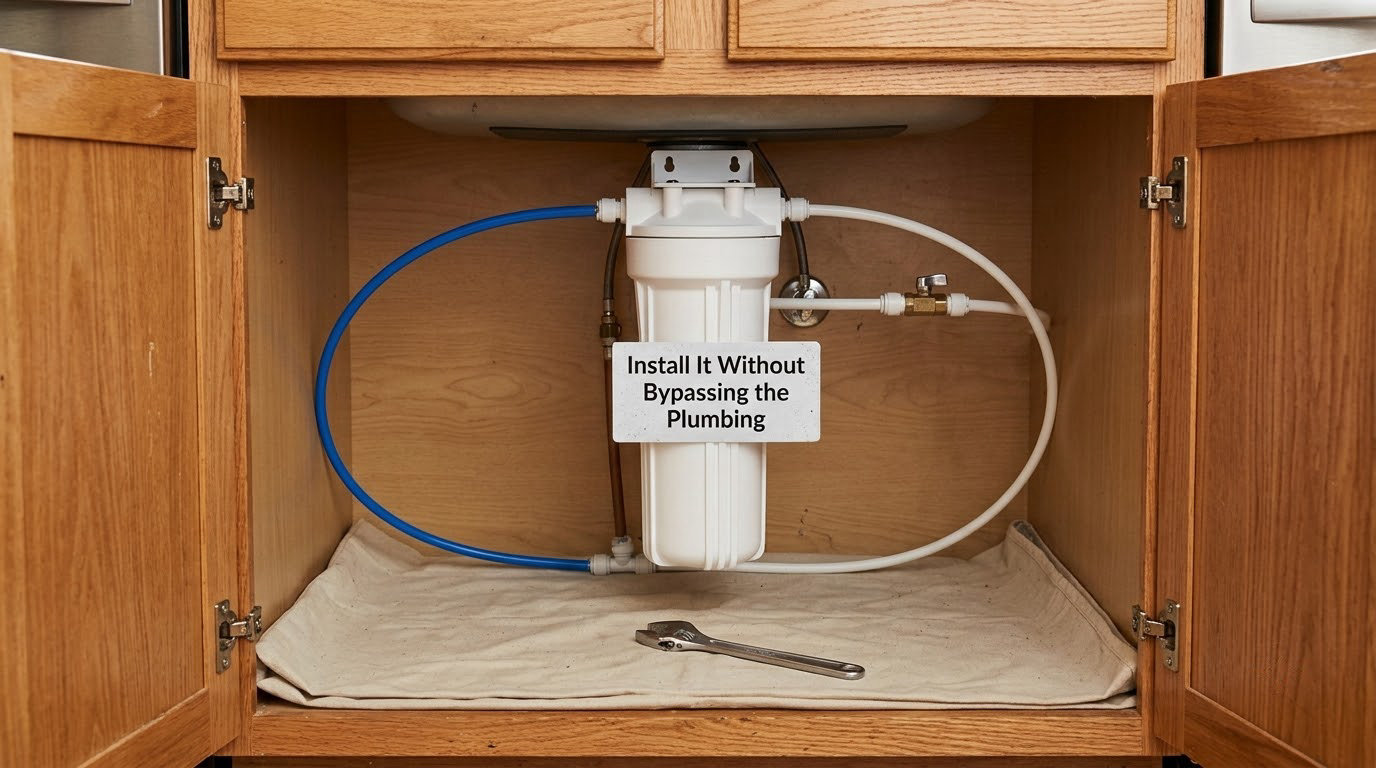
Follow the manufacturer’s instructions above anything else in this article. If the manual says to call a plumber, call a plumber.
For a pitcher, nothing to install. For a faucet-mounted filter, shut off the faucet, unscrew the existing aerator, hand-tighten the filter onto the threaded spout — no plumber’s tape and no wrench, because over-tightening cracks the finish — then fit the adapter sleeve over the spout and run water while holding a paper towel underneath to catch drips.
For under-sink, shut off the cold water valve, open a cold tap upstairs to relieve pressure, disconnect the existing cold line, cut the tubing with a sharp tubing cutter rather than a hacksaw, and push it into the housing and faucet ports until it seats. Keep the manufacturer’s flow direction arrows visible, mount the housing upright, and hold the housing up while you tighten so the housing doesn’t twist.
Sanitize where the manual says to sanitize, typically by running water through the new filter for the stated period before drinking any. Don’t improvise connections with tape and hope, and don’t skip the shutoff valve step because it’s under a cabinet and easy to forget.
5. Flush and Test the Filtered Water
Run cold water through a new activated carbon filter for the flushing period in its manual, commonly a few minutes. This clears carbon fines and manufacturing residue, and it’s the single most common beginner mistake in this whole process. Water straight out of a new carbon cartridge can taste bitter and carry black specks.
Then look for leaks at every connection with a dry paper towel, run the tap for two minutes, and check again. Feel the cabinet floor. A slow drip under a sink shows up as damp wood long before it becomes a puddle.
Taste the water side by side with unfiltered water from the cold tap. Chlorine smell should be noticeably different. If you want confirmation on a specific contaminant, use a certified test for that contaminant rather than a general strip. Home test strips catch a handful of parameters and miss most of the ones on that table, so a clean strip result does not certify lead or PFAS.
6. Maintain a Schedule for Filtering Tap Water at Home
Write the installation date on the housing itself with a paint pen, then set a calendar reminder for the rated life minus two weeks. Most “my filter stopped working” complaints are simply an overdue cartridge, and carbon that’s gone past its life can give water a worse taste than unfiltered tap.
| Format | Typical cartridge life | Replace when | DIY or pro |
|---|---|---|---|
| Pitcher | Roughly 2 months or a set gallon count | Taste returns or timer | DIY |
| Faucet-mounted | Roughly 3 months | Flow drops or timer | DIY |
| Under-sink carbon | Roughly 6-12 months | Timer, or pressure drops | DIY |
| RO pre-filters | Roughly 6-12 months | Timer | DIY |
| RO membrane | Roughly 2-5 years | TDS creep or manual schedule | DIY or pro |
| Whole-house sediment | Roughly 3-6 months, sooner on a well | Pressure gauge drop | Plumber recommended |
Change the whole schedule when anything changes upstream. Heavy rain on a well, a new water heater, or a utility that switched disinfectants can shorten cartridge life. If the routine feels like one more thing to track, that’s worth designing around, the same low-effort way we think about the routines in how to handle autism meltdowns at home: fewer steps, visible trigger, done.
Dispose of spent media thoughtfully. If the filter handled lead or other heavy metals, don’t compost it or spread it around the garden, since that just moves the contaminant into your soil and food chain. Wrap it and put it in the trash per local guidance.
Common Mistakes
Choosing a filter by taste alone. Water that tastes fine can still carry lead, nitrates or PFAS. Decide whether you’re chasing taste or a contaminant, because the second one needs a certification.
Assuming carbon removes everything. Activated carbon does not reduce lead or PFAS by a meaningful margin in most residential cartridges unless it is certified and specifically rated for it, and it does nothing for nitrate or fluoride. Reverse osmosis or a certified filter is the answer there.
Skipping the water report. A ten-minute read of the utility’s annual report tells you your disinfectant, whether you’ve been notified, and what the system is actually testing for.
Not flushing the new cartridge. Run it for the manual’s stated time before the first glass.
Ignoring leak checks. Every new connection gets a dry paper towel test and a two-minute run. Under-sink drips cause cabinet damage long before anyone notices.
Overlooking capacity and household size. A small pitcher cartridge in a four-person home runs dry early, which pushes people back to bottled water. Check the rated gallon life against your household’s drinking and cooking water use.
Buying a faucet-mount filter for an incompatible faucet. Pull-style and remove-only faucets need different adapters. Check the adapter included before you buy.
Delaying a call to a plumber or the utility. If you have a boil-water advisory, visible lead-soldered joints, a private well with no recent test, or a valve that won’t operate, stop shopping and make that call first.
Frequently Asked Questions
Is it better to use a pitcher filter or an under-sink filter?
A pitcher filter is fine for taste and odor, needs no plumbing, and lets you compare brands before committing. An under-sink filter gives you higher capacity, a dedicated faucet, and certifications for contaminants a pitcher usually lacks. Renters and anyone still deciding what problem they have usually start with a pitcher. Households that want lead or PFAS reduction at the tap should go under-sink or reverse osmosis, and check NSF/ANSI 53 or 58 certification on the label.
Do I need to filter tap water if my city water is generally safe?
Municipal water has to meet legal standards, so filtering is usually about taste, odor, sediment, and specific contaminants like lead from older plumbing that testing does not catch. Read your utility’s annual Consumer Confidence Report first, since it tells you your disinfectant and what has been detected. If that report is clean and the chlorine smell is not bothering you, filtering is optional rather than necessary. If there is a specific finding or a pipe-material concern, filtering is well justified.
How often should I replace a home water filter cartridge?
Follow the rated life printed on the cartridge, which is usually given in months or gallons. Pitcher and faucet-mounted carbon cartridges commonly last about two to three months, under-sink carbon about six to twelve months, and RO membranes two to five years. Treat that as a ceiling, not a suggestion: heavy sediment, well water, or a switch in disinfectant shortens it. Mark the install date and set a reminder, because an overdue cartridge can taste worse than unfiltered water.
Does a carbon filter remove lead from tap water?
Only if it is certified for it, and general-purpose carbon cartridges are not. A few residential filters are certified to NSF/ANSI 53 for lead reduction and use media specifically rated and tested for it. Reading the certification label matters more than the word carbon on the box. Reverse osmosis also reduces lead reliably. Because lead is rarely detectable by taste or smell, verify with a certified test for lead rather than judging by flavor.
Can a home water filter remove PFAS?
Reverse osmosis is the residential option with a reliable track record for reducing PFAS, and some point-of-use filters carry NSF/ANSI 53 or 58 certification naming PFAS specifically. Ordinary activated carbon cartridges and pitchers are not a dependable answer, since standard carbon media does not hold the full range of PFAS compounds. Check the certification claim for the exact compounds you care about, and confirm with a certified lab test if the stakes are high for your household.
When should I call a plumber or my water utility instead of installing a filter?
Call the utility if there is a boil-water advisory, a lead service line notice, or an unexplained change in water color or odor in your area. Call a plumber if the shutoff valve under the sink will not turn, if your supply pipe is lead or galvanized, if the space below the sink is too tight, or if you want whole-house filtration at the main shutoff. Follow any advisory from the utility rather than relying on a filter to make advisory water safe.
Conclusion
Start with two things this week: pull up your utility’s annual Consumer Confidence Report and look up the material of your supply pipe. Everything else depends on those two answers.
From there the path is short. Chlorine taste and odor means a screw-on or under-sink carbon filter rated for your disinfectant. Sediment means a micron-rated filter sized to the particle load. Hard water means ion exchange, not carbon. Lead, PFAS, nitrates or fluoride means reverse osmosis with a post-filter. Install per the manual, flush it, test it, date it, and replace on the schedule rather than on the symptom.