
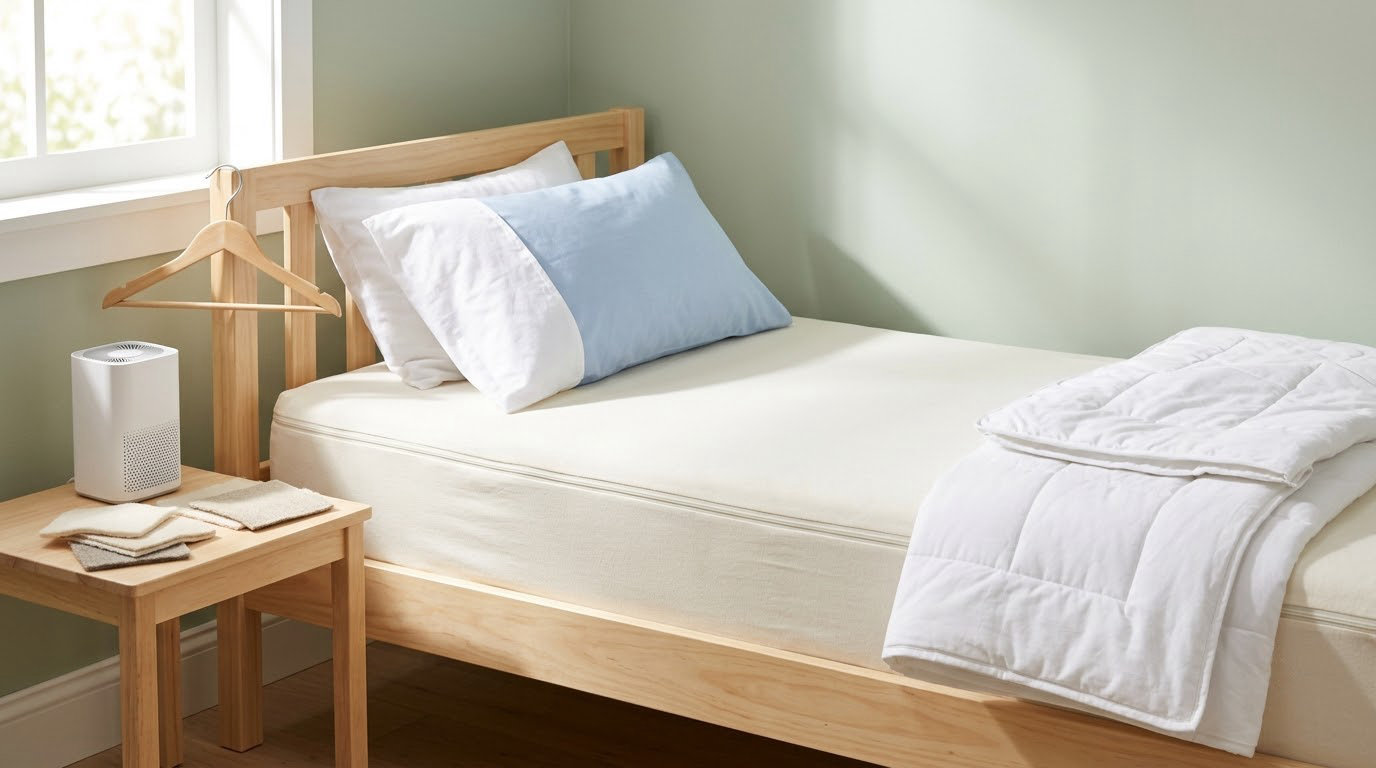
How to pick a mattress for a child with allergies: choose one with a washable cover or put the mattress inside a fully zippered allergen-impermeable encasement, keep the surface firm and breathable, and buy only from a seller who names a certification they hold. One warning up front: hypoallergenic is a marketing word, not a guarantee. Updated for 2026, this guide walks through the whole decision.
I spent a long stretch of my own life reading labels at eleven at night with a scratchy kid behind me, trying to work out which mattress was actually going to help. The honest answer I landed on is less satisfying than a shopping list: a mattress is one part of an exposure-control system, and it is often the smallest part.
Children spend ten to twelve hours in bed every night. That makes the mattress the largest soft surface in the room and the highest-dose contact point for dust mites, mold and chemical vapors. It is also the thing a parent can actually change.
Table of Contents
- What You Need
- Step-by-Step
- Identify the Child’s Allergy Triggers
- Choose Easy-to-Clean Covering Materials
- Check Ventilation, Firmness, and Safe Sleep Positioning
- Look for Transparent Safety and Material Certifications
- Test the Mattress Before and After Purchase
- Common Mistakes
- Maintain the Mattress to Reduce Allergen Exposure
- Frequently Asked Questions
- Are hypoallergenic mattresses actually good for children with allergies?
- What is the best mattress cover for a child with dust mite allergies?
- Is latex a good choice for a child with allergies?
- Should I choose memory foam or an innerspring mattress for allergies?
- How often should a child’s mattress be cleaned or replaced?
- When should a parent see a doctor about symptoms after changing mattresses?
- A Simple Starting Point
What You Need
Before you open a single shopping tab, gather a short list. Without it, mattress research turns into a browsing marathon that ends in a random choice.
- The child’s known triggers. Confirmed dust mite allergy, eczema, asthma, a latex sensitivity, or nothing diagnosed yet and you are guessing.
- Condition of the current mattress. Age, sagging dips, stains, smell, smells that appear in humid weather, and whether the cover has ever come off.
- Bed size and the base it sits on. Crib, twin, full, or a stack of foam cubes that will not take a traditional frame.
- A realistic budget range. Entry, mid, or premium. Not so you can buy the expensive one, but so you can spend on the right thing at your tier.
- Sleep position and sensory notes. Side, back, stomach, or a child who moves constantly. Also whether noise, tags, or strong smells bother them.
- Existing bedding. Can the duvet cover, pillowcase and sheet go in the washing machine with your child in the house right now?
- Medical guidance. If the child has a diagnosed allergy, eczema or asthma, ask their pediatrician, allergist or dermatologist what the trigger actually is.
That last one matters more than most parents expect. A lot of night-time coughing and scratching has nothing to do with the bed, and buying a mattress on a guess wastes money and several months.
Step-by-Step
Seven steps, in order. Each one tells you what to do and how you can tell it worked.
- Identify the trigger first. Write down what you actually know, and keep suspected causes separate from confirmed ones. You should be able to name the trigger or say plainly that you have not been told.
- Set your budget tier honestly. Decide which tier you are in before comparing brands, so you are not upgrading on looks.
- Choose the material based on the trigger. Latex, wool, cotton, memory foam and innerspring each fail differently. Match the material to the allergy, not to the marketing.
- Check certifications by name. A seller should name the certification and let you verify it. Vague words like clean, green and non-toxic are not certifications.
- Confirm washability and encasement fit. A machine-washable cover or a zip encasement that fits with a few inches of slack is worth more than any core material.
- Match firmness to age and get the size right. A firm, flat surface for infants; medium-firm from toddler age up. Check that it sits on a firm, flat, non-slatted base.
- Air it out and watch the symptoms. Let it sit in a ventilated room for two to three days before first use, then track night-time symptoms for several weeks.
Identify the Child’s Allergy Triggers
Start by separating a real allergen problem from a comfort or durability problem. Those get confused constantly, and they lead to different purchases.
Dust mites live and die inside mattresses, pillows and upholstery. Symptoms show up overnight: stuffy nose, coughing, itchy eyes, waking scratchy.
Mold needs moisture. Smells that show up in humid months, a damp musty smell near the bed, or dark speckling on the underside point at the frame or the mattress core, not the ticking.
Pet dander is not a mattress problem. It lives in the room, on clothing, in the carpet. A new mattress will do very little for you here.
Latex is the one parents miss most, because latex is usually the recommended answer. Reactions show as contact dermatitis, hives, wheezing or a new runny nose that starts in the bedroom and clears once your child leaves it.
Fragrance and VOCs show as irritation or cough with no other pattern, sometimes days after a new mattress arrives.
If symptoms involve breathing, come with an emergency, or keep coming back despite environmental changes, take your child to their pediatrician. Untreated rhinitis and eczema disrupt sleep, and children who sleep badly struggle at school the next day. An allergist can tell you whether a mattress is even part of the problem. This guide is general information about reducing exposure, not diagnosis or treatment.
Choose Easy-to-Clean Covering Materials
The cover matters more than the core. A mattress you cannot clean is a reservoir you sleep on for five years.
Look for a cover that unzips completely, comes off in one piece, and goes in a home washing machine. Tight micro-weave fabric blocks mites better than loosely woven ticking. Smooth surfaces with minimal seams and no deep quilting give you fewer places for allergen to settle.
Know the difference between a protector and an encasement. A mattress protector is a fitted sheet that stops spills. An allergen-impermeable encasement is a zippered bag woven so tightly that mites and their droppings cannot pass through. For a child with dust mite allergy, the encasement is the part that does the work.
Fit is everything. Get one with a few inches of slack on each side, or it will tear at the seam the first time a fitted sheet goes on. Brands that list the allergen or particle rating for the fabric are more useful here than brands selling the word hypoallergenic.
Washability also solves the problem parents mention most often: bedwetting and potty training. A mattress that survives a soaked sheet saves you replacing it, and one parent on r/toddlers described choosing a washable twin mattress precisely because it handled potty training and allergies at once.
Check Ventilation, Firmness, and Safe Sleep Positioning
Firmness guidance is about safety, not softness. For infants, the American Academy of Pediatrics recommends a firm, flat surface with no memory foam, no waterbed and no positioner wedges, and the mattress should fit the crib so nothing gets wedged between mattress and rail. For children past infancy, medium-firm is the practical target: supportive enough for a growing spine, soft enough that hips and shoulders sink in for side sleepers.
Ventilation matters more for eczema than most parents expect. Warm, damp bedding irritates broken skin and encourages mold in the core. Look for breathable fibers and a surface that releases heat rather than trapping it.
Check the base too. A slatted base with wide gaps lets a mattress sag between slats, and a soft platform or a sagging box spring changes the firmness your child actually sleeps on. If you are going to crib size, twin or full, check that the mattress matches the frame’s dimensions.
Look for Transparent Safety and Material Certifications
Certifications are the most repeated trust signal in this category, and most parents cannot say what any of them actually test. Here is the plain version.
- CertiPUR-US tests foam for volatile organic compounds, and requires the foam to be made without ozone depleters, PBDEs, TDCPP or TCEP flame retardants, lead, mercury and certain phthalates. It certifies the foam, not the whole mattress.
- GREENGUARD Gold certifies low chemical emissions and low total VOC emissions, tested through a full room protocol rather than a material swatch. Ask for the specific certification level, since GREENGUARD exists at more than one level.
- GOTS certifies the processing of organic textiles, covering the fiber, the dyes and the factories. It says nothing about the foam inside the mattress.
- OEKO-TEX Standard 100 certifies that the fabric has been tested against a list of harmful substances. It applies to the cover, not the filling.
Then check the flammability label. US mattress law requires a warning label about the flammability standard, and a mattress that quietly skips it or makes the label hard to read is telling you something.
Read the warranty and return policy with the same attention. Parents on forums keep describing the same disappointment: a highly recommended mattress sags inside two years. Look for a stated warranty length, a stated sag depth threshold, and a return window measured in nights rather than days. If the return policy requires keeping the packaging or removing nothing, that is a good sign. Certification tells you what was tested. It does not tell you your child will stop coughing.
Test the Mattress Before and After Purchase
In the store, unzip the cover if a demonstrator is available. Look for a dense, even surface, well-fitted seams and no visible gaps. Smell it: a strong rubber or chemical scent is a sign of off-gassing that has not finished, and it tends to persist once sealed in a plastic-wrapped box in a small bedroom.
At home, unbox it in a ventilated room and leave it two to three days before your child sleeps on it. Keep the room aired out during that window and leave the cover off if the manufacturer allows.
Confirm the base is firm, flat and in good condition, and check that the encasement does not lift the mattress or block airflow around the sides. Then track symptoms. Note night-time coughing, congestion, scratching, and how long it takes to settle to sleep. Give it four to six weeks of consistent bedding-washing habits before you judge the mattress, because you are changing two variables at once otherwise.
Common Mistakes
These are the mistakes that show up over and over, each with the fix that actually works.
Shopping by the hypoallergenic label. It is an unregulated marketing term with no standard test behind it. Fix: evaluate the cover, the washability, the certifications and the encasement instead.
Buying latex because it is the usual recommendation. Latex is the default low-allergen answer and also a common allergen. Fix: check whether your child has any latex sensitivity first, and if you are unsure, order something else.
Skipping the encasement. A low-allergen core does nothing about the dust already living in the mattress. Fix: budget for an encasement before you budget for the mattress.
Leaving the old mattress in the room. Moving a new mattress into a room that still holds the old one changes nothing. Fix: get the old mattress out of the bedroom entirely, or wrap it fully.
Buying something you cannot return or cannot wash. Fix: confirm the return window in nights before you order, and check that the cover fits in a home washer.
Expecting symptoms to change by themselves. New mattress, same cough, then the search starts over. Fix: fix the bedding, the humidity and the room before you blame the mattress again.
Ignoring the age band. A crib mattress that fits a three-year-old on a toddler frame can gap around the edges, which is a suffocation risk. Fix: re-check size and fit whenever the bed changes.
Maintain the Mattress to Reduce Allergen Exposure
Follow the manufacturer’s care instructions first, since cleaning advice differs by core. On top of that, the following is what the allergy guidance and the practical consensus both point at.
- Wash all bedding weekly in hot water. Dust mite droppings dissolve with heat. Dry it hot too, not just warm.
- Use allergen-impermeable encasements on mattress and pillows. Wash the encasement on the same schedule as the bedding.
- Vacuum with a HEPA vacuum, slowly. Move it off the bed every time and vacuum the mattress top, sides and the floor around it.
- Hold indoor humidity between 30 and 50 percent. Higher humidity feeds both mites and mold. A cheap hygrometer tells you where you actually are.
- Keep the mattress surface bare. No piles of plush toys, thick comforters or loose blankets on the mattress itself.
- Skip soft furnishings where you can. Carpet, rugs and fabric headboards near the bed hold allergen even when the mattress does not.
- Rinse your nose with saline before bed if your clinician has recommended it, and follow their plan for any prescribed treatment.
If your child is autistic or has sensory sensitivities, the same rules apply with a few extra filters worth looking for: a tagless cover, quiet coils, and a surface that does not smell chemical on arrival. Consistent predictable firmness also matters more here than for a typical child, since an unfamiliar feel can take weeks to settle.
Frequently Asked Questions
Are hypoallergenic mattresses actually good for children with allergies?
Partly. Hypoallergenic is an unregulated marketing word with no standard test attached, so it tells you very little on its own. What does help is what the label often obscures: a removable machine-washable cover, a tightly woven surface, verifiable CertiPUR-US or GREENGUARD Gold certification, and a fully zippered allergen-impermeable encasement fitted over the mattress. Judge the mattress on those things, not on the word on the box.
What is the best mattress cover for a child with dust mite allergies?
An allergen-impermeable zip encasement is the cover that matters, not a fitted protector. Protectors stop spills; encasements are woven tightly enough that mites and their droppings cannot pass through. Buy one with a few inches of slack on each side so it does not tear when the fitted sheet goes on, and confirm the fabric carries a particle or allergen rating. Wash the encasement weekly in hot water with the bedding.
Is latex a good choice for a child with allergies?
It depends entirely on the child. Natural latex is genuinely resistant to dust mites and mold because nothing organic eats it, which is why it is recommended so often. But latex is also a common allergen, and reactions show up as hives, contact dermatitis, wheezing or a runny nose that starts in the bedroom and clears on the way out. If your child has any known sensitivity, or you are unsure, choose a washable cotton, wool or hybrid core instead.
Should I choose memory foam or an innerspring mattress for allergies?
For a child with a diagnosed dust mite allergy, both need an encasement, but for different reasons. Memory foam is closed-cell and resists mite penetration, yet the surface fabric, seams and any ticking still harbor allergen, and the core cannot be washed once it is dirty. Innerspring coils collect more in the seams and must never be exposed. Choose based on washable cover and encasement fit first, and expect more off-gassing from foam.
How often should a child’s mattress be cleaned or replaced?
Wash the encasement and all bedding weekly in hot water, and follow the manufacturer’s instructions for the core itself, since cleaning advice differs by material. Vacuum the mattress top and sides with a HEPA vacuum whenever you do the bedding. Plan on replacing a mattress every five to seven years, or sooner if it sags, smells in humid weather or has a cover you can no longer wash. Frequent accidents are a reason to replace, not to patch.
When should a parent see a doctor about symptoms after changing mattresses?
See your child’s pediatrician if symptoms involve breathing, come with an emergency, or do not improve after six weeks of consistent environmental changes. Untreated rhinitis and eczema disrupt sleep, and children who sleep badly struggle at school. An allergist can tell you whether the mattress is even involved, and a dermatologist can advise on eczema skin-barrier care. A general guide like this one can help you reduce exposure, but it cannot replace their advice.
A Simple Starting Point
Start with the encasement, not the mattress. Buy a correctly sized allergen-impermeable zip encasement for the current mattress, wash all bedding weekly in hot water, hold humidity between 30 and 50 percent, and run the room for four to six weeks. That path costs far less than a new mattress and it is the step most often skipped.
If symptoms do not change, get the trigger identified before you spend anything else. Once you know what you are dealing with, choose a firm breathable surface at the right size, a washable cover or encasement, and a named certification you can verify. Ask your child’s pediatrician or allergist when the trigger is unclear or the symptoms involve breathing, and keep the old mattress out of the bedroom either way.