You can improve indoor air quality at home by doing three things: control pollution sources, increase ventilation, and filter the air. The order matters. Removing a source at the point it is created beats any machine you can buy, and a purifier works best in a home that is already aired out and dry.
Most of the work is free. Open a window, run the bathroom fan while the shower runs, take the shoes off at the door, wash the furnace filter. Spend money only after the cheap steps are already in place, and only on the pollutant you can actually name.
That last part matters more in some homes than others. Children with asthma or allergies react at levels adults shrug off, and sensory-sensitive kids often get headaches and agitation from fumes that nobody else notices. Infant lungs keep developing until roughly age seven, so what seems like a minor irritation in an adult can be a bigger deal in a small body.
Table of Contents
- What You Need
- How to Improve Indoor Air Quality at Home, Step by Step
- 1. Identify and Remove Indoor Air Pollutants
- 2. Increase Ventilation Without Losing Comfort
- 3. Use the Right Filtration
- 4. Clean Without Spreading Dust or Adding Fumes
- 5. Control Moisture and Prevent Mold
- 6. Make Low-Tox Choices for the Whole Family
- 7. Measure Progress and Make It a Routine
- Common Mistakes
- Frequently Asked Questions
- What is the best way to improve indoor air quality at home?
- Can an air purifier remove all indoor air pollution?
- Should I keep windows open when outdoor air quality is poor?
- What indoor humidity level is generally comfortable for a family home?
- How do I know if a musty smell means I have mold?
- Are air fresheners and scented candles bad for indoor air quality?
- Start With the Biggest Source of Pollution
What You Need
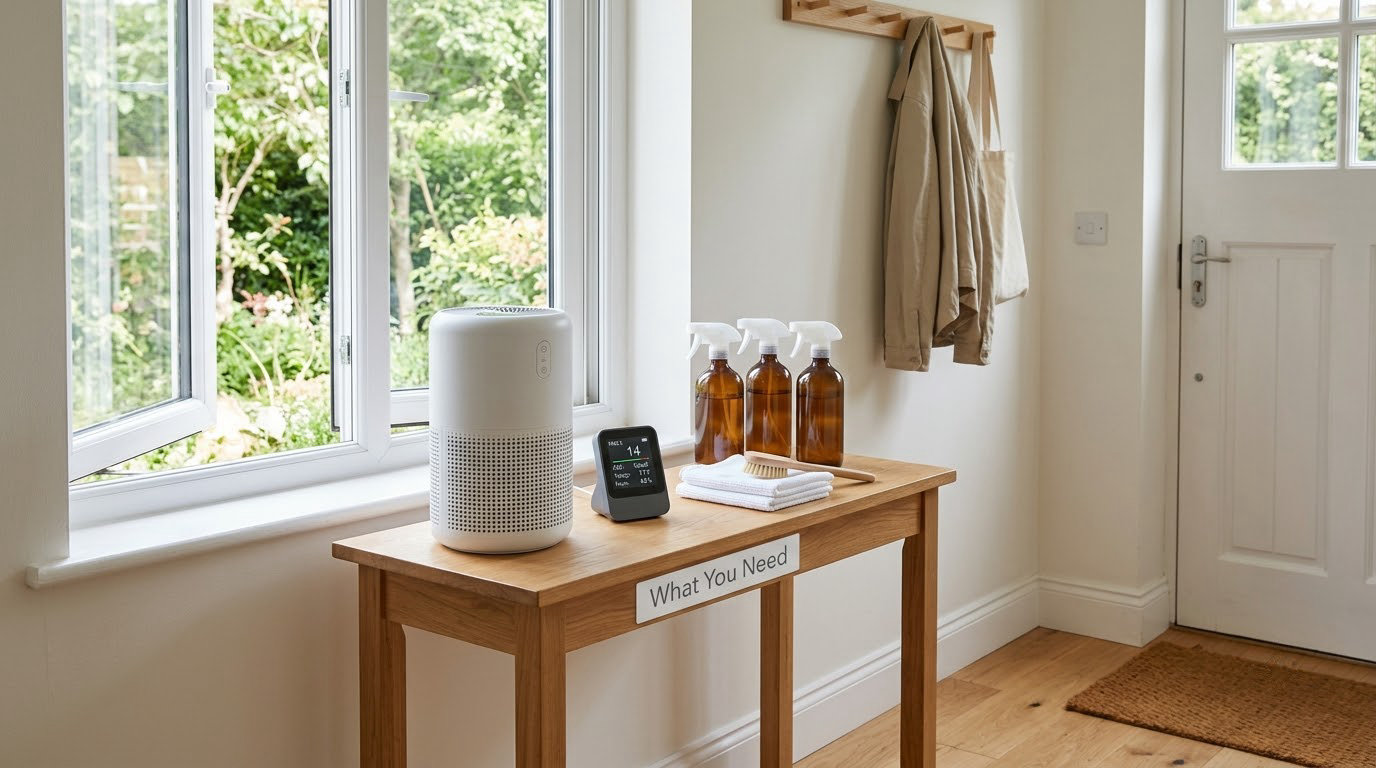
Start with a pencil and a walk through your home. Note every source you can smell or see: smoke, cooking grease, a musty closet, a damp basement corner, a new sofa, an aerosol can. That list decides what you spend money on.
From there, a short supply list:
- A ventilation check. Do your kitchen and bathroom exhaust fans run, and do they vent outdoors rather than into the attic? Free.
- Damp cleaning supplies. Microfiber cloths, a mop, fragrance-free soap. Free.
- A humidity monitor. A cheap hygrometer that shows a number beats guessing from the feel of the floor.
- A replacement HVAC filter. Match the size printed on the old filter housing and buy the highest MERV rating the system allows.
- Optional: a HEPA vacuum, a portable air cleaner with a true HEPA filter, or a monitor that reads PM2.5 and CO2.
Not every home needs equipment. A house with good airflow, no smoke, and no new furniture needs a new filter and a sponge. A house with pets, carpets, and an older duct system needs more. Decide after the walk-through, not before.
How to Improve Indoor Air Quality at Home, Step by Step
These seven steps are in order of impact. Skipping ahead to equipment is the most common mistake people make, and it is the step where money disappears fastest.
1. Identify and Remove Indoor Air Pollutants
Most indoor pollution comes from something you chose or something that leaked. Cigarette smoke and vaping aerosol, scented candles, incense, plug-in air fresheners, diffusers, aerosol cleaning sprays, harsh drain cleaner, new carpet, particleboard furniture, and paint all add something to the air.
You cannot remove all of it, so remove the biggest source first. If someone smokes inside, that conversation comes before anything else on this list. If the scent comes from a candle burning eight hours a day, the candle goes, not the other three sources.
New furnishings and paint off-gas volatile organic compounds, including formaldehyde from particleboard and plywood adhesives, strongest in the first weeks. Ventilate hard during that window, keep new furniture out of a child’s bedroom until it has aired, and choose low-VOC paint next time. Caregivers on r/AirQuality consistently rank the scent sources as the easiest wins because they cost nothing to remove.
2. Increase Ventilation Without Losing Comfort
Cross-ventilate: open a window on two sides of the house so air moves through rather than just entering one opening. Even ten minutes in the morning and again at night moves more air than you would expect, and in a closed-up winter house it matters more than any other single habit.
Run the kitchen exhaust fan whenever you cook, especially with a gas stove. Turn on the bathroom fan during the shower and for another 10 to 15 minutes afterward, because that moisture keeps soaking into surfaces after the shower ends. If a fan sounds like it is blowing into an attic or a closet rather than outdoors, it is doing nothing useful for your air.
There is a catch that most pages skip: check the outdoor AQI first. On a clean day, open everything. On a wildfire smoke day or a high-pollen morning, shut the windows, close the curtains, and run your filtration instead. Opening a window when the outdoor AQI is in the unhealthy range simply brings the problem inside.
3. Use the Right Filtration
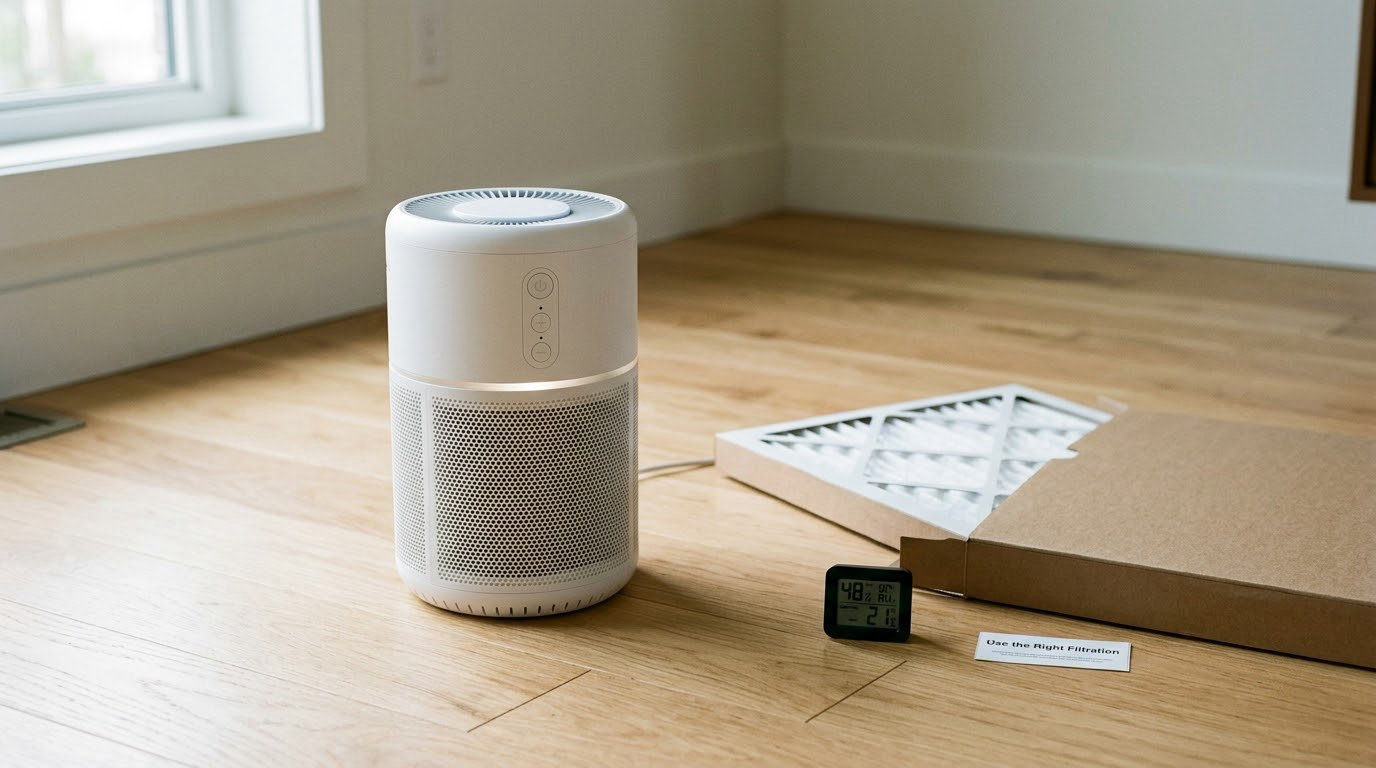
Three filters do three different jobs. Your HVAC filter catches what the duct system delivers to the rooms. A portable air cleaner captures particles in one room, including the ones your ducts never see. A HEPA vacuum removes dust and allergens from carpet and upholstery before they resuspend into the air.
Replace the HVAC filter every 90 days, or sooner in a home with pets or heavy cooking. A dirty filter works like a sieve full of lint: airflow drops and pressure builds in the ductwork.
Sizing a portable air cleaner comes down to one number. Multiply room length by width by height for the volume in cubic feet, then choose a unit whose CADR, or clean air delivery rate, for smoke covers roughly two thirds of that volume. A clean air delivery rate in air changes per hour is another way to say it; six air changes per hour is a reasonable target for a bedroom with an allergy-prone child.
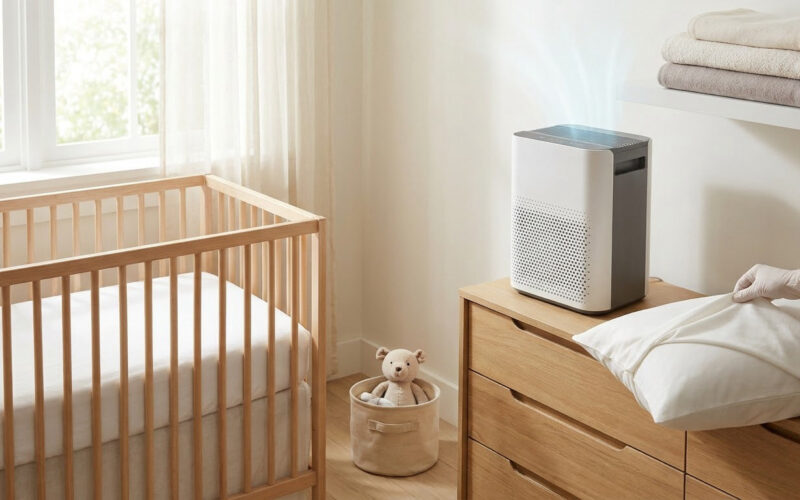
Placement matters as much as size. Put the unit in the room where the person spends hours, not where there is floor space. Keep it a foot or two off the wall so air can move, and run it continuously on low, or on high while you are cleaning.
4. Clean Without Spreading Dust or Adding Fumes
Dry dusting pushes dust into the air for other people to breathe. Dampen your cloth first, or use a microfiber mop, and clean top to bottom so whatever falls lands on a surface you have not cleaned yet.
Ventilate while you clean. That includes spraying anything, from glass cleaner to furniture polish, which is exactly why pump bottles and soap-and-water mixes beat aerosol cans. Aerosols put their contents directly into the room air; a spray put into a cloth does not.
Bedrooms deserve extra attention. Wash bedding weekly on hot, use mattress and pillow covers, and keep stuffed animals and books off the floor. Sleeping is roughly a third of your life, so a bedroom is where air quality work pays off most. When a child has asthma, an allergist or pediatrician can help you build a bedroom checklist that fits their specific triggers.
One warning: mold is different from dust. If you see mold spreading, coming back after cleaning, or covering more than about 10 square feet, stop scrubbing and get it professionally assessed. Bleach on a wall looks like a fix and changes nothing.
5. Control Moisture and Prevent Mold
Keep indoor relative humidity between 30 and 50 percent. Below 30, dust gets drier and more easily airborne, and sinuses dry out. Above 50, mold and dust mites start to win.
Buy a hygrometer and check it in a few rooms, especially the basement, bathroom and bedroom. Persistent readings above 50 percent mean you need action: run a dehumidifier, fix the leaking pipe, move the laundry dryer away from a damp wall, or improve exhaust. A dehumidifier lowers moisture; it does not remove particles, so it is not a substitute for an air cleaner.
In winter the same rooms may drop below 30 percent. A humidifier fixes that, and many parents on r/AirQuality prefer a cool-mist unit for a child’s room over warm mist, partly because cool mist leaves less mineral residue behind. Clean the tank often. A dirty humidifier is a mold source, which is the opposite of the goal.
6. Make Low-Tox Choices for the Whole Family
Scent is a chemical, not a neutral detail. Air fresheners, scented laundry detergent, dryer sheets, candles, wax melts and diffusers all add volatile organic compounds, and they are especially hard on sensory-sensitive children. For a lot of families on this site, unscented everything is not a preference, it is the difference between a calm evening and a hard one.
Fragrance-free is usually also the better buy chemically. Products labelled fragrance free legally can still carry a masking scent, so look for the phrase certified fragrance free or check that plant-derived essential oils are out of the ingredient list. Pump bottles over aerosols. Vinegar, baking soda and dish soap handle most household cleaning without fumes.
Keep the same rule for the rest of the house: shoes off at the door, doormats at each entrance, and no idling cars or wood-burning appliances attached to the living space. The family that spends nine hours indoors is also the family that notices the difference.
7. Measure Progress and Make It a Routine
You do not need equipment to start, but a single monitor that tracks PM2.5 and CO2 changes the conversation from guessing to knowing. CO2 is the useful one: it rises when a room is stale and falls fast when you open a window, so it tells you whether your ventilation habit is working. PM2.5 tells you whether smoke, dust or cooking is getting into the air.
Place it at breathing height, about 3 feet up, and away from a vent, a window or a purifier outlet. Ignore VOC and formaldehyde meters unless you specifically suspect new furniture; consumer sensors for those are noisy and not very reliable.
Set a baseline before you change anything. Record a weekday morning, a cooking hour and an evening reading for a week. Then change one habit, leave it for a week, and compare. Big fixes show up fast; a new HVAC filter takes longer.
Turning this into a routine is what makes it stick:
- Daily: range hood and exhaust fan during cooking and showers, shoes off at the door, no candles or plug-in scents.
- Weekly: wash bedding hot, damp-wipe surfaces, vacuum with a sealed or HEPA system, check the humidity reading.
- Monthly: inspect the filter, wipe the vent grilles, look under sinks and at window trim for damp or mold.
- Seasonally: run fans during pollen season, keep windows shut on smoke days, air out new furniture, check for ice and condensation.
Common Mistakes
Relying on air fresheners. They mask odor by adding more chemicals. Ventilate, absorb, or remove the source instead.
Opening windows on a bad air day. Cross-ventilation helps when the outdoor AQI is good. During smoke or heavy pollen, shut the windows and run filtration.
Buying a purifier before checking the filter and the fan. Most of the air moving through a home comes through the duct system. A clogged filter limits everything downstream.
Leaving the range hood off while cooking. Oil smoke and fine particles stay suspended for hours. Run the hood before the burner lights and for 10 minutes after.
Filling the house with scented products. More fragrance means more VOCs, and for a sensory-sensitive child it can mean a headache or a meltdown. Unscented is a real intervention, not a lifestyle choice.
Ignoring a musty smell. That is mold or a moisture problem, and no purifier fixes a water source.
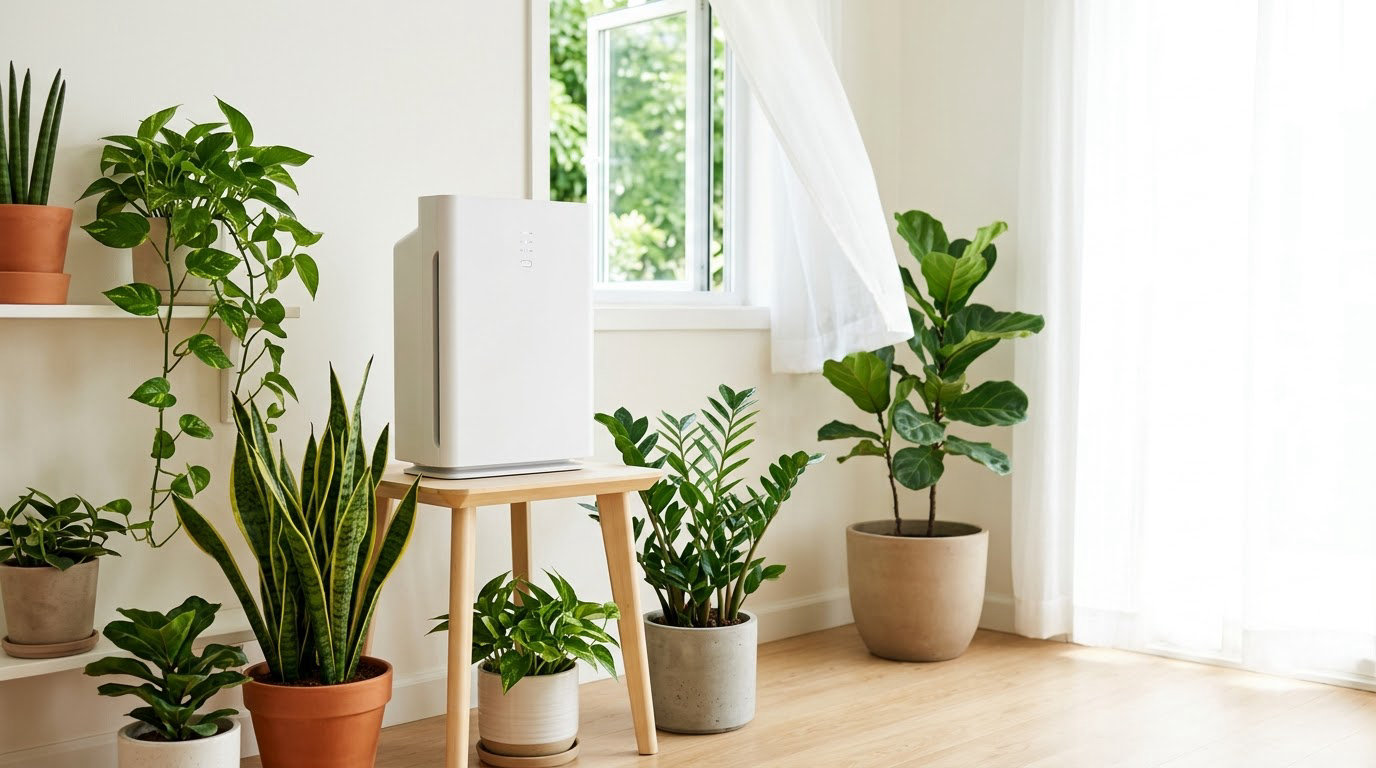
Believing houseplants will clean the air. You would need hundreds of plants in a sealed room to match the output of one modest air cleaner. They are decoration; treat them that way.
Two more worth naming, because both get recommended anyway: ionizers and ozone generators are not HEPA substitutes, and a dehumidifier does not filter particles. Buying either expecting the other job is a common waste.
Frequently Asked Questions
What is the best way to improve indoor air quality at home?
Start by controlling pollution sources at the point they are created, then increase ventilation, then filter what remains. In practice that means removing smoke, scented products and aerosol cleaners, running exhaust fans while cooking and showering, and keeping windows open when the outdoor AQI is good. Only then add filtration. Equipment cannot outrun a source that is still producing.
Can an air purifier remove all indoor air pollution?
No. A true HEPA unit captures fine particles like dust, pollen, pet dander and PM2.5 very well, including many VOCs, but it does nothing about carbon dioxide, radon, or most gases unless it has an activated-carbon filter. It also cannot remove a source. A purifier in a home full of cooking smoke and open windows is working harder for the same result as one in a controlled room.
Should I keep windows open when outdoor air quality is poor?
No. Closing windows and curtains is the standard advice on days when the AQI is unhealthy, especially during wildfire smoke. Run your HVAC filter and portable air cleaner instead, and keep physical activity indoors. Once the AQI drops below about 50, cross-ventilate again. Checking the reading takes ten seconds and prevents the most common ventilation mistake families make.
What indoor humidity level is generally comfortable for a family home?
The EPA recommends keeping indoor relative humidity between 30 and 50 percent. Below 30 percent, dust becomes more airborne and dry sinuses are common, which is worse for asthma. Above 50 percent, mold and dust mites thrive. A small hygrometer in the bedroom and basement is enough to keep track, and a dehumidifier is the usual fix for persistent high readings.
How do I know if a musty smell means I have mold?
A musty smell usually means somewhere is damp and organic material is growing on it, though smell alone cannot confirm it. Check under sinks, behind appliances, in basements, around window trim and near any known leak. If mold appears in an area of roughly 10 square feet or more, or returns after cleaning, have it assessed professionally rather than scrubbing it, since bleach on a porous surface changes appearance without fixing the water source.
Are air fresheners and scented candles bad for indoor air quality?
They add chemicals rather than removing anything. Candles, incense, diffusers and plug-in fresheners release volatile organic compounds, and aerosol sprays put their contents straight into the room air. For most people that is unpleasant and unhelpful; for children with asthma or sensory sensitivities it can mean headaches, irritation or a hard evening. If your household already avoids scents on that basis, air quality is one more solid reason to keep it up.
Start With the Biggest Source of Pollution
If you do one thing this week, walk through your home and identify the loudest pollution source. Smoke, scented products, a leaking pipe, cooking smoke with no range hood. Remove it or reduce it, and most of the rest of this guide becomes easier.
Second, move the air. Exhaust fans during cooking and showers, cross-ventilation on clean days, windows shut and curtains drawn on smoke days. Third, and only then, add filtration: a fresh HVAC filter, a hygrometer, and a HEPA air cleaner in the room where someone sleeps if the first two are already in place.
Indoor air is typically far dirtier than the air outside it, which is why a few small habits beat expensive equipment. Children with asthma or sensory sensitivities feel the result first, which is usually how families notice the improvement. This guide was checked for 2026.