

A day program for a young adult is a weekday daytime service, usually with no overnight stay, where adults with autism or another developmental disability work on life skills, job skills, and community participation alongside peers. Finding one means building a shortlist, touring programs, checking staff training and sensory fit, and sorting out who pays.
Start earlier than most families think you should. Waiver waiting lists run long in many states, and school-based services legally end at 21, so the search is really a transition-year project rather than a last-minute errand.
This guide walks through the whole process: what to gather before you call anyone, six steps from first search to first day, the mistakes that waste months, and what to do when the fit is wrong.
Table of Contents
- What You Need
- A written list of goals
- A support-needs summary
- A realistic picture of the daily routine
- Eligibility and funding paperwork
- Transportation details
- A simple comparison checklist
- How to Find a Day Program for a Young Adult: Step by Step
- 1. Define what a good day looks like for your young adult
- 2. Search for a day program for a young adult in your area
- 3. Check whether the program fits their support needs
- 4. Visit and ask concrete questions
- 5. Review transportation, costs, and scheduling
- 6. Try the program and monitor how it is working
- Common Mistakes
- Frequently Asked Questions
- What is a day program for a young adult with autism?
- How do I find an autism day program near me?
- Does Medicaid pay for a day program for a young adult?
- What should I look for when visiting a day program?
- What if no day program is available in my area?
- How do I know whether a program is helping my young adult build independence?
- What to Do First
What You Need
Programs ask for specific information, and families who arrive with it get further in the process. A one-page summary of your young adult is usually enough to start a conversation with several programs at once.
A written list of goals
Three to five goals, in plain language. For example: catching a bus to work independently, managing sensory overload during group activities, or holding a part-time job. Vague goals like getting more independence make it hard to tell whether a program is helping.
A support-needs summary
Note communication method, whether your young adult uses AAC, level of supervision needed in public, toileting and bathing support, medication needs, mobility or accessibility requirements, and any behavior support plan currently in place. Autism support varies enormously between two people with the same diagnosis, and programs need specifics rather than a label.
A realistic picture of the daily routine
What does a good day look like? Work, community outings, a quiet structured afternoon, physical activity? Some young adults do best with high structure and few transitions. Others need choices and community time. Programs build schedules around participant strengths, so tell them plainly what your young adult responds to.
Eligibility and funding paperwork
Gather the diagnostic documentation, proof of age, and any determination of eligibility you already have. If you are not sure, ask your state developmental disabilities agency what a determination requires. Many families apply for a Medicaid home and community-based services waiver at the same time they start looking for programs, because a waiver can fund a program that private pay cannot.
Transportation details
How will they get there and back? Some programs provide transportation within a set radius. Many do not. If family members cannot do the daily drive, a program without transportation is not an option, no matter how well it fits. Check this early, because it eliminates good programs fast.
A simple comparison checklist
One page, same columns for every program you visit. Staff-to-participant ratio, staff autism training, sensory space, whether staff use person-first respectful language, transportation, progress reporting, schedule flexibility, cost and funding source. Comparing three programs in your head on a tour gets blurry by the third one.
How to Find a Day Program for a Young Adult: Step by Step
1. Define what a good day looks like for your young adult
Write down the goals before you browse programs, not after. The list keeps you from being swayed by a nice facility that cannot actually address your young adult’s needs.
Most goals fall into a few buckets: independence in daily life, job skills or supported employment, health and self-care routines, making and keeping friendships, managing sensory needs, and getting out into the community. Pick two or three to start. Programs do better with a focused plan than with a dozen aspirations.
How do you know it worked? You have a short, specific list you can repeat to any program, and you can tell whether a tour visit actually addresses those goals. If a program’s day is mostly sitting in a circle, that is worth knowing before enrollment, not after.
2. Search for a day program for a young adult in your area
Four places to search cover nearly every option. Search all of them, because no single directory is complete.
Your state developmental disabilities agency. This is the starting point for a waiver application, an eligibility determination, and a list of providers in your region. The agency can tell you what services exist in your county, not just statewide.
Your Medicaid office or the state’s HCBS waiver program. Home and community-based services waivers fund day supports for eligible people, and the waiver is often the difference between a program being affordable and being impossible. Ask specifically how to join the interest or waiting list, and how long the list currently is.
Local Arc organizations and other nonprofit disability providers. Arcs run day programs, supported employment, and family support in many communities, and they are often the least bureaucratic place to start asking questions.
Vocational rehabilitation and state licensing databases. Your state vocational rehabilitation office can connect you with job training and supported employment, and the state licensing database tells you which programs are actually certified to serve people with developmental disabilities.
Online directories and search terms complete the list. Search for day habilitation programs, adult day services for developmental disabilities, and autism day programs near me. Availability varies a lot by location, especially in rural areas, where the nearest program may be an hour away with no transportation.
How do you know it worked? You have a shortlist of five to ten programs within a realistic travel distance, and you know which of them accept your funding source.
3. Check whether the program fits their support needs
Fit matters more than reputation. Compare each program against the specific needs you wrote down rather than against a general impression.
Look at who the program serves. Some cater to people who need substantial daily support. Others are built for people who are largely independent and need structure, community access, or job coaching. A commenter on r/disability described the frustration of being 85 to 90 percent independent and then being offered nothing but sitting and supervision, because the program only knew how to serve one kind of need.
Then check staffing. Ask for the staff-to-participant ratio, how much turnover the program has, and whether staff have training in autism and in the specific supports your young adult uses. Consistent, familiar staff matter more than impressive-sounding certifications.
Check the physical and sensory environment. Noise level, lighting, a quiet room, room to move, and how a busy schedule feels to someone sensitive to it. Ask how communication supports like AAC are used and whether visual schedules are built into the day.
Check the administrative basics: accessibility of the building, the vans, and the places they go on outings, plus their emergency procedures and medication practices.
How do you know it worked? You can point to the specific features that match your young adult’s needs and name at least one where the program falls short.
4. Visit and ask concrete questions
Tour at least two programs before you choose. One visit tells you very little.
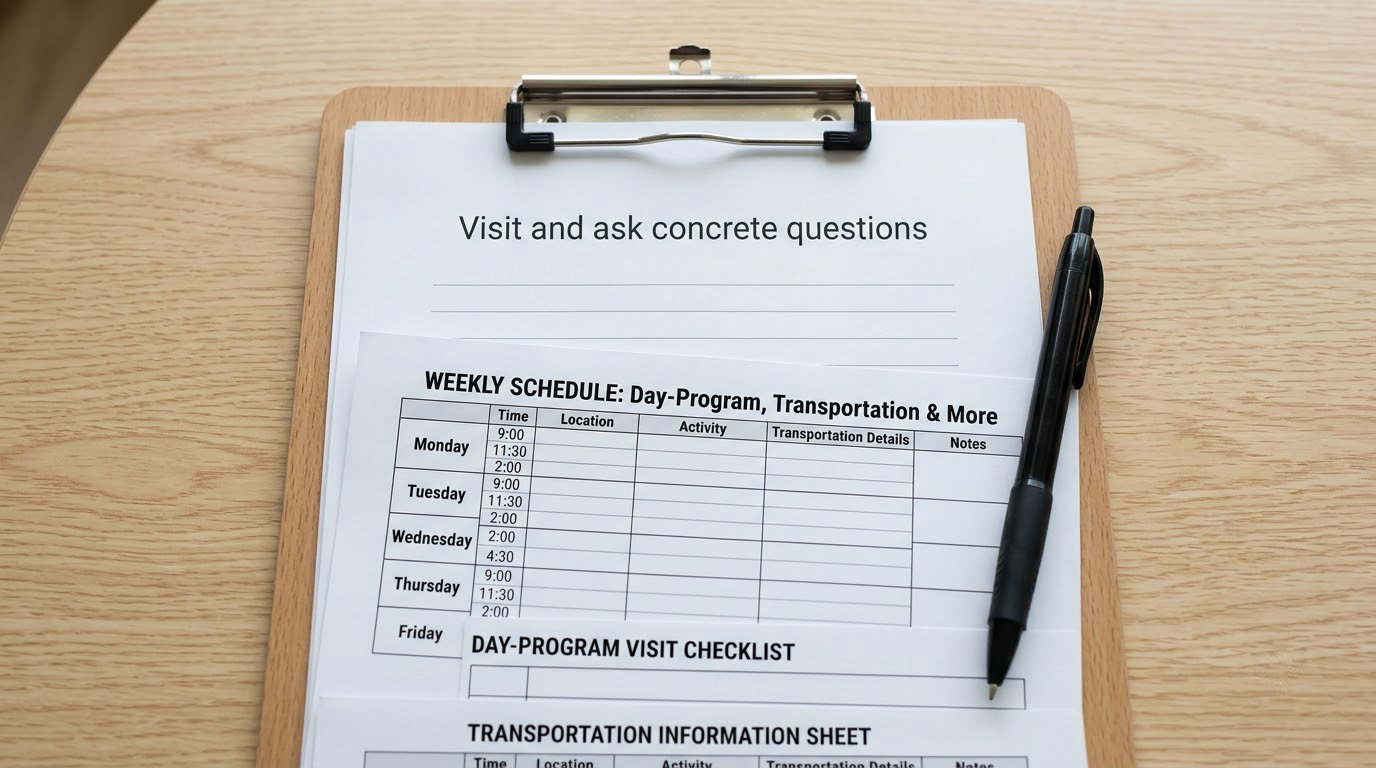
Watch how staff speak to the participants. That is the fastest read on a program, and parents on r/SpicyAutism point at it as the quickest way to judge. Staff who use a baby voice, talk down to adults, or answer questions about the participants as if they are not in the room have already told you how your young adult will be treated.
Ask questions with specifics attached. Staff who say they offer sensory accommodations should be able to name the room and describe what happens during a meltdown. Staff who say they track progress should be able to show you a sample report.
A tour checklist worth using:
- What is the staff-to-participant ratio, and how much did the last year of turnover look like?
- How many of your staff have autism-specific training, and how often is it renewed?
- What does a typical day look like hour by hour, including how much choice participants get?
- How do you support communication, including AAC and visual schedules?
- Is there a quiet or low-stimulation space, and how is it used?
- What is your staff-to-participant training plan for behavior support and de-escalation?
- How do you handle emergencies and medical needs, including medication?
- What accessibility issues exist in the building, the vans, and outing destinations?
- How do you write and review an individualized service plan, and how often do families see it?
- How do you measure progress, and can you show me a sample report?
- What is the schedule, and how flexible is it for appointments or a part-time schedule?
- Do you provide transportation, and within what radius?
- Which funding sources do you accept, and what costs fall on the family?
- Is there a trial period or a gradual start option?
- May I speak with another family, and unannounced, can I visit again?
Two tactics that families report as unusually useful. One parent suggested visiting unannounced if possible and asking to speak with current participants about an ordinary day. Another suggested touring with a group of other parents, agreeing on shared questions beforehand, and comparing notes after each visit. Both reduce the loneliness of the search and make it harder for a program to put on a show.
How do you know it worked? You have notes for each program on the same questions, and you know who to call for a reference.
5. Review transportation, costs, and scheduling
Work out the full weekly and annual commitment, not the daily rate. Add the program fee, transportation, meals, any equipment or therapy costs, and the hours your family spends getting someone ready and dropped off. A day that looks affordable per session can be a large annual number once everything is counted.
Then look at funding. Most day programs are paid through a Medicaid home and community-based services waiver or a state developmental disabilities agency contract, which is why eligibility determination and the waiting list matter so much. Vocational rehabilitation can fund job coaching and supported employment. Private pay is often the only option when a waiver is unavailable, and it varies widely by region and by how much support the person needs.
Medicare is not the payer for day programs, which is a common source of confusion in search results. Day supports for developmental disabilities run through Medicaid and state agencies, not Medicare.
On scheduling, test the hours against the rest of your family’s week. If appointments, therapy, a part-time job, or a sibling’s schedule collide, say so during the search rather than after. Flexibility is a real factor in choosing between two otherwise similar programs.
How do you know it worked? You know exactly who pays, what the family owes, and how the hours fit the week.
6. Try the program and monitor how it is working
Ask for a trial period or a gradual start. Many families worry most about the first day, and a short trial makes the transition manageable for everyone.
Set three measurable goals in writing before the first week. Track progress against them with the program on a fixed schedule, monthly at minimum. Ask for the same format each time so you can see change rather than read a fresh narrative each month.
Watch for warning signs. Parents describe programs that look fine on paper and turn out to be supervised sitting with little structure or engagement. Other warning signs: an identical schedule for everyone with no individualized plan, staff turnover, no quiet space, and vague progress reporting. If the fit is wrong, talk to your case manager first, then to the program’s director in writing, and keep a record. If the response is still nothing, your state agency has a complaint process, and in a serious safety situation there are adult protective services and the 988 Suicide and Crisis Lifeline for a family member in crisis.
Signs it is working look plainer: your young adult has people they look forward to seeing, a predictable morning, a skill they can show you, and a calmer evening at home. Track those too.
How do you know it worked? You can answer, with a specific example, whether your young adult is building independence. If you cannot answer that after a few months, the program has not shown you.
Common Mistakes
Choosing on convenience alone. The nearest program with open hours is easy to find and often a poor fit. Check staffing and sensory fit first, then see whether transportation can be solved.
Ignoring transportation until the first week. A program that is fifteen minutes away on paper can be an hour and a half with traffic, two transfers, and no backup driver. Solve this before signing.
Starting without a written plan. Without goals, you cannot measure whether the program is working, and you cannot push for a better individualized service plan. The fix is one page, written before the first tour.
Skipping staff qualification questions. Ask about autism training, turnover, and behavior support training. A program that cannot answer concretely has told you something.
Not visiting, or visiting alone. A brochure is marketing. A tour is information, and touring with other parents makes it sharper.
Confusing a day program with medical or behavioral care. A day program supports daily life, community participation, and skills. Ongoing medical, psychiatric, or behavioral treatment is a separate service from a separate provider.
Waiting too long to start. Waiver waiting lists, agency reviews, and tour scheduling all take time. Starting at 17 or 18 gives you options before services end at 21.
Starting at full schedule with no ramp. A gradual start, even a partial first week, is a reasonable request and one most programs have agreed to before.
Frequently Asked Questions
What is a day program for a young adult with autism?
A day program is a structured, community-based service that runs during weekday daytime hours with no overnight stay. Participants work on life skills, job skills, social skills, and community participation, often with a mix of group activities and one-to-one support. Each participant has a written plan, and the program tracks progress against goals set with the family.
How do I find an autism day program near me?
Start with your state developmental disabilities agency, which can confirm eligibility and list certified providers in your county. Then search your Medicaid office for home and community-based services waiver information and how to join the interest list, contact local Arc organizations, and check your state licensing database. Search terms like day habilitation and autism day programs near me pull up the rest.
Does Medicaid pay for a day program for a young adult?
Often yes, but only through a home and community-based services waiver or a state agency contract, not as a standard benefit. Eligibility depends on your state rules and usually requires an eligibility determination and a waiver application, and there is often a waiting list. Apply early. Private pay and vocational rehabilitation funding exist for people who do not qualify or are still waiting.
What should I look for when visiting a day program?
Watch how staff speak to the participants first, because that reveals more than any brochure. Then ask about staff-to-participant ratio, staff turnover, autism-specific training, sensory accommodations such as a quiet space, how AAC and visual schedules are used, and how progress is measured. Ask to see a sample individualized service plan and a sample progress report, and request a reference family.
What if no day program is available in my area?
Ask your state developmental disabilities agency about providers serving neighboring counties and about supported employment and in-home services funded through a waiver. A community-based program with fewer hours can fill part of the gap. Join a waiting list anyway, because openings and new programs appear, and ask local Arc and disability organizations whether they know of a start-up.
How do I know whether a program is helping my young adult build independence?
Set three measurable goals in writing before the start, then ask for a progress report on the same schedule each month. Look for a skill your young adult now does without help, a wider circle of people they are comfortable with, a calmer response to stress, and consistent attendance. If months pass and you cannot name a specific example, ask the program how it measures outcomes.
What to Do First
Call your state developmental disabilities agency this week and ask two things: how to get an eligibility determination, and how to join the home and community-based services waiver interest list. Those two answers set the clock for everything else, and the list position is the part you cannot speed up later.
While that is in motion, write your young adult’s three goals on one page. Programs that can connect their day to those goals are the ones worth touring, and goals in hand make the tours quicker and easier to compare.