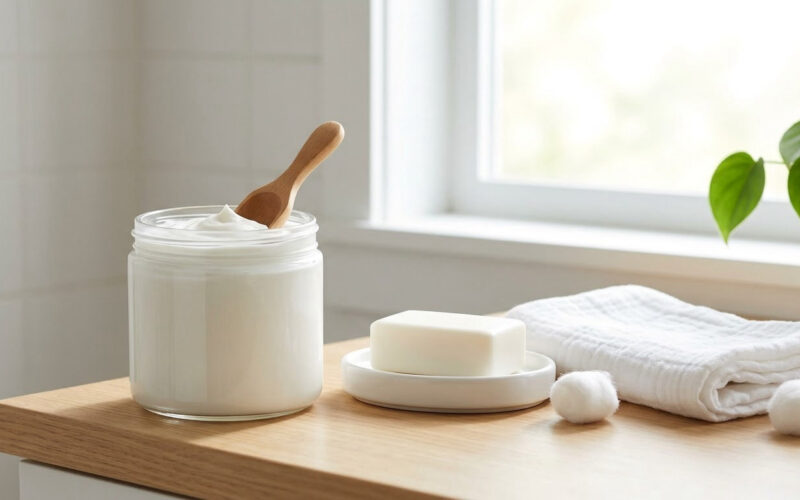
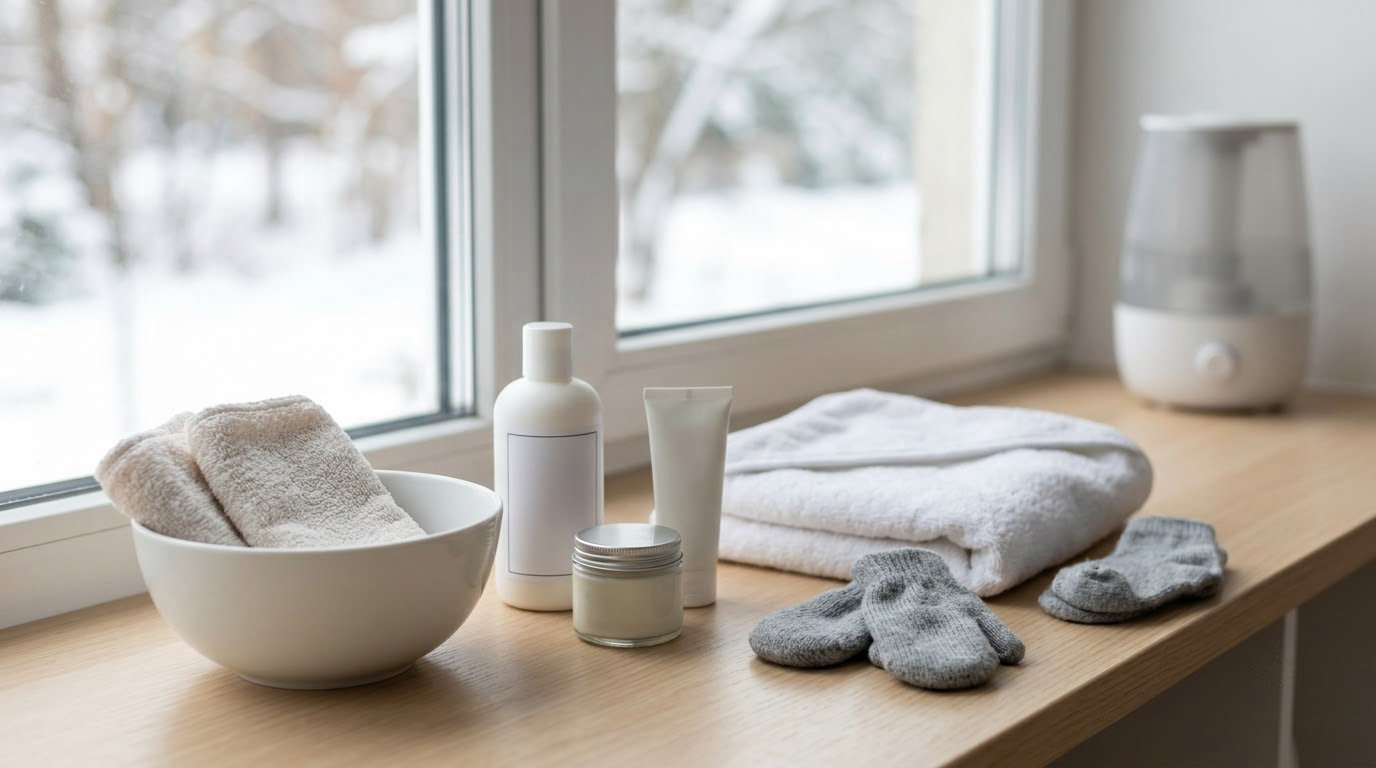
How to soothe dry winter skin on children comes down to three habits: shorter lukewarm baths, moisturizer applied while the skin is still damp, and fragrance-free products used more often than you think you need. Cold outdoor air and heated indoor air both pull water out of your child’s skin barrier, so the routine has to put back what the air takes out.
That barrier is the outermost layer of skin, a thin film of water and natural oils that keeps moisture in. Winter strips it twice: cold dry air outside, and forced or central heat inside, which can drop a bedroom’s humidity to desert levels in a week. Add frequent handwashing, hot baths and wind, and the barrier stops keeping water in. What parents call winter dryness has a clinical name, xerosis, and it shows up as rough, flaky, tight, itchy patches that eventually crack and sometimes bleed.
The routines below are general care, not medical advice. If a rash is weeping, yellow-crusted or spreading, or if your child has a fever or looks unwell, contact your pediatrician rather than trying another lotion.
Last reviewed: October 2026. Guidance aligns with general advice from the American Academy of Dermatology and the National Eczema Association.
Table of Contents
- What You Need
- Step-by-Step: How to Soothe Dry Winter Skin on Children
- How to shorten baths without drying the skin
- How to apply moisturizer for longer-lasting relief
- How to protect a child’s face and hands outdoors
- How to improve indoor air and clothing habits
- How to soothe dry winter skin on children who flinch at every lotion
- Common Mistakes
- When to contact a pediatric healthcare professional
- Frequently Asked Questions
- How to treat extremely dry skin in kids?
- What is the best moisturizer for children’s dry skin?
- Why is my child’s eczema getting worse in winter?
- How do I stop my child from scratching dry skin at night?
- How often should I moisturize my child in winter?
- When should I call the pediatrician about dry skin?
What You Need
You do not need a shelf full of products. Most of what matters costs almost nothing and is already in the house.
- A fragrance-free, dye-free cleanser for face, hands, feet and the diaper area. If the label lists fragrance, parfum, or essential oils, put it back on the shelf.
- A plain ointment for the driest spots: cheeks, nose, knuckles, elbows, shins. Petroleum jelly and similar thick barriers work well and cost pennies.
- A bland cream for the whole body. Creams sit between lotion and ointment and are easier to spread over large areas than a heavy ointment.
- Soft cotton towels, washed without fabric softener. Rough or scratchy terrycloth adds to the problem.
- A laundry detergent free of dyes and perfume, plus no dryer sheets, which deposit their own fragrance onto clothing.
- A cheap hygrometer or humidifier display so you are not guessing about bedroom humidity.
- A lip balm without flavor or fragrance for chapped lips, kept where your child can reach it.
If your child has eczema, a diagnosed skin condition, or reacts to products often, talk to your pediatrician before starting anything new. They can point you toward a specific product class that suits your child’s skin rather than you trialling a dozen at once.
Step-by-Step: How to Soothe Dry Winter Skin on Children
- Keep baths to 5 to 10 minutes of lukewarm water.
- Use a small amount of fragrance-free cleanser, and skip scrubbing.
- Pat dry with a soft towel and press rather than rub.
- Apply moisturizer within about 3 minutes, while the skin is still damp.
- Choose cream or ointment over lotion for the driest patches.
- Reapply two or three more times a day, and after every handwash.
- Keep the bedroom between 30% and 50% humidity, with a clean humidifier running at night.
How to shorten baths without drying the skin
Hot water feels wonderful on itchy skin, and it is the single most counterproductive thing in most winter routines. Warm water strips the oils that seal the skin, so the relief lasts about ten minutes and the tightness afterward is worse than before.
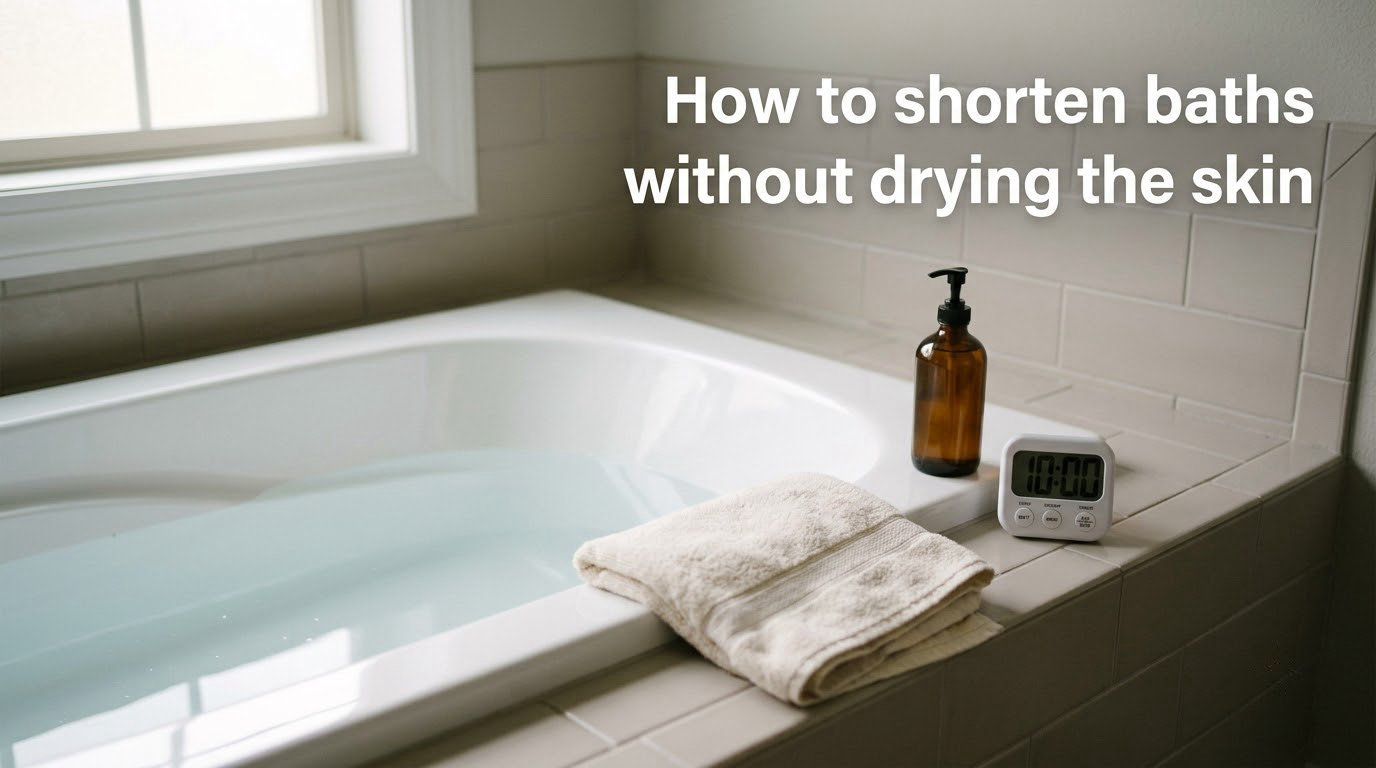
Fill the tub so it feels closer to body temperature than to shower temperature. If you are not sure, run it on your inner wrist first; it should feel neutral, not hot. Keep the whole bath between 5 and 10 minutes, and 5 for babies, then out. Two or three baths a week is usually enough in winter unless your child plays outside heavily or has swim lessons.
You do not need to soap the whole body. Use a small amount of fragrance-free cleanser on the parts that need it: hands, feet, bottom, behind the knees, and the face. Parents often use a different, milder face product, which is fine as long as it is not fragranced.
Getting out is where a lot of moisture is lost. Press with the towel instead of rubbing, and pay attention to the knees, elbows, ankles and the back of the knees where water lingers. A soft cotton T-shirt straight onto damp skin beats rubbing everything and then hunting for pajamas.
How to apply moisturizer for longer-lasting relief
Timing matters more than the bottle. Skin that is already air-dried has lost the water you are trying to replace, and a heavy cream sits on top of it. Skin that is still damp grabs water from the cream and holds it in.
So the window is the three minutes between getting out of the water and being completely dry. Have the product open and waiting before the bath starts, because hunting for it at the end is how the window closes.
Layering works better than a single thick pass for many families. A thin layer of an everyday cream first, then an ointment over the driest areas, is the most repeated tactic in parent forums like r/Parenting and beyondthebump. It sounds excessive, but it is simply two textures doing two jobs.
Use a generous but sensible amount. A fingertipful is roughly right for a small child’s face and hands, and children need progressively more as they grow, up to a couple of handfuls for a tween covering their whole body. Smooth it in with gentle downward strokes rather than circular scrubbing.
Target the spots that crack first: cheeks, the bridge of the nose, the chin, knuckles, elbows and shins. Reapply mid-morning and after school, and always after handwashing. The creams that get complained about are usually the ones that were applied once and then absorbed for six hours.
When you introduce a new product, patch test it first: a small amount on the inside of the forearm or behind the ear, twice a day for two or three days, watching for redness or itching before you use it everywhere.
You will know it is working within a week if the tight feeling after the bath fades, flakes stop showing up on the sheets, and the number of times you catch your child scratching drops. Those three changes are the practical test of whether how to soothe dry winter skin on children is actually working in your house.
How to protect a child’s face and hands outdoors
Faces take the most exposure and get treated the least. Wind and cold air hit cheeks and the nose, and saliva and snot drip onto the same skin all day, which is what makes chapping there so persistent.
Put a thin layer of plain cream on the face before going out, and reapply when you get back. Keep a lip balm in the pocket, and choose one without flavor or fragrance, because flavored products get licked. If your child wipes their nose on the back of their hand all day, that skin will stay raw until the weather or the routine changes.
For hands, mittens beat gloves because they keep the moisture in. Avoid cotton gloves against skin, since they absorb moisture and leave damp fingers against the skin when the outer layer comes off. If gloves get wet inside, swap them rather than leaving them on for the rest of the day. Same rule for wet socks.
Use clothing instead of repeated product application where you can: a hat that covers the ears, a scarf over the cheeks in wind, and a balaclava only if your child tolerates one. Many kids would rather be cold than have a face covered, which is a fair trade if you use a moisturizer instead.
How to improve indoor air and clothing habits
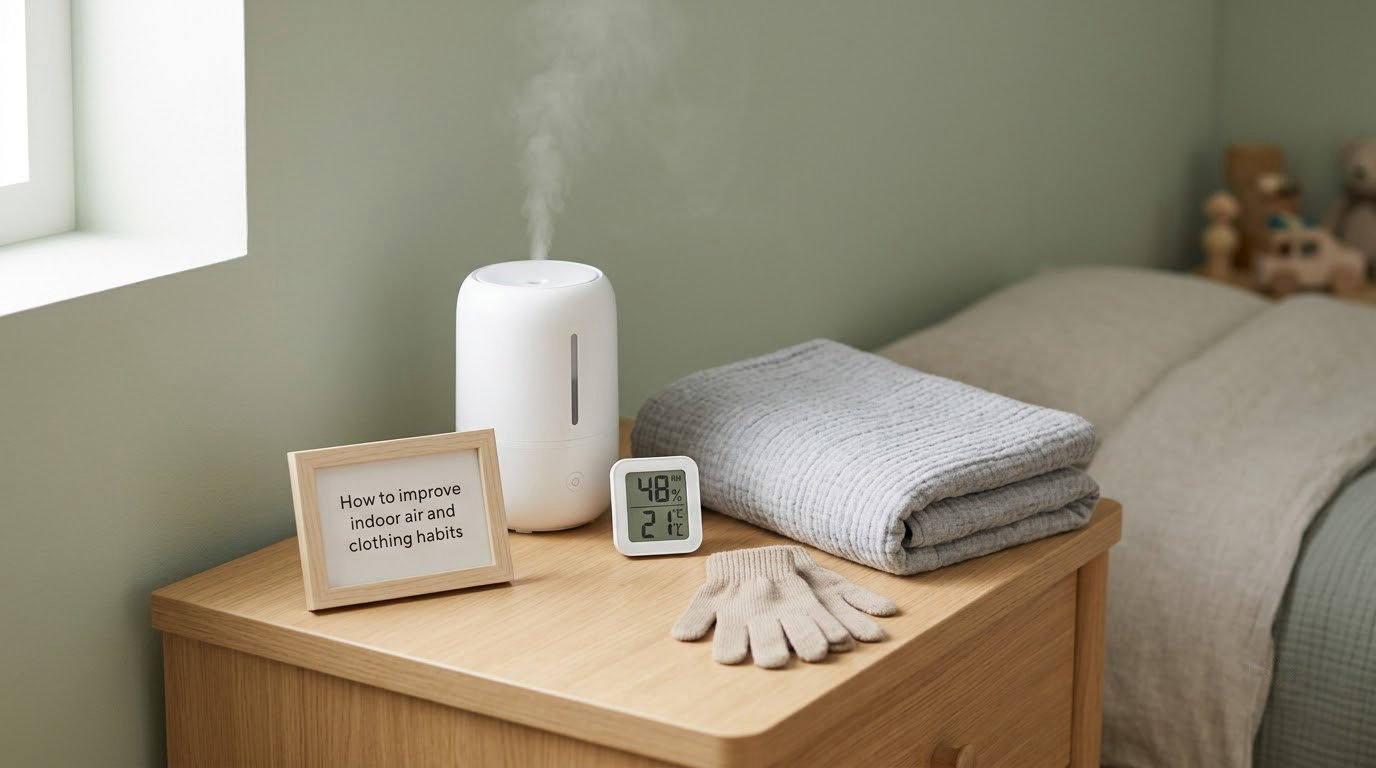
Indoor air is often drier than outside air, especially in November and February when the heating has been running for weeks. Aim for a reading between 30% and 50% in the child’s bedroom, which a basic hygrometer will show you for very little.
Put the humidifier in the bedroom rather than the living room, on a raised waterproof surface a few feet from the wall and away from curtains, and close the door at night so the moisture stays in the room. Clean it. A dirty humidifier circulates mineral dust and mold, which defeats the whole purpose, and any child with eczema will notice the difference within a night.
Change the water daily unless the unit is designed to run longer, wash a washable filter weekly, and descale as the manual describes. Skip essential oil diffusers entirely. Fragrance in the air is a common flare trigger, and it adds nothing here.
For clothing, the rule is soft and breathable next to skin. Cotton base layers are the safest default. Skip wool and rough synthetic fabrics against bare skin, and skip the extra layer that makes a child sweat, because damp skin under a coat dries out faster than cold skin.
Change wet clothes as soon as you get back inside, including gloves, socks and a damp hat. For laundry, use a detergent free of dyes and perfume, skip fabric softener and dryer sheets entirely, and run an extra rinse if your child reacts to even the mildest detergent.
How to soothe dry winter skin on children who flinch at every lotion
Some children’s skin reacts to everything, including products labeled hypoallergenic, and a well-meaning recommendation can make things worse. That is the most common frustration in parent forums, and it is not a failure of care. The same product can be fine for one sibling and rashy for another, because skin barrier genes and sensitivities differ.
When every product causes a rash, run a reset rather than a guessing game. Stop all topical products for about a week, apart from a plain petroleum-jelly-type barrier on the worst cracks, and let the skin settle. Then add products back one at a time, a patch test at a time, and keep a short journal of what went on and when. Coconut oil and lanolin are frequent culprits, and so are essential oils hiding inside products described as natural.
For sensory-sensitive children, including autistic kids, the problem is often the routine rather than the cream. A predictable order, the same sequence every night, does more than any product swap.
- Warn five minutes before: one visual schedule with pictures works for many kids.
- Let your child choose a small thing, such as the towel color or which arm goes first.
- Skip anything that stings or smells sharp. Alcohol and menthol are common in products marketed as cooling.
- Apply when your child is calm, not at the end of a meltdown.
- Frame the pressure as help, in words like helping, not fixing, and keep it predictable.
- Let them do the last step themselves with a scoop or their own hands, even if it takes longer.
Reapplying twice as often but with less each time usually works better than one heroic application. Small amounts, more often, are easier for a sensory-sensitive child to accept.
Common Mistakes
- Hot showers to relieve itch. The relief lasts minutes and the tightness lasts hours. Lukewarm, short, and moisturized straight away is the correction.
- Scrubbing or exfoliating flakes away. Flaking skin is a symptom, not dirt. Pat it off gently, or leave it to soften with moisturizer.
- Waiting until the skin is fully dry before moisturizing. You have already lost the water. Moisturize within about 3 minutes while it is damp.
- Using thin lotion as the only product. Lotion contains mostly water. Move up to a cream, and to ointment on the cracks.
- Trusting natural and hypoallergenic labels. Read the ingredient list instead. If fragrance, parfum, or an essential oil is listed, that is your answer about who reacts.
- Using steroid creams or home remedies on your own. Ask your clinician about prescription options. Putting a home remedy or someone else’s cream on a child’s skin can delay the treatment that would have helped.
- Leaving wet outerwear on indoors. Damp skin under a coat loses water quickly. Change socks, gloves and hats as soon as everyone is inside.
- Skipping moisturizer on the school day. Repeated handwashing at school undoes the morning routine. Send a stick of plain, unscented product if the school allows it.
When to contact a pediatric healthcare professional
Some things belong with a clinician rather than a bathroom cabinet. Book the same day if a rash is weeping or has yellow crusts, if redness is spreading, if there are blisters or open sores that bleed, if the child has a fever, seems unusually tired or unwell, or is drinking and eating less than usual. Pain that looks out of proportion to the rash matters too.
Book a routine appointment instead if nothing has clearly improved after two weeks of a consistent routine, if itch is waking your child repeatedly, if cracks on the hands or feet are interfering with play or school, or if you want help telling winter dryness apart from eczema or another condition. Eczema tends to be itchier, to recur in the same places such as the creases of the elbows and knees or the face, to run in families, and to respond poorly to moisturizing alone. A clinician can diagnose that and talk to you about the prescription options.
Bring photos taken on your phone, a short timeline of when the flare started, the ingredient lists of everything you have tried, and a note of what your child washes with at school. It makes the visit far more useful, and it costs you nothing to prepare.
Frequently Asked Questions
How to treat extremely dry skin in kids?
Start with the three-minute method: shorten baths to 5 to 10 minutes of lukewarm water, use a small amount of fragrance-free cleanser, pat dry without rubbing, then apply a cream or ointment while the skin is still damp. Reapply two or three times a day and after every handwashing, and keep bedroom humidity between 30% and 50%. Add a thick barrier ointment on cracked areas such as cheeks, knuckles and shins.
What is the best moisturizer for children’s dry skin?
For a child’s whole body, a bland, fragrance-free cream is the practical choice, because it spreads easily over large areas. For the driest patches, an ointment such as petroleum jelly seals better and lasts longer. Avoid fragranced, dyed or essential-oil products. If your child reacts to everything, stop all products for a week apart from a plain barrier, then reintroduce them one at a time with a patch test.
Why is my child’s eczema getting worse in winter?
Cold outdoor air and heated indoor air both remove water and lipids from the skin barrier, so an existing eczema flare tends to get worse every winter even when the routine has not changed. Humidifiers, shorter baths, and applying a thick moisturizer within about three minutes of getting out of the water all reduce flare-ups. If eczema is not settling with consistent moisturizing, ask your pediatrician about prescription options.
How do I stop my child from scratching dry skin at night?
Sustained scratching happens because itch and scratch feed each other, so treat the itch before bedtime rather than after the child wakes up. Apply a thick moisturizer just before bed, keep the bedroom cool and humid between 30% and 50%, and put soft cotton pajamas on damp skin after the bath. Keep nails short and offer a cool compress. If scratching wakes your child most nights or breaks the skin, book an appointment.
How often should I moisturize my child in winter?
At least two or three times a day, plus straight after every handwash or bath, and within about three minutes of getting out of the water. School-age children need a reapplication at midday because repeated handwashing strips what the morning routine put down. Thick barriers on cracks can be reapplied at night. If you find yourself reaching for the product that often, move up from lotion to a cream or ointment.
When should I call the pediatrician about dry skin?
Call the same day for weeping or yellow-crusted skin, spreading redness, blisters, open bleeding sores, fever, or a child who seems unwell or is eating and drinking less. Book a routine visit if there is no improvement after two weeks of consistent care, if itch wakes your child repeatedly, or if cracks interfere with daily life. A visit also makes sense if you suspect eczema and want to discuss prescription treatment.
If you do one thing this week, change the bath: lukewarm water, under ten minutes, moisturizer within three minutes. That single change does more than any product swap, and it is what I would start with before buying anything.