
If you’ve ever stood in a supermarket aisle wondering whether what you’re seeing is a tantrum or a meltdown, here’s the honest answer: a tantrum is an outburst your child can still steer, aimed at getting something, while a meltdown is an involuntary response to overload where the thinking brain has gone offline and words stop working. Both can be loud. Only one is chosen.
I’ve sat on the floor with both. The toddler screaming over the last scoop of ice cream is a tantrum — she’ll stop if I offer a different bowl. The child beside her, head down, hands over her ears, inconsolable after a bright, noisy birthday party, is in a meltdown, and nothing I say will reach her.
Getting this right matters more than tidiness. A tantrum needs a calm, firm boundary. A meltdown needs less input and a safe body. Treat one as the other and you either punish a nervous system or remove the only limit your child has.
Table of Contents
- Difference Between a Tantrum and a Meltdown at a Glance
- What Is a Tantrum?
- What Is a Meltdown?
- The Difference Between a Tantrum and a Meltdown
- How to Tell the Difference in the Moment
- Common Triggers for Tantrums and Meltdowns
- How to Respond to a Tantrum
- How to Respond to a Meltdown
- What Not to Do During a Meltdown
- Tantrum or Meltdown? Which Response Fits?
- When to Seek Additional Support
- Which Should You Choose?
- Frequently Asked Questions
- Can a child have a meltdown on purpose?
- What is the main difference between a tantrum and a meltdown?
- How long does a tantrum usually last compared with a meltdown?
- Should I discipline my child during a meltdown?
- What helps a child recover from a meltdown?
- How can I tell whether my child is overwhelmed or frustrated?
- A Calm Plan Starts With Recognizing the Difference
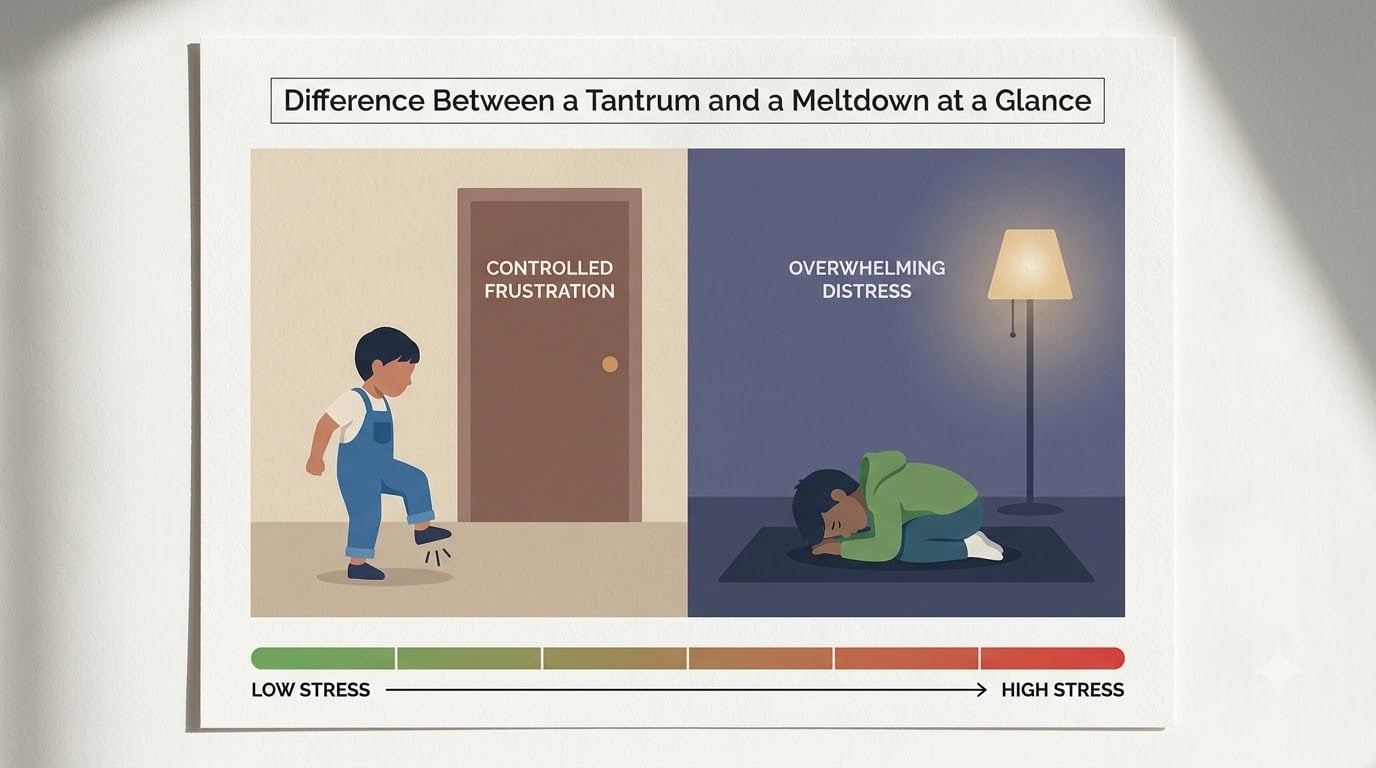
Difference Between a Tantrum and a Meltdown at a Glance
| What to look at | Tantrum | Meltdown |
|---|---|---|
| Purpose | Goal-directed: to get an object, an activity, or your attention | Not goal-directed; a stress response |
| Level of control | Some control remains; the child can pause and watch you | Control is gone; the child cannot stop it on request |
| Typical trigger | A denied request, a broken boundary, frustration at being told no | Sensory overload, too many demands, unexpected change, accumulated stress |
| Audience awareness | Often present — they check whether you are watching or reacting | Absent — the room and people fade out |
| Language | Words often still work, even between screams | Words do not land; ears, eyes, and skin may be overwhelmed |
| Physical signs | Stamping, dropping to the floor, arching, repeated demands | Thrashing, bolting, covering ears, hitting own head or face, throwing objects |
| Typical duration | Usually minutes; often ends when the goal is met or given up | Minutes to over an hour; recovery can take far longer than the episode |
| What ends it | You holding the line, or a distraction, or the child giving up | The nervous system discharging — time, quiet, and lower demand |
| Best response | Short words, a clear limit, limited choices, then reconnection | Reduce input, protect safety, wait, then reconnect gently |
One honest caveat before we go further. Parents on forums have said for years that the line is blurrier than the table makes it look. On Mumsnet’s special needs board, one parent wrote that she had never found the distinction anything like as clear-cut as some people insist. She isn’t wrong. Most children live on a spectrum between the two columns, and the labels are a tool for choosing a response, not a verdict on your child.
What Is a Tantrum?
A tantrum is an emotional outburst that usually follows frustration, a boundary being tested, or a request being turned down. The important word is usually — a child throwing a toy across the kitchen after being told it is time to tidy up is the textbook case.
What makes it a tantrum rather than a meltdown is that some part of the child is still driving. They are still oriented toward you. They pause to see if you are watching. They can be redirected, and when you hold the line and stay calm, the episode loses its fuel.
A common framework splits tantrums into three types, and it is useful because each one needs a slightly different reply:
- Frustration tantrums — common from around 1 to 3 years, when language is still too small to hold big feelings. The child wants the ice cream, the parking spot, the blue cup.
- Attention or rejection tantrums — often around 3 to 5 years, appearing when a caregiver looks away, answers the phone, or says no to a game. These are the ones where giving in teaches the child that the outburst works.
- Sensory or escape tantrums — the child bolts from noise, crowds, bright lights, or a demand that is simply too big right now. These are the ones most often mislabelled as meltdowns.
That last type is why “just ignore it” fails so often. An escape tantrum is not a bid for attention — it is a bid for the noise to stop, and ignoring the bid while leaving the noise going teaches nothing.
What Is a Meltdown?
A meltdown is an involuntary response to overwhelming sensory, emotional, communication, or environmental demands. The nervous system has flooded, and the child is running on the stress response — fight, flight, or freeze — with no access to language or reason.
Parents on r/Autism_Parenting describe the real-world markers far better than any textbook: the child becomes completely inconsolable, and in the blink of an eye is thrashing and throwing things. One parent described a two-year-old melting down for over an hour after the television was turned off, noting that after about half an hour it had clearly moved past a tantrum into overload.
Two things make a meltdown different in practice. It often continues after the trigger is gone — the party ended, the noise stopped, and it is still going. And it is not a choice. As autistic adults have said about their own experiences, what helps is often just sitting quietly and waiting while they work through it.
None of this means a meltdown is not connected to what you did or didn’t do. It usually means the demands around your child were bigger than what their system could hold. That is a different problem from a boundary that keeps sliding.
The Difference Between a Tantrum and a Meltdown
The difference comes down to control. In a tantrum, the child is still the pilot, albeit an immature one who keeps crashing the plane. In a meltdown, the controls are gone.
By intention, a tantrum points somewhere — toward the biscuit, the later bedtime, the open laptop. A meltdown points nowhere. It is the brain dumping load.
By recovery, a tantrum usually resolves within minutes once the goal is met or abandoned. A meltdown runs on the length of the stress response, and afterward there is often a long flat period where the child is tired, quiet, or shaky.
By response to you, a tantrum softens when you hold a limit. A meltdown does not respond to your tone, your reasoning, or your tears, because the part of the brain that receives them is offline.
How to Tell the Difference in the Moment
You rarely get time to write this down. Run through five quick questions instead:
- Can they hear you? Say their name. If words land, you likely have a tantrum. If they cannot hear you over the noise inside their head, think overload.
- Are they looking for you? A child who checks your face for a reaction is still performing. A child who has turned away from everyone is not.
- Can they be redirected? Offer a simple alternative. If a different option changes the behaviour, it was goal-directed.
- Is the body in fight, flight, or freeze? Bolting, thrashing, ear-covering, or hitting their own head are overload signals.
- Does it stop when the trigger stops? Remove the noise. If it carries on unchanged, it was not the noise alone.
When two or three answers point the same way, act on that. If they point in opposite directions, treat it as a meltdown and drop the demands. Erring toward “this is overload” is the safer mistake.
Common Triggers for Tantrums and Meltdowns
Tantrums cluster around one thing: a want that did not happen. The wrong cup, the screen turned off, the sibling who took the block, the parent who hung up the phone and turned away.
Meltdowns cluster around accumulation. The typical pattern is a long nursery day, a noisy bus home, and a request to put on shoes in a hurry. None of those is huge. Together they push past the threshold of what the child can tolerate.
- Transitions — leaving the park, ending screen time, switching rooms. Our guide to making transitions between activities easier has specific warning-time steps that reduce this trigger.
- Unexpected change — a cancelled plan, a different route home, a visitor arriving early.
- Sensory load — flickering lights, hand dryers, a full restaurant, a tag or scratchy label.
- Communication barriers — not having the words for the need. If your child uses AAC, our breakdown of choosing between a speech device and an app is worth a read, because inaccessible communication shows up here as a meltdown.
- Fatigue and hunger — the episode that always lands at 4pm.
- Pain or illness — earache, constipation, a headache. Unusual sudden escalation deserves a look.
If episodes cluster around school, that is worth understanding rather than managing in the moment. School support, from an IEP or a 504 plan, is often where the load gets addressed before it reaches you at pickup. We explain the difference between an IEP and a 504 plan if you are not sure which one your child has.
How to Respond to a Tantrum
You are the calm in the room. That is the whole job. A tantrum ends when the adult holds steady.
- Get low and get close. Eye level, hands visible, shoulders down. Kneeling cuts the sense of being towering over.
- Say the boundary once, in five words. “Screen time is finished.” Repeating it louder does not help.
- Name the feeling, not the accusation. “You really wanted more time. I know.” No “you could have asked.”
- Offer two acceptable choices. “Shoes or socks first?” Both are things you can live with. This hands control back without surrendering the limit.
- Hold when you waver. If you give the toy back mid-tantrum, the lesson you teach is that screaming works. Hard, but true.
- Reconnect within a few minutes. Once they’re calm: a quick hug, then back to the routine. Do not let it hang over the rest of the day.
How to Respond to a Meltdown
During a meltdown, your job is safety and a quieter room. Not teaching, not winning, not even being understood right now.
- Lower the demands immediately. The shoes are not happening. Say so plainly, then stop asking.
- Cut sensory input. Lights down, noise off, move them out of the crowd. This is the single most useful thing you can do.
- Protect without restraining. If they are hitting their head or face, block the impact with a cushion or your hands, keep a clear path, and remove hard objects nearby. Guiding them to a softer spot beats holding them down.
- Stay close and quiet. A few feet away, low, silent. Presence without pressure.
- Wait it out. It ends when their system has discharged, not when you decide it should.
- Recover gently afterwards. Quiet, water, a blanket, no debriefing. Ask nothing about what happened while they were dysregulated.
Somewhere in the first few minutes afterwards, when they can hear you again, one line helps more than any other: “That was a lot. You were past full.” Naming the state rather than the behaviour gives them something to learn from.
What Not to Do During a Meltdown
- Do not reason, lecture, or explain why the behaviour is wrong.
- Do not ask questions — no “are you okay?”, no “what do you need?”
- Do not offer rewards or consequences for the next ten minutes.
- Do not punish. There is nothing to teach a dysregulated child.
- Do not crowd them, follow them, or narrate what is happening to a room.
- Do not promise it will stop soon.
- Do not take it personally, and do not argue that this is a choice.
Tantrum or Meltdown? Which Response Fits?
Sometimes the answer is both at once. A child starts with a goal-directed protest about screen time, the protest runs long, the hearing and touching and being told no pile up, and thirty minutes in you are looking at a full meltdown with a tantrum-shaped hole at the start of it.
Two things can be true in that situation: the limit still stands, and the recovery needs to be low-demand. So say the boundary once at the beginning, then let go of everything except safety. You do not take shoes off the list permanently — you just stop asking for them tonight.
The mistake to avoid in the opposite direction is treating every episode as overload. If your child learns that a meltdown earns them a quiet room with no follow-up, the tantrum cycle gets stronger. Overload and boundary-testing need different replies, and the giveaway is usually the pause to check your reaction.
When to Seek Additional Support
Contact your pediatrician or your child’s therapist if any of these are true. None of this is medical advice, and none of it is a diagnosis — these are signals that a professional should take a proper look.
- Episodes are frequent, getting longer, or getting more intense over weeks.
- Your child hurts themselves regularly, or the injury risk is hard to manage in the moment.
- Everyday things — dressing, eating, school arrival, bedtime — have become reliably difficult when they used to be fine.
- Sleep, appetite, or daily functioning has changed noticeably.
- Your child’s distress is something you feel unable to cope with, more than most weeks.
- You are regularly the one who is at the breaking point. That is a support signal in its own right.
A meltdown is a state, not a diagnosis. It can show up with autism, ADHD, sensory processing differences, anxiety, or in a neurotypical child under extreme stress. Escalation-driven raging tends to show up more with ADHD, and overload-driven meltdowns more with autism, but that is a starting point for a conversation with a clinician rather than a conclusion. If you are wondering about formal support for school, that is a separate conversation worth having early.
Which Should You Choose?
Choose by capacity, not by label. If your child still has some control and is checking your reaction, hold the boundary and offer a choice. If they have gone past hearing, stop talking and start reducing.
Ask three things: can they still process what you are saying, is anyone in danger, and what does their nervous system need right now? Those three answers will tell you more than any label, and they take about five seconds.
Start tonight with one thing, not a system. Put a note on the door for the spot that already works — the small room with the door that closes. That is the answer to what helps a child recover faster, and it takes ten minutes to set up.
Frequently Asked Questions
Can a child have a meltdown on purpose?
No. A meltdown is an involuntary nervous system response to overload, and a child cannot start one deliberately or stop one on request. What you can influence is the load: the demands, the noise, the transitions, and how quickly you drop everything when the first signs appear. A child may also cry beforehand and choose where it happens, which can look like choice. That is not the same as causing it.
What is the main difference between a tantrum and a meltdown?
Control. In a tantrum, your child is still partly in charge: they are oriented toward you, they can be redirected, and the episode ends when the goal is met or given up. In a meltdown, control is gone. Words do not register, they cannot stop on request, and the behaviour continues until their body has finished discharging the stress.
How long does a tantrum usually last compared with a meltdown?
A tantrum often runs five to fifteen minutes and ends quickly once the boundary holds. A meltdown can last anywhere from a few minutes to over an hour, and the recovery afterwards may take just as long. Parents describe children who stayed inconsolable for more than an hour after the original trigger had ended. Duration alone does not decide which it is, but it is a strong clue.
Should I discipline my child during a meltdown?
No. Discipline requires a child who can hear you, understand the rule, connect the behaviour to the consequence, and remember it later. None of that is available during a meltdown. Reasoning, consequences, or rewards add load and usually lengthen the episode. Hold your usual boundaries quietly, focus on keeping everyone safe, and hold the teaching moment for afterwards when your child is regulated.
What helps a child recover from a meltdown?
Less, mostly. Reduce light and noise, lower every demand to zero, and stay nearby without talking. Keep them physically safe, especially if they hit their head or face, and remove hard objects from reach. Then give quiet: water, a blanket, low light, and no questions. Autistic adults have described the most helpful thing as simply someone sitting quietly while they worked through it.
How can I tell whether my child is overwhelmed or frustrated?
Try three quick tests. Say their name: if words land, think frustration. Check whether they look for your reaction: if they are checking, they are still performing. Then offer one simple alternative: if it changes the behaviour, they were in control. Overwhelmed children tend to turn away from people, cover their ears, or lose the ability to hear. When in doubt, treat it as overload, because that is the safer response.
A Calm Plan Starts With Recognizing the Difference
The first step is noticing, not judging. For two weeks, jot down three things after each episode: what happened just before, what your child’s body did, and how long the recovery took. Patterns show up fast, and most parents find one trigger accounting for most of the hard evenings.
Then build the quiet room. Lower light, a cushion, a blanket, somewhere they are allowed to go without it being a reward or a punishment.
Teach one way to say “too much” that works when words are still available, even if it is a card or a sign. And if episodes are frequent, escalating, or frightening, bring your pediatrician or your child’s therapist into it early. You do not need to be certain about the label before you ask for help.
Most of all: you are not doing this wrong. Every caregiver has a day where they handled it badly and a day where they handled it well. Both are still the parent their child needs at 4pm.