
An IEP gives a student specialized instruction, measurable goals, and services such as speech or occupational therapy. A 504 plan gives a student with a disability accommodations, like extra test time or preferential seating, so they can access the same general education classes as everyone else. The difference between an IEP and a 504 plan is what the plan is allowed to do: one changes the instruction, the other changes the conditions around it.
Parents often ask this question after a school offers a 504 following an evaluation, or after a child who had an IEP in elementary school asks for a 504 in middle school. Both plans are legitimate, federally required supports, and neither is automatically the better choice. What matters is whether your child needs instruction that is specially designed, or simply the removal of a barrier.
Table of Contents
- Difference Between an IEP and a 504 Plan at a Glance
- What Is an Individualized Education Program (IEP)?
- What Is a 504 Plan?
- How Do Eligibility Requirements Differ?
- How Do Services, Accommodations, and Goals Differ?
- What Is the Difference in IEP and 504 Plan Paperwork?
- Can a Child Have Both an IEP and a 504 Plan?
- Which Should You Choose?
- Frequently Asked Questions
- A Clear Starting Point for Your Child’s School Plan
Difference Between an IEP and a 504 Plan at a Glance
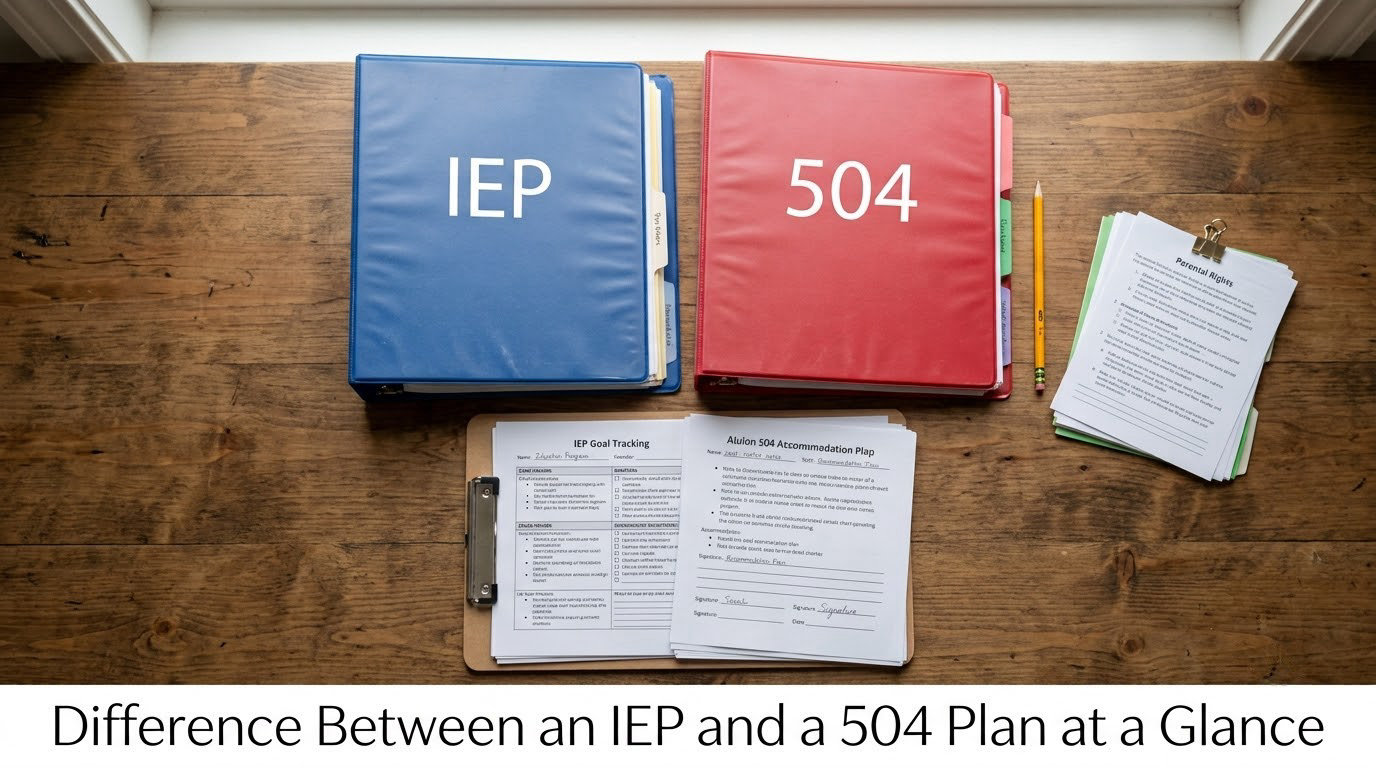
Here is the side-by-side comparison, row by row. The single most important line is the third one: what the plan provides.
| Category | IEP | 504 plan |
|---|---|---|
| Governing law | IDEA (Individuals with Disabilities Education Act), Part B | Section 504 of the Rehabilitation Act |
| Who it is for | Students ages 3 to 21 who qualify under one of 13 disability categories and need special education | Students, K through 12, whose disability substantially limits a major life activity |
| What it provides | Specialized instruction, related services, and a free appropriate public education | Accommodations that remove barriers to the general education program |
| Eligibility test | Disability plus adverse impact, need for special education, and need for a specific type of support | Physical or mental impairment that substantially limits one or more major life activities |
| Specialized instruction | Yes, that is the core of the plan | No, not offered through a 504 |
| Related services | Yes, such as speech, occupational therapy, physical therapy, counseling, transportation | Not funded by the 504 itself |
| Measurable annual goals | Required, with progress reported at least as often as regular report cards | Not required |
| Team members | Parents, the child when appropriate, the general education teacher, a special education teacher, a school psychologist, and a district representative, plus others by need | Usually the parent, one or more teachers, the principal or 504 coordinator, and a counselor, depending on district practice |
| Parent role | Parents consent to the evaluation and are part of the team that writes the plan | Parents are typically asked to consent to evaluation; most districts do not require consent to the accommodations themselves |
| Review cycle | Reviewed at least annually, with reevaluation every three years unless more often is needed | No federal schedule, so frequency varies by state and district |
| How long it lasts | Stays in effect for a defined period set by the team, then requires a new plan | No set expiration, and it follows the student into college and the workplace as a disability accommodation |
| Dispute route | State complaint, mediation, resolution session, or due process hearing | Internal grievance process, then a complaint to the Office for Civil Rights |
| Cost of services | Public funding covers the services the team lists | The school provides accommodations; it does not fund special education services |
What Is an Individualized Education Program (IEP)?
An IEP is a legally binding written plan, required by the Individuals with Disabilities Education Act, for a student who qualifies for special education services. It is not a summary of what a teacher intends to do. It is a document with specific services, measurable targets, and named providers, and the school is accountable for delivering it.
Three IDEA requirements shape everything in it. The first is FAPE, free appropriate public education, meaning the placement and services are designed to meet the student’s unique needs. The second is the least restrictive environment, so a student is educated with non-disabled peers as much as possible. The third is measurable annual goals, written with a baseline, a target, and a way to measure progress.
A typical IEP lists present levels of performance, annual goals in areas like reading or speech, the special education and related services the student receives, the accommodations the student uses in general classes, the placement, and how progress will be reported. A high schooler usually also gets a transition plan, which covers post-school goals and the services that support them.
What Is a 504 Plan?
A 504 plan is a written plan under Section 504 of the Rehabilitation Act, a civil rights law. It requires schools receiving federal funds to provide equal access to the program for students with disabilities. It does not require special education, and it cannot provide it.
The eligibility standard here is broader and simpler. If a student has a physical or mental impairment that substantially limits one or more major life activities, such as learning, reading, concentrating, thinking, communicating, or caring for oneself, the student can qualify. Some schools also use 504s for things outside IDEA’s 13 categories, including temporary or post-operative conditions.
What a 504 actually contains is usually short: a list of accommodations, a contact person, and a review date. Common accommodations include extended time on tests, preferential seating away from distractions, movement or sensory breaks, graphic organizers, chunked assignments, a designated person to help the student stay organized, assistive technology, or a ramped route between classes.
How Do Eligibility Requirements Differ?
The difference between an IEP and a 504 plan starts with the legal test each one applies. IDEA asks three questions: does the student have one of 13 qualifying disability categories, does it have an adverse educational impact, and does the student need special education and a specific type of support? Section 504 asks only whether there is a substantial limitation of a major life activity in the program.
IDEA’s 13 categories are specific, and parents who have read an evaluation report usually recognize the one that applies:
- Autism
- Deafness
- Deaf-blindness
- Hearing impairment
- Intellectual disability
- Multiple disabilities
- Orthopedic impairment
- Other health impairment
- Specific learning disability
- Speech or language impairment
- Traumatic brain injury
- Visual impairment, including blindness
- Emotional disturbance
The practical consequence is that a diagnosis alone does not produce an IEP. A student with ADHD, for example, may be found eligible, or may be evaluated and found not to need special education. Section 504 is usually the easier eligibility box to check, which is one reason schools reach for it first.
One more thing to keep in mind: 504 procedures are less federally standardized than IDEA procedures. How often a district reevaluates, who has to sign, and what paperwork a 504 requires can differ from one state to the next, so ask your own district rather than relying on a general description.
How Do Services, Accommodations, and Goals Differ?
Words get blurred together, and the blur costs families. Accommodations change how a student accesses learning. Modifications change what the student is asked to learn. Specialized instruction is teaching designed around a student’s specific needs, delivered by a special education teacher rather than by adding support to a general class.
The simplest way to see the gap is to picture a student with dyslexia finishing a timed reading assessment. Here is how the same student would be supported under each plan.
| Support | Under a 504 plan | Under an IEP |
|---|---|---|
| Test time | Extra time, or reduced time pressure, as an accommodation | Extra time, plus the same support during daily instruction |
| Reading instruction | Same reading curriculum as the class | Structured literacy instruction from a special education teacher, in addition to the general class |
| Progress tracking | No formal goals required | Annual goals with benchmarks and progress reports each grading period |
Related services are the other big difference. Speech, occupational therapy, physical therapy, counseling, and transportation can all be written into an IEP when the team finds them necessary for the student to benefit from education. A 504 cannot fund them. If your child needs therapy, that is a strong signal to ask for a special education evaluation rather than settling for accommodations.
Accommodations also have a practical limit worth naming. A 504 can make the work accessible, but it cannot teach a skill the student has not yet learned. Put plainly: a 504 removes the barrier, it does not add the instruction.
What Is the Difference in IEP and 504 Plan Paperwork?
The paperwork is where the two processes look most different, and it is also where families feel the gap most. An IEP has a defined legal structure and a team with required members, including a district representative and a special education teacher, not just the people who know the child best.
Before either plan exists, there is a written evaluation request. For an IEP, you receive a psychoeducational evaluation, a written copy of the results, and then a meeting within a set timeline. You also get prior written notice when the school proposes or refuses to identify your child, which is a right many parents do not know they have until they need it.
A 504 process is lighter by design. The school gathers information, often informally, and holds a meeting with a smaller group that typically includes you, the teachers involved, and a 504 coordinator. You are usually asked to sign consent for evaluation, but consent to the accommodations themselves varies by district. That gap is worth asking about directly.
Records worth collecting now: your child’s current plan, evaluation reports, any outside testing, and a short list of what is working and what is not. Ten minutes of filing now saves weeks later.
Can a Child Have Both an IEP and a 504 Plan?
A student has one school plan for special education purposes, not two. The two laws overlap, and everything in a 504 plan can already sit inside an IEP, so schools do not run an IEP and a 504 at the same time for the same academic needs.
What does happen is that a 504 can follow a student into settings the school does not fund through IDEA, such as an after-school program, a summer camp, or a workplace. A 504 coordinator will sometimes write a separate 504 for an extracurricular activity. That is different from holding two plans at school, and it is a reasonable question to raise when your student is included in a program that is not covered by the IEP.
Parents also ask about the reverse move: a student stepping down from an IEP to a 504 before graduation, usually because the needs have become milder or the school wants the student in general education with supports. That is legally allowed, and it should be a decision made from current data, not from a staff member’s prediction about a slower child.
Which Should You Choose?
Neither plan is stronger in a vacuum. The IEP carries more legal weight because IDEA guarantees FAPE, and it is the only one of the two that can deliver specialized instruction and related services. But a well written 504 that fully meets your child’s needs beats a hollow IEP that adds a label without changing instruction.
Start with the question of what your child needs, not which plan sounds better. A child who needs instruction designed around a specific skill, who requires speech or occupational therapy, or who is not making progress in the general curriculum with accommodations alone is an IEP case. A child who can access the general education curriculum and needs specific supports to do it is a 504 case.
When schools recommend a 504 first, families usually are reacting to speed, paperwork, and a smaller team meeting. Those are legitimate reasons, and they do not mean a 504 is the right long-term fit. The escalation ladder matters here: ask how each accommodation will actually be implemented, request a 504 review meeting if the supports are not landing, and then request a written special education evaluation if the gap remains.
Two more things parents should know. First, ask what happens to the plan in college. Accommodations usually have to be requested again through a disability services office, and documentation that is years old is often not enough without a current evaluation. Second, every year matters, not only the plan year. A new set of teachers often does not know a plan exists, which is the most common implementation failure parents report.
Frequently Asked Questions
Is it better to have an IEP or a 504 plan?
Neither is better in general. An IEP is legally stronger and can include specialized instruction, related services, and measurable goals. A 504 is faster and covers a wider range of disabilities, but it only provides accommodations. If your child can learn the general curriculum with supports like extra time or seating changes, a 504 works. If they need teaching designed for them, ask for an IEP evaluation.
What is stronger, an IEP or a 504 plan?
The IEP. It is created under IDEA, which guarantees a free appropriate public education, requires measurable annual goals, and provides a formal dispute process. A 504 plan is a civil rights guarantee of equal access under Section 504, and it provides accommodations rather than instruction. Stronger does not always mean better matched, so match the plan to the child.
Should a child with ADHD have an IEP or a 504 plan?
ADHD can qualify under IDEA’s Other Health Impairment category, so an IEP is possible. A 504 is appropriate when accommodations are enough, such as preferential seating, movement breaks, or extended time on tests. An IEP is the better fit when the child also needs specialized instruction, such as structured reading intervention, explicit self-regulation instruction, or a behavior plan with measurable goals.
Why do schools push 504 instead of IEP?
A 504 is faster to put together, requires a smaller meeting, involves less paperwork, and carries less administrative and legal risk. Section 504 also covers a broader range of students. If you are unsure, ask how each accommodation will be implemented in class, request a 504 review meeting, and if the needs are still unmet, request a written special education evaluation.
What should I do if a 504 plan is not being implemented?
Start by asking each teacher, in writing, how they plan to deliver each accommodation listed in the plan. If the answers are vague, request a 504 review meeting with the coordinator and the principal and ask them to add measurable details to the plan. If the supports still are not enough, request a special education evaluation so the question of an IEP gets asked formally.
A Clear Starting Point for Your Child’s School Plan
The difference between an IEP and a 504 plan is a difference in what a school promises to provide: specialized instruction and goals, or accommodations alone. Work from your child’s actual needs and the paperwork will follow a clear path.
Four things you can do this week. Pull together every record you have, including old evaluations and any notes about what is working. Request a copy of the current plan so you know exactly what is written rather than what you were told. Ask each accommodation to be tied to a class and a person, in writing. Then document where your child is struggling right now, with specific examples a teacher could act on.
If your child needs more than accommodations, ask for a special education evaluation and keep the request in writing. Procedures vary by state and district, so your district office is the right place to confirm timelines and forms.