
Yes — a child can be diagnosed with ADHD and autism at the same time, and many children are. In plain terms: ADHD and autism together means your child meets the criteria for both conditions, which clinicians often call a dual diagnosis, and which some parents and adults informally call AuDHD. This guide walks through what the combination looks like in daily life, how an evaluation works, and which supports tend to make the biggest difference at home and at school. It is general educational information, not medical advice, so please take anything specific to your child to a pediatrician or a qualified developmental professional.
Table of Contents
- Can a child have ADHD and autism together?
- ADHD and autism together: how the conditions differ
- What should parents notice when both conditions are present?
- How are ADHD and autism together evaluated?
- What support helps when both conditions are present?
- How can parents support attention, sensory needs, and executive function?
- Mornings
- School
- Meals
- Travel and appointments
- Hard moments
- What should parents tell the school about ADHD and autism together?
- When should parents contact a doctor or qualified professional?
- Frequently Asked Questions
- Can ADHD mask autism symptoms, or can autism make ADHD harder to notice?
- What should parents say when asking whether their child has both ADHD and autism?
- Does an ADHD and autism diagnosis change the educational support a child can receive?
- Can a child be autistic and have ADHD without taking ADHD medication?
- What is the best way to support a child who has both ADHD and autism?
- Where should parents start with ADHD and autism together?
Can a child have ADHD and autism together?
Yes. Since 2013, when the fifth edition of the DSM was published, a single diagnosis is no longer required — a person can be diagnosed with both ADHD and autism spectrum disorder at once. That change matters practically, because supports written for only one of the conditions often leave the other half of the child unsupported.
Here is the distinction parents find most useful. A diagnosis is a clinical description of how a developing brain is wired, based on defined criteria. Everyday labels like “difficult,” “disruptive,” or “lazy” are descriptions of behaviour in a moment, and they often describe the wrong thing entirely.
Prevalence estimates for the combination vary quite a bit depending on the sample and the method, which is why you will see ranges rather than one number. Studies commonly report that somewhere around 20 to 50 percent of children with ADHD also meet autism criteria, and that roughly 30 to 80 percent of autistic children also show significant attention or hyperactivity traits. The spread is wide because masking, language ability, and clinician judgement shift the count. Nothing about that uncertainty means your child fits an average — you are describing one child, not a statistic.
ADHD and autism together: how the conditions differ
The two conditions overlap heavily, which is exactly why they get confused. The table below is a starting point for conversation, not a checklist to diagnose your own child — individual presentation matters far more than any stereotype.
| Area | More typical of ADHD | More typical of autism |
|---|---|---|
| Attention | Shifts quickly, inconsistent, easily pulled away | Deep focus on interests, struggles with irrelevant tasks |
| Movement | Restless, impulsive, difficulty staying seated | May be active or may be genuinely low-energy |
| Sensory processing | Seeking movement for stimulation | Avoiding or seeking specific sensations, strong reactions |
| Routines | Works better with novelty and change | Needs predictability; change is hard |
| Communication | Fast talkers, interrupts, blurts answers | Delayed language, literal phrasing, flat tone |
| Emotion | Big reactions that fade quickly | Meltdowns, shutdowns, or masking that takes hours to recover |
| Executive function | Starts, loses the thread, forgets steps | Same, plus difficulty generalising a routine to a new setting |
When both are present, the two patterns collide rather than average out. Autism pulls toward sameness and routine; ADHD pulls toward novelty. Parents describe this as a constant internal tug — the child can focus for hours on one topic and still lose a sock five minutes after being told to put it away.
Genetic research supports the overlap being real rather than coincidental. Both conditions show substantial heritability in twin and family studies, they share risk factors, and they run together in families more often than chance would predict. So when a parent with ADHD has an autistic child, or the reverse, it is worth taking seriously rather than treating it as an odd coincidence nobody expected.
Common informal terms you will meet: AuDHD (the community label, not a clinical one), comorbidity (two diagnosed conditions occurring together), and executive function (the brain’s management system for starting, sequencing, and finishing tasks, which is where both conditions tend to bite hardest). Knowing the words helps when you read or join support groups.
What should parents notice when both conditions are present?
Documenting observable behaviour over two or three weeks gives a clinician far more to work with than memory does. Most parents end up with a pattern list that looks something like this.
- Attention that swings. Distractible during a noisy classroom, then completely absorbed in a special interest for forty minutes.
- Restlessness plus a need for sameness. Fidgeting at the table, then distress if the seating changes.
- Sensory differences. Covering ears in a busy room, seeking pressure, avoiding a particular texture of clothing.
- Social communication patterns. Difficulty reading cues, literal interpretations, or talking at length about a topic without a turn-taking instinct.
- Transition difficulties. Meltdowns around small changes, not just big events.
- Regulation differences. Some days a small problem is fine; other days the same problem ends the day.
What looks like a contradiction at home is often the clearest signal that both conditions are in play. A child who cannot sit still in class and melts down when the weekly schedule shifts is not being inconsistent — two different needs are taking turns driving the behaviour. Adults with a dual diagnosis describe it as a constant battle inside the brain.
Strengths belong in your notes too, and they deserve their own list rather than a footnote. Adults with AuDHD frequently talk about pattern recognition, learning fast once genuinely interested, unusually direct communication, and noticing details other people miss. A child who remembers every character’s name in a story but cannot find the right folder is showing you both profiles in the same afternoon.
Write strengths down and hand a copy to the school. They are the part of the picture that predicts how your child learns best, and they are the first thing that disappears from a file once behaviour takes up all the room.
A useful exercise is to run each behaviour through four questions before you interpret it: is this attention, is this sensory load, is this anxiety, or is this a genuine disagreement about the rules? The same loud refusal of socks means four different things depending on the answer, and the supports you pick follow the answer. It takes about ten seconds per behaviour and it stops a lot of arguments you do not need to be having.
How are ADHD and autism together evaluated?
Evaluation is done by a qualified professional — commonly a developmental pediatrician, child psychiatrist, or neuropsychologist. Expect a combination of developmental history, your observations, teacher input, standardized screening questionnaires, and direct clinical assessment. Most clinicians look at attention and autism-related needs separately, because a child who passes on one screen may still need support for the other.
Bring more than you think you need. Samples of schoolwork, a short video of a typical difficult moment if you have one, your own notes, and any earlier reports. Many parents arrive with one concern and leave having realised that a second pattern they had written off as personality was part of the picture all along.
It is also reasonable to ask, before you book, whether the clinician regularly sees children with both conditions. Experience with a dual diagnosis changes what gets asked and which supports get considered first, and you are entitled to ask about that on the phone.
Two honest caveats. First, a diagnosis under about age five is often provisional, since traits are still moving. Second, an assessment is a snapshot; many families ask for a re-evaluation as the child grows and school demands increase. If you want to know what to bring, the IEP eligibility meeting guide covers how schools handle written documentation, which is useful to read early.
What support helps when both conditions are present?
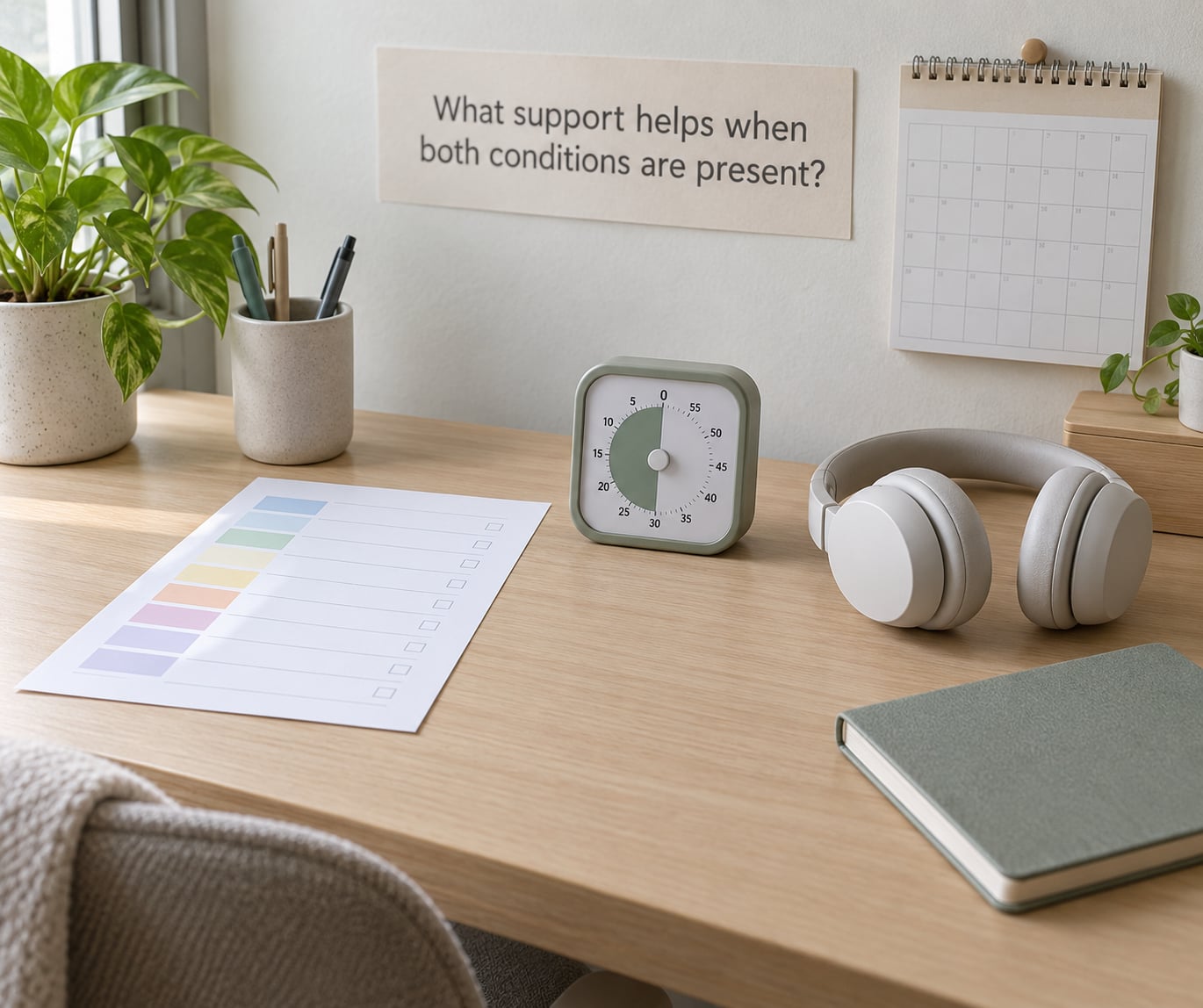
Start with one support that you can run for two weeks and evaluate, rather than rewriting your whole household in a weekend. The framework below is the one that tends to hold up best, and each item should be checked with your child’s care team before you commit to it.
- Predictable routines. A visual morning sequence beats repeated verbal reminders, because working memory is one of the weakest points in a dual diagnosis.
- Lower sensory demand. Reduce background noise, offer headphones in the car, and let your child leave a crowded room without it being a negotiation.
- Clear, literal instructions. One step at a time, said once, with an example of what finished looks like.
- Built-in movement. Movement breaks during schoolwork often help attention more than longer sitting time.
- Protected sleep. A consistent wind-down matters more here than in most children; fatigue amplifies every other symptom.
- Limited choices. “Which shirt, the blue or the green?” closes decisions without asking for compliance.
One warning: sensory distress is not defiance. When a child melts down because a sound is unbearable, treating it as misbehaviour teaches them to hide it, which makes the next episode worse. Our guide to handling autism meltdowns at home walks through the difference between a meltdown, a shutdown, and ordinary frustration.
How can parents support attention, sensory needs, and executive function?
It helps to plan by part of the day, because the demands and the failure points change as the day goes on.
Mornings
Lay out clothes the night before, keep breakfast the same two or three options, and use a visual timer for the routine rather than a countdown shouted from another room. Most morning battles in a dual diagnosis are executive-function battles wearing a costume.
School
Ask for movement breaks, a seat away from high-traffic areas, and either chunked instructions or written steps for multi-part tasks. Track whether the accommodations actually landed — a plan nobody checks is not a plan.
Meals
Reduce noise and expectations during eating. For many autistic children, food texture and predictability are the whole battle, and rigid pressure at the table reliably makes it worse. Our picky eating guide for autistic children goes deeper on that.
Travel and appointments
Preview what happens next, pack a familiar item, and build in slack for a hard exit. Transitions are where most plans are tested, and they are the easiest place to quietly decide you are not going to the appointment.
Hard moments
Give yourself a short window to regulate alongside your child rather than trying to reason with someone whose nervous system is flooded. Afterwards, note what happened. Patterns emerge faster than you expect.
Two frameworks help more than any single tactic. The first is an age band, because what works at four rarely survives at twelve.
| Stage | What usually helps most | Common blind spot |
|---|---|---|
| Preschool | Visual routines, movement, predictable transitions, occupational therapy for sensory needs | Being asked to sit still for adult-length tasks |
| Elementary | Chunked instructions, sensory breaks, a seat away from distraction, movement breaks | Assuming the child understood the first direction |
| Middle school | Advance notice of schedule changes, help between classes, organisation systems built by an adult | Notices about schedule changes arriving after the change |
| High school | Self-advocacy, written task lists, quiet workspace, deadlines with check-in points | Expecting independence that executive function still cannot deliver |
The second is the attribution check described earlier: is this attention, sensory load, anxiety, or genuine conflict? Different answers need different responses, and mixing them up is how well-meaning support ends up making things worse.
Keep records by age band, not by calendar year. A note that says “needs a written list” is far more useful to a clinician or a school than a note that says “bad week,” and the pattern of when the difficult weeks cluster is often informative on its own.
What should parents tell the school about ADHD and autism together?
Write it down. A two-page summary a teacher can read in ninety seconds changes more than a twenty-minute conversation you have three times.
Include your child’s strengths first, then the specific conditions and what each one affects in a classroom: what a sensory overload looks like, how long a task takes before attention drops, what a shutdown looks like versus defiance, and which supports already work at home. Ask for accommodations in writing, with a review date, rather than as a favour.
Whether you go for an IEP or a 504 plan depends on how much the conditions affect academic access and functional performance, which is a conversation with the school team. The important part is checking that the document addresses both conditions — an IEP that only lists attention supports, or only lists sensory supports, leaves half your child unserved.
Also decide who is your one point of contact. If the classroom teacher, the special education teacher, and the school counselor each hear a different version, the inconsistencies parents describe in support groups show up at school too.
If home and school genuinely disagree, the usual reason is that one side is managing and the other is accommodating. Ask which supports are already working at home, then ask for those specific ones at school. Moving a system you know works is a stronger argument than a theoretical description of what usually helps.
When should parents contact a doctor or qualified professional?
You do not need a crisis to justify a call. Concerns that affect safety, sleep, eating, communication, learning, or daily functioning are all reasonable reasons to book an appointment, and you can ask for a developmental evaluation without having a diagnosis to point to.
Certain things should prompt faster contact: a child who has stopped eating, is not sleeping, has stopped speaking after previously speaking, is harming themselves or others, or is losing skills they once had. Anything involving immediate danger warrants emergency care rather than waiting for an appointment.
Two groups often put off asking, and both are worth reconsidering. Parents who recognise themselves in one or both conditions sometimes feel unqualified to raise concerns; you do not need a diagnosis to describe a pattern, and you are the person who sees it every day. The empathy that comes from shared wiring is a genuine advantage here — parents in support groups describe understanding their child in a way their peers could not.
Parents whose child was assessed young frequently assume the picture is settled; many autistic traits only become obvious as demands increase, so a re-evaluation in a couple of years can be reasonable to request. It is also normal for a profile to shift as the child grows, and a second look is a sign of diligence rather than doubt.
If cost, waitlists, or insurance are part of the picture, ask specifically what documentation the school or clinician requires before the first appointment. Many families lose months to a referral that was never going to be accepted, and that delay is avoidable.
Frequently Asked Questions
Can ADHD mask autism symptoms, or can autism make ADHD harder to notice?
Both directions happen. An active, impulsive child can be read as simply too much energy, which hides sensory and social-communication needs. A quiet autistic child who has learned to mask can look inattentive in a way that gets attributed to ADHD alone. Masking usually appears later, once a child understands that their behaviour is noticed, which is why many autistic traits become clearer in the school years rather than the toddler years.
What should parents say when asking whether their child has both ADHD and autism?
Describe patterns, not conclusions. Say what you see, where, and how often: how long they can focus on a preferred activity, what happens at transitions, how they respond to noise or texture, how they handle unfamiliar people, and what their mornings and evenings look like. Bring two or three weeks of notes if you have them. That gives a clinician something concrete to evaluate rather than a label to argue with or accept.
Does an ADHD and autism diagnosis change the educational support a child can receive?
It can, because the two conditions point to different support needs. An IEP or 504 plan that names only attention difficulties may omit sensory accommodations, communication supports, and transition warnings. Recording both conditions, with examples of how each affects learning, gives the school team more to work with. It is worth checking the written document rather than assuming the labels changed anything on their own.
Can a child be autistic and have ADHD without taking ADHD medication?
Yes. Medication is one option among several and is a decision for the child’s clinician and family, based on severity, age, and individual response. Behavioural approaches, parent training, occupational therapy, classroom accommodations, and routine changes can all be part of a plan with or without medication. Worth knowing: some autistic children respond differently to stimulant medication, including increased stimming, anxiety, or emotional volatility, so any change should be tracked carefully and reported.
What is the best way to support a child who has both ADHD and autism?
Pick one manageable support, run it for two weeks, and watch what happens. In practice that usually means a predictable visual routine, a lower sensory load, one-step instructions, built-in movement, protected sleep, and limited choices offered instead of demands. Track what changes rather than relying on a good or bad day. Bring what you observed to your child’s care team, since supports that help an inattentive brain can sometimes worsen sensory overload.
Where should parents start with ADHD and autism together?
Four steps, in this order. First, record what you actually observe for two or three weeks, including the strengths, not just the hard moments. Second, arrange a developmental or medical evaluation through your pediatrician or a qualified professional. Third, choose one support to run for two weeks and judge it on what changed. Fourth, keep revisiting it, because what helps at five rarely stays the same at fifteen.
If you take one thing from this guide, let it be this: comparing your child to another family’s story is rarely useful. Understanding your own child’s specific pattern, and matching support to that pattern, is the work that pays off.