
Strep throat in children usually shows up as a sore throat that starts fast, often with fever, swollen glands in the neck, and red or white-patched tonsils. What sets it apart from most other sore throats is what is missing: no cough, no runny nose, no hoarseness.
Most sore throats in kids are viral, so symptoms alone can never confirm strep. They can tell you whether strep is worth asking about, and that is genuinely useful. The diagnosis itself takes a throat swab and a clinician’s call, usually within the same day.
Below is what parents usually notice first, how the pattern compares with a viral sore throat, what else can look similar, and when it is worth picking up the phone to your pediatrician. Nothing here replaces a medical evaluation, and no symptom list can tell you which infection your child has.
Table of Contents
- What Are the Symptoms of Strep Throat in Kids?
- How Do Strep Symptoms Differ From a Regular Sore Throat?
- What Other Illnesses Can Cause Similar Symptoms?
- When Should Parents Call a Doctor?
- What Emergency Warning Signs Need Immediate Attention?
- How Is Strep Throat Diagnosed in Children?
- How Can Parents Help a Child Feel More Comfortable?
- Is Strep Throat Contagious, and When Can a Child Return to School?
- How Can Families Help Prevent Strep Throat?
- Frequently Asked Questions
- Can a child have strep throat without a fever?
- How long does a sore throat last before parents should call the doctor?
- Does a white patch on the tongue or tonsils always mean strep?
- Can infants and toddlers get strep throat?
- How soon after strep exposure do symptoms usually appear?
- Should a child with a sore throat stay home from school?
- What to Do First
What Are the Symptoms of Strep Throat in Kids?
The classic picture is a child who was fine at bedtime and woke up miserable. Here is what tends to show up, and how parents describe it.
- Sudden-onset sore throat. Many parents say their child went from running around to wincing in a single evening, which is more typical of strep than of a cold that built up over days.
- Painful swallowing. Even water can hurt. Children often eat less, drink less, or stop swallowing without saying why.
- Red, swollen tonsils, sometimes with white patches. The white material looks like pus or thick streaks, and parents often notice it while checking the mouth in a flashlight.
- Swollen, tender lymph nodes. The lumps under the jaw and along the front of the neck feel puffy and a little sore to the touch.
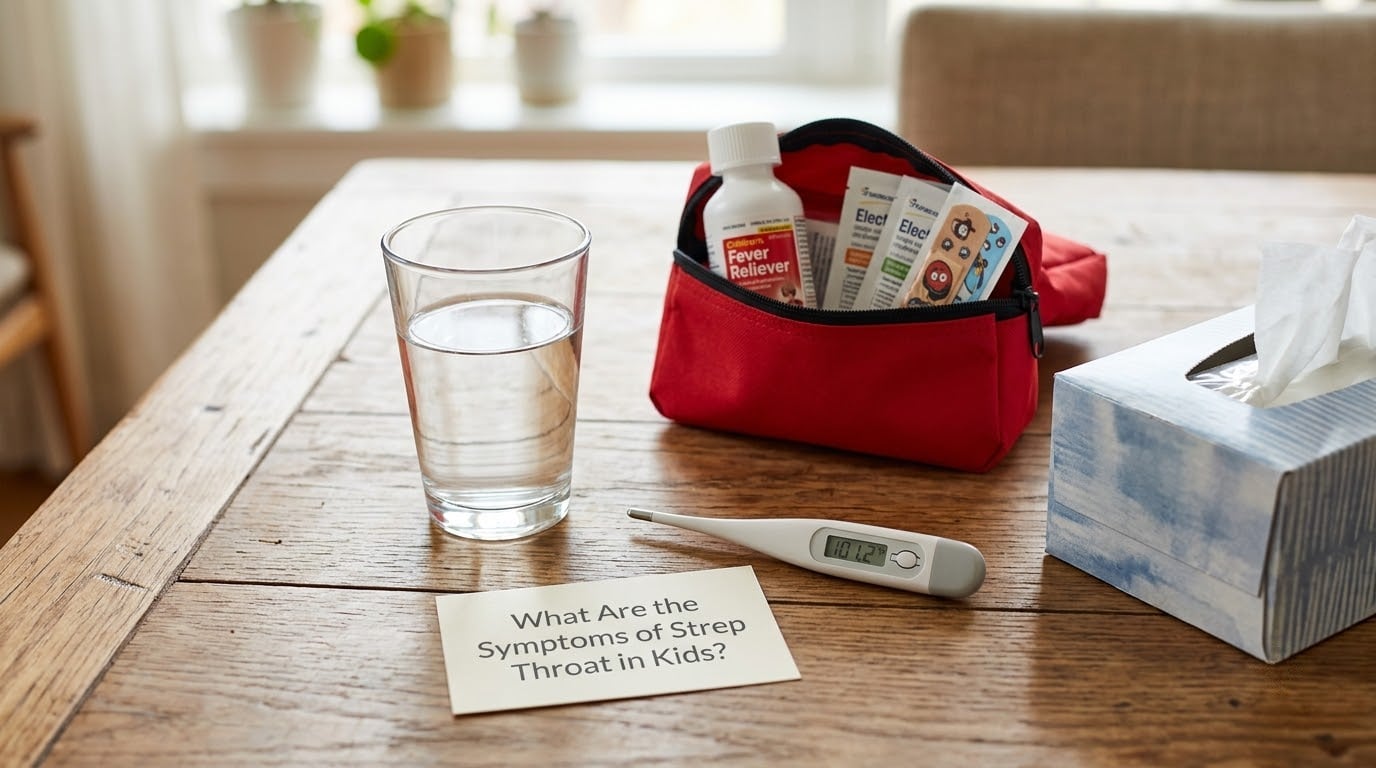
- Fever, often around 101°F or higher. Fever can spike overnight, ease after fever medicine, then climb again in the morning.
- Headache and stomachache. In kids, belly pain is common enough that some children are diagnosed from abdominal symptoms rather than throat complaints.
- Vomiting or nausea, sometimes at the start of the illness.
- A sandpaper-textured rash that begins on the neck, chest, or trunk and spreads. When a child has strep plus this rash, clinicians call it scarlet fever.
- Red spots on the roof of the mouth, tiny and pinpoint, called petechiae. Parents often describe them as speckles that do not wash off.
- Behavior changes. A child who normally eats well may refuse all food, become clingy, or act irritable for no clear reason.
School-age kids, roughly 5 to 15, most often get the textbook version. Toddlers under 3 tend to present differently: more nasal discharge and irritability, less obvious throat pain, and stomach symptoms leading the way.
Here is the honest limit. These symptoms are common to strep and to several other illnesses, and plenty of kids with strep have only a few of them. If your child’s symptoms linger, keep a rough note of when they started and how high the fever ran. That timeline is genuinely useful to a pediatrician.
How Do Strep Symptoms Differ From a Regular Sore Throat?
The difference is mostly about pattern. Strep tends to be sudden, fever-heavy, and dry, while viral sore throats usually come with a runny nose, cough, or hoarseness and build gradually.
- Onset: strep often starts abruptly, sometimes overnight. Viral sore throats tend to creep in alongside other cold symptoms.
- Fever: common with strep, often present with viral sore throats too, so this one alone tells you very little.
- Cough and runny nose: unusual for strep. Their presence points away from it, though not conclusively.
- Glands: tender neck nodes fit strep better than most viruses.
- Tonsils: red and swollen, sometimes with white patches. Note that white patches can also occur with viruses, including mononucleosis.
- Abdominal pain: more common in kids with strep than many adults expect.
Clinicians formally score some of these clues, most often with the Centor criteria, to decide how likely strep is before testing. Those scores are useful inside a clinic. At home, the honest summary is this: absence of cough and runny nose plus sudden onset plus fever is a reasonable reason to call your pediatrician, and nothing more than a reason.
What Other Illnesses Can Cause Similar Symptoms?
Several conditions produce a sore throat with fever and swollen glands in children, which is exactly why testing matters.
- Viral pharyngitis. The most common cause of a sore throat at any age, and it can produce white patches on the tonsils too.
- Influenza. Fever, sore throat, body aches, and exhaustion together, often with a cough.
- COVID-19. Frequently brings a sore throat alongside fever and fatigue, and it can look much like other respiratory viruses.
- Mononucleosis. Can cause significant tonsillar swelling, white patches, fever, and swollen glands, plus unusual fatigue. That combination gets mistaken for strep often.
- Hand-foot-and-mouth disease. Sore throat or mouth sores with spots or blisters on the hands and feet, usually in younger children.
- Reflux or irritation. Can cause throat discomfort, especially in the morning, without fever.
- Peritonsillar abscess. Deep in the throat, this is rare in young children but tends to occur after strep and causes severe one-sided pain, drooling, and trouble opening the mouth.
This is the practical reason strep gets diagnosed with a swab rather than with a parent’s intuition. Several of these look identical from the doorway.
When Should Parents Call a Doctor?
Call your pediatrician when strep is plausible and the illness is not resolving on its own. Routine reasons include a sore throat with fever lasting more than a few days, a child who will not drink, pain that keeps getting worse instead of better, and any concern if your child is a toddler.
A quick phone call is cheap and often saves a wasted trip. Tell them when the symptoms started, the highest temperature you recorded, and whether there is any cough or runny nose. Ask whether your child needs to be seen, whether a rapid test makes sense today, and what to watch for overnight.
Ask about testing in these situations: a school-age child with fever and a sore throat but no cough, a clear known exposure to strep, a sibling or classmate with confirmed strep, or a child with recurring tonsillar infections. Clinicians often skip testing when viral features are prominent, and testing a child with clear viral symptoms is one of the more common reasons for an unnecessary visit.
One more call-worthy situation: a child on antibiotics who has not improved after about 48 hours, or whose fever returns after a stretch of feeling better. Let the prescribing clinician know rather than changing anything on your own.
What Emergency Warning Signs Need Immediate Attention?
Some signs mean the situation has moved beyond a routine pediatrician visit. Go to an emergency department or call emergency services if your child has:
- Difficulty breathing, or noisy, labored, or fast breathing at rest.
- Drooling or a strong inability to swallow saliva, or a muffled, hot-potato-sounding voice.
- Inability to keep any fluids down, with no urination for many hours and no tears when crying.
- Unusual sleepiness, difficulty waking, or noticeable confusion.
- Swelling or stiffness in the neck, or severe headache with light sensitivity.
- A rash that does not fade when you press a glass against it, or blue-tinged lips or fingertips.
- Rapid deterioration: fine in the morning, clearly worse by afternoon.
- Signs of shock, such as very pale skin, cold clammy hands and feet, and a fast weak pulse.
A dehydrated infant or young toddler who has stopped feeding and has very few wet diapers belongs in urgent care or the emergency department the same day, regardless of whether strep is suspected at all.
How Is Strep Throat Diagnosed in Children?
Diagnosis is a sequence: history, examination, and a throat test. The clinician asks when the sore throat began, whether there is cough or runny nose, and whether anyone at home or school has confirmed strep recently.
A rapid antigen test detects group A streptococcus quickly, usually in about 15 minutes. Throat culture takes longer, often one to two days, but is more sensitive. Many practices test a child who has clear strep features, and if the rapid test comes back negative while suspicion remains, they send a culture.
A few practical notes. Negative rapid tests in very young children can be less reliable, and any child under 3 with a confirmed strep infection generally gets a culture for confirmation. Testing a child who is under 3 and has viral symptoms is usually skipped, because accurate rapid testing is hard in that age group and the infection is uncommon.
Home test kits and symptom checklists cannot give you a reliable diagnosis. They are easy to run on the wrong day, or on saliva instead of a proper swab. Some families use them for peace of mind after a confirmed household case, and that is a reasonable conversation to have with your clinician, since false results at home cause a lot of confusion.
One more thing worth knowing: a good share of healthy children carry group A streptococcus in their throats without any symptoms at all. Parents sometimes worry when an asymptomatic sibling tests positive after an outbreak, but a carrier is a normal finding, not a sign that something is wrong.
How Can Parents Help a Child Feel More Comfortable?
Comfort care is about fluids, rest, and reducing throat pain while your clinician decides on testing or a treatment plan. Nothing here is a substitute for that plan, and dosing is a conversation to have with your pediatrician or pharmacist.
- Keep fluids coming. Offer small amounts often: water, diluted juice, broth, breast milk, or formula. Cold drinks and popsicles often feel better than warm ones.
- Soften the food. Appetite usually returns once swallowing hurts less. Our piece on why food texture matters more than taste for some kids has practical ideas for building an easy-food list ahead of time.
- Skip the hard stuff. Crunchy, salty, and very acidic foods sit badly on an inflamed throat.
- Choose rest over screen-free guilt. A sick child watching a show is doing exactly what the moment requires.
- Use a cool-mist humidifier if your child’s clinician recommends it, particularly overnight.
- For children old enough to gargle safely, salt water can take the edge off throat soreness.
Watch hydration closely rather than just food. Ask your clinician about pain relief options appropriate for your child’s age, including anything you should avoid, and check the label rather than estimating.
Do not give a child leftover antibiotics, and do not give honey or anything similar unless your clinician says it is appropriate for their age. If your child already has a careful routine around gut sensitivity or sensory food aversion, our guide to managing constipation in autistic kids holds up surprisingly well during a sick week when everything else falls apart.
Is Strep Throat Contagious, and When Can a Child Return to School?
Yes, strep throat is contagious. It spreads mainly through respiratory droplets and through hands and shared objects, which is why classrooms and homes are efficient at passing it along.
General timelines, as described by pediatric guidance: a child may become contagious about one to two days after symptoms start, before any fever. Once an effective treatment is started, transmission drops substantially within roughly a day to a day and a half, and remains low as long as treatment continues.
Return-to-school decisions usually rest on several things at once, not just the clock:
- Confirmed or strongly suspected strep, and whether prescribed treatment is underway.
- At least 12 to 24 hours of appropriate treatment in most school and district guidance.
- No fever for 24 hours without fever-reducing medicine.
- Feeling well enough to participate, manage hydration, and focus.
- Any additional requirements from your child’s school, daycare, or local health guidance.
Check with your school directly rather than assuming a general rule applies. Requirements vary, and your clinician may be more specific about your child’s case.
How Can Families Help Prevent Strep Throat?
There is no vaccine for group A streptococcus, so prevention is largely about breaking the chain of transmission. None of it is a guarantee.
- Wash hands properly, for about 20 seconds, after coughing, before eating, and on coming home from anywhere busy.
- Stop sharing cups, bottles, utensils, straws, and toothbrushes. This matters more in a household where strep is already circulating.
- Cover coughs and sneezes, and teach kids to do the same without being reminded.
- Clean frequently touched surfaces, including toys, doorknobs, and backpacks, and be aware that some disinfectants irritate skin that is already raw from frequent handwashing.
- Keep a noticeably ill child home, regardless of cause, since they will not absorb much and they will pass plenty on.
- Follow clinician guidance on exposure. If a household case is confirmed, ask what the office recommends for siblings and whether anyone should be tested, keeping in mind that asymptomatic carriers are common.
If your child has sensitive skin or eczema that flares with frequent cleaning and handwashing, our guide to managing eczema flare ups in kids covers how to keep the protective habits going without making a rash worse.
Frequently Asked Questions
Can a child have strep throat without a fever?
It is uncommon but not impossible. Group A streptococcus can cause a sore throat with swollen, sometimes white-patched tonsils and tender neck glands even when a child has no fever. Because viral sore throats also skip fever sometimes, the pattern cannot settle the question. The reliable answer comes from a throat swab, so ask your pediatrician if symptoms are lingering or the child seems unwell.
How long does a sore throat last before parents should call the doctor?
Most viral sore throats start improving within three to five days and are largely over within a week. It is reasonable to call earlier than that if a child will not drink, has pain that is getting worse instead of better, or if you suspect strep because there is fever but no cough or runny nose. Early strep generally shows up fast, so a sore throat that has dragged on for weeks is more often something else.
Does a white patch on the tongue or tonsils always mean strep?
No. White patches or streaks can come from a variety of causes, including viruses such as mononucleosis, as well as irritation and other infections. White material on the tonsils is a useful observation to mention to your pediatrician, but it is not a diagnosis on its own. The throat swab is what separates strep from the alternatives.
Can infants and toddlers get strep throat?
They can, but it is uncommon, especially in children under 3. When very young children do get it, they often look different from school-age kids: more nasal discharge and irritability, less obvious throat pain, and stomach symptoms such as nausea or belly pain coming first. Clinicians generally confirm these younger cases with a throat culture, because rapid tests are less reliable at that age.
How soon after strep exposure do symptoms usually appear?
The incubation period is usually around 2 to 5 days after exposure, though some children show symptoms sooner. A child can also pass the infection on before any symptoms start, which is why one case in a classroom or home often turns into several over the following week. If you know about a specific exposure and a fever and sore throat develop in that window, mention it to your pediatrician.
Should a child with a sore throat stay home from school?
Keep a child with fever, significant throat pain, or fatigue home, whatever the cause. Staying home protects classmates and gives the child time to rest and drink. For strep specifically, most guidance expects a child to be on appropriate treatment for at least 12 to 24 hours and fever-free for 24 hours before returning. Your school and your child’s clinician can confirm the exact rule for your situation.
What to Do First
Write down when the sore throat started, the highest temperature you recorded, and whether there is any cough or runny nose. That three-line summary is more useful to a pediatrician than a guess at the diagnosis.
Then call when strep is possible, head to urgent or emergency care for the warning signs above, and keep comfort care to fluids, soft foods, and rest while you wait. Recognizing the symptoms of strep throat in kids gets you to the right conversation faster; it does not replace it.