

What is ABA therapy and how does it work? Applied behavior analysis is a science-based approach to teaching skills and reducing problem behavior, built on the simple idea that behavior that is followed by something a person values will happen more often. It is delivered by a team led by a board certified behavior analyst and is used most often with autistic children.
That is the short version. The rest of this guide walks through what happens inside a program, what a session actually looks like, and how you decide whether a provider is the right fit for your family.
One note before we start. Everything here is general education about how ABA programs work, not medical advice. Decisions about your child belong with you, your child’s providers and your care team.
Table of Contents
- What Is ABA Therapy?
- How Does ABA Therapy Work?
- What is ABA therapy and how does it work in practice?
- The ABC model: antecedent, behavior, consequence
- Positive reinforcement: how a new skill gets taught
- Teaching methods compared: DTT, PRT and NET
- Who delivers ABA and what they actually do
- What Skills Does ABA Therapy Target?
- What Happens During an ABA Session?
- How Do You Know if ABA Therapy Is Working?
- ABA Therapy vs. Other Autism Supports
- How to Choose an ABA Provider or Program
- Questions to ask before you sign
- Green flags and red flags on a center tour
- Frequently Asked Questions
- Can you do ABA therapy yourself at home?
- How stressful is ABA therapy for a child?
- How long does ABA therapy take to work?
- Does insurance cover ABA therapy?
- Why are some parents and autistic adults against ABA?
- Is ABA therapy only for children with autism?
- Where to Start With ABA Therapy
What Is ABA Therapy?
ABA stands for applied behavior analysis. It started as a laboratory science in the 1940s, studying why behavior happens and what changes it. What we now call ABA therapy is that science applied to real life: teaching communication, independence and safety to a specific person, one measurable step at a time.
It is important to clear up two things parents often get told. First, ABA is not one fixed program or a branded curriculum with a set number of sessions. Two children with the same diagnosis can be in completely different programs, because the plan is written around the individual.
Second, ABA is not a guarantee. No provider can promise a particular result or a particular timeline, and any program that does should make you cautious. What a good program can promise is a clear process: written goals, recorded data, regular review, and an honest conversation when progress stalls.
Autism Speaks describes ABA as one of the most widely studied treatments for autism, with decades of research behind it. Most children who receive it are autistic, but ABA is also used with people who have intellectual disabilities, traumatic brain injuries and some developmental delays.
How Does ABA Therapy Work?
What is ABA therapy and how does it work in practice?
It works through a cycle, repeated over months. A behavior analyst studies what is happening, writes goals, teaches skills using planned teaching methods, records what happens every session, and then changes the plan based on what the data shows.
Each link in that chain matters. Skip the data and you have no idea whether a change came from the teaching or from a normal Tuesday.
The ABC model: antecedent, behavior, consequence
The ABC model is the backbone of how ABA therapy works. It is simply a way of recording what came before a behavior and what came after it.
- Antecedent is the thing that happens immediately before: the instruction, the noise level, the demand, the change in routine.
- Behavior is what the person did that the team is trying to understand or change.
- Consequence is what happened right after, which is what made that behavior more or less likely next time.
Here is a real example. A child is asked to put on shoes before leaving (antecedent), throws the shoes (behavior), and the parent ends up dressing the child to avoid the delay (consequence). The throw worked, so the throw repeats. Now the team has something specific to work on.
Positive reinforcement: how a new skill gets taught
Positive reinforcement means adding something the child finds valuable right after a behavior you want to see more of. The “positive” part means something is added, not that anyone is being nice.
When a child says a word or signs for a snack and receives the snack, that consequence makes the communication more likely to happen again. Over hundreds of repetitions, a new skill becomes reliable enough to use in a real setting.
Good programs start small. The first goal might be making eye contact, then it becomes imitating a sound, then pointing, then asking for something. Reinforcers are matched to what actually motivates that child, which is a big part of why the plan has to be individual.
Teaching methods compared: DTT, PRT and NET
Three teaching methods come up constantly. Providers mix them depending on the child, the skill and the setting.
- Discrete Trial Training (DTT) uses short, structured repetitions with clear instructions and immediate feedback. It is well suited to early academic and foundational skills, and easy to measure.
- Pivotal Response Treatment (PRT) happens during play and everyday routines, with the therapist following the child’s interest and weaving in turns, choices and comments.
- Natural Environment Teaching (NET) takes place where the behavior would naturally occur, like a grocery store or a playground, using the real objects and real stakes of that moment.
DTT builds skills in a controlled way. PRT and NET build skills in the places your child actually has to use them. Most long-term plans use all three, then spend time on generalization, which means checking that a skill holds up with different people and in different places.
Who delivers ABA and what they actually do
The team structure confuses a lot of families at first. The short version is that one person writes the plan and many people help deliver it.
- Board Certified Behavior Analyst (BCBA) conducts the assessment, designs the program, supervises the team and is legally responsible for the treatment. This is the person whose judgment matters most.
- Board Certified Assistant Behavior Analyst (BCaBA) supports and works under the supervision of a BCBA.
- Registered Behavior Technician (RBT) is the person working directly with your child, often one-on-one, carrying out the written plan and recording data.
Parents frequently notice the difference between a BCBA who is genuinely involved and one who signs paperwork from another state. On r/Autism_Parenting, parents have talked about asking to see how often the analyst actually visits or video records sessions, and whether they can reach the analyst directly.
What Skills Does ABA Therapy Target?
The targets are written for one child, but they usually fall into a handful of areas. A program may work on communication, daily living skills, social interaction, play, learning readiness and behavior reduction, and it may target several at once.
Communication is often the first goal, and it may mean verbal speech, signs, a picture exchange system, or a device. A team should not insist on one method over another without a reason tied to the child.
Daily living skills include dressing, toileting, feeding, hand washing and moving safely through a home or a building. For many families these produce the biggest change in daily life, because they turn a fight into a routine.
Social and play skills cover waiting, taking turns, sharing, following a peer, using imaginary play and reading another person’s cues. These are the areas autistic people most often tell you they were never taught, and they are the areas many parents care about most.
Behavior reduction goals usually target something that is genuinely dangerous, such as self-injury, aggression, elopement or destruction of property. A good behavior intervention plan explains why the behavior is happening before it tries to stop it, which is why the analysis comes first.
Whether a goal is written this way matters more than the category. “Will reduce hand-flapping from 12 occurrences to 3 per hour at the table” is a usable goal. “Improve social skills” is not.
What Happens During an ABA Session?
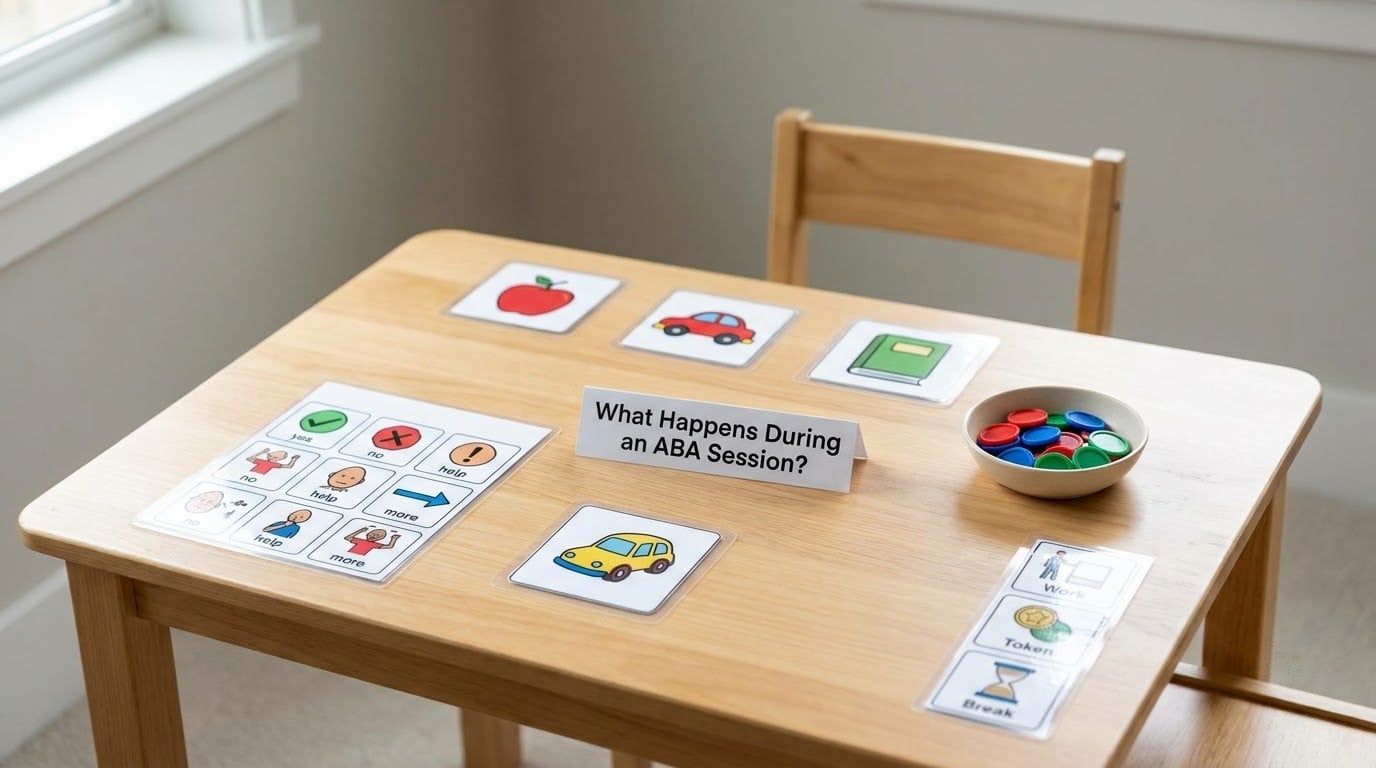
A typical session is two to three hours with a set of planned activities, and it changes a lot from one day to the next. A therapist might start with a short warm-up, run several trial-based blocks, switch to a play activity, practice skills in the break room, then finish with something the child chooses.
Session length and frequency vary widely. Some children get a few focused hours a week, others get intensive daily schedules. Focus on what the plan says and whether the delivered hours match it.
During the session the therapist will be prompting, which means giving a cue and then reducing the help as the child does more on their own. They will model the action, repeat it in different ways, and keep score on what happened. Toys, cards, tokens and simple visual schedules are common tools.
Breaks matter too. A child who is overloaded cannot learn, so a good session has planned breaks and a plan for what to do when a meltdown happens. That plan should protect the child’s dignity, not just manage noise for the adults in the room.
Expect some noise, repetition and crying early on. Children often resist at the start, and a change in routine can trigger an increase in the very behavior you are trying to reduce, which behavior analysts call an extinction burst. It usually settles within a few weeks when the plan is being followed consistently. Parents on parenting forums describe this adjustment period as the hardest stretch of the whole program.
After the session, data gets recorded and reviewed. Good providers share progress with families, not just at a yearly report. Parents on the Autism_Parenting subreddit have said they rarely see session data until a formal review, and that providers willing to share it daily were the ones who felt like real partners.
How Do You Know if ABA Therapy Is Working?
Progress is measured in what your child can do, not in how many hours they have logged. No one can tell you a reliable number of months, because the range between children is enormous and depends on the goals, the intensity and how consistent the team is.
Watch for these kinds of changes instead:
- New skills that hold up with different people, in different rooms, without a lot of prompting.
- More independence in daily routines that used to require an adult to step in.
- Real communication, even if it is signed, gestured or typed rather than spoken.
- Fewer or shorter problem behaviors, especially the dangerous ones.
- More participation: playing alongside peers, joining an activity, tolerating a change of plan.
- Better quality of life for the whole family, including less stress for you.
Ask what the baseline was. Without a starting measurement you cannot tell improvement from natural development, and you cannot tell a bad fit from a hard month.
Be alert to the reverse signal too. If months pass with no written goals, no data shared with you, and no changes to the plan, that is information. The response should be to raise it with the BCBA, ask for a re-evaluation, and consider a second opinion from another qualified provider. Asking to keep services through age 18 is also a common question, and it is worth understanding what happens to benefits when your child turns 18 early rather than late.
ABA Therapy vs. Other Autism Supports
ABA is one support among several, and most children who do well combine it with other things. The best question for a provider is how their work fits with the rest of the team, not whether it replaces them.
- Speech-language therapy focuses on speech, language and feeding. An ABA program often targets communication too, so ask who is teaching what and how they avoid contradictory goals. Some families have hit friction when an SLP and a behavior team pull in different directions, and the fix is usually a shared plan.
- Occupational therapy focuses on fine motor skills, daily self-care and sensory processing. Sensory strategies belong here, and a sensory-informed ABA program should defer rather than duplicate.
- Educational services under an IEP cover instruction and accommodations in school. If your child is heading toward school-based services, what happens at an IEP eligibility meeting is worth reading early so you know what evidence to collect.
- Medical care addresses sleep, seizures, gastrointestinal issues, medication and co-occurring conditions. Behavior change will be harder while pain and poor sleep are untreated.
- Other approaches such as speech-focused programs, relationship-based interventions, floortime and developmental approaches have different evidence bases and different goals. You can combine them, and your child’s team can help you weigh them.
There is real debate inside the autism community about ABA, and it deserves a straight answer rather than a brush-off. Some autistic adults describe harm: forced eye contact, suppression of harmless stimming, being trained out of distress signals that were actually communication.
Historically, some of that criticism was fair. Older practice did include compliance-focused goals and aversives. Modern programs increasingly frame goals around what the autistic person says they want, and a growing number of providers describe themselves as neurodiversity-affirming.
That does not mean every current program is well run. Ask directly what the goals are, whether your child’s autonomy and communication are respected, and whether the program would still be acceptable if your child could read the plan and speak up. A provider who answers those questions honestly is a good sign.
How to Choose an ABA Provider or Program
Questions to ask before you sign
You are interviewing a company that will spend years with your child. Take the tour seriously and ask the hard questions up front.
- Who is the supervising BCBA, and how often do they work directly with my child rather than reviewing paperwork?
- Will the goals be written with me, or handed to me? A collaborative plan you helped write is a plan you will support.
- How is progress measured, how often is it reviewed, and how will I see the data?
- How do you assess skill generalization across people and settings?
- What training and turnover do your technicians have, and how are new staff trained before working alone?
- How do you handle a meltdown, and what happens to the child’s dignity?
- What does parent training look like here, and is it ongoing or one meeting?
- What are the actual available hours, and what happens if staffing falls short?
- How do you handle authorization and insurance, and who does the paperwork?
- Can I speak with a current parent, and can I observe a session?
- What happens when we leave the program, and how do you support the transition?
Ask about waitlists early. Families on r/ABA have described waiting two years and then being offered a fraction of the prescribed hours, which can be gutting. Get the realistic number of hours in writing before you commit.
Green flags and red flags on a center tour
Tour more than one. Your ability to tell the difference improves quickly once you have seen three or four.
Green flags: the BCBA greets you and uses the child’s name; technicians seem calm and comfortable; you see data being recorded during sessions; the room is not overstimulating; the staff use the child’s communication method rather than insisting on speech; parents are welcome to watch; the website and forms use respectful language.
Red flags: nobody can tell you who supervises the program; goals are printed rather than discussed; technicians are visibly exhausted and each one works with large caseloads; the plan rewards compliance with eye contact or quiet hands without any functional goal attached; staff talk about the child as a diagnosis; you are told you cannot observe.
On cost, ask what an hour costs, what your insurance covers, and how authorization works before you agree to anything. Rates, coverage and rules vary by state and change over time, so get the numbers from your insurer and the provider in writing rather than relying on a range you read online.
Frequently Asked Questions
Can you do ABA therapy yourself at home?
You can do a lot of the daily practice at home, but a formal program needs a qualified professional. Consistency between sessions and everyday life is one of the strongest predictors of whether a skill sticks, so home practice counts for a lot. What you cannot do alone is assess why a behavior happens, design a plan, and supervise the data collection. Ask your BCBA for a home program with specific, short daily routines.
How stressful is ABA therapy for a child?
The first few weeks are usually the hardest. Children often resist, cry, or show more of the behavior you are targeting, which can look like things are getting worse before they improve. Good providers plan for that period, reduce demands when a child is overloaded, and keep breaks in the session. Ask what their adjustment protocol is and how they decide a child has had enough.
How long does ABA therapy take to work?
There is no reliable single answer, because goals, intensity, starting skills and consistency all differ. Some children show new skills within a few months of consistent practice. Others need years of support. Any provider promising a fixed result or a guaranteed timeline is overstating what they know. Ask what their baseline data looks like and how they will tell you whether a goal is met.
Does insurance cover ABA therapy?
Coverage varies widely by state, plan and the child’s age, and it is often limited rather than comprehensive. Some Medicaid programs cover a set number of hours per week, and some states fund behavior analysis services directly. Private plans vary too. Contact your insurer before enrolling and ask specifically about ABA, the supervising BCBA, the setting, and whether an authorization is required.
Why are some parents and autistic adults against ABA?
The objection usually centers on goals and consent: forced eye contact, reducing harmless stimming, and suppressing distress signals that were communicating something. Some autistic adults describe this as coercive or as trauma, and those criticisms shaped modern practice toward honoring communication and autonomy. Others see the same history as a reason to demand better oversight rather than to drop the approach entirely.
Is ABA therapy only for children with autism?
No. Most people who receive it are autistic, but behavior analysis is used more widely. It supports people with intellectual disabilities, developmental delays, traumatic brain injuries and some behavioral concerns after injury or diagnosis. A BCBA assesses whether behavior analysis fits the person and the goals, rather than fitting the person to a diagnosis. Your child’s care team is the right place to raise the question.
Where to Start With ABA Therapy
Start with a written plan, not a sales meeting. Before you sign anything, get the goals in writing, the hours you will actually receive, the name of the supervising BCBA, and how progress data reaches you.
Tour at least two providers, ask to observe a session, and talk to a current parent who has been there long enough to see the adjustment period pass. That last conversation tells you more than any brochure.
And remember that you can change providers. A program that shares data, respects your child’s communication and invites you into the planning is worth a lot. If yours does not, you have not failed your child by leaving.