
Self care ideas for busy moms are small, repeatable acts of care that fit the margins of a real caregiving day, not a fantasy one. Think three quiet minutes with coffee while it is still hot, a shower during the house’s calmest hour, or asking someone else to own one task completely. Nothing on this list needs a spa, a budget, or a nap schedule that actually happens.
Most self care advice assumes a tidy house, a supportive partner, and disposable income. If you are parenting a child with autism, a disability, or a whole lot of sensory needs, those assumptions rarely match your Tuesday. So this list is built around what moms say actually survives a hard week: routines that take under five minutes, ideas that work in a house that is rarely quiet, and permission to do the smallest possible version on the worst days.
Every idea here is sorted by the time it actually takes and the moment it slots into. Pick one, repeat it for a week, and adjust it to fit your family. That is genuinely all it takes to start.
Table of Contents
- Self Care Ideas for Busy Moms at a Glance
- 1. Use a Five-Minute Morning Reset
- How to choose self care ideas for busy moms realistically
- 2. Batch Simple Care Tasks
- 3. Schedule Ten-Minute Care Breaks
- 4. Keep Hydration Within Reach
- 5. Use a Two-Minute Movement Reset
- 6. Make a Sensory-Friendly Reset Space
- 7. Follow a One-thing-at-a-Time Evening Routine
- 8. Practice a Daily Three-Minute Check-In
- 9. Build a No-Screen Wind-Down Pocket
- 10. Set a Weekly Respite Boundary
- 11. Use a 15-Minute Low-Energy Care Menu
- 12. Ask for Practical Support Without Guilt
- Frequently Asked Questions
- How much time does self care actually need for a busy mom?
- Is self care selfish for a mom who has kids?
- What self care works for sensory-sensitive or chemical-sensitive moms?
- How can I get my family involved in my self care?
- When should a mom call a doctor or therapist instead of trying self care ideas?
- Start With One Small Step
Self Care Ideas for Busy Moms at a Glance
The table below shows each idea, roughly how long it takes, the best moment to use it, and what it gives you. Nothing on this list needs more than a few minutes of prep the night before.
| Idea | Typical time | Best moment | How it helps |
|---|---|---|---|
| Five-minute morning reset | 5 minutes | Before the house wakes up | Starts the day on your own terms |
| Batch simple care tasks | 2 minutes each | During routine chores | Cuts decision fatigue |
| Scheduled care breaks | 10 minutes | Fixed time, same daily | Makes rest non-negotiable |
| Hydration within reach | 30 seconds | Every time you pass the kitchen | Steadier energy through the afternoon |
| Two-minute movement reset | 2 minutes | After drop-off or a nap | Releases tension without a workout |
| Sensory reset space | 5 to 15 minutes | Overstimulating moments | Fewer inputs, faster recovery |
| One-thing-at-a-time evening routine | 15 minutes | After bedtime | Fewer bedtime decisions |
| Three-minute daily check-in | 3 minutes | Any quiet pause | Names what you need before it grows |
| No-screen wind-down pocket | 10 minutes | Transitions and evenings | Offline calm on hand |
| Weekly respite boundary | 60 minutes or more | One protected window weekly | A real recovery window |
| Low-energy care menu | As little as 1 minute | Exhausted days only | Covers the days nothing else fits |
| Asking for practical support | One conversation | Weekly, or when it breaks | Removes a task instead of adding one |
1. Use a Five-Minute Morning Reset
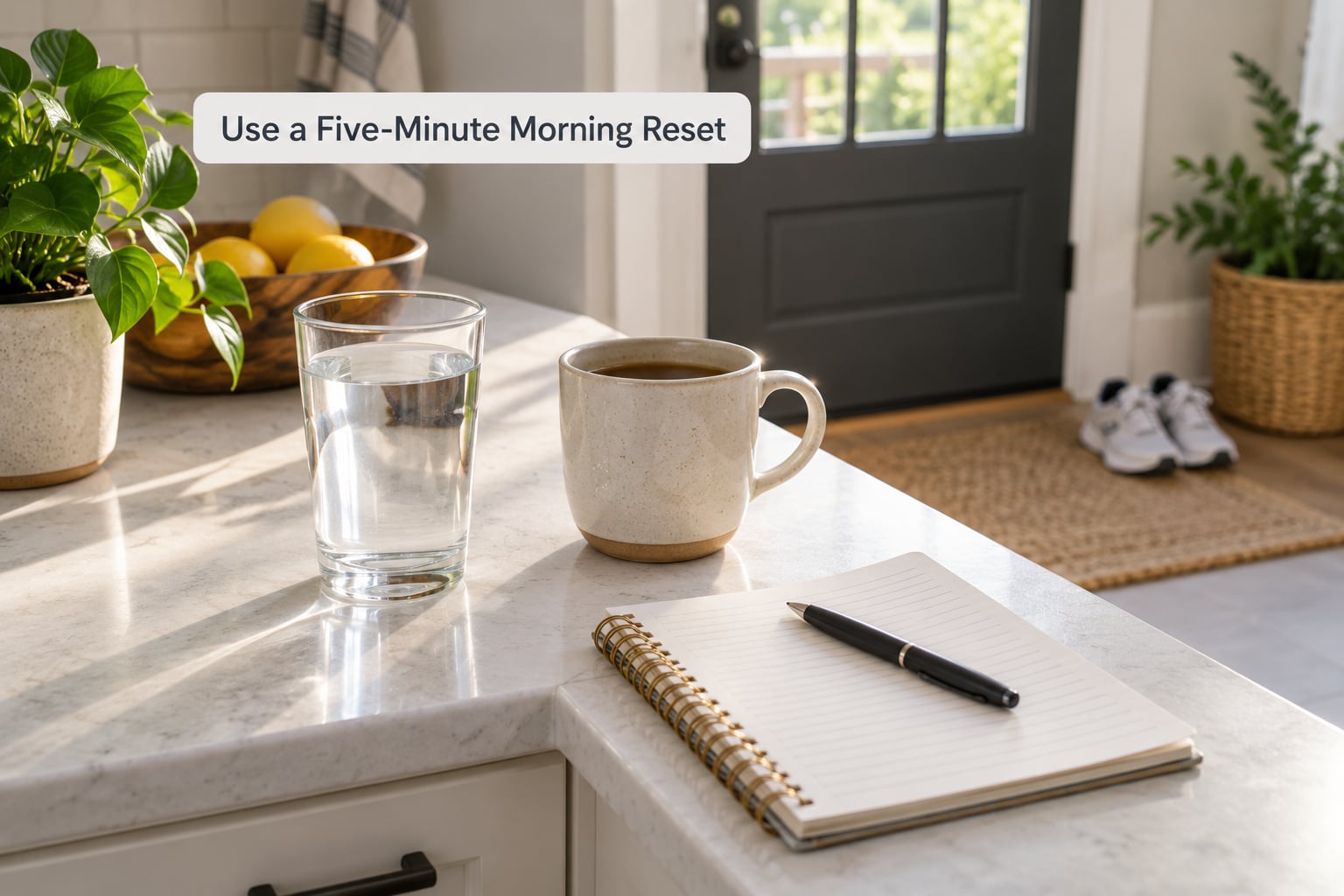
The most reliable self care ideas for busy moms happen before anyone needs you. A five-minute morning reset is four small things in order: drink a full glass of water, take any medication prescribed to you, use the bathroom, and take three slow breaths before you start anything else.
That is the whole routine. It matters because the version of your morning that happens while everyone else is asleep is the only one you fully control.
If mornings are not possible, do it at bedtime instead. The anchor habit just needs to attach to a time that reliably belongs to you.
How to choose self care ideas for busy moms realistically
Choose based on the time, energy, and sensory conditions you actually have, not on the version of your life you wish you had. The smallest routine you can do on your worst day beats the best routine you can do on a good one.
Start there, run it for a week without changing anything, then adjust. A routine that survives contact with a hard Tuesday is the only kind worth keeping.
2. Batch Simple Care Tasks
Pair personal care with something you already do instead of adding a new step. Check the calendar while the coffee brews, apply lotion or deodorant the second you step out of the shower, put your hair up while dinner is in the oven.
The point is not to finish a long routine. It is to remove the dozens of small decisions a day asks you to make, because decision fatigue is often what exhausts caregivers more than the tasks themselves.
3. Schedule Ten-Minute Care Breaks
Ten minutes, same time every day, written on a family calendar so it is visible rather than secret. Put a timer on it so it does not quietly become an hour of scrolling or nothing at all.
Use a transition signal both you and your child understand. A song that starts, a lamp that dims, a specific phrase you both say. When the cue is predictable, starting the break stops feeling like a negotiation.
4. Keep Hydration Within Reach
Put a filled container where you already stand. A glass on the bathroom counter, a refillable bottle on the kitchen counter, a second one on your nightstand for the middle-of-the-night wake-ups.
Our guide to how to stay hydrated during a busy day has more practical setups. General guidance aside, persistent fatigue, headaches, or dizziness are worth raising with your doctor, since hydration habits are not a substitute for medical care.
5. Use a Two-Minute Movement Reset
Walk one lap of a room, roll your shoulders back ten times, stretch your calves at the kitchen counter, or step outside for a slow loop around the block. Movement counts even when it is not exercise.
If pain or limited mobility gets in the way, try seated options instead: ankle circles, gentle neck turns, or shifting weight from heel to toe while seated. These quick workouts you can do at home between drop-off and dinner have low-impact options for exactly this reason.
Persistent pain is not something to work through. Your doctor or a physical therapist can point you toward movements that are actually safe for your body.
6. Make a Sensory-Friendly Reset Space

Pick one low-stimulation spot in your home and gather a few things that help you settle. A soft chair, a blanket, a simple lamp, noise-reducing headphones, and a small basket of items you actually like.
For caregivers whose homes run on sensory overload, this is often the difference between a hard afternoon and a manageable one. Keep scented products out of it if fragrance bothers you, and follow our steps on how to build a calm down corner at home if you want a step-by-step version.
Whatever you gather, keep the space safe for a child who wanders in, and skip anything with small parts or cords.
7. Follow a One-thing-at-a-Time Evening Routine
Write three items on paper and cross each one off as you go: set out tomorrow’s clothes, check what needs to come out of the freezer, set a timer for brushing teeth. One line, one action, done.
Lists work better than willpower at 8:30pm when you are the last one awake. This is also the moment when the mental load quietly transfers from your head to paper, which is most of the point.
8. Practice a Daily Three-Minute Check-In
Three minutes, no journaling required. Take five slow breaths, then name one physical need, one emotional need, and one small action that would answer one of them.
Stuck on the emotional one? That is common, and noticing it is already information. Some moms use a notes app, some say it out loud in the shower, some just think it through. Pick the version you will actually repeat.
9. Build a No-Screen Wind-Down Pocket
Keep a small basket or drawer of calming offline options within reach: a book, an audiobook, a simple craft, a playlist, a puzzle. A stack of paper and a pen works too.
The value is in the speed of access. When a transition turns into a meltdown, a decision about what to offer is one problem fewer. For some households, choosing non-toxic materials for anything you handle daily, like candles and bath products, makes the whole basket more usable.
10. Set a Weekly Respite Boundary
Pick one window each week you protect. Write down what the time is for, say it out loud plainly, and treat it the way you would treat a medical appointment that does not move.
A script helps: “Saturday from nine to ten is mine. I am off the clock and not planning anything. I will be back at ten.” Specific, short, and not up for debate in the moment.
Some households can arrange backup, and some cannot. Build the habit around what is genuinely available to you rather than an ideal support system.
11. Use a 15-Minute Low-Energy Care Menu
Some days have nothing left. Keep a written list of things that cost almost nothing: sit outside for ten minutes, put on one song you like, take a screen break, ask someone to hand you a drink, do exactly one grooming task such as washing your face.
This is the idea moms come back to most often, because the fatigue is so deep that even a walk feels like another assignment. Reading the list is itself a form of care.
12. Ask for Practical Support Without Guilt
Vague requests get vague answers. Turn a wish into a specific, owned task: someone cooks dinner on Tuesdays, someone drives your child to their appointment, someone covers the bath routine for one evening.
Try saying it plainly: “I need you to own the laundry on weekends so I am not doing it at night.” One task, one name, one timeframe. A task that is genuinely handed off is worth more than five things you are still half-managing yourself.
If you are parenting alone, the same script points outward: a neighbor, a sibling, a respite service, a church group, a sitter swap. The task still needs an owner, and you are allowed to name exactly what would help.
Frequently Asked Questions
How much time does self care actually need for a busy mom?
Most of the self care ideas on this list take under five minutes, and that is not a compromise. Short, repeated routines are easier to keep than one long block you schedule once and never reach. Pick a two-minute idea first, then add a ten-minute break once that habit feels automatic. If you can only protect one window a week, protect that one and let the small ones fill the gaps.
Is self care selfish for a mom who has kids?
It is not selfish, and the guilt that shows up is a habit rather than a fact. A shower, three quiet minutes, or a scheduled break leaves you more patient for the people who depend on you, not less available. Many moms say the guilt comes from comparing their recovery to a picture of someone with no responsibilities at all. A two-minute ritual is a reasonable thing to want.
What self care works for sensory-sensitive or chemical-sensitive moms?
Scented candles, fragranced bath products, and heavily scented skincare are often the first things people suggest and the first things that make some caregivers feel worse. Unscented options, simple cotton or wool fabrics, dim lamps, and noise-reducing headphones tend to work better in sensitive households. Building a reset space around what does not bother you matters more than following a standard self care list.
How can I get my family involved in my self care?
Announce the break as routine rather than reward, so it does not compete with the kids. Tell them the time, the signal, and what happens if they need you, then keep the signal visible on a shared calendar. Involve older children by letting them cover a small task, like setting the table, which builds the habit before you need it from them.
When should a mom call a doctor or therapist instead of trying self care ideas?
Talk to a healthcare professional if exhaustion does not improve with rest, if you cannot sleep even when you have the chance, or if low mood, anxiety, or numbness lasts more than a couple of weeks. Postpartum mood and anxiety disorders can appear in the first year and respond well to treatment. Support from a doctor, a therapist, or a perinatal mental health specialist is a next step, not a failure.
Start With One Small Step
Look down the table and pick the idea that needs the least planning. That is usually the water glass, the two-minute walk, or the three-minute check-in, and those three are where most people should start.
Do it for a week without adding anything else. If the morning gets away from you, move the habit to bedtime instead of dropping it. Small routines that hold up on a hard day are the ones that change how a season feels.