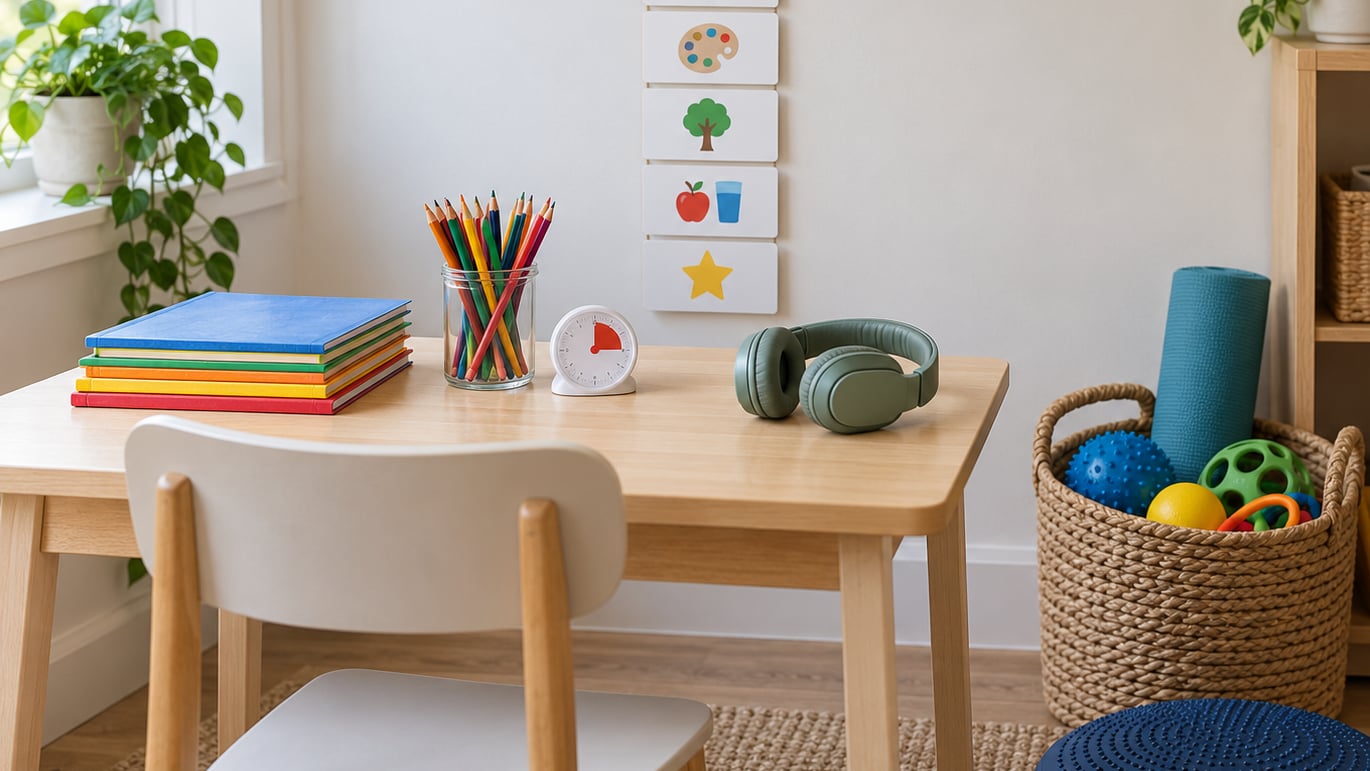
Homeschooling a child with ADHD works best when you pair a predictable daily routine with short, chunked lessons and plenty of movement. The schedule gives your child the structure they cannot generate on their own, the short blocks keep work from feeling endless, and the movement breaks reset attention before it collapses.
Most families find this in about four to six weeks of steady practice, not overnight. Mornings are usually the hardest part of the day, so start there and build outward from what already works.
This guide walks through the materials you need, a six-step process for building and running the school day, the mistakes that trip most families up, and a simple first-week plan you can start tomorrow.
Table of Contents
- What You Need
- Step-by-Step: How to Homeschool a Child With ADHD
- Choose a Flexible Daily Routine
- Keep Lessons Short and Specific
- Build In Movement and Sensory Breaks
- Use Visual Instructions and Checklists
- Track Progress Without Constant Testing
- Adjust the Plan as Your Child Changes
- Common Mistakes
- Frequently Asked Questions
- Does my child need to be a certain age or grade for this to work?
- How long should homeschool lessons be for an ADHD child?
- How do I homeschool a child who refuses to do schoolwork?
- Do I need teaching experience to homeschool a child with ADHD?
- How do I keep my child from feeling isolated while homeschooling?
- How to Start Your ADHD Homeschool Routine
What You Need
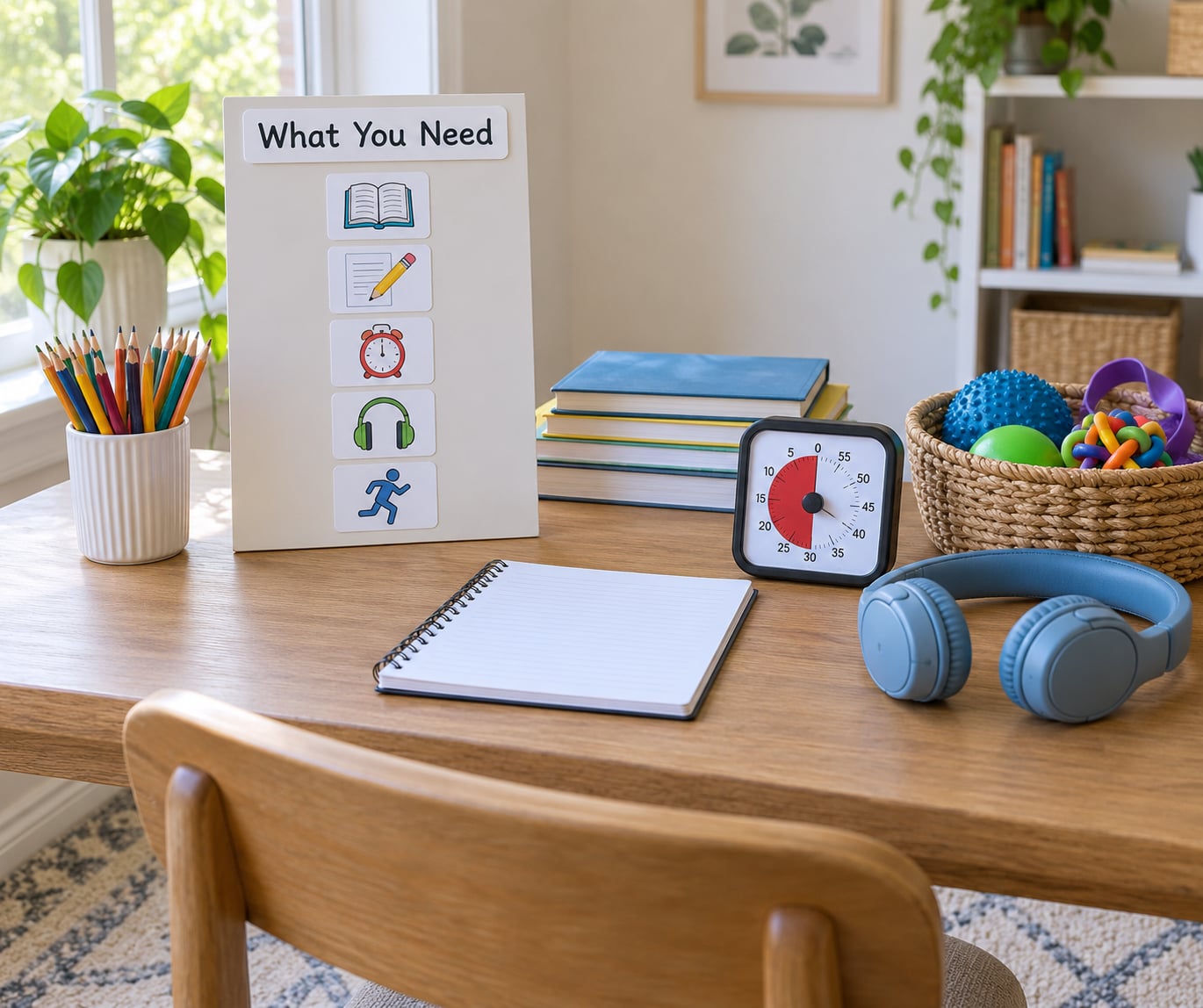
The list is shorter than most homeschool checklists suggest. What you need first is a written schedule you can see, a checklist your child can read without asking you, learning materials at the right level, some movement supplies, a couple of sensory supports, and a simple record of progress.
A visual schedule can be a laminated poster, a dry-erase board, a page of index cards taped to the wall, or a printout in a clear pocket. The format matters far less than the fact that it stays in the same place every day.
For learning materials, choose fewer books than you think. One core text or workbook per subject, one read-aloud book for pleasure, and a math resource with manipulatives you can physically move are plenty. A child with ADHD rarely benefits from a shelf of options; decision fatigue is part of the problem.
Movement supplies can be cheap and ordinary: a mini trampoline, a scooter board, a resistance band, a ball, chalk on the driveway, or a stacking cushion. Pick two your child actually enjoys and keep them within reach of the learning spot.
Sensory supports include noise-canceling headphones, a wobble cushion or balance ball for sitting, a small fidget kit, and a designated calm-down corner with soft lighting. Not every child needs all of these, and offering the full set on day one usually overwhelms rather than helps.
For a simple progress record, a notebook with the date, what was covered, and how it went is enough. A weekly glance back through it tells you far more than any single day’s grades.
Here is a printable-style daily structure you can copy and adapt. Adjust the times to your child’s age, strengths, and attention span, and treat the whole thing as a starting template rather than a rulebook.
| Time | Block | What it looks like |
|---|---|---|
| 8:00 | Wake and morning routine | Same three steps, same order, written on the wall |
| 8:30 | Breakfast and movement | No school talk yet, outdoors or trampoline if possible |
| 9:00 | Hardest subject | 10 to 20 minutes of focused work in the best focus window |
| 9:20 | Movement break | 10 to 15 minutes of heavy work or outdoor time |
| 9:40 | Second subject | Shorter block, hands-on if possible |
| 10:10 | Reading and check-off | Independent or read-aloud, then mark the checklist |
| 10:30 | Outdoor time or free play | Unstructured, no learning expected |
| Afternoon | Light review or interest-based project | Repeat the morning concept once before it fades |
| Evening | Dinner and end-of-day check-in | Two questions: what went well, what was hard |
One more tool worth having is a way to handle screens during school time without a daily argument. If your child uses a tablet for any part of the curriculum, setting clear limits ahead of time saves a lot of friction, and our guide on how to lock down a tablet for a young child covers the setup.
Step-by-Step: How to Homeschool a Child With ADHD
Choose a Flexible Daily Routine
Build the routine from your child’s best focus window, not from a clock. Most children with ADHD do their clearest thinking in the first couple of hours after waking, so the hardest subject usually belongs there.
Keep one main learning block, then break the rest of the day into short subject sessions with movement between them. Include meals, outdoor time, quiet time, and a short end-of-day check-in so the day has an obvious finish.
Leave gaps in the schedule on purpose. Ten unscheduled minutes between activities absorbs a slow transition, a lost shoe, or a sudden fixating interest without the whole day collapsing.
You will know this routine is working when your child can start the morning without being asked three times, and when a bad morning no longer derails the afternoon.
Keep Lessons Short and Specific
Ten to twenty minutes per subject is the range most families land on, and it scales with age. A kindergartner might manage eight minutes of actual work; a high schooler can often hold twenty-five.
Give one clear goal at a time rather than a page of directions. Instead of “do the math worksheet,” try “finish the four problems on the left side, then tell me when you’re done.”
Reduce visual clutter before the lesson starts. Clear the table of everything that is not the current subject, close unrelated tabs, and put the phone in another room. A child with ADHD filters poorly in a noisy visual field.
Give a visible finish line. A timer, a set of problems counted out, or a specific section of the page all work, because “do some math” is an open-ended task and open-ended tasks stall.
Chunk larger work into five-minute pieces with checkmarks between them. You can see more on how to help a child with homework meltdowns when a task feels too big to begin.
What works here is what works for your child. Reading may click with a decodable text one day and an audiobook the next, and neither result is failure.
Build In Movement and Sensory Breaks
Alternate demanding work with movement rather than saving movement for the end of the day. A short burst before a hard subject often does more good than a longer break afterward.
For children who fidget, movement during work can matter more than movement between work. Standing at a counter, walking while listening to an audiobook, or doodling on a specific page keeps the body busy without stopping the thinking.
For children who become overwhelmed, a quiet break is different from an active one. A calm-down corner with dim light, a soft blanket, and no screens gives a sensory reset without adding stimulation.
Heavy work, the kind that involves pushing, pulling, or carrying, tends to settle a restless body fast. Raking leaves, washing the car, or climbing anything counts.
Outdoors beats indoors when you have the option. A park, a yard, or a neighborhood walk gives regulation that a fidget toy cannot, and most children need it more often than their behavior suggests.
Follow your child’s known preferences and any guidance from their occupational therapist or other professionals. What regulates one child can wire up another.
Use Visual Instructions and Checklists
Turn directions into something your child can see instead of something you have to say. A posted morning list, a picture sequence for getting started, and a small checklist taped to the desk remove a surprising number of daily conflicts.
For getting started, try a three-step card: shoes on, breakfast on the table, backpack by the door. Three is usually the limit before the list becomes wallpaper.
For clean-up, one line beats a paragraph. “Books back on the shelf, pencils in the cup, trash to the bin” is a checklist. A reminder about tidying is a wish.
For transitions, give a two-minute warning and a five-minute warning, then finish the block yourself so the handoff is clear. Many children who stall are waiting to see whether the stop is real.
Offer two choices instead of one instruction. “Do reading first or math first?” gives control back without giving up the structure, and it sidesteps most power struggles.
Then fade the prompts. Once a checklist has been followed reliably for two weeks, remove one item from it and let your child complete that step from memory. The goal is independence, not a better checklist.
Track Progress Without Constant Testing
Watch for skills rather than scores. Can your child start a task with one reminder, stay with it for the agreed time, and ask for help when stuck? Those three things predict academic progress better than any quiz score.
Keep a weekly portfolio of two or three work samples. Looking back at six weeks of samples tells you what actually stuck in a way that a daily judgment call never will.
Use work samples, checklists, and your own observation instead of timed tests. Testing often captures a child’s worst day rather than their typical one, and the resulting data leads parents to change strategies that were working fine.
At the end of the week, ask three questions. What did you finish fastest, what felt hardest, and what would you rather do tomorrow? Their answers are usually more accurate than your impression from across the table.
Share your notes when you want a second opinion from a teacher, a tutor, your child’s pediatrician, or another qualified professional. If written work is consistently illegible, if reading level has stalled for months, or if anxiety or avoidance is growing, that is a signal to bring in someone who can assess properly.
If your child was on an IEP or 504 plan before you started homeschooling, keep a copy of it. It documents what the school identified as helpful, and it is a starting point when you ask a tutor or occupational therapist for input. More on that trade-off in how to help a child keep up with classroom pace.
Adjust the Plan as Your Child Changes
Revise based on what you observed, not on what you hoped would happen. Attention drops at 9:15 every day? Move the hard subject fifteen minutes earlier rather than blaming the child.
Change one or two variables at a time. Shortening lessons, moving the break earlier, changing the format, and adding a reward all at once tells you nothing about which change helped.
Write down what you changed and what happened. A one-line note is enough, and three weeks of those notes become a very clear picture of your child’s pattern.
Some children need a full off day, and some weeks call for a break week instead of a rest day. A week off is a scheduling decision, not falling behind.
If nothing has improved after three or four weeks of honest adjustment, the plan is wrong rather than your child. Families who thrive on a year-round rhythm with no long summer break report doing better partly because of that flexibility.
Know the exit sign too. If months of effort produce increasing conflict, worsening self-esteem, or no academic progress, talk with your child’s team about other options. Switching back to school, using a hybrid co-op, or adding outside support is a valid plan, not a failure.
Common Mistakes
Copying a public school schedule. A seven-period day with bells is built for a teacher managing thirty children. It produces exactly the opposite of what a child with ADHD needs. Fix: build one main block and let the rest of the day be short, flexible, and interest-led.
Making every day identical. A rigid routine has no room for a bad morning, and one bad morning becomes a ruined week. Fix: plan an alternate short version of the day that still counts. Twenty minutes of reading and math is a homeschool day, not a failure.
Planning work that is too long. Forty minutes of writing for an eight-year-old is a wall. Fix: set blocks at ten to twenty minutes, then raise them gradually as attention stretches.
Using worksheets as the only activity. A stack of worksheets trains compliance, not thinking, and it is boring enough that attention will not last. Fix: alternate hands-on work, reading aloud, projects, and conversation with written practice.
Rewarding behavior with food. It works once, then it needs to work harder each time, and it can crowd out meals. Fix: use access, not consumption. Choice of the next activity, ten extra minutes of the thing they love, or choosing the family’s film works better.
Treating one bad day as failure. One parent described it as all-or-nothing: three good weeks followed by one hard morning, and the whole month felt lost. Fix: judge the week, not the day, and keep going.
A few things that steady most families: put the hardest work in the sharpest hours, say yes to hyperfocus when it happens instead of stopping it, keep the daily check-off visible so progress is obvious, and let some days be small.
And take care of yourself. The parent is the intervention here, and parent exhaustion is the most common reason an ADHD homeschool routine quietly falls apart. If you are the one keeping everything running, your own support matters as much as the curriculum.
Frequently Asked Questions
Does my child need to be a certain age or grade for this to work?
No. The approach works from preschool through high school, but what changes is the length of the block and the amount of independence you expect. A kindergartner needs short, hands-on sessions with you beside them. A middle schooler can manage twenty-minute blocks with a checklist. A high schooler usually needs a weekly plan rather than a daily one.
How long should homeschool lessons be for an ADHD child?
Ten to twenty minutes per subject is the working range for most children, and shorter for younger ones. Watch the child’s behavior rather than the clock. When attention breaks, ends of sentences get short, or pencil work becomes doodling, that is your signal to stop even if the block is not finished. Most families raise block length gradually over weeks.
How do I homeschool a child who refuses to do schoolwork?
Start smaller than feels useful. Offer five minutes instead of twenty, lower the difficulty by one step, and pair the task with something your child genuinely wants afterward. If refusal is consistent rather than occasional, note what happened right before it and talk with your child’s pediatrician or a specialist, since refusal can signal that the work level or pace is wrong.
Do I need teaching experience to homeschool a child with ADHD?
Most parents start without it. What matters more is willingness to adjust the plan daily and to keep records of what is covered. Families typically join a local homeschool co-op or group early on, which supplies curriculum ideas, social time for the child, and adults who have already solved the problems you are about to hit.
How do I keep my child from feeling isolated while homeschooling?
Plan regular contact before it is needed. Interest-based groups, library programs, sports, and scheduled play dates work better than open play, because a known arrival time lets your child prepare. Aim for a few predictable meetups each week, plus one shared activity with other families each month, and remember that a shared activity is often easier than a conversation-based playdate.
How to Start Your ADHD Homeschool Routine
Start tomorrow with five things. Pick one priority subject, set a short daily time block for it, print one visual checklist, put movement supplies where they are easy to grab, and put a notebook by the desk for the end-of-day note.
Run it that way for five school days. At the end of the week, look at the notebook and ask two questions: did the routine start more easily than it used to, and where did the day fall apart? Adjust one thing.
That is the whole method. A predictable routine, short lessons, movement, a visual checklist, and a weekly look back at what actually happened.
Consistency here does not mean a perfect day. It means a routine you can repair in five minutes after a bad morning. A child who knows what happens next can handle a lot, and so can you.