Quick workouts for busy moms at home work because they ask almost nothing of you: no drive to a gym, no equipment, no changing clothes, no childcare. If you can clear five minutes on a living-room floor, you can do one of these ten routines today.
I built this list around the actual windows a caregiver gets, not an ideal 45-minute session. Some of these fit a three-minute gap while dinner cooks. Others are built for a full 20 minutes with a toddler handing you beanbags. Every one includes a lower-impact or seated swap, because a routine you have to modify is a routine you will actually keep.
A note before you start: this is general fitness information, not medical advice. If you are pregnant, recovering from a C-section, or more than a few weeks postpartum, check with your doctor, midwife, or physical therapist before adding load. Stop immediately for sharp pain, dizziness, chest pain, or unusual shortness of breath.
Table of Contents
- Quick Workouts for Busy Moms at Home at a Glance
- How to choose among quick workouts for busy moms at home
- 1. 10-Minute Full-Body Strength Circuit
- 2. 15-Minute Low-Impact Cardio Intervals
- 3. 7-Minute Stair and Chair Cardio
- 4. 10-Minute Core Routine for Busy Caregivers
- 5. 12-Minute Strength Circuit With a Resistance Band
- 6. 8-Minute Mobility and Stretching Reset
- 7. 5-Minute Wake-Up Movement Break
- 8. 15-Minute Dumbbell Strength Workout
- 9. 10-Minute Quiet Apartment Workout
- 10. 20-Minute Family Fitness Game
- Frequently Asked Questions
- What is the shortest workout a busy mom can do at home?
- Can quick home workouts help a complete beginner get active?
- Which options work without weights or exercise equipment?
- How hard should a home workout feel when I have little time?
- How can busy caregivers build a consistent exercise routine?
- What to Do First for Your Shortest Workout Break
Quick Workouts for Busy Moms at Home at a Glance
How to choose among quick workouts for busy moms at home
Match the routine to the constraint you actually have today, not to the one that looks hardest on paper. Time is usually the binding one; equipment and noise are usually the second.
| Routine | Time | Intensity | Equipment | Main focus | Best for |
|---|---|---|---|---|---|
| Full-body strength circuit | 10 min | Moderate | Chair | Legs, chest, glutes, core | Your default weekday option |
| Low-impact cardio intervals | 15 min | Light to moderate | None | Calves, hips, endurance | Joint-sensitive or postpartum days |
| Stair and chair cardio | 7 min | Moderate | One stair, one chair | Glutes, calves, stamina | Small apartments with stairs |
| Caregiver core routine | 10 min | Light to moderate | Mat or carpet | Deep core, stability | Postpartum rebuild, lifting heavy kids |
| Resistance band circuit | 12 min | Moderate | One band | Back, shoulders, glutes | Pulling strength without heavy weights |
| Mobility and stretch reset | 8 min | Very light | None | Hips, shoulders, spine | Between tasks, end of a hard day |
| Wake-up movement break | 5 min | Light | None | Full body, circulation | Before the house wakes up |
| Dumbbell strength | 15 min | Moderate to high | Two light dumbbells | Legs, back, shoulders | Progressive strength once you have a baseline |
| Quiet apartment workout | 10 min | Light to moderate | Wall, chair | Full body, no impact | Upstairs neighbors, napping baby |
| Family fitness game | 20 min | Light to moderate | Balloon, cards | Coordination, fun, endurance | Movement that includes your kids |
1. 10-Minute Full-Body Strength Circuit
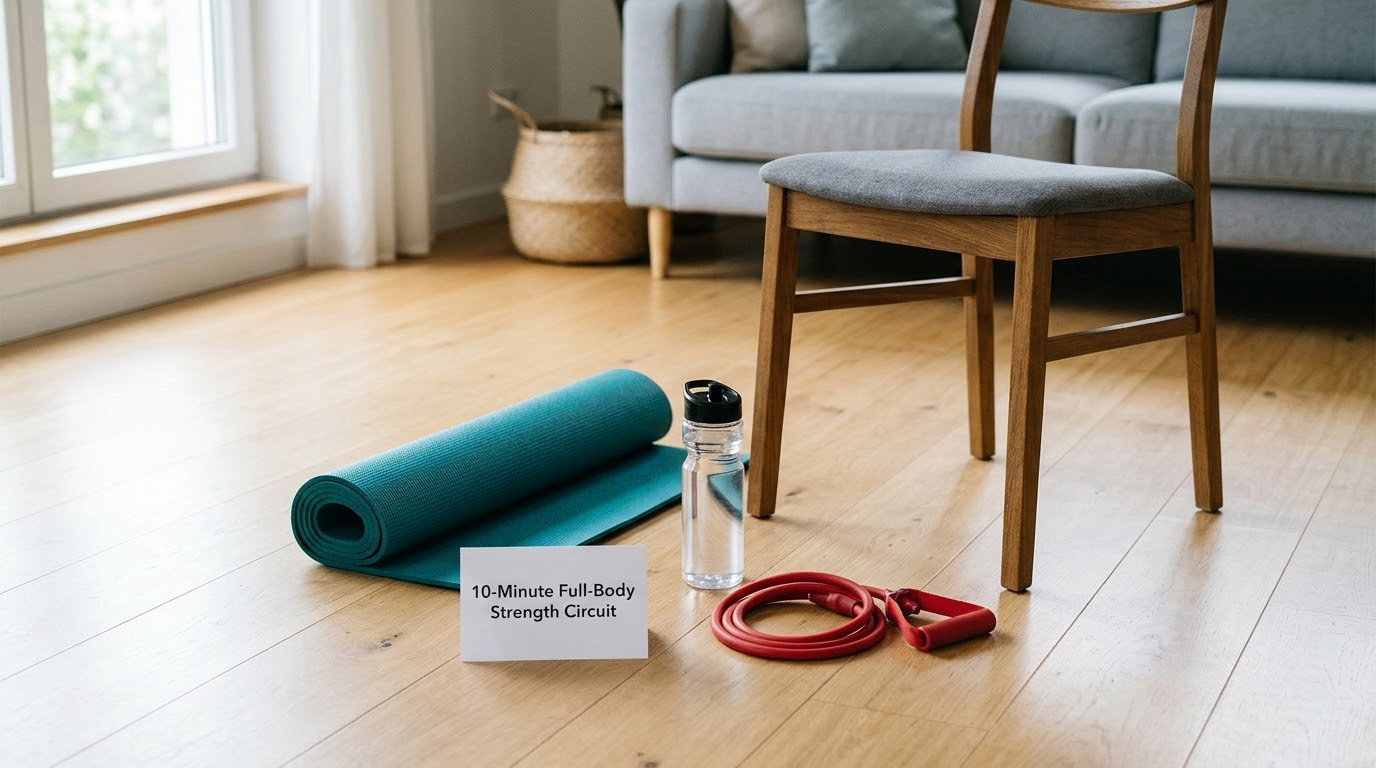
This is the one I send people to first because it trains everything in a predictable order and never surprises you mid-set. Two rounds, 40 seconds of work and 20 seconds of rest per move, is ten minutes including the setup.
- Chair squats, 40 seconds. Stand in front of a sturdy chair, tap it lightly with your hips, and stand back up. Keep the chair behind you, not under you.
- Wall push-ups, 40 seconds. Hands at shoulder height, body in one line, lower until your chest nearly touches. Elbows at roughly 45 degrees.
- Glute bridges, 40 seconds. On the floor, feet flat and close to your hips, drive through your heels. Lift to your knees, ribs down.
- Modified plank hold, 40 seconds. Forearms down, knees down if needed, squeeze your glutes so your hips do not sag.
- Standing knee raises, 40 seconds. Marching in place with one arm overhead on the same side. No impact on your joints.
Low-impact swap: drop the wall push-ups to counter push-ups, or lift one foot off the floor during the bridges instead of both.
How to scale it: work to about a 7 out of 10 effort and stop with a rep or two in reserve. When two rounds of all five moves feels easy, drop to 15 seconds of rest instead of adding reps.
2. 15-Minute Low-Impact Cardio Intervals
Low-impact cardio gets your heart rate up without a single landing with impact, which makes it the safest pick for postpartum return, joint pain, or a tired week. Structure it as 45 seconds moving, 30 seconds marching easy, repeated for about three rounds of five moves.
- Step touches side to side, arms swinging low
- Alternating knee lifts at walking pace
- Side steps with a small arm reach
- Heel digs with a long reach overhead
- Slow forward and back step pattern
Seated substitutions: sit tall in a chair and do alternating toe taps, seated marches lifting one knee at a time, and torso rotations reaching one arm behind you. The same interval structure works.
Beginner pacing means you can talk in short sentences throughout. If you cannot, slow the marching by half and keep the rest intervals honest.
3. 7-Minute Stair and Chair Cardio
Seven minutes is short enough to finish before a monitor chirps. Stairs add a surprising amount of leg work for zero extra time, since you are already using them a dozen times a day.
- Step-ups, 45 seconds, 10 on each leg
- Supported squats holding a railing, 45 seconds
- Quick march on the flat, 45 seconds
- Slow step-ups, 45 seconds
- Standing calf raises at a railing, 45 seconds
- Repeat the block once, finishing with a slow march
Use the lowest safe step and keep one hand on the rail. If your home has no stairs, trade step-ups for supported squat pulses or march on the spot. On a sensory-overload day when noise and unpredictable effort feel like too much, you can learn more about how a regulated nervous system responds to stress at how to handle autism meltdowns at home and keep this one gentle and repeatable.
4. 10-Minute Core Routine for Busy Caregivers
Core work for a caregiver is less about visible abs and more about holding your shape while lifting a 30-pound toddler out of a bathtub. This ten-minute sequence builds that stability with movements you can scale down aggressively.
- Standing marches with a small knee lift, 20 each side
- Heel touches from a tall kneeling position, 20 taps
- Bird dogs, 10 slow reps each side
- Dead bugs, 10 slow reps each side
- Modified plank hold, 3 holds of 20 seconds
The rule: if getting to the floor is uncomfortable, in pain, or not something you can do safely with your body as it is today, skip the floor entirely and do standing marches, standing heel taps with a hand on your hip, and wall plank presses. A good version is the version that suits your body.
Hold your ribs down and exhale on the effort. If you feel a bulge or doming along your midline, reduce the range, exhale longer, or check with a pelvic health physiotherapist about a proper assessment rather than pushing through it.
5. 12-Minute Strength Circuit With a Resistance Band
One loop band gives you rows, presses, and lateral work in a bag the size of a lunchbox. Three rounds of four moves, 40 seconds on and 20 seconds off, is roughly twelve minutes.
- Banded rows, 12 to 15 reps
- Banded squats, 12 to 15 reps
- Lateral band walks, 10 steps each way
- Banded chest press, 10 to 12 reps
Anchor the band under both feet for squats and presses, or around a fixed post at chest height for rows and lateral walks. Start with the lightest band and step up only when 15 reps feel easy.
No band? Do towel or backpack rows by pulling the load toward your ribs, slow bodyweight squats with a long pause at the bottom, and wall push-ups in place of the press.
6. 8-Minute Mobility and Stretching Reset
An eight-minute mobility reset is the routine most likely to get repeated, because it is the only one that can happen mid-task. It targets the three places caregivers carry tension: neck and shoulders from carrying and feeding, hips from sitting, and calves and hamstrings from standing.
- Neck turns and side tilts, 5 each side
- Shoulder rolls and cross-body arm pulls, 10 each
- Standing hip hinge with hands on thighs, 60 seconds of slow breathing
- Half-kneeling hip flexor stretch, 30 seconds each side
- Seated forward fold to a bent knee, 30 seconds each side
- Calf stretch against a wall, 30 seconds each side
Every stretch stays in a pain-free range, and breathing out is what changes the position, not pushing. Seated versions of all six work fine in a chair at a desk. Intense pain is not the target of a stretch, and stretching a fresh injury is not a good idea to improvise with.
7. 5-Minute Wake-Up Movement Break
Do this before anyone else is awake and it becomes movement you do not have to negotiate for. Five minutes, no mat, no equipment, no noise worth worrying about.
- Arm circles, 30 seconds each direction
- Heel raises, 15 slow reps
- Torso turns, 10 each side
- Overhead side reaches, 8 each side
- Bodyweight squats, 10, sitting down into a chair if you like
A gentler seated version replaces squats with sit-to-stand from a sturdy chair, or with a wide seated stance you press through to lift your heels. If your mornings are the sensory crunch point, keeping the same five moves in the same order every day matters more than how hard you go.
8. 15-Minute Dumbbell Strength Workout
Dumbbells are where short home workouts earn real strength progress, because weight is the one variable you can raise without adding minutes. Pick a pair you can lift for 12 clean reps with two in reserve, roughly 5 to 10 pounds to start if you are unsure.
- Goblet squats, 12 reps
- Romanian deadlifts, 12 reps
- Single-arm dumbbell rows, 10 each side
- Overhead press, 10 reps
- Split-stance reverse lunges, 8 each side
Rest 60 to 90 seconds between moves and run the block for two rounds plus one lighter round if you have the time. Hold a chair or counter for balance on lunges and deadlifts, and swap a two-handed grip for a towel around the handle if your wrists protest. A backpack of books works in a pinch.
9. 10-Minute Quiet Apartment Workout
This is the routine for upstairs neighbors, a sleeping baby, or shared walls. Every movement stays grounded: no jumping, no repeated footfalls, and nothing that lands hard on the floor.
- Slow squats, 12 reps, two seconds down
- Wall push-ups, 12 reps
- Standing leg curls, 12 each leg, holding a chair
- Calf raises, 15 slow reps
- Standing wall plank, 3 holds of 25 seconds
- Slow torso rotations, 10 each side, to finish
Your upstairs neighbor will hear a foot on carpet and nothing else. A thick rug or a folded blanket underfoot also protects your knees and joints on the floor moves, and lets you skip the mat entirely.
10. 20-Minute Family Fitness Game
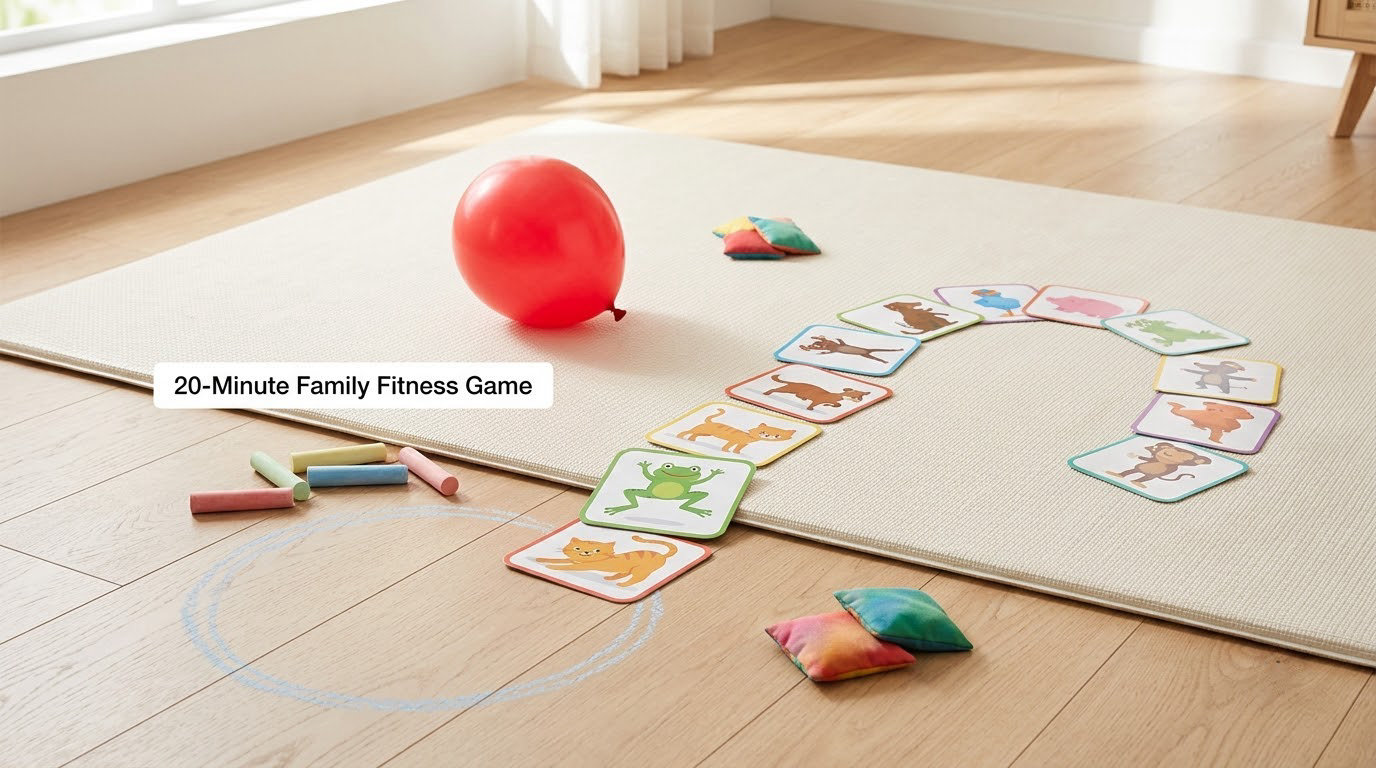
Twenty minutes is a lot of time to find twice a week, which is exactly why a family game works: the movement is the entertainment, so nobody is being asked to sit through someone else’s workout. This one is deliberately loose. Kids of any ability can join in, and so can you on your hardest day.
- Animal walks, 45 seconds each: bear crawl, crab walk, frog jumps, flamingo stand
- Mirror moves, one minute: copy your child’s pose, swap every ten seconds
- Balloon reaches, 2 minutes: keep it in the air without using your hands
- Dance prompts, 3 minutes: one song, everyone chooses their own version of it
- Floor challenges, 5 minutes: obstacle course from beanbags or taped floor spots
- Free finish, 5 minutes: everyone picks the last activity
Follow your child’s ability rather than pushing them, and stop the whole thing the moment anyone needs a break. On sensory-overload days, drop the music and the timer and keep only the animal walks, which are quiet, predictable, and easy to end mid-round.
Frequently Asked Questions
What is the shortest workout a busy mom can do at home?
Five minutes is the shortest session that still trains you properly, and the wake-up movement break on this list is built for exactly that window. If you only have three minutes, marching briskly, 10 chair squats, 10 wall push-ups, and a glute bridge set is a legitimate micro-workout. The key is finishing the session, so choose the routine you can complete rather than starting a longer one.
Can quick home workouts help a complete beginner get active?
Yes, and beginners often do better with short sessions than long ones because the habit has time to stick before boredom sets in. Start every routine at an easy level where you could keep going, and give yourself three weeks of consistent practice before adding resistance, speed, or extra moves. Progress one variable at a time, and remember that some postpartum or joint-related changes need clinical guidance first.
Which options work without weights or exercise equipment?
Routines 1, 2, 4, 6, 7, 9, and 10 need nothing beyond a chair, a wall, and floor space. The resistance band routine works with a towel or backpack, and the dumbbell routine works with filled water bottles or a bag of books. That covers the entire list, so a lack of equipment is never a reason to skip a session.
How hard should a home workout feel when I have little time?
Aim for an effort where you can still control your breath, roughly 6 or 7 out of 10 at the hardest point, with two reps left in reserve at the end of each set. Going all-out in ten minutes usually ends the session early. Stop immediately for sharp pain, dizziness, chest pain, or unusual shortness of breath, and check with a doctor before resuming.
How can busy caregivers build a consistent exercise routine?
Anchor the session to a fixed trigger rather than to free time, such as the moment the coffee brews or the moment screen time starts. Leave the equipment and shoes where you will see them, and decide in advance what your minimum version is, because doing half of a short routine still counts. Expect to miss a week; the rule is to return at the next window instead of restarting the plan.
What to Do First for Your Shortest Workout Break
Start with the 10-minute full-body strength circuit if you have a full window, and the 5-minute wake-up movement break if you do not. Put the chair where you need it, set the timer for 40 seconds of work and 20 seconds of rest, and go through the list once at an easy pace.
Then pick your next session by constraint rather than by ambition: quiet apartment routine if the walls are thin, mobility reset if you are sore or depleted, family game if the kids are awake and want in. The habit you build from quick workouts for busy moms at home comes from repeating a routine that fits your actual day, not from the hardest version on any list.