Teaching a teenager to cook comes down to one repeatable meal, a written routine they can follow without you narrating every second, and a safety checklist they run through themselves. Start with something they already eat, like quesadillas, pasta with jar sauce, or scrambled eggs, and repeat it until it feels boring and easy.
That first meal matters more than a fancy one. Repetition builds the motor memory and sequence skills that make a second recipe possible, and teenagers get discouraged fast by recipes with fifteen steps and eight ingredients they have never seen before.
Most of this is a teaching job rather than a cooking job. Your job is to set up the space, write the steps down, run the safety check, and then stay quiet while they cook. If a teenager learns to make three or four meals well, they can feed themselves, and that is the whole goal.
This guide works for neurotypical teens and for autistic teenagers or teens with motor, sensory, attention and reading differences. The structure is the same; only the supports change.
Table of Contents
- What You Need
- Step-by-Step: How to Teach a Teenager to Cook Simple Meals
- 1. Start With One Familiar Meal
- 2. Break the Recipe Into Small Steps
- 3. Teach the Safety Routines First
- 4. Practice Before the Real Meal
- 5. Cook Together With Prompts, Not Takeover
- 6. Let Your Teenage Chef Check the Meal
- 7. Build Toward Simple Independent Meals
- Common Mistakes
- Frequently Asked Questions
- How do I teach my teenager to cook when they are autistic or have sensory sensitivities?
- What are the easiest meals for a teenager to cook on their own?
- How do I handle allergies when teaching a teenager to cook?
- How much supervision does a 14 year old need in the kitchen?
- What if my teenager can follow the recipe but the food still turns out badly?
- Conclusion
What You Need
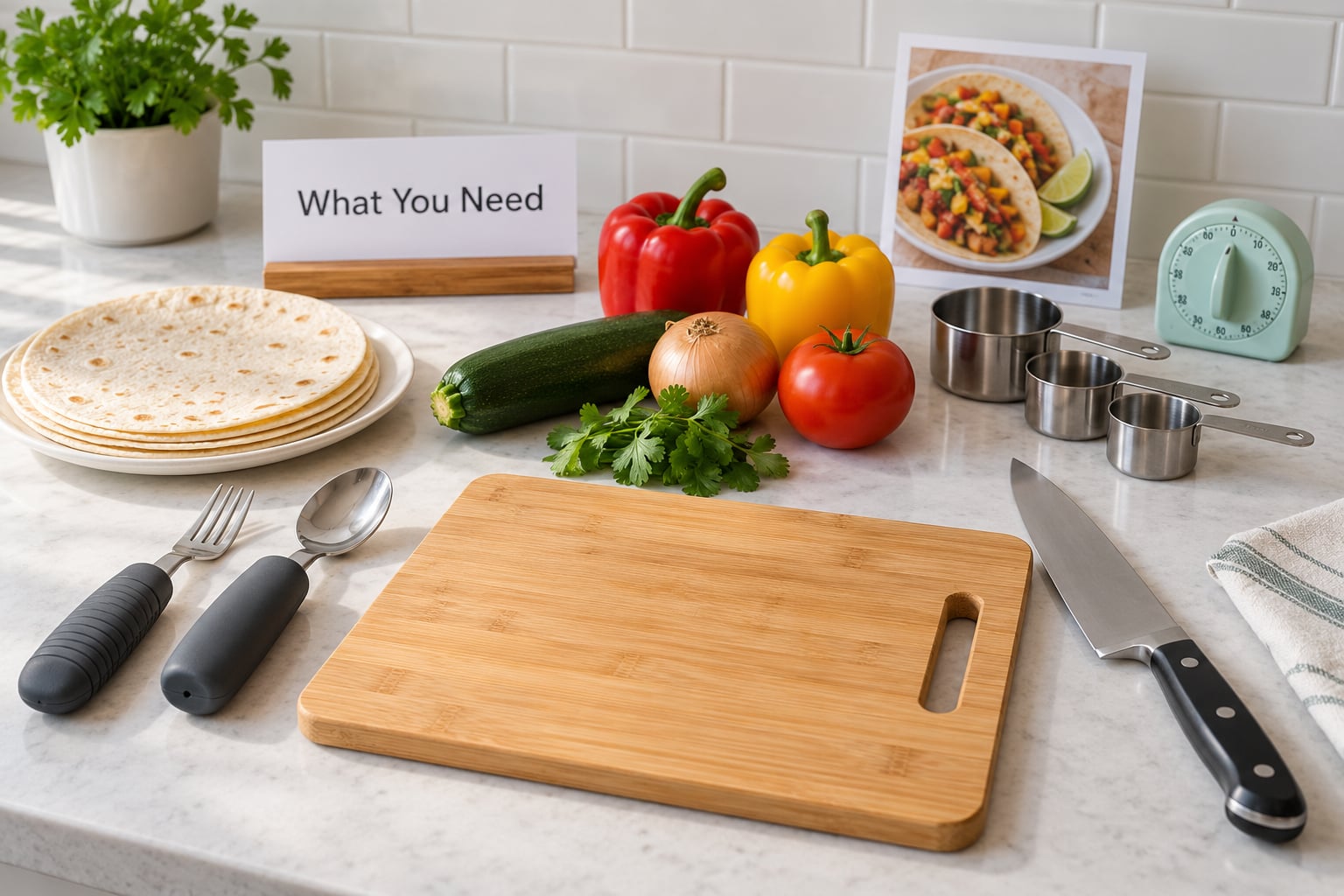
You need far less than a kitchen inventory. Everything below is either essential for the routine itself or for removing a barrier your teenager runs into.
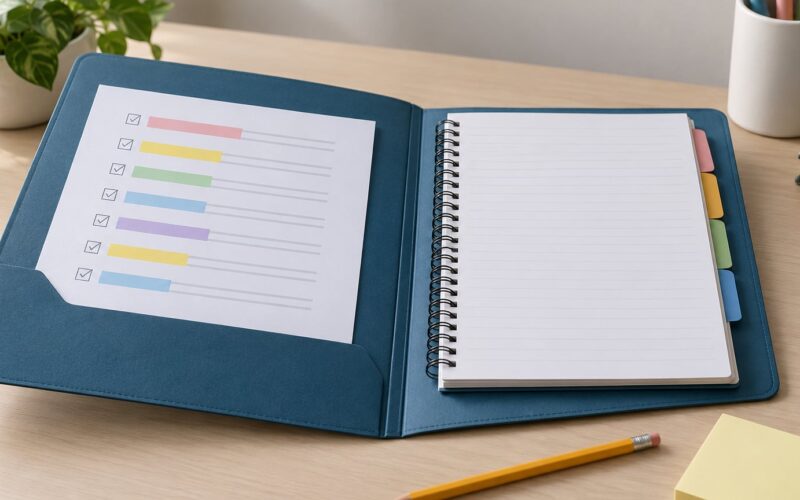
- A written recipe in short steps. One action per step, printed or handwritten in large print. Photographs of each stage help more than a paragraph of text.
- A timer with a visible display. A kitchen timer they can see from the counter beats an app they have to unlock.
- A knife that suits their hands. A chef knife for a confident teen, a rocker knife for reduced hand strength or tremor, a nylon crinkle cutter for vegetables, or pre-cut produce for a first session.
- A non-slip mat or damp cloth. Bowls slide on a wet counter, and that is the single most common spill I have seen.
- Measuring cups and spoons in a nested set so they go back in one piece.
- A food thermometer. Guessing doneness is the biggest food safety gap in teen cooking.
- A visual allergy and dietary needs note kept with the recipe card, so a substitute ingredient never depends on memory.
- A cleaning kit staged before cooking starts: bin, sponge, dish soap, tea towel, and a clear counter for dirty dishes.
Ingredients matter less than equipment. Two or three fresh items and a pantry staple produce a workable meal. Frozen vegetables are a legitimate shortcut, not a compromise, and they cut cooking time roughly in half.
| Barrier | Swap it for |
|---|---|
| Hard to grip a handle | Rocker knife, electric can opener, non-slip mat under the bowl |
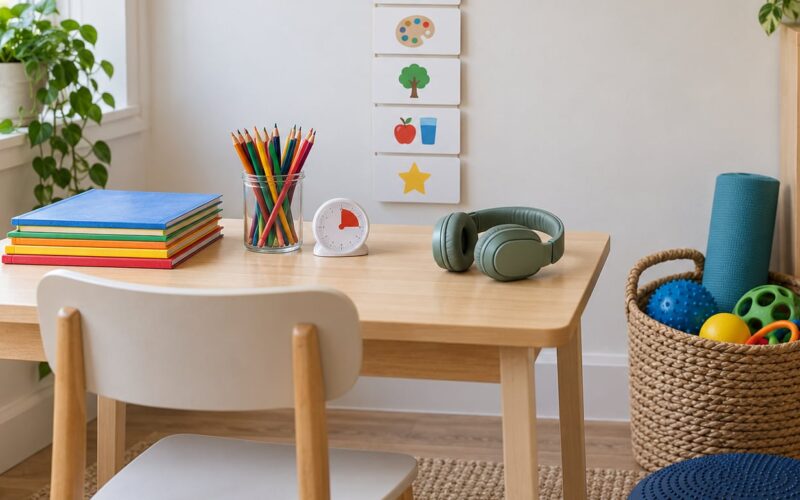
| Reading is slow or tiring | Photo step cards, one card per step on a ring, high-contrast black on white |
| Sequencing or remembering steps | Numbered checklist they tick off, steps clipped to the counter |
| Sound or texture is overwhelming | Headphones for the first attempts, quieter appliances, foods they already accept |
| Losing track of time | Timer plus a written cue for what to do while it runs |
If your teenager is learning alongside other routines at home, our guide to teaching chores to an autistic child uses the same prompt-and-check structure that works in a kitchen.
Step-by-Step: How to Teach a Teenager to Cook Simple Meals
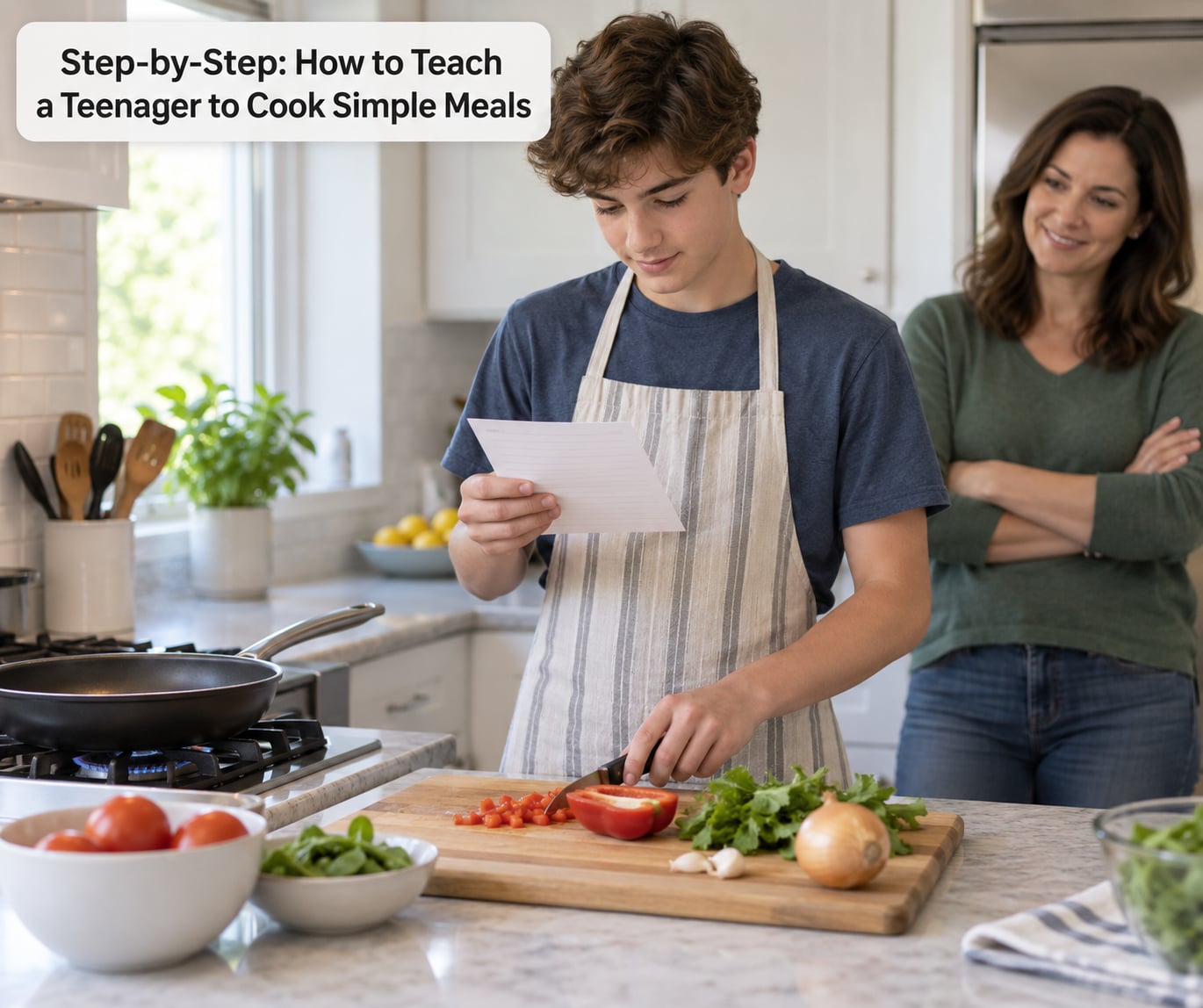
1. Start With One Familiar Meal
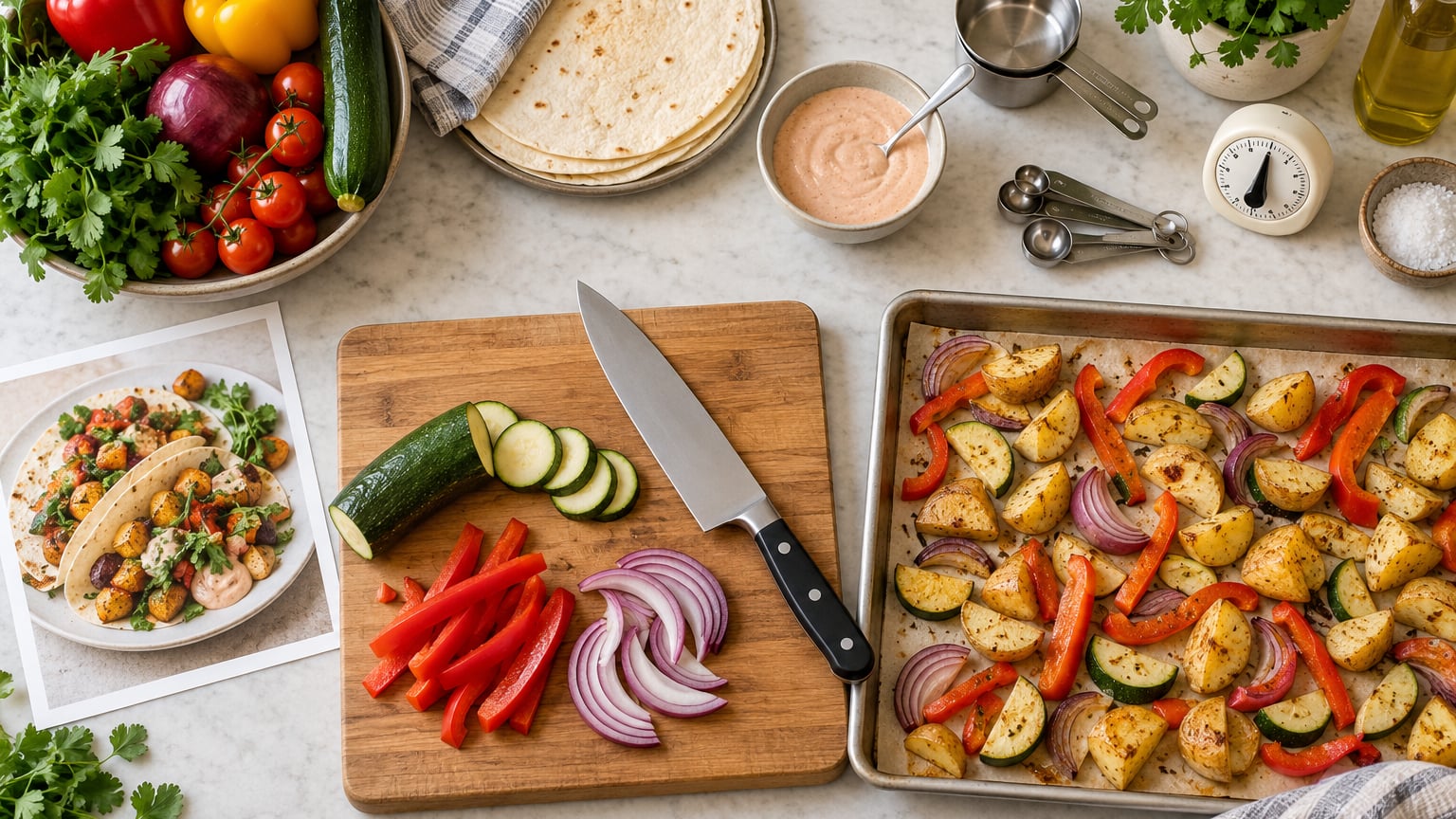
Pick a meal with five steps or fewer, using ingredients they already eat without complaint. Quesadillas, scrambled eggs, toast with toppings, pasta with jar sauce, and a sheet pan of frozen vegetables and sliced potatoes all qualify.
Choose it because it is low risk on the first attempt. Nothing that requires precise timing, high heat, or raw meat. If allergies or dietary needs are part of the picture, start with a version that already works, so nobody is managing a new recipe and a new restriction at the same time.
Cook it once yourself, on camera, and write down what actually happened rather than what the recipe says. Most first attempts run into one or two snags, and this is where you find them.
2. Break the Recipe Into Small Steps
Rewrite the recipe as a checklist with one action per line. Instead of “preheat oven and prepare vegetables”, write “Set oven to 200C” on one line and “Rinse and chop vegetables” on the next.
Put the physical setup first: what goes on the counter before anything heats up. That single change removes most of the flustered searching that makes cooking feel chaotic.
Add a clear stopping point at the bottom of the card, such as “stop here, call me, do not start the next step”. A teenager who knows where to pause can work independently without you hovering.
3. Teach the Safety Routines First
Run the safety check before the recipe every time, even after ten successful dinners. It takes two minutes and it builds the habit instead of the exception.
- Handwashing with soap for at least twenty seconds, with a visual or a timed song rather than a verbal reminder.
- Cross-contamination. One cutting board for raw meat, a different one for everything else. If that doubles the washing up, choose recipes with no raw meat at the start.
- Knife handling. Curl the fingertips of the guiding hand back, cut on a flat stable surface, walk with the knife pointed down, and put it down before reaching for anything.
- Stove and oven. Turn pan handles inward, use the back burner for anything that needs boiling, and set an oven mitt by the oven before preheating.
- Allergy checks. Read the label on every packaged item out loud before it goes in the pan, including butter, stock and sauces.
- Temperature checks. Use the thermometer rather than colour or time. Poultry reaches 165F (74C), ground meat 160F (71C), and whole cuts and fish 145F (63C).
- Storage. Refrigerate within two hours, in shallow containers so the centre cools quickly.
For a family with a diagnosed allergy, keep the teenager’s plan written down and confirm it with their doctor or allergist rather than adjusting it at the stove.
4. Practice Before the Real Meal
Rehearsal removes the pressure. Have them set out the equipment and read the steps aloud without touching anything, or assemble the ingredients and put them back. Dry runs take ten minutes and catch most misread instructions.
Other low-pressure options: mixing a cold batter or dressing, measuring dry ingredients into bowls, stirring with a spoon instead of a whisk, or rolling play dough as a stand-in for rolling pasta.
You can also record yourself doing the recipe once and watch it back twice. That is the same idea as using video modeling to teach life skills, and it lets them pause and rewind without asking you to repeat yourself six times.
5. Cook Together With Prompts, Not Takeover
This is where most parents lose the plot. Stepping in feels helpful, and two minutes later you are making the pasta while they watch.
Use these four strategies instead:
- Naming what is happening without directing. “You are on the chopping step” is information. “Cut it smaller” is an instruction that removes the decision.
- Waiting. Give the prompt, then stay quiet for the full ten seconds. Teenagers often start mid-thought in the pause.
- Waiting again. If nothing happens after ten seconds, restate the prompt and wait another ten.
- Hand-over-hand only for a safety risk, such as a knife heading the wrong way. If it is a preference, such as how much cheese goes on, let it stand.
Say what you saw the moment a step is finished. Specific praise lands harder than general praise, and it teaches what good work looks like: “You checked the label before adding the butter, that is the allergy habit I want every time.”
Keep corrections to one per attempt. Correcting every step teaches them that cooking is something you do badly.
6. Let Your Teenage Chef Check the Meal
Hand the checking job to them. Compare the plate with the recipe card, notice what changed, and decide the one adjustment for next time.
Where food safety allows it, have them taste before serving and describe the flavour in one or two words. Even just “salty” or “needs more acid” builds judgement, and parents on cooking forums say the same thing: skill transfers once the teenager can judge, not just follow.
Ask two closing questions and write the answers down. What would you change next time? What should we make again? That short review is what turns one dinner into a curriculum.
7. Build Toward Simple Independent Meals
Move up in stages rather than all at once. First, an adult cooks and the teenager follows the checklist beside them. Next, the teenager leads while the adult stands nearby and watches for safety, not quality. Then the teenager cooks two meals a week alone, with an adult in the house and on call.
Some families pick a fixed night each week. One parent I know set Tuesday aside for their teen to cook dinner for the household, shopping included, and it turned into the least argued-about evening of the week because the teen got to decide.
As the list grows, move on to one-pan meals, a simple roast, a stir-fry, and a soup they can scale up. Adding a second recipe should only happen once the first one needs no reminder.
When several people in the house eat differently, our post on cooking one dinner for different dietary needs covers the base-plus-adjustments approach that keeps this from turning into three separate meals.
Common Mistakes
Starting with a recipe that is too ambitious. Fifteen steps on a Tuesday night ends with takeout and a teenager who says they cannot cook. Fix: cut to five steps and add complexity one recipe at a time.
Giving instructions in a long stream. Three sentences the teenager has to hold in working memory will be lost by the second sentence. Fix: one line per step on the card, and let the card do the remembering.
Correcting everything. Constant mid-cook correction breaks attention and turns the kitchen into a place where they get it wrong. Fix: one correction per session, written down afterwards while they rest.
Skipping the temperature check. A teenager will judge chicken by the colour of the juices. Fix: the thermometer is part of the recipe, not an optional extra, and it goes on the card as its own step.
Treating cleanup as a separate fight. Cleanup battles happen when the person who makes the mess is not the person who clears it. Fix: clean as you go, put the washing-up in the routine card, and keep the counter space clear so dirty dishes have one obvious home.
Expecting independence in two weeks. Repetition over months, not sessions, builds a reliable cook. Fix: aim at the next stage only after the current one feels easy.
Fighting every vegetable. Insisting on a new vegetable every night ends in refusal. Fix: cook what they will eat, add one unfamiliar item they can taste without eating, and keep going.
One more worth naming: teaching when you are exhausted. A relaxed, unhurried session teaches far more than a rushed one, and a session that ends with burnt food teaches the wrong lesson.
Frequently Asked Questions
How do I teach my teenager to cook when they are autistic or have sensory sensitivities?
Keep the routine identical each time and change one variable at a time. Use a photo checklist with one action per step, a visible timer, and the same pan, board and knife every session. Start with ingredients they already eat, add one new food as a taste-only step, and keep the kitchen predictable by using headphones during noisy moments and avoiding strong smells such as searing fish.
What are the easiest meals for a teenager to cook on their own?
The easiest meals are five steps or fewer, use pantry ingredients, and cannot ruin easily. Quesadillas, scrambled eggs, toast combinations, pasta with jar sauce, and sheet pan vegetables with sliced potatoes are good first choices. Once one of those is reliable, add a stir-fry or a simple soup, then a tray bake, adding only one new technique at a time.
How do I handle allergies when teaching a teenager to cook?
For a diagnosed allergy, follow the teenager’s written plan from their doctor or allergist, and check labels on every packaged ingredient including butter, stock and sauces. Start with a version of the recipe that already meets the restriction so nobody manages a new recipe and a new restriction together. Keep an epinephrine auto-injector accessible and know where it is before starting any cooking session.
How much supervision does a 14 year old need in the kitchen?
An adult should be in the home and available the whole time, and within sight of the stove for anything involving heat, knives or raw meat. The level of hands-on supervision changes as skills do: lead your own cooking while they follow the card, then cook with an adult nearby watching for safety rather than quality, then cook alone while you stay on call in the house.
What if my teenager can follow the recipe but the food still turns out badly?
That is the expected stage, and it is where cooking judgement gets built. Ask two questions while the food is still warm: what would you change next time, and what should we make again. Write the answers on the card. Over several weeks you will see the same fix repeated, which is far more useful than correcting the plate every single time.
Conclusion
Start tonight with one meal they already eat. Write it as a checklist of five steps or fewer, stage every ingredient on the counter first, and run a two-minute safety check before anything heats up.
Then do less than feels natural: prompt, wait ten seconds, wait again. Correct one thing afterwards, not during.
Repeat that same meal until it needs no reminder at all, then add one more. Teaching a teenager to cook simple meals is not a single big lesson; it is a short routine that gets a little longer every week, and it works far better than any cooking class your teenager has to be dragged to.