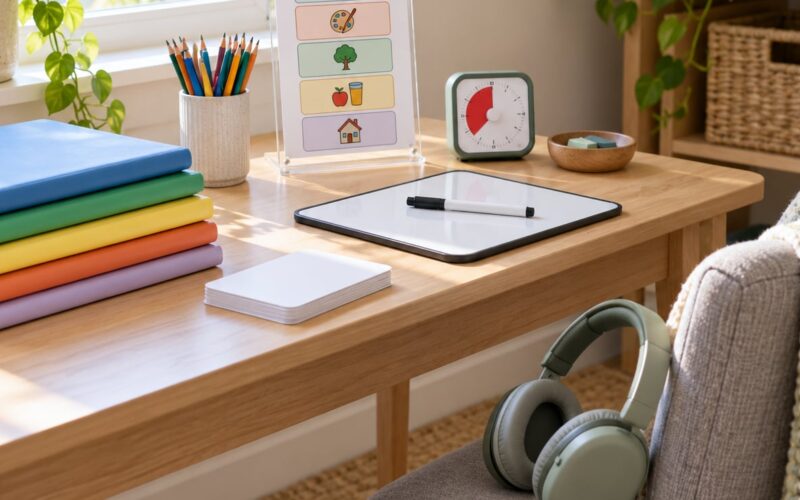
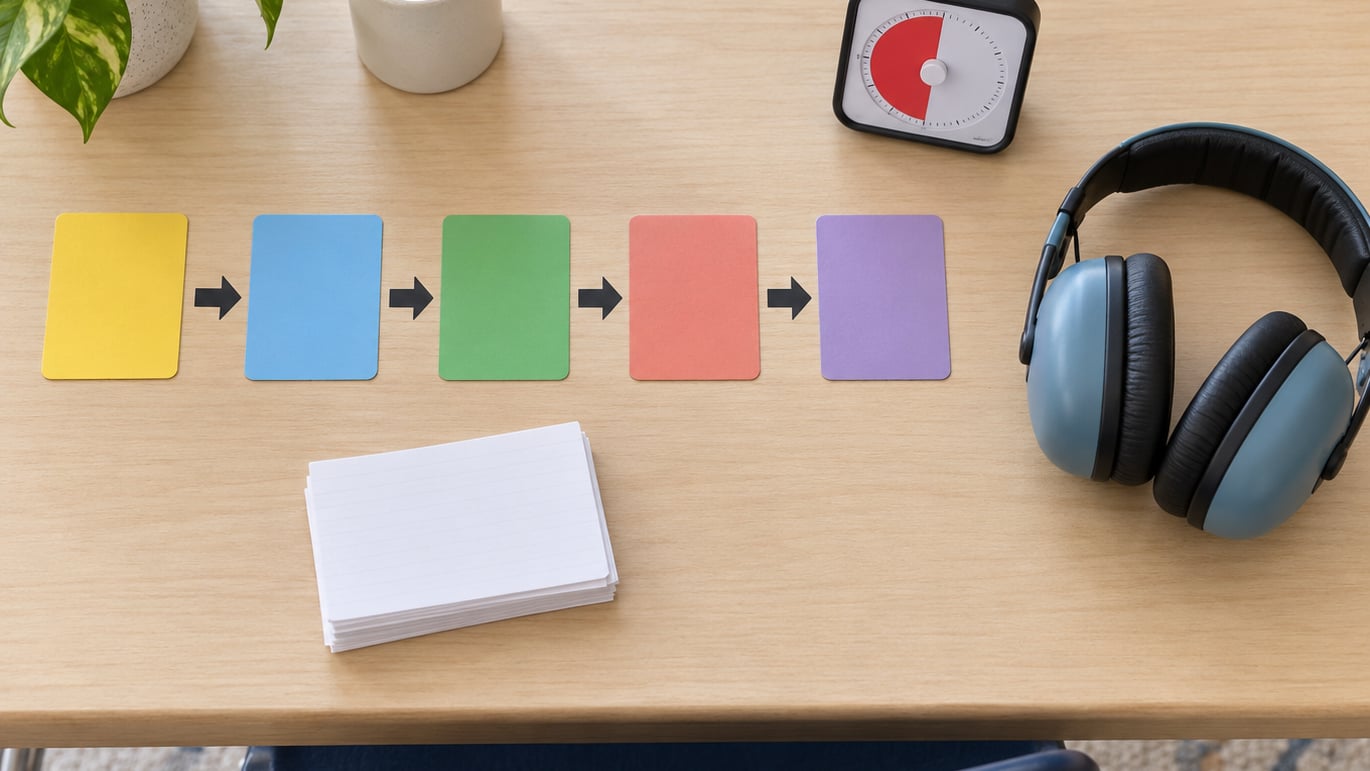
If you are searching for IEP accommodations for autism examples, you are probably sitting on a stack of notes and wondering which ones are worth asking for. An IEP, or Individualized Education Program, is a legally binding plan that lists the supports a school will provide so your child can access the same curriculum as classmates without changing what is taught. Accommodations are the practical part of that plan: a visual schedule, a sensory break, a quieter seat, extra time, a scribe.
This guide gives you ten of the most commonly requested accommodations, with wording you can adapt for your own child’s plan. Most of the language below is written the way a team would need it to read, with the who, where, when and how long spelled out.
A short note on wording: this article uses identity-first language, meaning autistic student rather than student with autism. Many autistic adults and self-advocates prefer it, and you will see both in school paperwork. I also use autism accommodations and accommodations for students with autism interchangeably, since parents search both ways.
This is general educational information, not legal or medical advice. Rules vary by state and district, and every plan should be built with your child’s IEP team.
Table of Contents
- IEP Accommodations for Autism Examples at a Glance
- 1. A Visual Schedule With Checked-Off Steps
- Why IEP Accommodations for Autism Examples Need Measurable Language
- 2. Scheduled Sensory Breaks in a Designated Space
- 3. A Quiet Space for Decompression
- 4. Advance Warning Before Changes and Transitions
- 5. Movement and Heavy-Work Opportunities
- 6. Noise-Reduction Supports
- 7. Instruction and Materials in a Clearer Visual Format
- 8. Support for Executive-Function Demands
- 9. Communication Supports During Class and Group Work
- 10. Adapted Testing and Task Conditions
- Frequently Asked Questions
- What is the difference between an IEP and a 504 plan for a child with autism?
- Can a school refuse an autism accommodation if the child has an IEP?
- How do I write measurable IEP goals for sensory or attention support?
- What is the difference between an IEP accommodation and a related service?
- How often can parents request a change to an IEP?
- What to Do First With These IEP Examples
IEP Accommodations for Autism Examples at a Glance
The table below covers all ten examples in this guide, with the reason each one may help and a short version of what the measurable language in an IEP can look like.
| Example | Why it may help | Measurable IEP language | Where it applies |
|---|---|---|---|
| Visual schedule with checked-off steps | Reduces uncertainty about what happens next | Daily visual schedule available in each classroom, reviewed and updated when the schedule changes | All settings, strongest in K-2 |
| Scheduled sensory breaks in a designated space | Gives planned regulation time before overload escalates | Two 10-minute sensory breaks scheduled at set times, with a defined space and a return routine | All settings |
| Quiet space for decompression | Allows a low-demand pause during overwhelm | Access to a designated low-demand space on student or staff request, with a documented return plan | All settings |
| Advance warning before changes | Makes fire drills, subs and schedule swaps predictable | Visual or verbal warning at least one activity ahead of any change to routine, staff, or location | All settings |
| Movement and heavy-work opportunities | Supports attention and self-regulation through movement | Scheduled movement break of a set length and frequency, plus access to a designated movement tool | All settings |
| Noise-reduction supports | Lowers competing auditory input during tasks | Seating away from identified noise sources, with noise-reducing headphones available for specified tasks | All settings, especially open-plan rooms |
| Clearer visual format for instructions and materials | Reduces language and processing load during directions | Written directions paired with verbal, presented in short numbered steps with uncluttered examples | All settings |
| Executive-function support | Reduces memory and organization load on multi-step work | Checklist provided for multi-step tasks, materials organized by staff cue at defined points | Grades 3-12, increases with demand |
| Communication supports in class and group work | Gives a way to participate and to be understood | AAC device or written response option available during instruction and group activities, with added processing time | All settings |
| Adapted testing and task conditions | Separates knowledge from sensory and processing load | Extended time on assessments and a reduced-distraction setting, consistent with state testing rules | Classroom quizzes and state tests |
1. A Visual Schedule With Checked-Off Steps
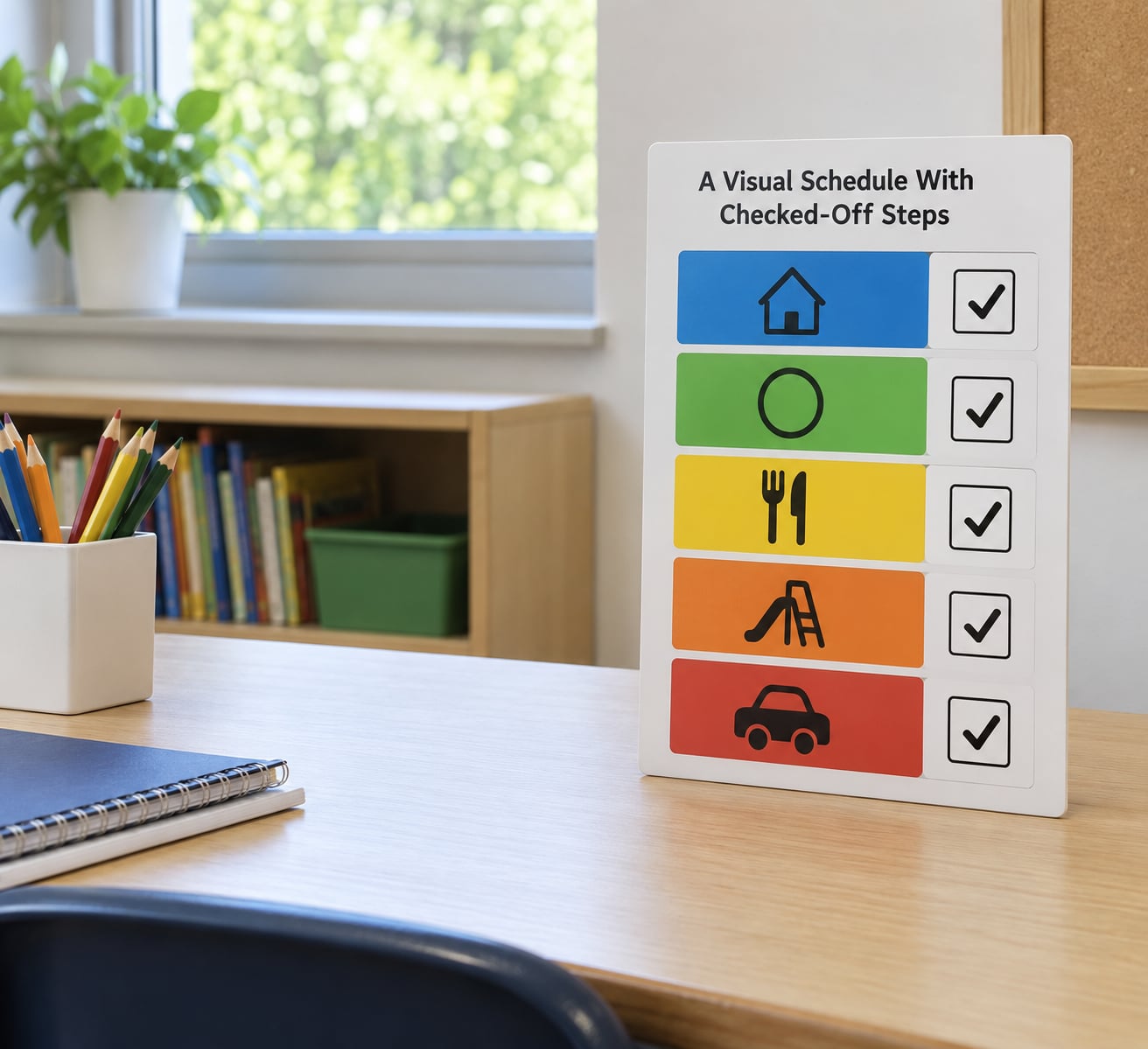
A visual schedule shows the sequence of a school day in a form the child can check without having to ask an adult. For many autistic students, not knowing what happens next is the bigger stressor than the activity itself.
The version that works best in most classrooms is a daily strip with each block shown in order and a way to mark it done. A laminated sheet in a pocket on the desk does the job for a lot of students. When your child is older or the schedule is more complicated, a first-then board, a weekly overview with the current day highlighted, or a check-off list for one task can take its place.
Sample wording: “A daily visual schedule will be available in every instructional setting, including specials and lunch. The schedule will be reviewed with the student at the start of each day and updated in advance whenever the schedule changes. Staff will point to the schedule during transitions.”
The team should develop the schedule together, rather than handing your child a generic one, when the day includes activities that are hard to predict. Ask who updates it and what happens the day a schedule change is announced late.
Why IEP Accommodations for Autism Examples Need Measurable Language
Vague requests get soft during meetings. “He needs help with transitions” has no author, no location and no length, so six months later nobody can say whether it happened.
Measurable language answers four questions: when, where, who, and how long. Compare “staff will provide support during transitions” with “the classroom aide will give a two-minute visual and verbal warning before each of the four daily transitions, at the door of the current location.” The second version can be implemented, observed, and reported on at the next meeting.
If a support is written as a goal instead of an accommodation, it becomes much harder to hold the school to. Goals describe what your child will learn; accommodations describe what adults will do.
2. Scheduled Sensory Breaks in a Designated Space
Sensory breaks work best when they are scheduled and predictable, not earned. A break the child has to ask for is a break that often gets skipped on the hardest days, which are exactly the days it is needed.
Breaks can include a short walk, water, a quiet corner, stretching, listening to music, or a designated sensory tool. A parent on r/Autism_Parenting described a go-to list of “chewies, wiggle chair, food bands,” and a parent in a Facebook Support Autism group described an IEP that included “several work breaks with his sketchbook, playtime, swing time and trampoline.” Those are parent reports, but the pattern holds: the tool matters less than the child having a say in which one.
Sample wording: “The student will have two scheduled 10-minute sensory breaks each school day, at approximately 10:00 and 1:30, in the designated sensory space. Breaks are scheduled in advance on the visual schedule and are not contingent on behavior. A staff member will accompany the student to and from the space.”
Ask whether the break is written as a schedule or as staff discretion. Parents frequently report that a scheduled break can quietly become something the child has to earn.
If breaks at home are a bigger issue right now, our guide on how to handle autism meltdowns at home covers the regulation side of the same picture.
3. A Quiet Space for Decompression
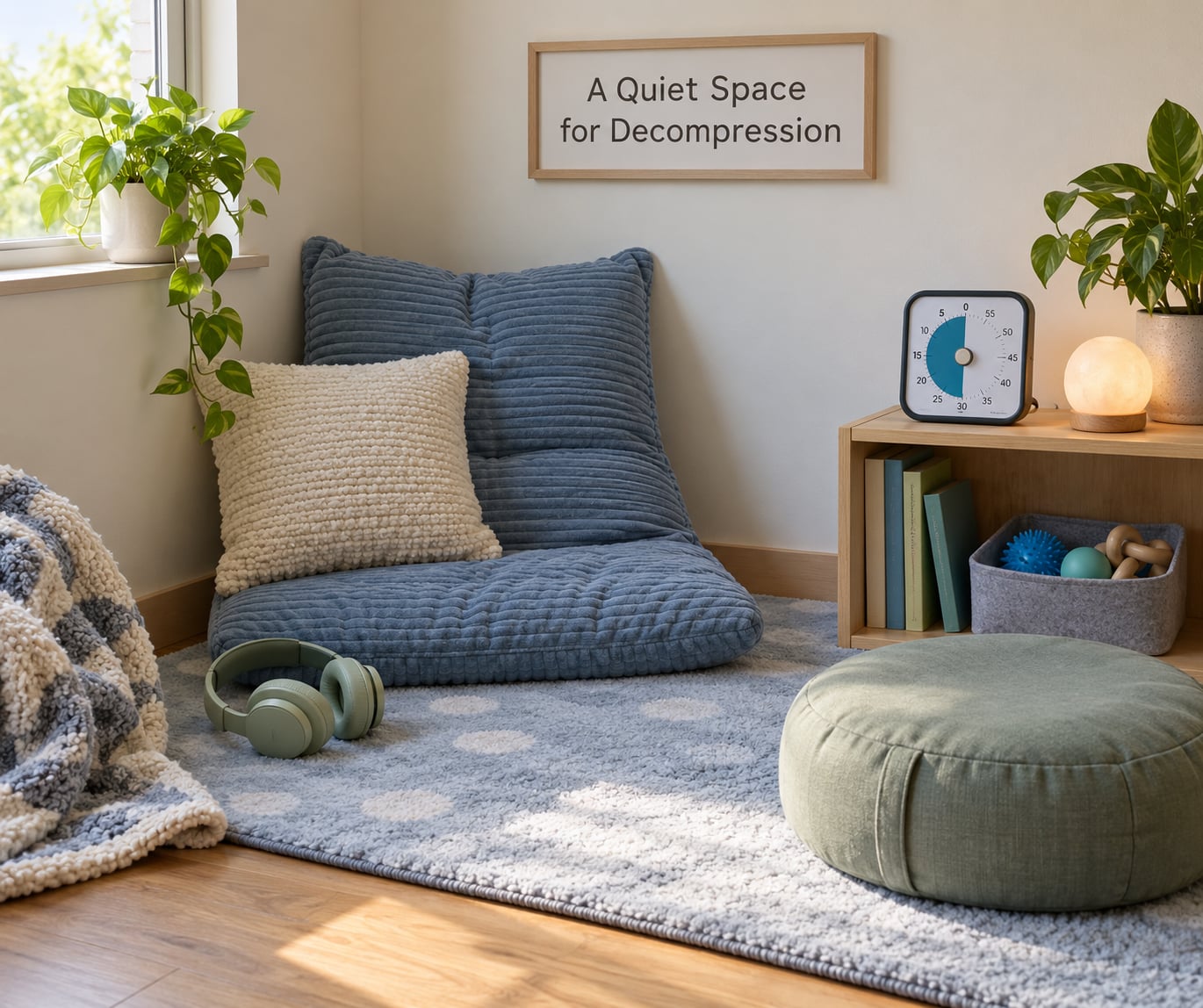
A quiet space is a low-demand place the student can go when a room becomes too much, rather than sitting through the rest of the activity in escalating distress. The distinction from a sensory break is that a sensory break is scheduled and short, while a quiet space is accessed when needed and is not time-limited in the same way.
For it to work, the space needs to be defined, available, and quietly monitored. A folding chair in a hallway is not the same as a room with softer lighting, fewer people, and a clear signal that using it is expected rather than punished.
Sample wording: “A designated low-demand space will be available in the school building and identified on the student’s schedule. The student may request access, or staff may offer it, during periods of escalated stress. The student is not required to explain why. Staff will check in quietly at agreed intervals rather than requiring a conversation.”
Teams sometimes worry that a quiet space becomes avoidance. Build the safeguard into the language rather than leaving it to interpretation. A written note that the student returns to a defined activity after regulation, with a short re-entry routine and a staff member to walk them back, keeps access tied to learning.
4. Advance Warning Before Changes and Transitions
Unexpected change is one of the most common triggers families name. Fire drills, substitute teachers, assemblies, schedule swaps, and a classroom that moved to the library all fall into the same category: the plan changed without notice.
The accommodation is small to write and easy to deliver: a warning before the change rather than after. Some students need it as a visual, some as a verbal cue, and some need both. Tying the warning to a defined amount of notice makes it measurable.
Sample wording: “Students will receive a visual and verbal warning at least one activity in advance of any change to routine, staff, location, or schedule, including fire drills, assemblies, substitute coverage, and last-minute room changes. When notice is not possible, staff will provide a brief preview as soon as the change is known and mark it on the student’s schedule.”
Parents on r/specialed and r/Teachers note that most of these supports would benefit the whole class if everyone got them. That is a useful argument to make, because a support designed for the whole room is much cheaper for a school to approve than one that only works for your child.
5. Movement and Heavy-Work Opportunities
Movement supports include scheduled movement breaks, classroom movement activities, and supervised heavy-work tasks like pushing a cart, carrying a bin, or climbing. Many autistic students use movement to stay regulated enough to attend, and the request is usually framed as access rather than as a behavior consequence.
Sample wording: “The student will have a movement break of five minutes’ duration at a scheduled frequency, at times determined by the classroom team and recorded on the visual schedule. The student also has access to a designated movement tool during seated work, such as a resistance band, fidget, or wobble cushion, at the student’s discretion.”
I want to be straight about expectations here. Movement breaks often look helpful, and families frequently report improvement in attention and settling afterward, but no accommodation guarantees an outcome. What the research and the classroom practice both support is access to movement as a routine support, not as something your child has to earn by finishing work.
Note the wording difference in practice. “Break after you finish your worksheet” is a consequence. “Break at 10:20 and again after lunch” is an accommodation.
6. Noise-Reduction Supports
Auditory input that an adult can tune out may be physically exhausting for an autistic student, and many will not raise a hand about it. Noise-reduction supports range from where a child sits to how the room itself is treated.
Common examples include seating away from the speaker, radiator, door, or pencil sharpener; seating farther from the busiest hallway route; noise-reducing headphones for specified short tasks; a quieter lunch option; reduced hallway traffic during passing periods; and acoustic adjustments such as felt covers on chairs or a classroom rug.
Sample wording: “The student will be seated away from the primary noise sources identified in the classroom, including the door, radiator, and audio equipment. Noise-reducing headphones will be available for independent work, tests, and other specified tasks as documented. Staff will avoid asking the student to remove headphones during those tasks.”
Match the support to the setting rather than requesting everything. Headphones that help during independent work can get in the way of group instruction or speech work, so a written note about when they apply saves a fight later.
7. Instruction and Materials in a Clearer Visual Format
Directions delivered only out loud, then handed over in writing on a crowded page, ask an autistic student to hold two versions of the same information in working memory at once. Visual format accommodations reduce that load: instructions on the board as well as spoken, directions broken into numbered steps, a model of what finished work looks like, captioned video, and uncluttered worksheets with extra space.
Sample wording: “Directions will be provided in writing and verbally, in numbered steps, with a visual example of the expected product. Worksheets and slides will be uncluttered, with instructions presented separately from the task itself. Video content will be captioned and available in advance when provided to the class.”
A caution worth saying out loud. Not every autistic student processes information visually, and visual supports that are not matched to the child can add noise. Ask what your child says helps, and use their report rather than a checklist. If your child does not speak, watch where they go looking when directions get confusing.
8. Support for Executive-Function Demands
Executive function is the set of skills behind starting a task, sequencing steps, tracking time, and finishing. A student can know the material and still not get credit for it because of the paperwork around the task. These accommodations are about the paperwork.
Examples include a checklist for multi-step assignments posted before the work begins, a partially completed organizer, a timer or visual timer for timed work, staff reminders at defined points, and help locating or organizing materials.
Sample wording: “For multi-step assignments, the student will receive a task checklist broken into numbered steps before beginning work. Staff will provide a reminder at the start, midpoint, and end of the assignment period. Materials will be stored in a consistent, labeled location, with staff assistance to gather them at the start of independent work time.”
This cluster grows with the school day. A first grader needs a one-step checklist taped to the desk; a ninth grader may need a weekly planner review with a case manager. Same support, different scale.
For families planning further out, our post on how to find a day program for a young adult with autism covers what changes once school stops being the structure.
9. Communication Supports During Class and Group Work
Group work is where many autistic students get left out of the conversation they were actually part of. Communication accommodations include access to augmentative and alternative communication devices during instruction and group activities, speech-language support, written or visual response options instead of speaking aloud, and extra processing time before a question is treated as unanswered.
Sample wording: “The student will have access to their AAC device during instruction, group work, and independent tasks. When the student uses a response board, written response, or device, staff will allow the documented processing time before re-prompting. In group activities, the student may respond in writing or on their device, and the group facilitator will read responses aloud to peers when requested.”
Two distinctions parents run into constantly. Communication supports and speech-language services are different entries in the plan: one is how your child accesses instruction, the other is what a provider teaches. And a written accommodation for extra processing time has to name the amount of time, because “give him a minute” means something different to every adult in the building.
If siblings are asking questions too, simple scripts for explaining autism to siblings may help the whole household keep the language consistent.
10. Adapted Testing and Task Conditions
Testing conditions are where accommodations get tested hardest, both literally and legally. State assessment rules set limits, so the first question for any team is what the state allows, not what would be ideal.
Common classroom supports include extended time on tests and assignments, a reduced-distraction or separate setting, reduced copying demands, permission to answer orally or by typed response, a scribe, accessible formats such as large print or text-to-speech, and alternate ways to show mastery such as a project, video, or hands-on demonstration.
Sample wording: “On classroom assessments, the student will receive extended time as specified in the IEP, in a setting reduced from typical classroom distraction. Staff will read test directions aloud without clarifying the content. The student may respond by typing, by speech-to-text, or orally with a scribe, as documented.”
Keep the classroom list and the state-testing list separate. They are governed by different rules, and a school may implement one and not the other. Ask in writing which applies to the state assessment and who at the district is responsible for it.
Frequently Asked Questions
What is the difference between an IEP and a 504 plan for a child with autism?
An IEP is a legally binding Individualized Education Program under IDEA, for students whose disability affects educational performance. It covers goals, services, and accommodations, and it is reviewed regularly. A 504 plan sits under Section 504 and provides accommodations, related services, and access to general education, but no goals or direct services. Many autistic students start with a 504 and move to an IEP when the team determines services are needed.
Can a school refuse an autism accommodation if the child has an IEP?
No. Once an accommodation is in a signed IEP, the school is required to provide it. Teachers do not have discretion to decide whether an agreed support is worth doing, and a substitute covering the classroom is not an exception. If a support is not being delivered, document dates and specifics in writing, ask the team to correct it, and if it continues, request a state complaint or due process complaint through your state education agency.
How do I write measurable IEP goals for sensory or attention support?
Describe the support first, then the outcome. Name who provides it, where, how often, and for how long: for example, two 10-minute sensory breaks daily with a staff escort. Then write a separate goal for the child’s response, with a measurable condition such as independently requesting a break in four of five opportunities by a stated date. Keep the two apart, since the accommodation is a promise and the goal is a measurement.
What is the difference between an IEP accommodation and a related service?
An accommodation changes how your child accesses instruction: extra time, a visual schedule, noise-reducing headphones, a scribe. A related service is support provided by a specialist to help your child benefit from education, such as speech-language therapy, occupational therapy, counseling, or interpretation. A parent on r/Autism_Parenting raised whether to push for related services in the same meeting, which is reasonable, but they belong in different sections of the plan.
How often can parents request a change to an IEP?
As often as you have a reason. You can request a meeting at any time, without waiting for the annual review, if your child’s needs change or an accommodation is not being delivered. Schools must also reevaluate at least every three years if conditions warrant it. Bring observations and dates to the request. Many parents also record the meeting with permission, since a single IEP discussion can cover a surprising amount of ground quickly.
What to Do First With These IEP Examples
Pick one unmet need, not ten. A parent who walks in with a page of requests usually leaves with nothing documented, and the support that would have changed the most this month gets buried under the rest.
Then gather what makes the request concrete: dates, what happened, what your child did, what instruction was missed as a result. Two weeks of honest notes beat a stack of general concerns. Take the wording from the section above that matches and put it in the plan’s accommodations area rather than the goals area.
At the meeting, ask for one thing to be read back and recorded as written, with the who, where, when and how long filled in. Whatever the team agrees to, whatever they decline, get the decision documented either way. Declines in writing are useful later, because they tell you exactly what to challenge next time.
These IEP accommodations for autism examples are a starting set, not a menu to pick from in a meeting. Work with your child’s team, use the language that fits your child, and expect to revisit it as the school year changes what they need.