To help a child with auditory processing disorder, focus on three things: cut down background noise, speak in short clear instructions your child can follow, and get professional support from a qualified audiologist or speech-language pathologist. Most families see the fastest change at home the week they turn off the television during conversations and stop giving three directions at once.
The child’s ears usually work fine. What struggles is the brain’s ability to sort speech from everything else happening around it, so a classroom, cafeteria, or restaurant feels like listening through water. Nothing here diagnoses anything or replaces an evaluation. This is general information, and an individual plan belongs with a clinician who can actually test your child.
Try this today: pick one 10-minute conversation a day, turn off every background sound, face your child, give one instruction, then wait five to 10 seconds before repeating it. Track what happens. That single experiment tells you more than a week of guessing.
Table of Contents
- What You Need
- Step-by-Step
- Step 1: Document What Your Child Hears and Understands
- Step 2: Get an Evaluation From a Qualified Professional
- Step 3: Reduce Background Noise at Home
- Step 4: Use Clear, Short Instructions and Visual Supports
- Step 5: Build a Listening-Friendly Classroom Routine
- Step 6: Teach the Child to Ask for What They Need
- Step 7: Track Progress and Adjust the Plan
- Common Mistakes
- Frequently Asked Questions
- What are the signs and symptoms of auditory processing disorder in children?
- Is there a free test for auditory processing disorder?
- What school accommodations can a child with APD get?
- Does auditory processing disorder qualify for an IEP or a 504 plan?
- Does auditory processing disorder go away with age?
- How do I calm a child who is overwhelmed by noise?
- Conclusion: Start With One Small Change
What You Need
Before you start changing anything, gather four things. The work is mostly observation and small adjustments, not equipment or spending.
- A notebook or notes app. Write down the situation, the exact words your child missed, the environment, and what happened next.
- A way to capture sound conditions. A rough sketch of your home layout with a note on where noise is worst works better than you would think.
- Your child’s teacher, plus the special education or support contact if the school has one. You need the classroom teacher, not only the reading specialist, because that is who delivers the directions.
- Professional resources. A pediatric audiologist, a speech-language pathologist, and for learning questions an educational psychologist. Ask who has a waitlist.
One thing to be clear about: a general observation never confirms auditory processing disorder. Symptoms overlap with ADHD, autism, language disorders, and noise sensitivity, and a hearing test comes first to rule out a physical hearing loss. Your notes are not a diagnosis. They are the raw material a clinician needs to make one.
Step-by-Step
Step 1: Document What Your Child Hears and Understands
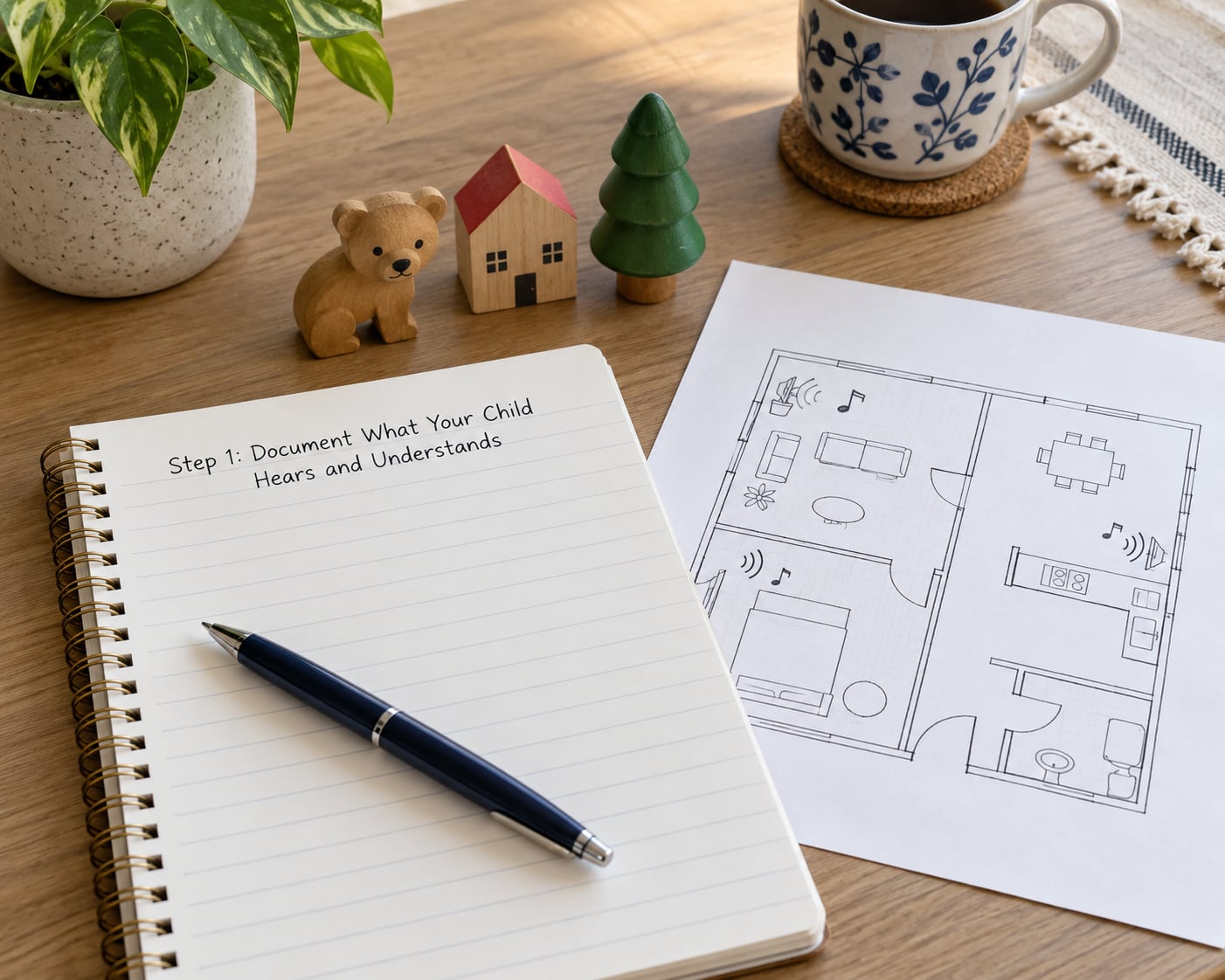
Write down specifics, not impressions. “Doesn’t listen” tells a clinician nothing. “Asked me to repeat the third step of directions while the dishwasher was running at dinner” tells them a great deal.
For each entry, note the time of day, the room, who was speaking, how far away, whether your child could see the speaker’s face, and what words or instructions broke down. Track the number of times your child asked for a repeat during a normal week. That number becomes your baseline, and it is the only way you will know whether anything is working.
Write for two weeks before changing your whole approach. Two weeks of honest notes beat six months of memory.
Step 2: Get an Evaluation From a Qualified Professional
To help a child with suspected auditory processing disorder properly, you need a licensed audiologist, and often a speech-language pathologist as well. Start with a hearing test through a pediatrician or an audiologist, because a child who cannot hear frequencies clearly cannot be assessed for how the brain processes sound.
Assessment beyond a standard hearing test usually looks at how a child understands speech in noise, distinguishes similar-sounding words, holds onto spoken information, and detects rhyme. Children are generally tested reliably around age seven, so a younger child may need a re-evaluation later rather than a verdict now.
When you call, ask about wait times, what testing includes, whether they are in your insurance network, and what the school needs from them in writing. Bring your notebook. Clinicians consistently say that organized parent observations speed up the visit.
Step 3: Reduce Background Noise at Home
Noise is where the day gets lost. The television on in the background while you give directions means your child is listening to the television too. Close the door on the dishwasher. Move the conversation out of the kitchen during homework. Ask your child to come to the room where you are instead of calling from another room.
Most homes can be fixed for the price of a few habits. You will hear the washing machine, the fan, the video games, the sibling arguing, the street. Pick the noisiest three and change those first. My rule is that any room where a conversation happens has exactly one voice in it, and that voice is the one speaking.
Noise-reducing headphones help for predictable trouble spots like a restaurant or a gym, but keep them for those situations rather than all day, since constant filtering makes some children feel more detached. A packed go bag with the headphones already inside beats remembering them, and I keep one in the go bag I build for medical and sensory needs.
Step 4: Use Clear, Short Instructions and Visual Supports
Give one instruction at a time, then pause. Five to 10 seconds of silence feels long to an adult and is about right for a child who is sorting words out of noise. If you repeat yourself faster and louder, you make the task harder, not easier.
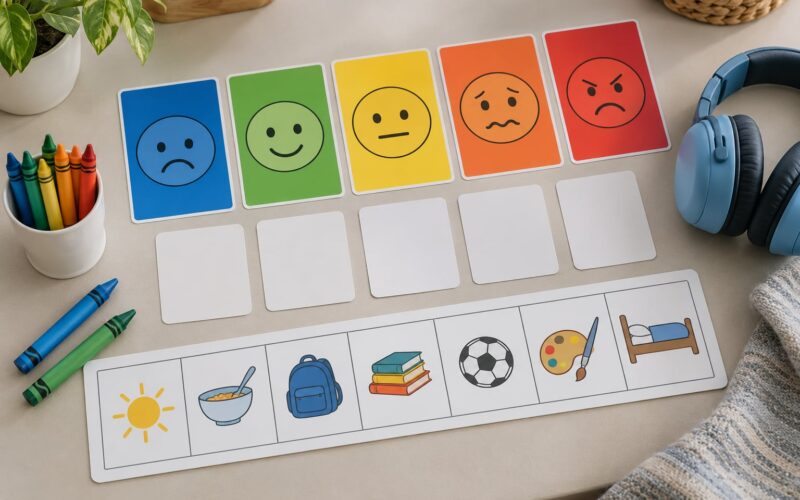
Rephrase instead of repeating the identical words. “Put the blue cup in the sink” is easier to decode than “the blue cup, in the sink.” Pair speech with something visual: a picture card, a written checklist, a gesture, or a demonstration of the task. Written backup matters most for multi-step routines.
A morning chart is the fastest visual support most families build. Six boxes, one per task, checked off in order: get up, bathroom, clothes, breakfast, bag, shoes. Kids who follow a chart of task sequences usually stop asking for the same instruction four times, which means less arguing before 8 a.m.
If homework is where the listening breaks down, I wrote about how to help a child with homework meltdowns, including the recovery plan for after a blow-up.
Step 5: Build a Listening-Friendly Classroom Routine
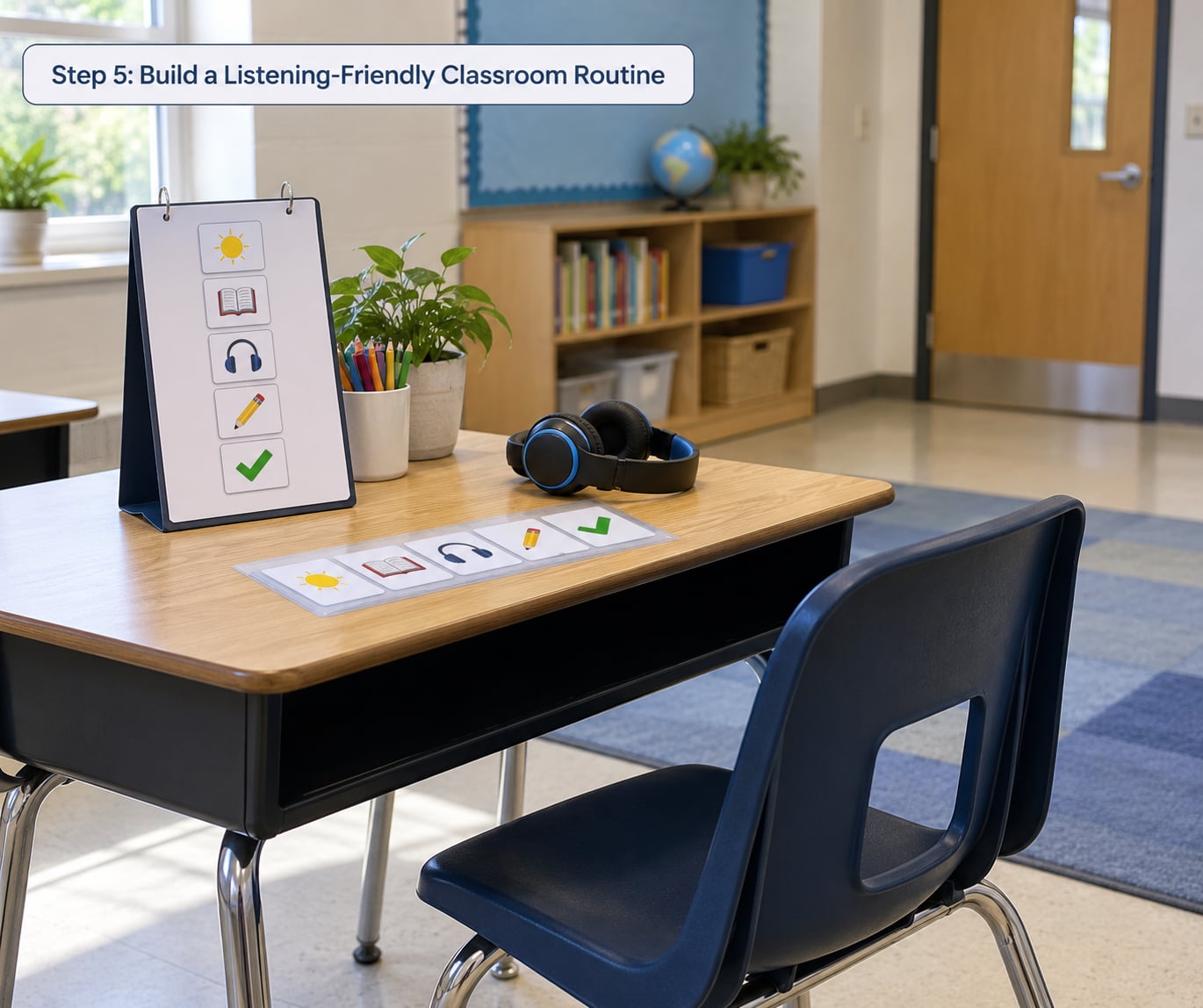
At school, the biggest lever is the classroom teacher, not the pull-out specialist. Parents who talk directly to the teacher report faster change than parents who only send notes through the office. Ask for a specific list rather than a general concern.
- Seating away from doors, windows, and the sink, as far forward as practical.
- Written copies of directions and a signal that written instructions are coming.
- One direction at a time, with the rest paused until the first is done.
- A warning cue before every transition or change of activity.
- Comprehension checks: ask your child to repeat the instruction back before moving on.
- A quieter place to work during the noisiest subjects, such as reading or math tests.
Some families ask about a remote microphone, often called an FM system, which sends the teacher’s voice directly to your child through headphones. It works well in some classrooms and is worth asking about, though it takes setup and practice. On the question of keeping up once the directions land, I covered how to help a child keep up with classroom pace separately.
Ask the school whether a 504 plan or an IEP makes sense for your child. A 504 covers accommodations such as seating and written instructions. An IEP is for a disability that affects educational performance and can include specially designed instruction. Which one fits depends on your child’s full evaluation, so bring the clinician’s written report and ask the school team to explain their options.
Step 6: Teach the Child to Ask for What They Need
A child who can say “please say that again” or “can you write it down?” saves themselves a lot of guessing. Practice the phrases when nothing is wrong, not in the middle of a hard moment. Keep the list short so it sticks: say it again, say it slower, write it down, move closer, repeat the first part.
One caution. Self-advocacy should not turn your child into the person responsible for every accommodation. Adults in the room, grown-ups included, should also ask for repeats and write things down when your child is tired. Keep the burden where it belongs.
Children who understand their own listening strengths and weaknesses tend to handle the social side better. A simple explanation to their teacher or a friend, in their own words, often does more good than a formal diagnosis card.
Step 7: Track Progress and Adjust the Plan
Review your notebook weekly. Count the repeat requests, note which rooms still break down, and mark the strategies that produced a change. Most families find two or three of the seven steps do most of the work, and the rest can relax.
Progress here is not a straight line. A child can read better in a quiet room and still fall apart in the cafeteria, and a good week at home can follow a rough one at school. Compare like with like: same room, same time of day, same level of noise.
Give each change three to four weeks before judging it, since new routines take time to become automatic. If difficulties keep spreading or get worse, go back to the professional with your notes and ask what the notes are telling them. Bring the notebook. It is the most useful thing you own in this whole process.
Common Mistakes
Assuming your child is ignoring you. A child who does not respond has usually not received the words yet. Look at noise and distance first, and then ask for a repeat in a calmer spot.
Saying it louder instead of clearer. Volume does not fix a processing problem. Shorter sentences, normal volume, and a pause work better than louder words in the same order.
Testing hearing only in perfect conditions. A child can pass a quiet-room hearing test and still fall apart in a noisy room. Insist on testing that includes speech in noise, and ask what was tested.
Introducing six supports at once. A child cannot hold six new expectations. Change one thing, watch for two weeks, then add the next.
Waiting months for an appointment to do nothing. You can start now. Turning off background sound, shortening instructions, and building a morning chart cost nothing and do not conflict with any evaluation or therapy.
Putting the whole plan on your child. If your child is the only one asking for repeats, the plan is unbalanced.
A few reminders worth sticking to: wait five to 10 seconds before repeating, give one direction at a time, face the speaker, always offer a written backup, and expect the quiet days to be the ones you celebrate.
Frequently Asked Questions
What are the signs and symptoms of auditory processing disorder in children?
Common signs include asking for repeats, missing words in noisy rooms, trouble following multi-step directions, difficulty understanding speech in groups, tiredness after listening, and reading or spelling difficulties despite normal hearing. These overlap with ADHD, autism, and language disorders, so signs alone cannot confirm anything. A pediatric audiologist and speech-language pathologist can evaluate your child individually.
Is there a free test for auditory processing disorder?
There is no widely available free screening for central auditory processing disorder in the US. Some early intervention programs, school districts, and hearing clinics offer evaluations on a sliding scale or at low cost, and a school-based speech-language assessment may be available to students. Call your insurance about a referral to a pediatric audiologist and ask clinics directly about reduced fees. Some families also see university training clinics.
What school accommodations can a child with APD get?
Common accommodations include seating away from doors and windows, written copies of verbal directions, reduced verbal directions, warning cues before transitions, a quieter testing environment, permission to ask for repetition, and access to a remote microphone. Start with the classroom teacher and bring the clinician’s written report. A 504 plan is where these accommodations are formally documented.
Does auditory processing disorder qualify for an IEP or a 504 plan?
Either is possible, depending on your child’s evaluation. A 504 plan provides accommodations, which are changes to how instruction is delivered, such as seating or written directions. An IEP provides accommodations plus specially designed instruction when the disability affects educational performance. Your child’s school team decides which fits, using the written evaluation, and should explain the reasoning to you in writing.
Does auditory processing disorder go away with age?
It does not always go away on its own, though many children improve as language, attention, and classroom demands develop. Some skills such as auditory memory strengthen with age and practice. Because hearing and understanding can still be affected in adulthood, children who build good communication habits and self-advocacy early tend to manage demanding listening settings better. Ask your clinician about your child’s specific pattern.
How do I calm a child who is overwhelmed by noise?
Lower the noise first rather than talking over it. Move to a quieter room, turn off the television, reduce lights and activity, and give your child a predictable choice between two options. Speak in a calm, low voice from the front and wait. Noise-reducing headphones help in predictable loud settings. If overwhelm happens daily or comes with physical symptoms, mention it to your child’s clinician.
Conclusion: Start With One Small Change
If you take one action from this guide, make it this: name the single hardest listening situation in your day, write down exactly what happens in it, and call a pediatric audiologist to get an evaluation started. Then change one thing at home, usually the television going off during conversations.
Learning how to help a child with auditory processing disorder is a series of small adjustments rather than one grand fix. The supports that hold up are the boring ones, the same short instruction and the same quiet room, used consistently across home and school. Let your child’s individual needs and your clinician’s guidance shape the plan, and expect it to look different for every child.