The short answer: you encourage a late talker by flooding their day with words about what is actually happening, creating real reasons to communicate, and then stopping talking long enough for them to try. Most parents need nothing more than a few minutes a day and a shift in how they respond to a grunt, a point, and a first word.
That is the part nobody tells you at the playground. The hardest part for most parents is not technique, it is the comparison. Your mother still mentions that her grandson was saying sentences at 18 months. Your neighbour’s three-year-old narrates everything. Meanwhile you are standing in the kitchen narrating socks, and your own child is handing you a spoon and saying nothing.
There is no evidence that parents cause their child to talk late. A systematic review of 34 early language intervention studies found expressive vocabulary improved in 93 percent of the children who took part. What helps is ordinary, responsive interaction, used consistently.
Table of Contents
- Quick answers before you start
- What You Need
- Step-by-Step: How to Encourage a Late Talker
- 1. Follow Your Child’s Attention
- 2. Add Simple Language to Everyday Moments
- 3. Give Your Child Time to Respond
- 4. Turn Play Into Back-and-Forth Interaction
- 5. Expand What Your Child Says or Does
- 6. Make Choices and Waiting Comfortable
- 7. Keep Communication Playful and Brief
- 8. Track Progress and Know When to Get Help
- What to do while you wait
- Common Mistakes
- Frequently Asked Questions
- At what age do late talkers start talking?
- Can a child outgrow speech delay?
- Is 7 too late for speech therapy?
- Is it normal for a 2.5 year old not to talk?
- My 2-year-old isn’t speaking. What should I do?
- Should a bilingual home use one language only?
- Conclusion
Quick answers before you start
If you only have a minute, these are the short versions.
- What is a late talker? A toddler, usually between 18 and 30 months, whose spoken vocabulary is limited for their age while their play, motor skills, social interest and understanding of language are developing typically.
- When is speech delay a concern? Fewer than 50 words and no two-word combinations by 24 months, or no words at all by 15 to 18 months, is the threshold ASHA uses for a speech-language evaluation.
- What works at home? Narrating routines, following your child’s attention, waiting, expanding their attempts, and creating communication temptations.
- Will they catch up? Roughly half do. About one in five late talkers is later diagnosed with Developmental Language Disorder, and many who catch up on vocabulary still show weaker grammar and literacy at school age.
- Should you wait? No. Early intervention beats wait-and-see every time, and you can start doing meaningful things at home today while you wait for a referral.
| Age | Typical spoken vocabulary | Worth raising with your pediatrician |
|---|---|---|
| 12 months | A few words besides mama and dada, plus lots of babbling | No words, and no gesturing to ask for things |
| 18 months | About 20 to 24 words | Fewer than about 10 words, or no babbling at all |
| 24 months | At least 50 words, and two-word phrases like “more milk” | Fewer than 50 words, or no two-word combinations |
| 30 months | Around 100 words and short sentences | Fewer than 50 words, no phrases, or nobody understands them |
| 36 months | 200 or more words and short sentences you can follow | Fewer than 50 words, or any loss of words or skills |
One more thing worth getting straight early, because most parents use these two words interchangeably. A speech delay is about producing sounds and words. A language delay is about understanding and using language, and the two often, but not always, appear together.
| What you see | Late talker | Wider language or speech delay |
|---|---|---|
| Words | Few words, but they come steadily | Few words, and progress has stalled or reversed |
| Understanding | Understands far more than they say | Does not follow simple instructions without gestures |
| Social interest | Wants people, shares enjoyment, checks faces | Pulls away, rarely looks for shared attention |
| Play | Normal pretend and functional play | Limited pretend play, repeated actions only |
| What to do | Try strategies at home and mention it at the next check-up | Ask for a speech-language evaluation now |
What You Need
Nothing to buy. You need about ten minutes a day, a few objects that can be used in more than one way, and one predictable part of the day where you are not rushing.
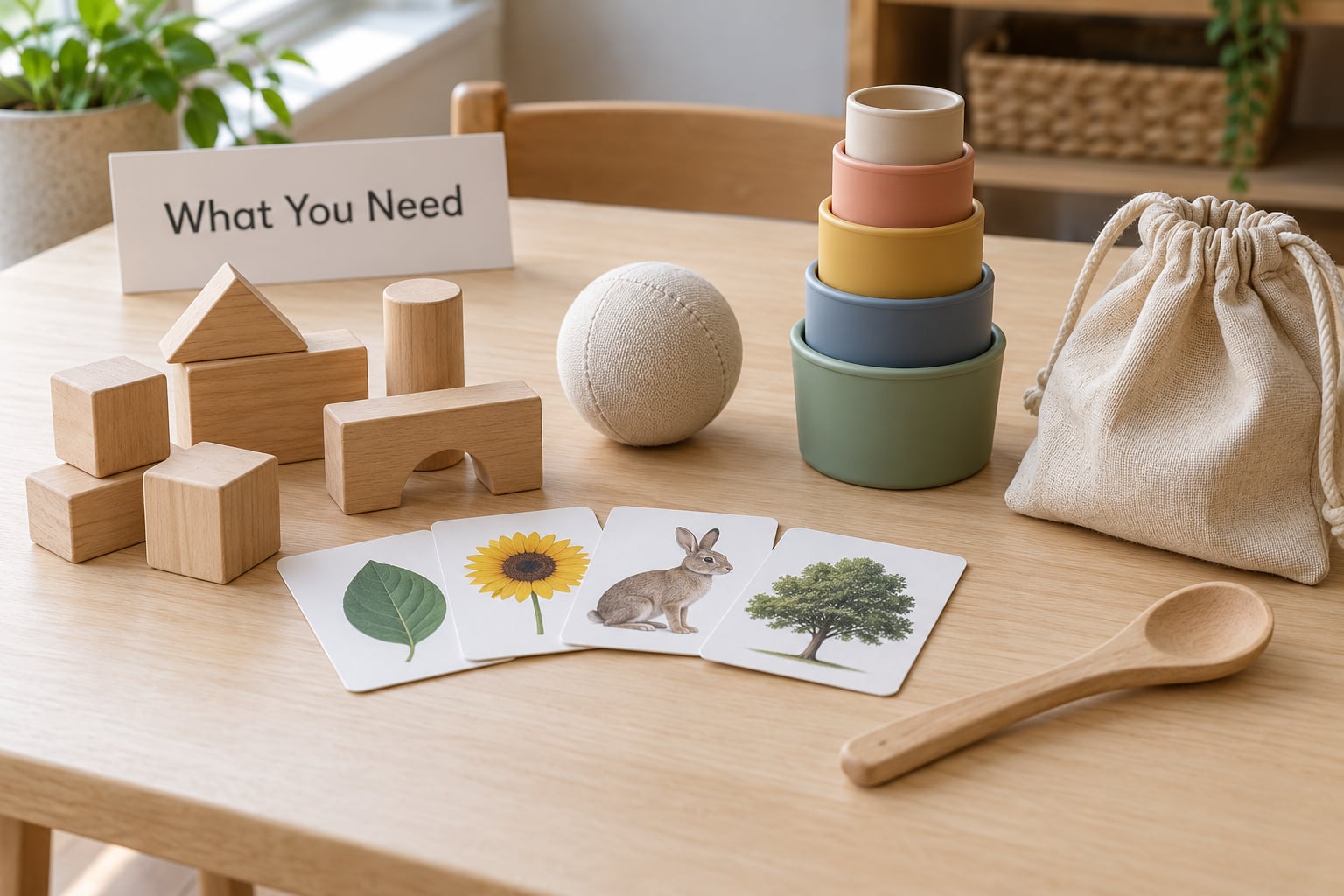
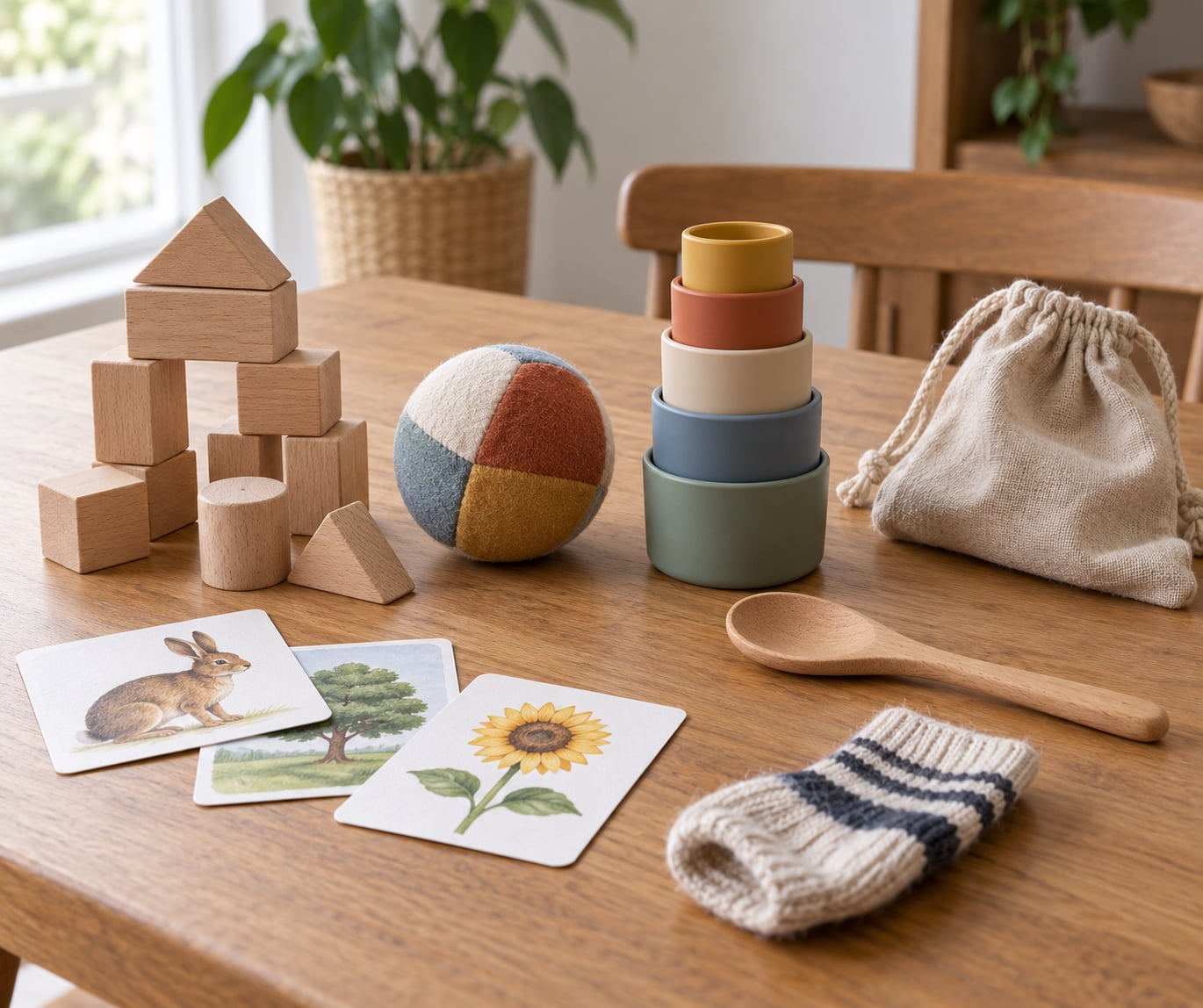
Open-ended toys. Blocks, a ball, cups, a container, a spoon, a scarf, cardboard boxes. These are better for language than a talking toy that does the talking for you, because your child has to do something with the object and you have to talk about it.
A calm slot in the routine. Pick something unhurried: playing on the floor after lunch, the bath, getting dressed, or the walk to the car. Communication is much harder to notice and respond to when you are also boiling pasta.
A few everyday objects as conversation bait. A wet washcloth, a spoon that is not a spoon, a shoe that will not go on, a box taped shut. Objects that create a small problem are the cheapest communication temptations there are.
A notebook. A phone note is fine. Write down each new sound or word and the date. Over a few weeks this becomes the most reassuring thing you own, because it turns a vague worry into a line going up.
Step-by-Step: How to Encourage a Late Talker
Work down this list in order rather than trying all eight at once. The first two matter most, and most parents who see real movement are the ones who kept at them for a few weeks.
1. Follow Your Child’s Attention
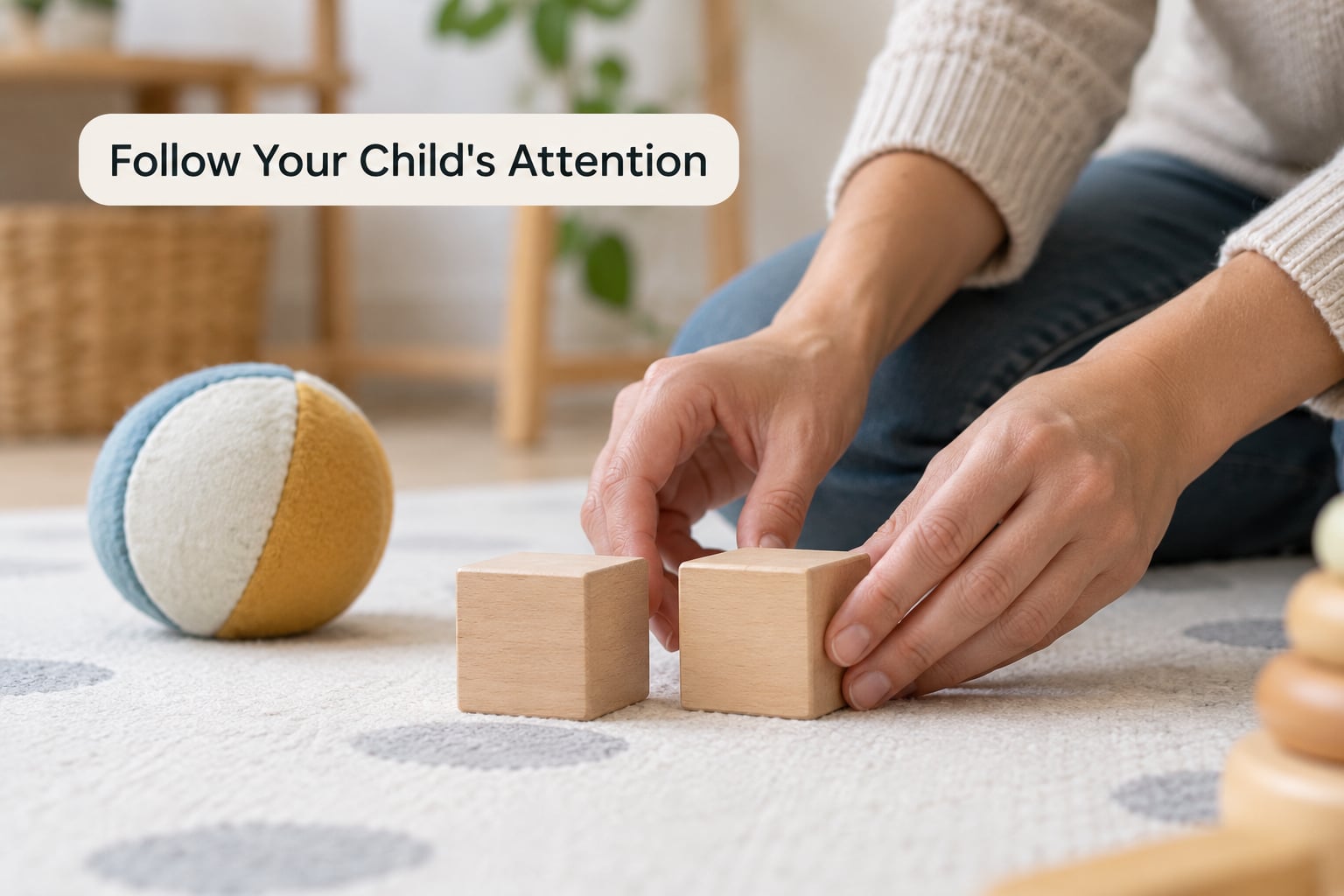
Watch what your child is already looking at, then join them there and talk about that. If they are pushing a toy car along the sofa, sit down and say “That car is going fast. It went up the hill.” You have joined their world before you asked for anything from it.
Children with fewer words often rely on gaze, pointing and showing. Recognising those and treating them as real communication is a technique speech pathologists use deliberately, and it is free to do at home.
The habit to avoid is asking a question before connecting. What gets a two-year-old talking is the back-and-forth, not the question.
2. Add Simple Language to Everyday Moments
Narrate what you are doing while you do it, then narrate what your child is doing. Keep the sentences short enough that you could say them with one breath.
- Getting dressed: “Shirt on. Other arm. Hat. Where are your socks? Here they are.”
- Bath time: “Water is warm. Wash your tummy. Now your feet. Towel. All done.”
- Meals: “Apple slices. Do you want the bowl or the plate? You picked the plate.”
- Car seat: “Buckle first, click. Book next. We are going to the shop.”
- Cleaning up: “Blocks in the box. Cups on the shelf. You put the last one in.”
Name an object once or twice, not twenty times. “Those are your shoes. Your shoes.” Repeating constantly teaches a child that words are noise, and parents on parenting forums worry far too much about not repeating enough.
Reading helps too, but talking about what you both see on the page matters more than reading the words perfectly.
3. Give Your Child Time to Respond
Ask, then stop talking. Five to ten seconds of expectant silence, looking at your child with an encouraging expression, does more work than repeating the question louder. Most parents rephrase faster than a toddler can answer.
Accept any answer. A grunt, a point, a sign, a sound that is not a word yet, a word that is not the one you asked for. Respond to the meaning you got, and your child learns that communicating with you works.
4. Turn Play Into Back-and-Forth Interaction
Play that requires turns gives your child a reason to make a sound. Roll the ball and wait for it to come back. Build a tower of three blocks, then knock it down together, then again. Sort buttons or socks into two bowls. Hand over one toy at a time from a closed container so the next one has to be requested.
Narrating your own play is useful, but narrating your child’s play and leaving a gap is closer to real conversation. Two or three sentences of describing what they are doing, then silence.
5. Expand What Your Child Says or Does
When your child produces a sound, gesture or word, add a little to it. Car becomes “big car”. Pointing at the door becomes “you want the door open”. A single word grows into a two-word phrase, which is the next milestone after vocabulary size.
Do this once, calmly, and then move on. Repeating it four times, or insisting they say it properly, turns a conversation into a test.
Videos of other children doing the same thing, including simple songs and nursery rhymes with clear actions, can add models without needing another adult in the room.
6. Make Choices and Waiting Comfortable
Offer two real options and accept either one: “Do you want the red cup or the blue cup?” or “Pants first or socks first?” Choices give your child a reason to communicate where the outcome genuinely does not matter to you.
Build short waiting into play, where the frustration is low. Let them push the shape along the track before you do it for them. Put the snack just out of reach. Expect the first attempts to be attempts rather than words, and treat them as successful.
7. Keep Communication Playful and Brief
Short and happy beats long and earnest. Five minutes of floor play when they are already engaged is worth more than an hour of drills at the end of the day, when everyone is tired and the child has no words left to spend.
End while it is still going well. Leave something unfinished on purpose: the puzzle half done, the block tower waiting, the next story unopened. Coming back to it tomorrow gives you a reason to return.
If a child who uses no words at all is becoming frustrated, sign along with them. Signing does not hold speech back, and parents in What to Expect communities report key word signing as one of the few things that visibly reduced the tantrums.
8. Track Progress and Know When to Get Help
Write down what you hear, not just words. A new consonant, a gesture, a longer sound, a first two-word combination. It takes thirty seconds and it is the thing that tells you whether any of this is working.
Then book the appointment rather than waiting for the next thing that worries you. Tell your pediatrician how many words your child has, what they understand, whether they point and gesture, whether they lost any words, and whether there have been ear infections or hearing concerns. Ask for a hearing check and a referral to a speech-language pathologist.
Waiting lists are the loudest frustration in parent forums, often months of them. Do everything in this list while you wait. It is not a consolation prize; responsive interaction is the core of what a good early language program asks parents to do anyway.
What to do while you wait
- Ask for a hearing screening and a speech-language referral in the same visit, so you are not making two trips.
- Ask whether your area’s early childhood intervention service accepts self-referrals. In many places you do not need a doctor’s note.
- Ask what the wait time is and what you should do if a milestone is missed while you wait.
- Keep a short vocabulary log and bring it to the appointment. Clinicians find it genuinely useful.
- Ask your nursery or preschool teacher how your child communicates there. They see the child when you cannot.
Common Mistakes
Most of what slows a late talker down is well meant. These are the versions I hear most often from parents, with a gentler swap for each.
Rapid-fire questions. “What’s that? What colour? Where’s the ball? What did I say?” Rapid questioning teaches a child that communication is a test they are failing. Swap three questions for one describing sentence and a pause.
Correcting every attempt. Repeating a word back correctly three times makes a child decide that talking is not worth it. Say the word yourself, once, correctly, and keep playing.
Talking over your child. If you narrate continuously, there is no gap left to fill. Narrate, then stop and wait three seconds.
Practising only when your child is tired. Bedtime drills are the wrong hour. Communication grows during play, movement and routine, not at the end of a long day.
Reading silence as a lack of understanding. Many late talkers understand far more than they say. Test it quietly by asking for something out of sight, “Where are your shoes?”, and see whether they go and get them.
Comparing to siblings, cousins or the child next door. “He was talking by eighteen months” is not a diagnosis, it is a memory of a different child. Development has a wide range, and the comparison stops helping in about a week.
Waiting and seeing by default. Waiting is reasonable only alongside professional advice. Around half of late talkers do not fully catch up, and many who do still struggle with grammar and reading later, so a check rather than a guess costs very little.
Blaming yourself or blaming screens. There is no evidence that ordinary parent talk causes a late talker. Video can help when it is another child doing the thing, but two hours of it alone will not.
Frequently Asked Questions
At what age do late talkers start talking?
Most late talkers begin speaking between two and three and a half years, and the spread is wide. Some begin at two and a half, others sit quietly until close to four. A useful rule is progress: if words are adding steadily and combinations are appearing, the pattern is reassuring. If the count has not moved in a few months, or words have been lost, ask your pediatrician for a speech-language evaluation rather than waiting.
Can a child outgrow speech delay?
Many do. Research following nearly two thousand children found roughly 19 percent were late talkers at age two, and about 30 percent had not caught up by age four. Children who do catch up often still show weaker grammar, literacy and conversational skills at school. That is the reason early help matters even for a child who eventually seems to catch up on their own.
Is 7 too late for speech therapy?
No. Speech-language pathologists work with children well into the school years and into adulthood, and later learners often make solid progress. Early intervention is more efficient because skills build on each other, but a referral at seven is still worth making and far better than assuming it is too late. A child who has had no words at all still needs a hearing check as well as a language assessment.
Is it normal for a 2.5 year old not to talk?
A small number of words is common at this age, but silence or a handful of words is below the typical range. By 30 months most children are near 100 words and using two-word combinations. If your child says almost nothing, does not point, does not bring things to show you, or does not seem to understand simple requests, treat that as a reason to call your pediatrician rather than a phase to wait out.
My 2-year-old isn’t speaking. What should I do?
Do three things. Book a pediatric visit this month and ask for a hearing screening plus a speech-language referral. In the meantime, narrate your routines, follow your child’s attention, and pause after every question. Keep a short note of every new sound and word. Do not start drills or wait for the referral before doing anything, because the interaction you practise at home is the core of early language work.
Should a bilingual home use one language only?
No. Learning two languages does not cause a speech delay, and switching a child to a single language does not speed speech up. Count words across both languages rather than in one. If your total vocabulary is low for age, that is worth an assessment; if the combined count is on track, keep speaking both languages the way your family already does.
Conclusion
Start with one thing tomorrow: pick a calm ten minutes, put something interesting within reach, and narrate what your child is doing before you say anything to them. Wait three seconds when they answer. Write down whatever sound comes out.
That is the whole method. It is unglamorous, it works while you wait for a referral, and it costs nothing except the habit of leaving space at the end of a sentence. And book the pediatric appointment anyway, because knowing how many words your child has, how well they understand, and whether they point and gesture is worth more than any amount of reassurance from strangers at a playground.