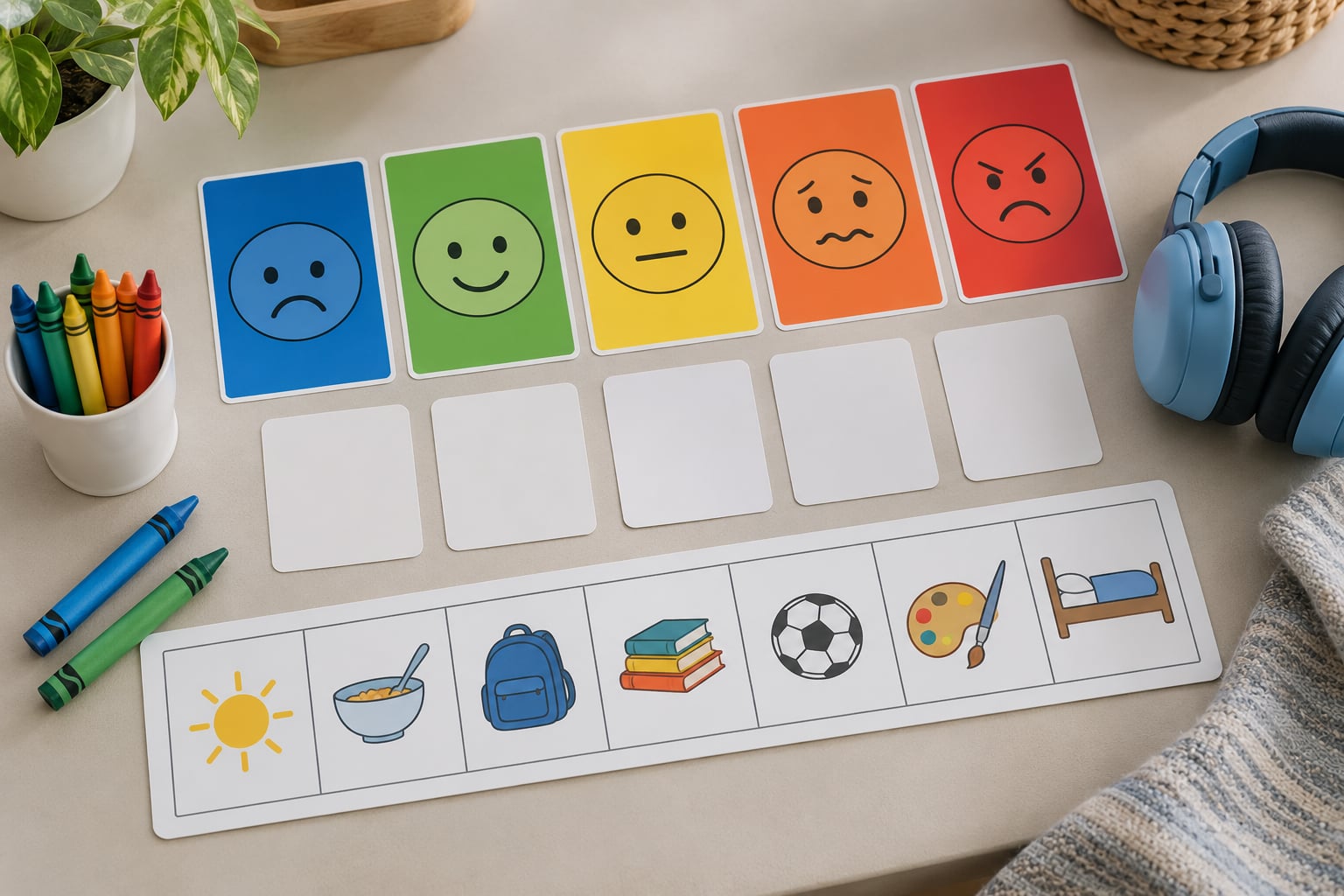
The Zones of Regulation is a colour-coded framework created by occupational therapist Leah Kuypers that sorts a child’s state of alertness and emotions into named zones, so adults and children can talk about big feelings before they escalate. The original framework had four colours; the current edition uses five. Here is how it works for parents in plain language.
Most parents meet this framework the same way: through a school. A home-school app message says your child was in Red at lunch, or a laminated colour chart turns up in the reading corner with no explanation. That is a rough introduction, so this guide fills in the background, including how to read early signs, what to actually say, and where the framework falls short for autistic children.
Two things first. The Zones is a copyrighted curriculum, and this is an independent parent-facing overview rather than official material from zonesofregulation.com. And this is general education, not medical or developmental advice. If your child’s regulation difficulties are affecting daily life, a paediatrician, an occupational therapist or a child psychologist is the right person for individual assessment.
Table of Contents
- Zones of Regulation Explained for Parents: A Quick Reference
- What Is the Zones of Regulation Framework?
- What Do the Five Zones of Regulation Mean?
- Blue Zone: too little input
- Green Zone: regulated and ready
- Yellow Zone: warming up
- Orange Zone: out of options
- Red Zone: peak dysregulation
- Children do not always fit neatly into one zone
- How Can Parents Tell Which Zone a Child Is In?
- What Triggers Move a Child Into a Higher Zone?
- Sensory triggers
- Uncertainty and transitions
- Communication breakdowns
- Demand and executive function load
- Emotional triggers
- Environmental triggers
- Unmet physical needs
- How Do You Help a Child Move Down a Zone?
- Step 1: Regulate yourself first
- Step 2: Name what you see, briefly
- Step 3: Lower the demand
- Step 4: Cut sensory input
- Step 5: Offer safe movement
- Step 6: Wait for readiness
- Step 7: Repair, then reflect
- Meltdown or shutdown?
- Zones of Regulation Explained for Parents: What to Say
- When you notice an early sign
- When you need to name a limit
- When you are offering something
- When the child corrects you or says no
- When they are coming back down
- When you mess up
- Lines to drop
- How Can Parents Use the Zones Without Making Them Feel Bad?
- What Routines Can Support Regulation at Home and School?
- Visual schedules that work
- Transition warnings
- A daily movement block
- Check-ins that are not inspections
- A calm-down corner that is always available
- A decompression slot after school
- Talk to the school with specific questions
- A sample day, one version
- What self-regulation looks like by age
- Does the Zones of Regulation Framework Work for Every Child?
- Frequently Asked Questions
- At what age can a child start learning about the Zones of Regulation?
- What if my child can name a zone but does not want to leave it?
- Should zones be used as rewards or punishments?
- How do I use the Zones of Regulation with an autistic child who does not identify with feelings?
- Can the Zones of Regulation replace therapy or behavioural intervention?
- What should I do when a child is overwhelmed and cannot accept verbal support?
- Conclusion: Start With One Shared Regulation Plan
Zones of Regulation Explained for Parents: A Quick Reference
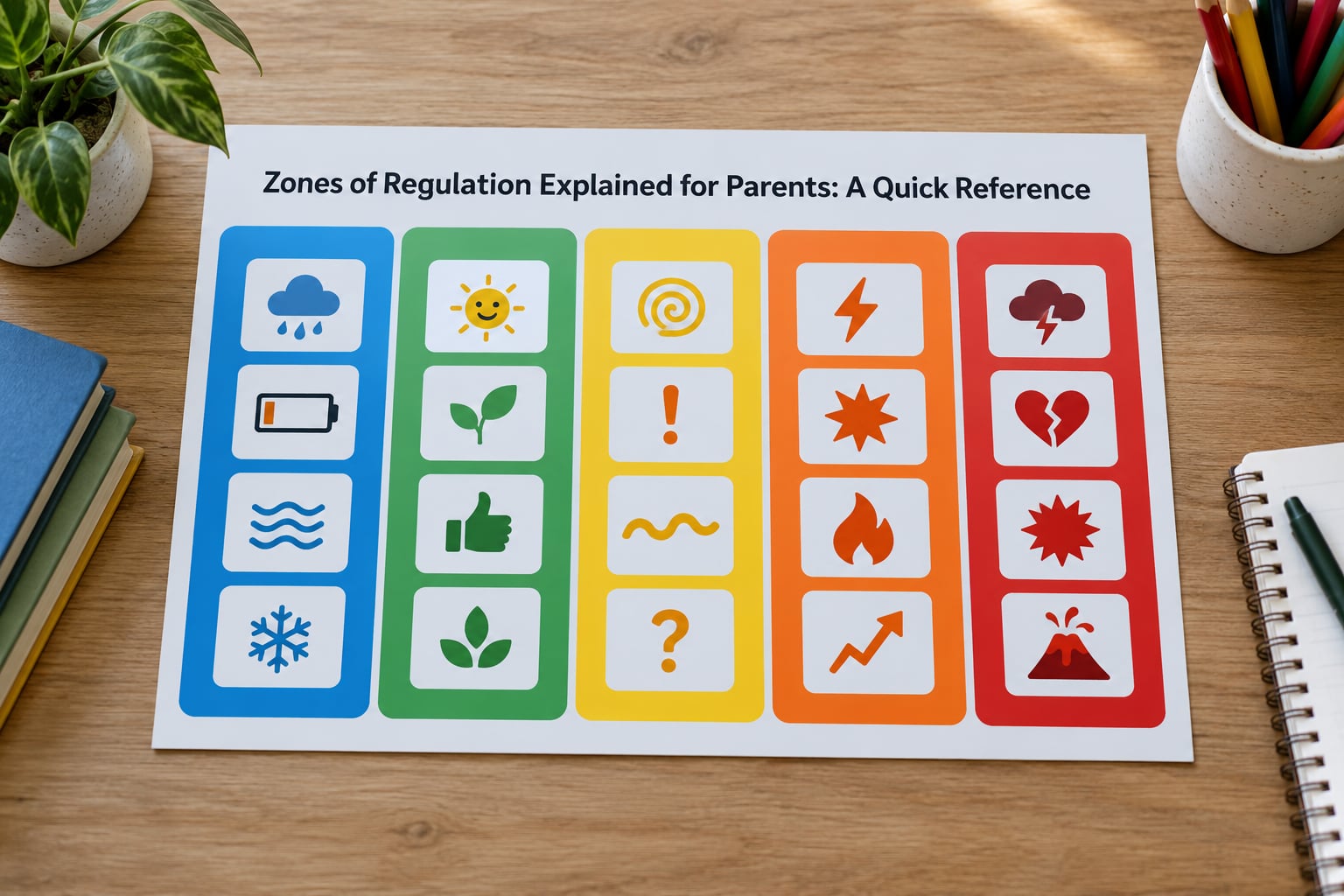
Regulation means how wound up or switched off a nervous system is right now. The Zones sort that state into five colours, from Blue at the bottom of the dial to Red at the top. Here is the whole framework on one page.
| Zone | State | How it feels | How it looks from outside | What helps first |
|---|---|---|---|---|
| Green | Ready | Calm, interested, able to think | Plays, answers, engages, flexible | Nothing much. Let them be in it. |
| Blue | Low | Tired, sad, sick, lonely, withdrawn | Quiet, slow to respond, flops, zones out | Alerting input: movement, light, water, noise |
| Yellow | Warming up | Excited, anxious, irritated, buzzy, restless | Fidgeting, louder voice, interrupting, spinning | Calming input plus fewer words and lower demands |
| Orange | Escalating | Frustrated, overwhelmed, out of options | Loud, rigid, pushy, refusing, demanding | Safety, low input, stay near, minimal talking |
| Red | Peak | Furious, panicked, overwhelmed, shut down | Meltdown or shutdown, no words, crying, bolting | Protect, reduce input, wait, then repair later |
One correction most parents need early: the goal is not to keep your child in the Green Zone all day. Every zone is legitimate. A Red Zone episode is not a character flaw, and Blue Zone rest is not laziness.
What Is the Zones of Regulation Framework?
The Zones of Regulation is a curriculum for teaching self-regulation, built by Leah Kuypers, an occupational therapist who noticed that many learners had no shared language for what their bodies were doing before behaviour became a problem.
Self-regulation is three things stacked on top of each other: noticing what you feel, working out why, and responding in a way that fits the situation. Young children do all three badly on a normal day, and much worse on a hard one.
Co-regulation comes first, and it is the idea most parents find most useful. Co-regulation is an adult lending their own settled nervous system to a child who does not have one available yet. A five-year-old does not calm themselves down; they calm down because the adult they are with got calm first.
So parents use the Zones for pattern-spotting rather than for labelling. Instead of reacting to behaviour in the moment, you look back and ask what happened before it. Which zone was the previous one in? What came just before the change? That question is the whole reason the framework exists.
Regulation is not only about feelings, either. It covers sensory load, arousal level, hunger, tiredness, pain and executive function. A child who is wired up because of noise has a regulation problem, not a discipline problem, even if the two look identical from the kitchen doorway.
What Do the Five Zones of Regulation Mean?
Each zone describes an energy level and a set of body states, not a moral category. Children move between them constantly, often faster than you can catch.
Blue Zone: too little input
Blue is the low-registration end of the dial. A Blue child may be tired, hungry, unwell, sad, bored or withdrawn. You often see sleepiness, a flat affect, slow responses, going off to a corner, or someone who answers “fine” to everything.
Calming tools make this worse. Deep pressure, a dark room and a quiet voice do nothing useful for a child who needs waking up. Blue needs alerting input: a walk, a drink, a snack, music, a change of position, or company.
Green Zone: regulated and ready
Green is the calm, baseline state where thinking is available and choices are flexible. A Green child can cope with disappointment, wait, negotiate and come back from a wobble without help.
Green is also where you do the real work. Strategies learned in Green, practised while everything is calm, are the ones that will be available later. A toolkit introduced for the first time mid-crisis is a box the child has never opened.
Yellow Zone: warming up
Yellow is the early-warning stage: excited, anxious, buzzy, irritable, overstimulated. You see fidgeting, a louder voice, interrupting, spinning, repetitive questions, or a sudden inability to sit still.
Yellow is the most teachable moment and the one most parents miss, because the child is still talking and still choosing. Fewer words, lower demands and a sensory reset often work here. Long explanations do not. A child correcting you at this point is not defiance, it is a brain with less access to logic.
Orange Zone: out of options
Orange is the escalation stage: frustrated, rigid, overwhelmed, loud, refusing, demanding, or starting to threaten. Language narrows and the child may not be listening at all by the end of this zone.
Stop negotiating and stop offering choices that all require effort. Lower the demand rather than raising your voice. Watch for the signs that Orange is heading for Red, because your response has less room in Orange than in Yellow.
Red Zone: peak dysregulation
Red is the top: full meltdown, panic, or shutdown. There is usually no reasoning available and often no language. Red may look like screaming, throwing, hitting, bolting, freezing, going limp, or going completely silent and unresponsive.
Nothing you say lands here. Your job in Red is safety, then reduced input, then presence without crowding, then waiting. The teaching happens afterwards, not during.
Children do not always fit neatly into one zone
Plenty of children skip Yellow and Orange and go straight from Green to Red in under a minute. Some sit in Orange for an hour without moving. A few fluctuate in a way that does not match the chart at all.
Treat the colours as a shared vocabulary rather than a diagnostic instrument. If your child’s pattern does not map onto the chart, the chart is wrong, not your child.
How Can Parents Tell Which Zone a Child Is In?
You tell by watching change over time, not by looking at a snapshot. A child on the swing is not in Red; a child on the swing and then silent for forty minutes is worth paying attention to.
Look at six things:
- Voice. Volume, pace and tone shift before most behaviour does. A consistently quiet child who suddenly goes clipped and hard is signalling something.
- Movement. Repetitive or escalating motion: pacing, spinning, jumping, rocking, or the reverse, going very still and floppy.
- Words. Fewer words, single words, or a shift to babbling, swearing or nonsense talk as language drops out.
- Sensory behaviour. Covering ears, seeking pressure, spinning, crashing, or suddenly avoiding touch they usually ask for.
- Decision-making. Flexibility collapses. Everything becomes no, or everything becomes a demand.
- Recovery. How long it takes to come back down. A child who takes forty minutes after a small wobble has a lower baseline than the moment suggested.
One caution on appearance. Studies of emotion recognition show adults read neutral and autistic faces as less emotional than they are, and the error runs in both directions. Do not assign a zone from a face alone.
What Triggers Move a Child Into a Higher Zone?
Triggers are easier to find once you group them. Most families only need one or two categories to explain almost everything that goes wrong.
Sensory triggers
Noise, bright or flickering light, scratchy clothing, a room full of bodies, a smell, being touched unexpectedly. Sensory triggers often hit without warning because the child has no early signal that the input is building.
Uncertainty and transitions
Not knowing what happens next, a change of plan, a cancelled activity, a substitute teacher, a queue that moves too slowly. Predictable structure does more work here than any calming tool.
Communication breakdowns
Being talked over, not being understood, being told no without a reason, having a yes ignored. Many Red episodes trace back to a sentence that landed as a wall.
Demand and executive function load
A task that felt manageable yesterday and cannot be started today. Executive function means the brain skills for noticing, pausing, choosing and remembering a strategy, and it fluctuates with sleep, hunger and demand load.
Emotional triggers
Rupture with someone they love, a change in the household, feeling left out. These run deeper and often produce Yellow rather than Red, but they are the ones that stick around longest.
Environmental triggers
Chaos, several simultaneous demands, a home that is too loud at 5pm after a full school day. Late afternoon is the classic pressure point, because a child who held everything together by masking all day arrives home with nothing left.
Unmet physical needs
Hunger, thirst, tiredness, pain, a full bladder, unmet sensory input. These are the boring ones and they account for a surprising share of what gets labelled as a behaviour problem.
Behaviour is not always deliberate, and a child in Yellow or Orange usually cannot choose differently. The useful question is what the nervous system needed three minutes before, not whether your instructions were clear enough.
How Do You Help a Child Move Down a Zone?
The sequence matters more than the technique. In every zone, co-regulation comes before self-regulation, and a regulated adult is the single most important ingredient.
Step 1: Regulate yourself first
Before you respond, take three slow breaths and drop your voice rather than raising it. A flooded adult escalates a situation they were trying to calm. If you need to step out for two minutes, do that; a reset parent is more useful than a present but dysregulated one.
Step 2: Name what you see, briefly
One short sentence: “You are in Orange right now.” Naming a state is not labelling a child, and it gives them something to work with once they can hear again.
Step 3: Lower the demand
Fewer words, one instruction at a time, less volume, more physical space. In Red, aim for no instructions at all beyond keeping everyone safe.
Step 4: Cut sensory input
Dim lights, reduce noise, move to a quieter space, offer water. Blue Zone children need the opposite: light, movement, a snack, a change of scene.
Step 5: Offer safe movement
Push, carry, jump, crawl, wall pushes, heavy lifting. Proprioceptive input through the joints and muscles tends to settle a rising nervous system faster than talking does.
Step 6: Wait for readiness
Regulating back up does not mean being Green. A child coming down from Red often lands in Blue, exhausted and quiet. Let them rest there rather than pushing them straight back to baseline.
Step 7: Repair, then reflect
Do the repair conversation the next day, not in the aftermath. “That was a big one. Your body was in Red. Nothing about you is wrong.” Reflection while a child is still recovering reads as a lecture and teaches nothing.
Meltdown or shutdown?
| Meltdown | Shutdown | |
|---|---|---|
| What it looks like | Loud: screaming, throwing, hitting, bolting | Quiet: freezing, going limp, no response, no words |
| What is happening | Fight-or-flight; nervous system pushed to its limit | Fight-or-flight with nowhere left to go; the system shuts down |
| Common triggers | Frustration, sensory overload, blocked escape | Overload, pain, shame, being overwhelmed by people |
| What to do | Protect, lower input, stay near, few words | Reduce demands, dim and quiet, no questions, allow stillness |
| What not to do | Reason, negotiate, correct, crowd | Prompt for a response, insist on eye contact, add tasks |
| Afterwards | Long recovery, then sleep or low-demand play | Rest, warmth, quiet, and gentle check-ins later |
Shutdown is the one parents miss. A quiet child after school can be recovering from a shutdown nobody noticed at 11am.
Zones of Regulation Explained for Parents: What to Say
Concrete lines beat general encouragement. Keep them short enough to say in the moment, and use the same ones every time so they become predictable.
When you notice an early sign
“I can see you are getting buzzy.” “Your body is heading towards Orange.” “You look like you need a break.” These work because they describe the body, not the behaviour or the child.
When you need to name a limit
“You are in Yellow, and we are still going to leave the park.” Say the boundary once, calmly, and then hold it without repeating. A boundary stated in Yellow is respected more often than one shouted in Red.
When you are offering something
“Do you want space, or company?” “Would the water break help, or the noise break?” Two real options, not three, and not a question you already know the answer to.
When the child corrects you or says no
“Okay, you disagree. I can hear that you are upset.” Acknowledge the feeling, hold the boundary, and stop talking. Arguing a point with a Yellow child costs you both more than losing the point.
When they are coming back down
“You are moving into Blue. That is the tired part, and it is allowed.” Give them credit for the wave they just got through without making a fuss about it.
When you mess up
“I raised my voice. That was me going to Red, not you. I am going to take a minute.” Modelling a zone repair for your child is worth more than any chart on the wall.
Lines to drop
“Calm down.” “You’re in the red zone, that’s not okay.” “If you’re in green, you can have…” Each of these either demands the impossible, fuses a state with a judgement, or turns the framework into a reward system. More on that below.
How Can Parents Use the Zones Without Making Them Feel Bad?
This is the concern that comes up most often, and the parents who raise it are usually the ones who use the framework best. Two rules protect against the harm.
All five zones are legitimate. If a child learns that Green means approval and Red means shame, the system teaches concealment. You will see it clearly at school: a child who is Green all day and collapses at 4.30pm is usually masking, not regulating. Masking is a child performing Green because they have learned that their real state is not welcome.
Never use zones as a behaviour chart. This is the most common misuse in schools, and it is worth naming plainly. Trajectory charts that show a child “staying in green all morning” and reward stickers measure compliance, not regulation. They also teach your child that the honest answer is the risky one.
Colour language itself carries baggage too. Red reads as bad and green reads as good, which quietly turns a traffic-light framework into a moral scoreboard. Some autistic children reject the whole thing for exactly that reason, and they are not being difficult. If your child dislikes the colours, drop them and keep the vocabulary of body states.
Other neurodivergent considerations: not every autistic child identifies with feelings vocabulary, and plenty cannot interocept, meaning they get no early signal that they are overheating. For those children, behaviour is a late signal and the adult has to read the earlier ones. Some children dislike the framework’s school flavour and prescriptive rules entirely, particularly children with a demand-sensitive profile. A shared language still works without the colours.
So: the zones are a descriptive tool. Not a diagnosis, not a reward, not a character judgement, and not a shortcut for skipping a conversation about what is actually going on.
What Routines Can Support Regulation at Home and School?
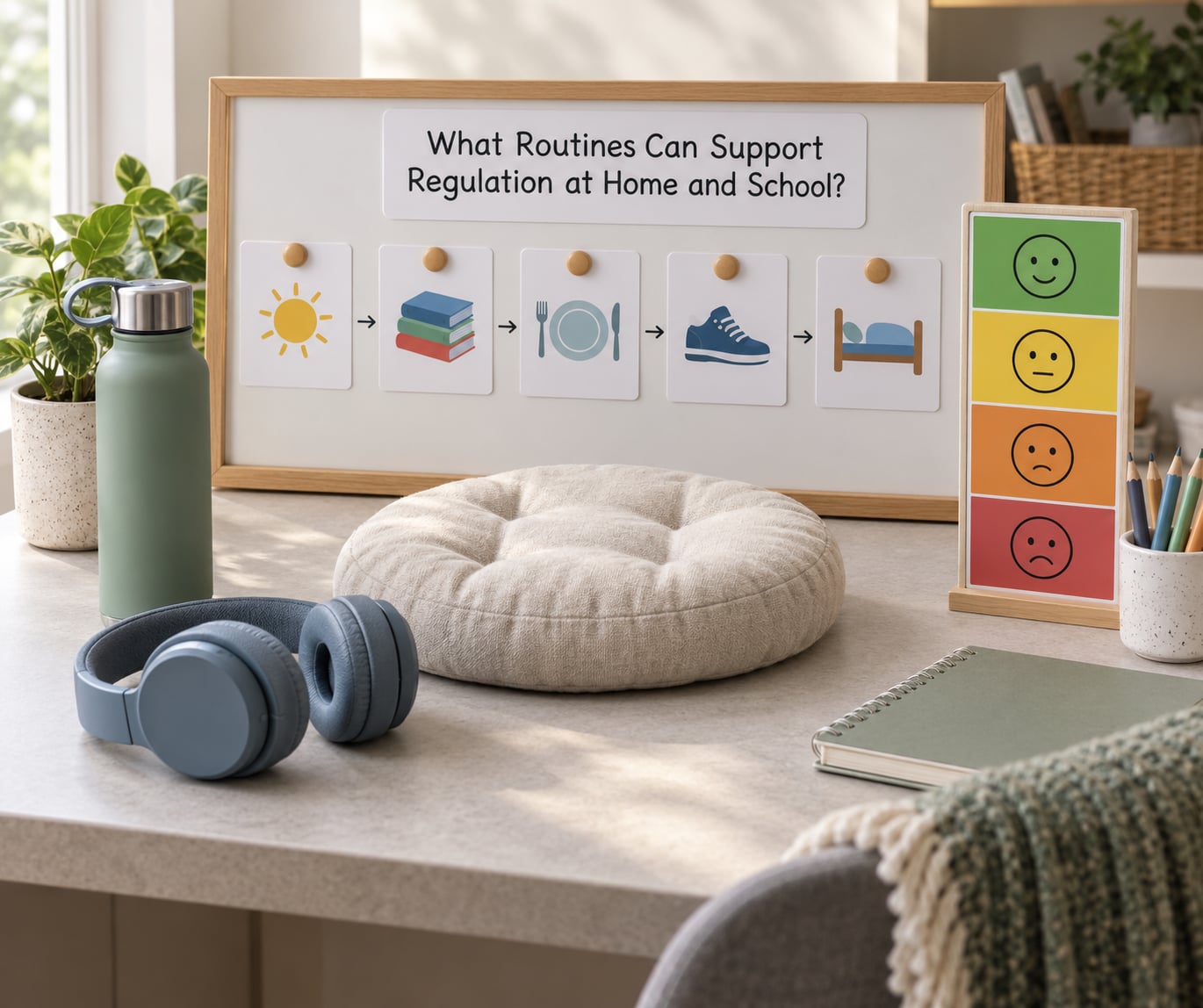
Regulation responds to predictability more than to any single tool. A stable shape of day removes the uncertainty triggers before they start.
Visual schedules that work
Keep it to the next two or three things, not the whole day. Use pictures your child reads without you. When a step changes, change the picture, so a change of plan is visible rather than surprising.
Transition warnings
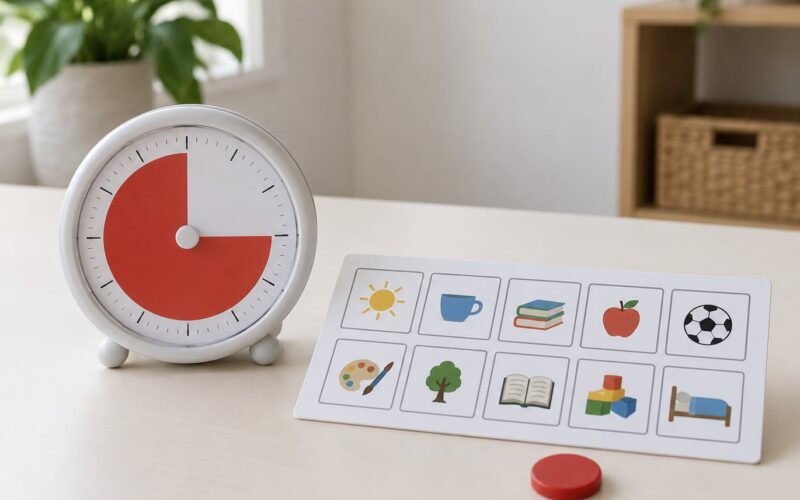
Give a warning before every change, and make it the same signal every time: a five-minute warning, a two-minute warning, then the change. Timers help for children who cannot read a clock but do not always help children who dislike the pressure of one.
A daily movement block
Ten to twenty minutes of heavy work or proprioceptive input, scheduled rather than earned. Pushing the shopping trolley, carrying a laundry basket, climbing, a crash mat, wall pushes. Doing it in Green is the point, so it is available when Yellow shows up.
Check-ins that are not inspections
A short daily moment where the child indicates their state, by colour card, traffic light, hand signal, or pointing. Ten seconds. The point is noticing, not reporting. Make it clear the answer can be “I do not know”, which is often the honest one.
A calm-down corner that is always available
Somewhere low-demand in your home: soft seating, headphones, a weighted blanket or lap pad, water, a chew or fidget item, dimmable light. Do not make it a punishment, or it becomes a place the child is sent rather than a place they can choose.
A decompression slot after school
Assume the first thirty minutes after a school day are not available for anything. No questions about school, no homework talk, no social debrief. Snacks, low demand, silence or background noise.
Talk to the school with specific questions
- How are the zones taught, and is any part of it used as a reward or consequence system?
- Can you tell me when my child changed zones today, and what happened just before?
- What does my child reach for when they are dysregulated at school?
- Who is the adult my child goes to, and how do they respond to a Red Zone episode?
- Is the class using a behaviour chart that tracks zones? If so, can we talk about whether that is helping?
Speaking the school’s own language back to them, gently, tends to work better than arguing about the framework itself. If the answers are unsatisfying, the school SENCO or the family liaison officer is the right escalation.
A sample day, one version
Morning: two-minute check-in at the door, no questions. Movement block before school. After school: snack and quiet, no debrief. Early evening: visual schedule showing dinner, bath, story, bedtime. Bedtime: one predictable sequence, same order every night. Plus one rule I would hold: any food-based routine, such as food chaining for picky eaters, follows the same shape of small steps and predictable ending, because predictability is the part that helps both.
What self-regulation looks like by age
| Age | What to expect | What adults still do |
|---|---|---|
| Under 3 | Notices big feelings in others; states own states physically | All the co-regulation; survives on routine and caregiver calm |
| 3-5 | Starts to name feelings with words; still needs adult support to return to baseline | Naming the zone, offering choices, holding the boundary |
| 6-8 | Can use a simple strategy with a prompt; begins to notice early signs | Practising the toolkit while calm; reminders, not rescue |
| 9-12 | Better at self-monitoring; strategies work more often, especially when practised | Stepping back, letting the repair conversation be theirs |
| Teen | Capable of self-regulation and often allergic to being told what zone they are in | Privacy, respect, and the same words used without pressure |
These are averages, and neurodivergent children often run on their own timeline in either direction. What matters is the direction of travel, not the age on the chart. Persistent difficulty across settings, or a loss of skills a child once had, is a reason to seek professional assessment rather than a reason to try harder with the toolkit.
Does the Zones of Regulation Framework Work for Every Child?
Honest answer: it helps many children, suits some poorly, and the evidence base is thinner than the popularity suggests.
What it does well is provide shared vocabulary. A word or a colour for a state that was previously invisible gives a child and an adult something to work with, and that is genuinely useful. The permission-giving element is real too: telling a child their Blue Zone is legitimate changes how they experience tiredness and sadness.
What it cannot do is teach the underlying skills. Naming a zone is not the same as managing a feeling, and a child who can name every colour can still be unable to get out of Red. Executive function, interoception, sensory processing and language all sit underneath the framework, and the Zones does not address them directly. For a child whose difficulty comes mainly from unmet sensory needs, poor sleep or school anxiety, colour language will not fix the cause.
On the evidence: the framework grew out of occupational therapy practice and is widely used in schools, but it has not been subjected to the kind of controlled trials that parenting programmes such as the evidence-based emotion coaching approaches are. That is a reason to treat it as a helpful language rather than a proven intervention, not a reason to abandon it. If your family wants something with a stronger research base, the Alert Program, Social Thinking programmes, the Interoception Curriculum and Gottman’s work on emotion coaching are the ones worth looking at, and an OT can tell you which fits your child.
Adapt it when it does not fit. Some children engage far better with a traffic-light system, an energy dial with levels, or plain words like “wound up” and “wiped out”. Some children dislike the school flavour of the colours altogether, and forcing a disliked system costs more than it gives. And if your child cannot connect to feelings language at all, the underlying mechanism still works: lower the demand, cut the input, stay nearby, wait, repair later.
Frequently Asked Questions
At what age can a child start learning about the Zones of Regulation?
Children can meet the colours from around three or four, but learning them is not the same as using them. A young child benefits from the routine, the vocabulary and an adult narrating it for them. Independent use of a strategy usually appears later, around six to nine, and much later for some children. Neurodivergent children often sit outside that range in both directions, so watch your own child rather than the age on a chart.
What if my child can name a zone but does not want to leave it?
That is common and often has nothing to do with defiance. Orange and Red can feel physically exciting or painful, and Blue rest is genuinely restful, so a child may be signalling they need more time rather than resisting help. Ask what the zone feels like and what might help, offer two options, and wait. Returning to Green is not a deadline and pushing a regulated-to-stay Blue child back into demand usually causes the next escalation.
Should zones be used as rewards or punishments?
No. Using zones as rewards teaches a child that the honest state is the one that costs them something, and a punishment frame turns regulation into compliance. If your school is running a green-stays-sticking chart or handing out zone-related rewards, that is a common misuse worth raising with the teacher or SENCO. Keep zones descriptive: this is your body, this is what it needs, here are the tools. Any reward system should sit on behaviour you have chosen, not on your child’s internal state.
How do I use the Zones of Regulation with an autistic child who does not identify with feelings?
Drop the feelings vocabulary and keep the body vocabulary. Many autistic children cannot reliably read or name internal states, and interoception, the sense of what is happening inside the body, can be weak or absent. Describe what you can see and what the body needs instead: your voice got louder, your body is going fast, let us make it quieter. Colour cards, an energy dial or hand signals work when words do not. Many autistic families also prefer plain terms like wound up or wiped out over traffic-light colours.
Can the Zones of Regulation replace therapy or behavioural intervention?
No, and be cautious with any source that suggests otherwise. The Zones is a language and a set of strategies, not a treatment. It does not build the executive function, sensory processing or communication skills underneath a child’s dysregulation, and it will not resolve pain, sleep problems or school anxiety. Use it alongside whatever a professional has recommended, and tell them you are using it, because it gives them a shared vocabulary for your notes.
What should I do when a child is overwhelmed and cannot accept verbal support?
Stop talking. In Red Zone, words rarely land, so shift to safety and environment: reduce light and noise, move to a quieter space, keep them in sight without crowding, and offer water or a safe movement option without insisting. Do not ask questions, correct behaviour, demand eye contact or narrate what is happening. Stay close and quiet, wait for the wave to pass, and do the repair conversation the next day when they are back near baseline.
Conclusion: Start With One Shared Regulation Plan
If you take one thing from this guide, make it smaller than a wall chart. Pick a single recurring trigger your child hits most often, usually a transition or a sensory situation. Write down what happens in the five minutes before it, in plain observable detail. Then choose one response you will use every time: lower the demand, cut the input, stay nearby, wait.
Write it down and share it with the adults who look after your child, so home and school use the same words and the same response. Review it after a fortnight and adjust. That single shared plan will do more than a full set of zones you never have to think about, and it is the version of this framework that holds up on a bad Tuesday.
If your child’s difficulties are consistent across settings, are getting worse, or have cost them skills they once had, book a conversation with a paediatrician, an occupational therapist or a child psychologist. You can ask for a co-regulation plan and a sensory assessment in the same appointment.