Calming activities for kids with anxiety are simple, repeatable sensory, movement, breathing and connection exercises that help a child’s nervous system settle so they can think clearly again. Most take under five minutes, need nothing more than supplies already in a kitchen drawer, and work best when practiced while the child is already calm. Nothing here replaces medical or mental health care, and it is general information rather than advice for your child.
Here is the honest version of how this works. Anxious children are not choosing to feel wound up; their stress response floods the body with adrenaline and cortisol, and until that settles, higher thinking is genuinely harder. A calming activity gives the body a signal of safety, usually through slow exhalation, heavy muscle work, or calm company.
I have grouped the twelve ideas below into one practical split: what to do in the moment when things are escalating, and what to practice daily to build capacity over weeks. Families who rush straight to tools during a meltdown usually get frustrated, because a dysregulated child cannot access a skill they have never practiced on a calm day.
Table of Contents
- Calming Activities for Kids With Anxiety at a Glance
- 1. Create a Quiet Calm-Down Corner
- How to Introduce a Calm-Down Space
- 2. Do Slow, Supported Breathing Together
- 3. Use a Weighted Lap Pad or Comfy Pressure
- 4. Play a Sensory-Toy Game
- 5. Add Repetitive Movement With Dance or Marching
- 6. Draw, Doodle, or Color by Sound
- 7. Build a Quiet Puzzle Together
- 8. Listen to a Calming Music Routine
- How to Make Music Calming Instead of Overstimulating
- 9. Use a Calm-Down Jar or Fidget Kit
- 10. Try a Gentle Wall Push or Squish
- 11. Read a Predictable Calming Story
- 12. Practice a Simple Transition Ritual
- Frequently Asked Questions
- How often should I use calming activities for kids with anxiety?
- What helps a child who refuses calming activities?
- Can sensory toys make anxiety worse?
- What calming activity works best for an autistic child?
- How do I know if my child’s anxiety needs professional help?
- When should I seek urgent help for my child’s anxiety?
- How to Start Calming Your Child Today
Calming Activities for Kids With Anxiety at a Glance
| Activity | Best setting | Main calming benefit | Sensory demand | Age fit | Easy adaptation |
|---|---|---|---|---|---|
| Calm-down corner | Home or classroom | Predictability and control | Low | 2 and up | Add a photo of a safe family member |
| Slow supported breathing | Anywhere | Slow exhalation | Low | 3 and up | Pinwheel instead of counting |
| Weighted lap pad | Seated, lap or back | Steady pressure input | Medium | 3 and up | Folded towel across the legs |
| Sensory-toy play | Table or floor | Hands busy, attention grounded | Medium to high | 2 and up | Swap sand for play dough |
| Marching or dancing | Living room or outside | Rhythmic muscle output | High | 2 and up | March seated in a chair |
| Drawing and doodling | Table | Low-pressure expression | Low | 3 and up | Large paper on the floor |
| Quiet puzzle | Table, beside your child | Absorption and success | Low | 3 and up | Two-piece puzzle |
| Music routine | Home or car | Familiar rhythm, lowered arousal | Medium | All ages | Volume down or off |
| Calm-down jar or fidget kit | One labeled basket | Choice and self-direction | Medium | 4 and up | Only two items in the kit |
| Wall push or squish | Hallway or floor | Heavy-work muscle input | Medium | 4 and up | Squeeze a soft ball instead |
| Calming story | Bedtime or car | Familiar narrative, feeling words | Low | 2 and up | Same book for months |
| Transition ritual | Any change of activity | Fewer surprises | Low | All ages | One-song warning instead of five |
1. Create a Quiet Calm-Down Corner
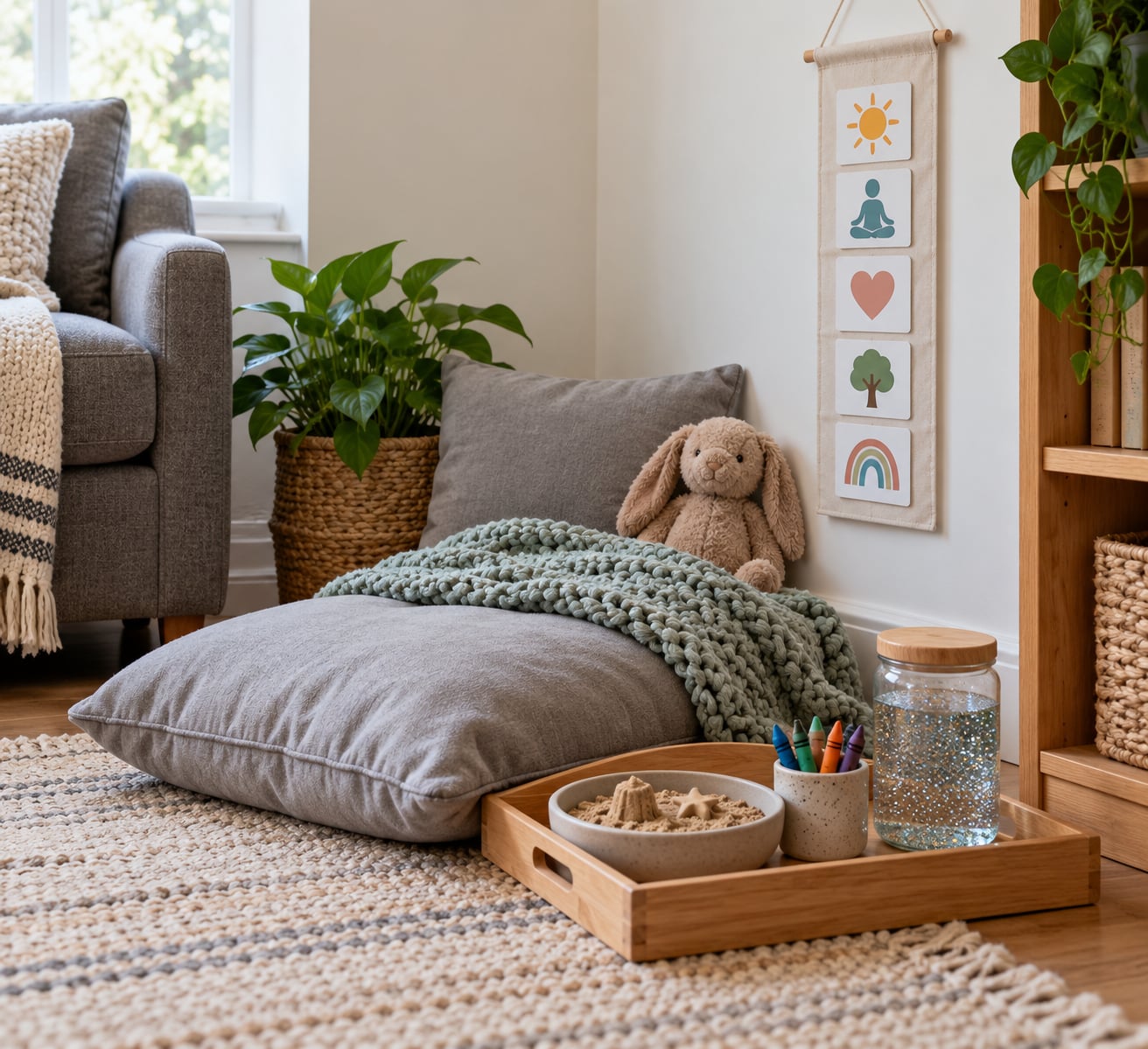
A calm-down corner is a small, predictable, low-stimulation space a child can go to without asking permission. It works because the room itself carries the signal, so the child does not have to explain what they need in the middle of escalating.
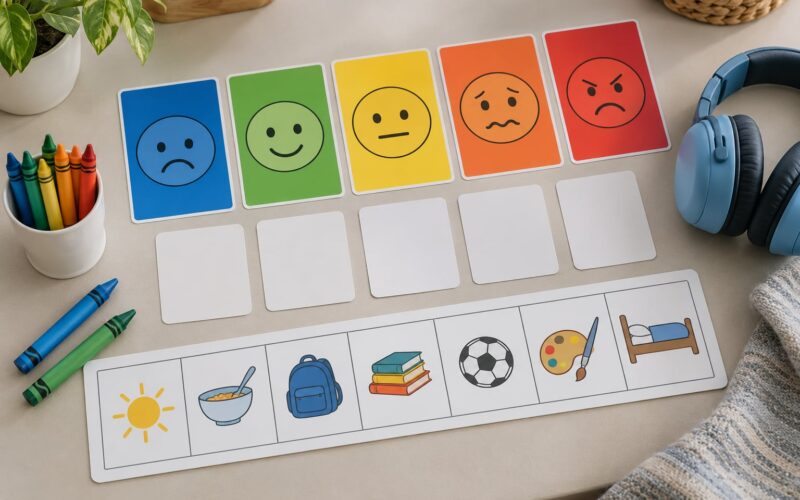
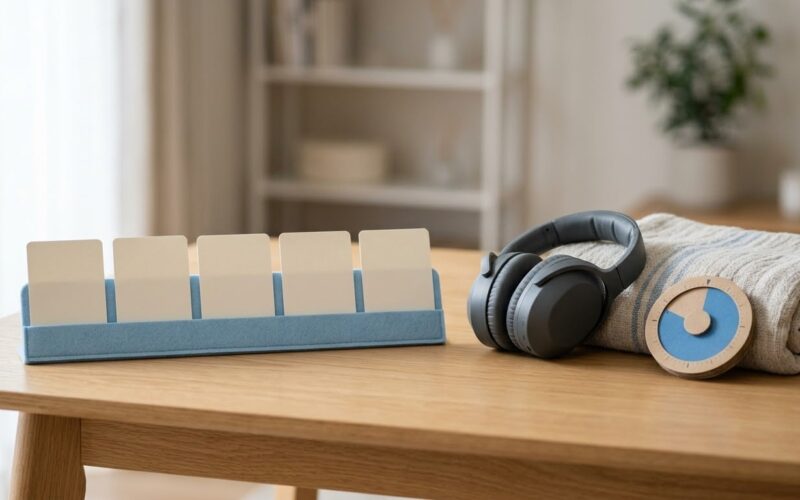
Keep it simple: soft lighting instead of overhead glare, one comfy seat or cushion, two or three sensory tools, and a visual choice card the child can point at. Calm-down corner ideas do not need to be elaborate, because consistency matters more than content. A corner that never changes becomes safe quickly.
How to Introduce a Calm-Down Space
Introduce it on a good day, not a hard one. Let your child pick the spot and help choose what goes in it, then practice sitting there together while they are already relaxed, reading a book or drawing.
Keep it available in a classroom too, if the school will allow it, and agree in writing with the teacher who may use it and when. The one rule to hold: this space is never a punishment and nobody is sent there against their will.
2. Do Slow, Supported Breathing Together
Breathing works best with a person, not as a solo skill, and it works best when it is anchored to something concrete. Blowing bubbles is the classic: inhale through the nose to fill the bubble, then blow slowly and long to pop it. A pinwheel does the same job, and so does the old flower-and-candle script, smell the flower, blow out the candle.
Keep your own breathing visible and calm. If your child resists, mimic them rather than instructing, and if the activity itself increases distress, stop immediately and try again later. Forcing a technique onto a distressed child can add a new thing to be afraid of.
3. Use a Weighted Lap Pad or Comfy Pressure
Some children settle noticeably under steady pressure, delivered through a weighted lap pad, a weighted blanket, or simply a folded heavy towel across the legs during a story. The pressure needs to feel even and gentle, roughly a few pounds on the lap, not enough to be restrictive.
Consent is everything here. Ask before you put it on, check in while it is on, and take it off the second the child says it feels wrong, trapped or itchy. Parents report this one going both ways, which is why the same tool can soothe one child and feel alarming to the next.
4. Play a Sensory-Toy Game
Hands-on sensory play tends to work better than purely conversational approaches for younger kids. Kinetic sand, play dough, water beads, textured fabric squares and a jar of dry rice all give the hands something specific and repetitive to do.
Supervise closely with anything mouthable. Water beads and dry rice are choking hazards, so skip them under age three and for any child who mouths small items, and choose play dough or a textured blanket instead. Sensory activities for anxious kids work best when you join in rather than supervising from a distance.
5. Add Repetitive Movement With Dance or Marching
Physical movement is the most reliably effective category on this list, and parents on parenting forums say it outranks talk-based techniques nearly every time. Marching in place, doing a slow dance, or following a short movement video gives the body a physical way to finish a stress cycle.
Rhythm matters more than intensity. Keep it predictable and repeatable, and swap in seated marching in a chair, arm circles, or gentle stretching for a child with mobility limits or a sensory need for low stimulation.
6. Draw, Doodle, or Color by Sound
The trick is removing the expectation of a finished picture. Put a big sheet of paper on the floor, hand over chunky crayons, and let your child scribble for five minutes without comment on what it looks like.
Color-by-number sheets give structure when free choice feels overwhelming, and drawing while a familiar song plays can carry a child through the hardest part of starting. Colors that feel calming to your child matter more than any coloring book brand.
7. Build a Quiet Puzzle Together
Puzzles absorb attention without demanding conversation, which makes them useful when your child has nothing left for talking. Pick the difficulty to match today’s tolerance rather than their best day: if yesterday’s twenty-piece puzzle worked, try the same one again.
Sit beside them and do not correct or hurry. If frustration climbs, switch to a two-piece puzzle or hand over a calming basket instead. For seated work that has gone sideways, our guide to how to help a child with homework meltdowns covers the same reset.
8. Listen to a Calming Music Routine
A short, familiar playlist works as a transition marker in a way that a random song does not. Fifteen minutes of the same instrumental tracks before homework, or one specific song as the cleanup cue, gives the day a rhythm the child can learn.
Keep the volume comfortable, well below a level where anyone in the room needs to raise their voice, and follow the headphone guidance for your child’s age and device. Headphone volume limits are a real ear-damage risk for young children.
How to Make Music Calming Instead of Overstimulating
Test tracks on yourself first, then on your child when they are already calm. If a song speeds them up, fast rhythms, loud percussion, or lyrics about losing things and being angry are common culprits, so cut those tracks.
Not every child calms with music, and some need silence instead. Keep a no-music alternative ready, such as a quiet walk or looking out a window, so the routine does not become another thing that fails on the same day.
9. Use a Calm-Down Jar or Fidget Kit
A jar of water, glitter and a little dish soap makes a classic glitter jar calm down activity: shake it, watch the glitter settle, breathe out for as long as it takes. Fill a small basket with paper breathing prompts, glue sticks, kinetic sand, textured cards or a squishy ball and keep it in one labeled place.
Offer it without requiring your child to finish anything or explain why they chose it. Sensory tools for anxious kids work through choice, and a kit with ten items usually gets ignored because picking is too hard. Two items is often plenty.
10. Try a Gentle Wall Push or Squish
Heavy work gives a child’s muscles something real to push against, which many find calming after a day of sitting still. Pressing both palms into a wall for ten slow counts, squeezing a soft ball hard then letting go, or doing an animal-style stretch on the floor all fit here.
Use gentle pressure and stop immediately if there is pain, dizziness or distress. If your child is not sure where to start, our list of proprioceptive activities for kids at home has the full progression.
11. Read a Predictable Calming Story
Choose books with repetitive language and simple emotional words, so the child hears feeling vocabulary modeled without having to explain anything. A story about a bear who cannot sleep until everyone is accounted for can do more at bedtime than an adult lecture about worry.
Let your child point at pictures, repeat favorite phrases, or predict what happens next. The goal is a shared, predictable experience, and forcing a discussion of feelings usually ends the moment it starts.
12. Practice a Simple Transition Ritual
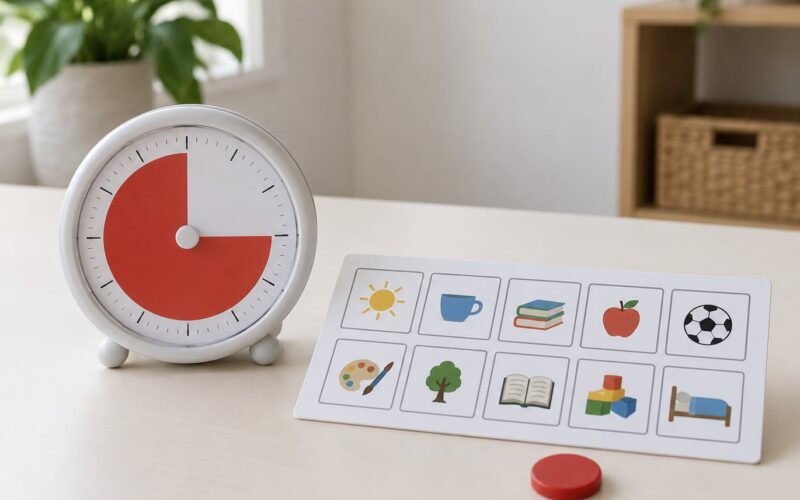
Transitions and drop-offs are the hardest moments, and parents say no activity has been pre-installed for that exact window. A visual schedule on the wall, a five-minute warning, a cleanup song, and a short goodbye sequence can be run in under five minutes total.
Have a version for the days when the routine falls apart, because it will. One song instead of the whole sequence counts as keeping the ritual, not breaking it. For the wider problem, see our guide to how to make transitions between activities easier.
Frequently Asked Questions
How often should I use calming activities for kids with anxiety?
Practice briefly most days, ideally when your child is already calm, rather than saving everything for a hard moment. Most families find that five to ten minutes once or twice a day builds a skill, while a two-minute version is enough during escalation. Repetition over weeks matters far more than how many activities you know.
What helps a child who refuses calming activities?
Stop asking and start offering. A child who refuses is often overwhelmed rather than defiant, and being told to calm down usually lands as dismissal. Sit nearby without talking, use a choice card with two options, or simply do the activity yourself alongside them. Movement and water usually get less resistance than stillness or breathing.
Can sensory toys make anxiety worse?
Yes, and for sensory-avoiding children it often does. Sensory tools help when a child seeks input and become another source of overstimulation when a child avoids it. Watch the child’s face and body: if they withdraw, freeze, cover their ears or escalate, stop the tool and try something quieter like drawing or reading instead.
What calming activity works best for an autistic child?
There is no single winner, but predictable, low-demand, chosen-by-the-child activities tend to work best. Movement, heavy work, music and a consistent quiet corner usually fit, while surprise and unclear rules often do not. Avoid making the activity a reward or a punishment, since that changes what the child believes it is for.
How do I know if my child’s anxiety needs professional help?
Look for duration and impact rather than occasional worry days. Talk to your pediatrician if anxiety lasts more than a few weeks, interferes with school, sleep or eating, causes physical complaints like stomachaches or headaches, or comes with withdrawing from things they used to enjoy. Screening and talk-based therapy have good evidence for children and teens.
When should I seek urgent help for my child’s anxiety?
Get help right away if your child talks about harming themselves or not wanting to be alive, tries to hurt themselves, has panic symptoms with chest pain or trouble breathing, or becomes unrecognizably agitated or withdrawn for a prolonged period. In the United States, call or text 988 for the Suicide and Crisis Lifeline, or take your child to an emergency department. Outside the US, contact your local emergency number.
How to Start Calming Your Child Today
Pick one activity from this list and do it tonight, while your child is calm, with no goal attached to the outcome. Five minutes of bubbles or a lap pad is enough. The single most useful habit in calming activities for kids with anxiety is noticing which one your child actually reaches for, then building a short routine around that choice instead of the one you hoped would work.