Speech therapy activities at home for toddlers are short play sessions you build around things your child already loves: a ball, a bath, a picture book, a sock puppet. You model words, you wait, you respond to whatever comes back. Most of it takes under ten minutes and costs nothing, and you can start this week.
I’m a parent, not a clinician, and I’ve spent enough evenings on the kitchen floor with a toddler who would rather eat crackers than name a spoon. What worked for us was not more drills. It was fewer minutes, more waiting, and letting go of whether the activity looked like therapy.
Nothing here replaces the work of a speech-language pathologist. If your child has lost words, does not respond to their name, or shows signs of a feeding or hearing concern, ask for an evaluation rather than trying a few games first. In the US you can request a free evaluation through your state’s early intervention program or through the public school district.
Table of Contents
- What You Need for Home Speech Practice
- Speech Therapy Activities at Home for Toddlers: Step by Step
- 1. Start With Whatever the Child Is Already Interested In
- 2. Practice Imitation With Everyday Toys
- 3. Turn Naming Into a Game With Pictures and Objects
- 4. Practice Requesting: Simple Speech Therapy Activities at Home
- 5. Build Listening Skills With One-Step Directions
- 6. Read the Same Short Book on Repeat
- 7. Woven Into Bath, Meal, Dressing and Cleanup
- 8. Keep a One-Minute Progress Note
- Quick Reference: What Each Activity Works On
- Common Mistakes to Skip
- Frequently Asked Questions
- How often should I do speech therapy activities at home with my toddler?
- What if my toddler refuses to participate or won’t imitate me?
- Can home activities replace speech therapy with a professional?
- How do I adapt these activities for an autistic or sensory-sensitive toddler?
- When should I contact a speech-language pathologist or my pediatrician?
- My toddler understands far more than they say. Should I be worried?
- A Simple Place to Start
What You Need for Home Speech Practice
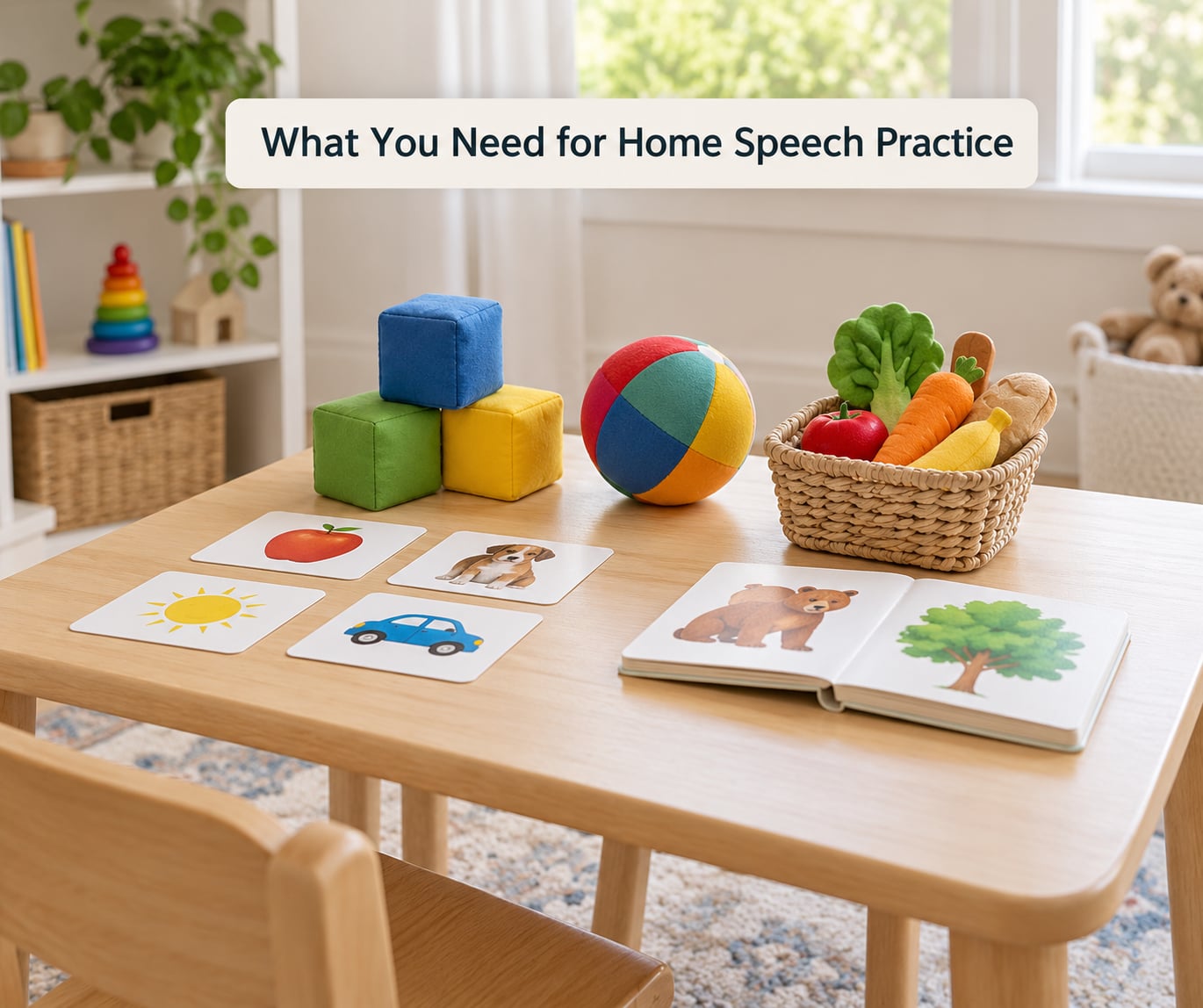
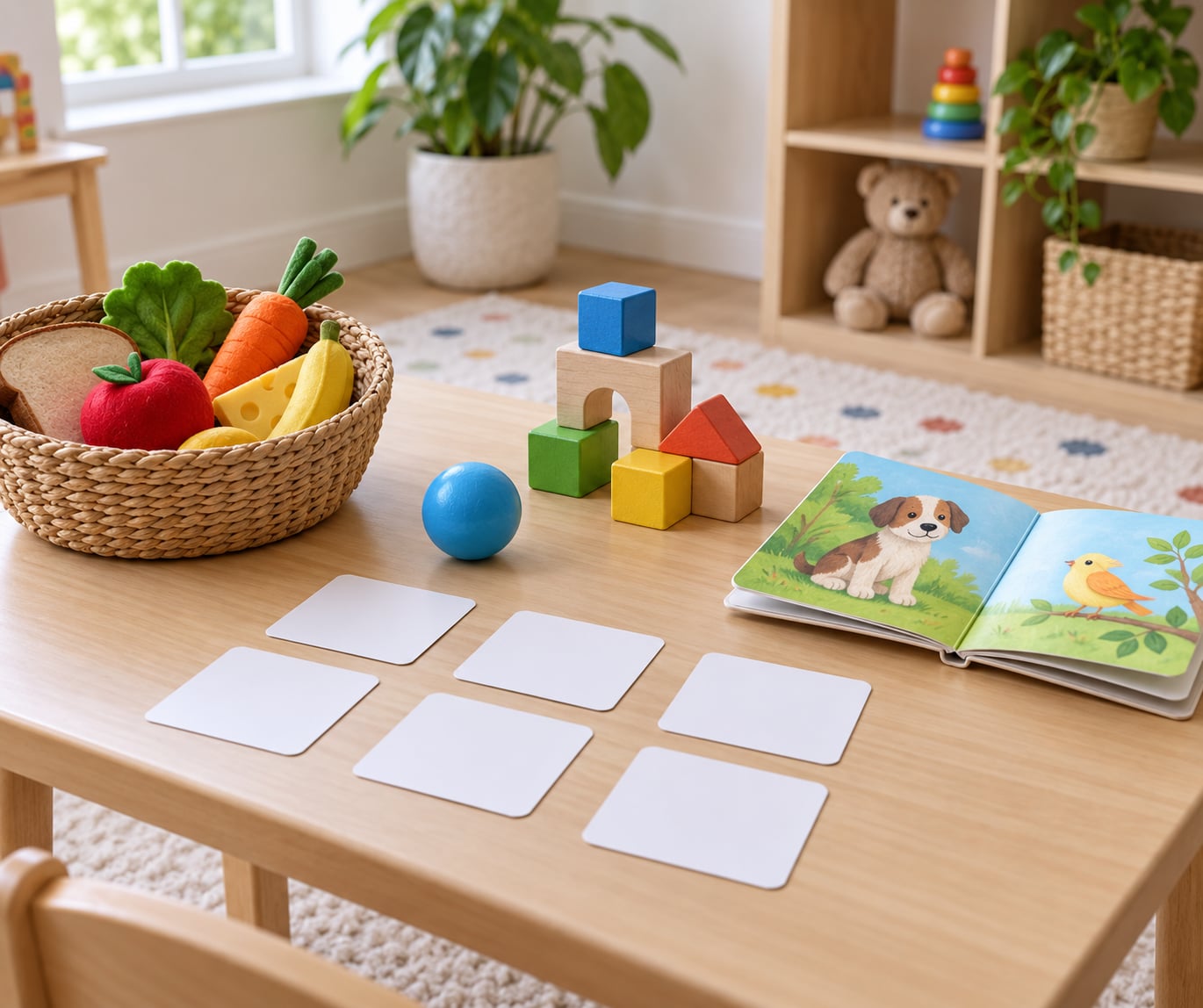
You need the ordinary stuff. A few toys your child already reaches for, two or three objects from a drawer, a book you can read in ninety seconds, and a bit of food if snack time is your practice window.
That is genuinely the whole list. No flashcard deck, no app, no printed curriculum. I know the market pushes kits at parents like us, and some of them are good, but the tools therapists actually lean on are modeling, waiting, and repeating, and none of those need equipment.
A few ground rules make the biggest difference. Keep sessions to five or ten minutes and end while it’s still fun. Follow your toddler’s interest rather than a worksheet. Sit at their eye level so they can see your mouth. And pair every word you say with something they can see or touch.
Small chunks are fine. If your child is nonverbal, pointing, showing, signing and making sounds all count as communication, and your job right now is to respond to those so the channel stays open.
Speech Therapy Activities at Home for Toddlers: Step by Step
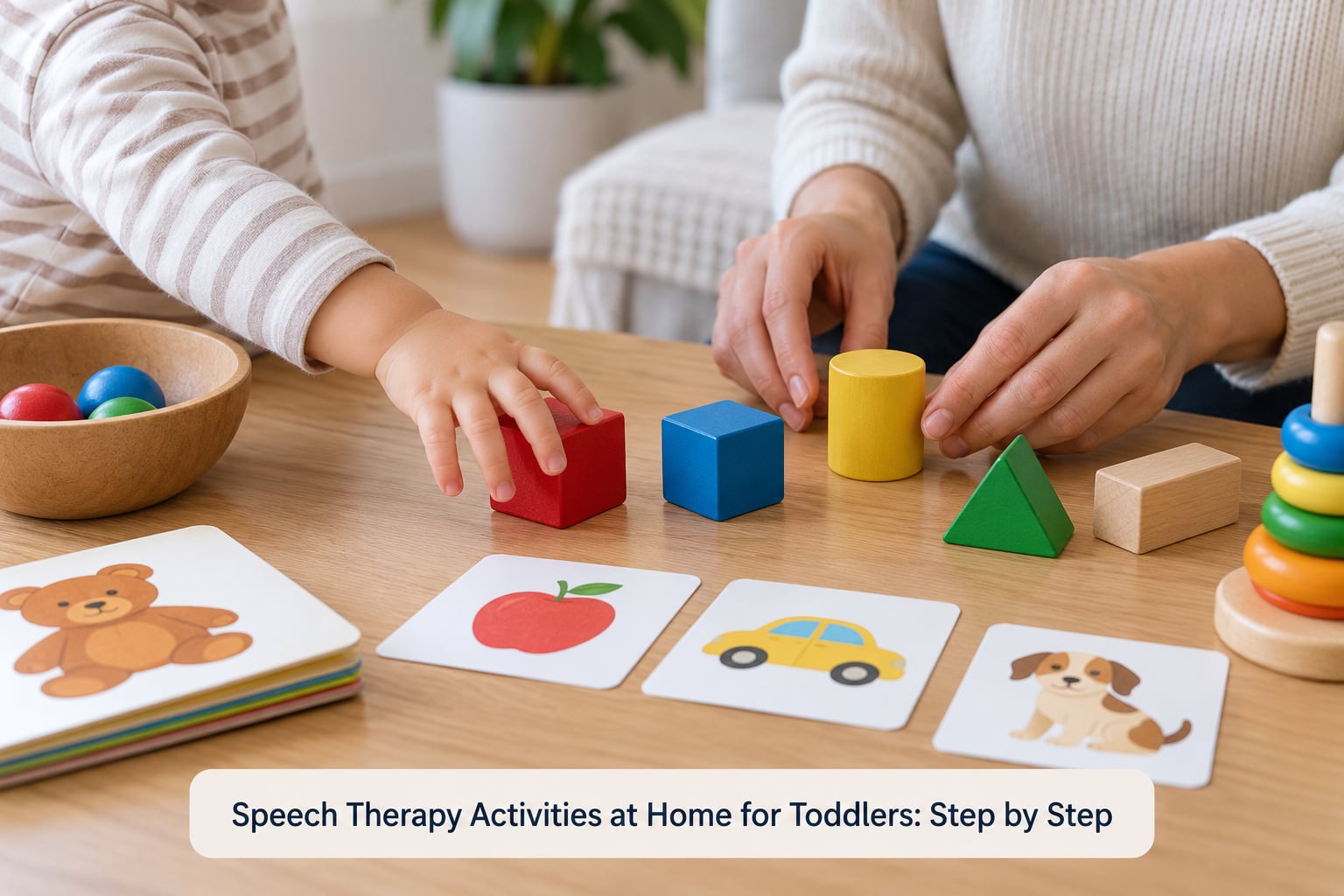
Start by watching what your toddler does for five minutes without talking at them. Notice what they point at, what they carry around, what makes them light up. That is your activity list.
Then run one activity at a time. Stop while your child is still asking for more.
1. Start With Whatever the Child Is Already Interested In
Whatever holds their attention becomes the lesson. If they are obsessed with trucks, sit beside them with a toy truck and narrate: “Red truck. Wheels go round. Your truck is fast.” Say a few words, then stop and wait five seconds.
Waiting feels awkward the first few times. Your child will fill the silence with a sound, a gesture, a word, or nothing at all. When they do something, respond immediately: repeat what they said if they said anything, or hand them what they pointed at.
Two techniques do most of the work here. Self-talk is narrating your own actions out loud, which teaches your toddler that language goes with doing. Parallel talk is describing what your child is doing right now, in words they don’t yet have: “You put the red block on top.” You would say “block” and “top”; they get the sentence a step ahead of them.
2. Practice Imitation With Everyday Toys
Pick an action with a visible result. You roll a ball across the table, then hand it over. You push a toy car down the ramp and stop. You make a bird sound with a sock on your hand.
Do it once clearly, then wait. Toddlers imitate sound and movement long before they imitate words, so a stretched “mmmmmm” or a clap pattern is a real win here, not a lesser one.
If your child does not copy you, lower the demand. Hand them the toy while saying the word, let them do the action without copying you at all, and simply enjoy the toy together. No correction, no “your turn.” Parents who push imitation too early often meet resistance, and the fun drains out fast.
3. Turn Naming Into a Game With Pictures and Objects
Two or three items on the floor, or two or three pictures from a photo album on your phone, is plenty. Name them yourself, then point and wait: “This is a cup. And this is a shoe. What is this?”
The trick is to keep it light. Real toddlers do not sit still for twenty questions in a row; by question three most of them are looking under the couch. Mix naming with something else: feed the doll, stack the blocks, throw the toys, and let the words ride along.
Add one step when it is going well: name the item, then add a describing word or a category. “Ball, big ball.” “Ball, your ball.” Categories come later, usually around three years old, and naming the group out loud, “those are all the shoes,” introduces the idea without quizzing.
4. Practice Requesting: Simple Speech Therapy Activities at Home
Requests are where expressive language actually starts, so set them up on purpose. Put the snack where they cannot reach it. Hold the open door. Give them a closed container they cannot open by themselves.
Model the request once, clearly: “Say more.” Or point to your own mouth. Or use the sign they already use. Then wait, and hand over the moment they signal, whether by word, sound, sign, reach or eye contact.
Reinforcing the attempt instantly is what builds the habit of trying. If your child uses a gesture instead of a word, accept it, and keep offering the word yourself so they hear what is available. If they make up their own sound for something, treat it as communication and pair it with yours: they say “bwa,” you say “want water,” and hand it over.
5. Build Listening Skills With One-Step Directions
Receptive language, what your child understands, grows before expressive language, what they say. It is easy to notice that a toddler understands far more than they speak and easy to forget to work on it.
Weave single-step directions into things already happening. Hand them a sock and say “give me the sock.” Walk to the door and say “find your shoes.” Say “put the ball in the basket” while they are already heading that way.
Keep it to one step and make the words concrete and visible. Move to two steps, “pick up the ball and put it in the basket,” only after one-step directions are landing most of the time. Most toddler practice fails because the directions are still too long, not because the child cannot listen.
6. Read the Same Short Book on Repeat
Choose a board book with three or four pages, predictable wording, and something to point at or make noise about. Read it enough times that your child can finish the lines.
Pause instead of reading straight through. Leave out a word and let them fill it in. Stop on a picture and ask “what is that?” or “what is happening?” Let your toddler turn the pages, even backwards, and describe what they point at rather than asking them to answer you.
Connect the story to a real object afterward, every time. Read about a bear, then hug a bear, then say “bear” while they hold it. That link between the printed word and the thing in their hands is where vocabulary sticks. As your child starts filling in your pauses, switch roles and let them be the one telling the story to you.
7. Woven Into Bath, Meal, Dressing and Cleanup
Some of the best practice happens when nobody calls it practice. These routines already happen every day, and your child is already paying attention.
- Bath: name the body part as you wash it, describe what you are about to do before you do it, and let them push the water.
- Meals: describe the food, let them choose between two things, and have them hand you each item. Add one question per meal, not ten.
- Dressing: narrate the sequence and leave the next step to them, “now the other shoe,” and let them pull it on.
- Cleanup: give one-step directions as you go, and sing the same short song every time so the routine has a predictable shape.
Routines also solve the time problem. A parent with ten free minutes does not need a session, they need a bath where they talk instead of looking at a phone. Transitions are where most home practice falls apart, and predictable wording helps there too. Our guide to making transitions between activities easier covers the same idea in more depth.
8. Keep a One-Minute Progress Note
Progress at home is invisible unless you write it down. Keep a note on your phone: the activity, what your child did, any new sound or word, and one thing to try next week.
Write observations, not judgments. “Said ‘more’ with a gesture” is an observation. “Refused to speak” is a label, and it will not tell you anything useful at the next appointment. When you do see a speech-language pathologist, a few months of these notes is far more valuable than a memory, because recall is generous and specific.
Notes are also how you catch a pattern. If pointing to pictures always produces a sound but reading never does, that tells you something real about what to practice next.
Quick Reference: What Each Activity Works On
| Activity | Skill targeted | Materials | Time |
|---|---|---|---|
| Follow the interest | Expressive language, attention | Any favorite toy | 3-5 min |
| Imitation | Sound imitation, motor planning | Ball, car, puppet | 3-5 min |
| Naming pictures | Vocabulary, categories | 2-3 objects or photos | 3-5 min |
| Requesting | Expressive language, cause and effect | Snack, closed container | Built into play |
| One-step directions | Receptive language | None, uses real objects | Built into routines |
| Repeated book reading | Listening, vocabulary, memory | Short board book | 4-5 min |
| Routine talk | Everyday vocabulary, sequencing | None | Throughout the day |
| Progress note | Tracking, next-step planning | Phone notes app | 1 min |
For children who find movement or heavy input regulating, adding a sensory warm-up before language work often makes the talking part easier. Our list of proprioceptive activities for kids at home has simple ones you can do in the same room.
Common Mistakes to Skip
Most home practice falls apart for one of a handful of reasons, and all of them are fixable this week.
Correcting pronunciation constantly. Repeating a toddler’s word back correctly feels helpful and teaches nothing. Say the word correctly once, use it yourself, and move on. Your toddler is learning from what they hear in a real conversation, not from a correction after every attempt.
Practicing too long. Twenty minutes of drilling ends with a child who hides the toys. Five minutes twice a day, kept enjoyable, does more for a toddler than a rare half hour that ends in tears. If you are counting on minutes, most of the best work happens in routines anyway.
Asking too many questions. Five questions in a row with no pause is an interrogation, not play. Ask one, wait, and if nothing comes back, answer it yourself and move the activity along.
Choosing the activity over the child. You know your toddler loves trains and you brought out picture flashcards instead. Interest is the engine, so lead with what they already want and fold the language into it. The same vocabulary goal works in both.
Turning practice into a demand. If every attempt is met with “again” or “say it properly,” the whole activity becomes a test. Accept gestures, sounds and single consonants, respond to them warmly, and let words come in their own time. Movement games help here too, and if you are choosing between a dedicated app and a physical device, our comparison of a speech device versus an app is worth a read.
Aiming at a milestone instead of at connection. Language growth is uneven. A child who says nothing today may produce three words on Saturday, and a quiet week is normal. Judge progress by months, not days, and take your specific questions to the professionals coordinating your child’s care.
Frequently Asked Questions
How often should I do speech therapy activities at home with my toddler?
Most toddlers benefit from short, daily practice rather than occasional long sessions. Five to ten minutes once or twice a day, plus talking through everyday routines, is realistic and easy to sustain. Consistency matters more than length, because your toddler is learning that communication gets a response. Skip days when your child is ill or overwhelmed and pick the routine back up the next day.
What if my toddler refuses to participate or won’t imitate me?
Stop the activity and change it, do not push through it. Hand over the toy while you say the word, and let your child use it without copying you. Return to favorite toys, sounds and movement rather than words, since toddlers imitate actions long before they imitate speech. Refusal usually means the demand is too high or the activity is not interesting yet, not that something is wrong.
Can home activities replace speech therapy with a professional?
No. Home practice reinforces and generalizes what a speech-language pathologist teaches, and it works best alongside sessions. Parents can absolutely support skills between appointments, but assessment, diagnosis and treatment planning need a qualified clinician. If sessions are limited by insurance, tell your therapist what you can realistically do daily so the home plan fits your actual time.
How do I adapt these activities for an autistic or sensory-sensitive toddler?
Predictability helps more than novelty. Use the same toy, the same three songs and the same short sequence each time, and stop before your child signals overload. Movement or heavy input activities often make talking easier for these children, so a sensory warm-up first can help. A speech-language pathologist with autism experience can set specific goals, and many do home visits or telehealth sessions.
When should I contact a speech-language pathologist or my pediatrician?
Ask sooner rather than later if your toddler does not respond to their name, has lost words they once used, does not point or gesture to share interest, or shows no words by about 16 months and no phrases by about 24 months. Also raise concerns about hearing, feeding or drooling. Early intervention services are most effective early, and in the US evaluations through early intervention and the public school system are free.
My toddler understands far more than they say. Should I be worried?
That gap is very common in toddlers, especially in boys, and strong receptive language with a smaller spoken vocabulary is usually a stage rather than a concern. Keep modeling and wait patiently for responses rather than demanding repetition. It is worth mentioning the gap to your pediatrician if there is no growth over a couple of months, since they can check hearing and refer you on.
A Simple Place to Start
Pick one thing your toddler already loves today. Sit with it, say two or three words about it, then stop and wait for whatever comes back.
Respond to whatever that is. Write one line about it before bed. That is the whole method behind good speech therapy activities at home for toddlers, and it takes less time than most parents expect.
Keep it enjoyable, keep it short, and bring in a qualified speech-language pathologist whenever you have a question or a worry. Home practice gives them a real record of how your child communicates day to day, and they can tell you what to work on next.