To teach a toddler to talk, you talk with them, not at them: narrate the ordinary moments of the day, repeat a handful of useful words until they stick, wait a few seconds for an answer, and make sure your toddler has a real reason to communicate. Most first words arrive through play and routine rather than practice, and progress is judged in months of back-and-forth exchange, not in drills.
That matters because the gap between toddlers is enormous. One child says mama at 8 months, another at 18, and both can land in the same place. If yours is quiet while a sibling or a friend’s child is chatty, that comparison tells you almost nothing useful about your own child.
This guide is written for caregivers of children from roughly 12 months to 3 years, including late talkers, bilingual households, and children with sensory, autism or other developmental differences. It covers what to do daily, what to stop doing, what the milestones generally look like, and when a pediatrician or speech-language pathologist should get involved. It is general information, not medical advice, and no technique here replaces an in-person evaluation.
Table of Contents
- What You Need
- Step-by-Step: How to Teach a Toddler to Talk
- Step 1: Join in With Your Toddler’s Attention
- Step 2: Use Short, Clear Sentences
- Step 3: Add Choice and Waiting Time
- Step 4: Build Language Into Everyday Routines
- Step 5: Play With Open-Ended Toys
- Step 6: Read Together Every Day
- Step 7: Repeat, Pause, and Respond
- Step 8: Keep Communication Positive and Pressure-Free
- Milestones and When to Get Help
- Common Mistakes
- Frequently Asked Questions
- How do I teach my toddler to talk when pointing is their main way to communicate?
- When should I be concerned if my toddler is not talking?
- How can I encourage talking without making my toddler feel pressured?
- Do speech-learning apps really help toddlers talk?
- How do I teach language skills to a toddler with autism or another developmental difference?
- How can bilingual toddlers learn to talk?
- Start With One Simple Conversation Today
What You Need
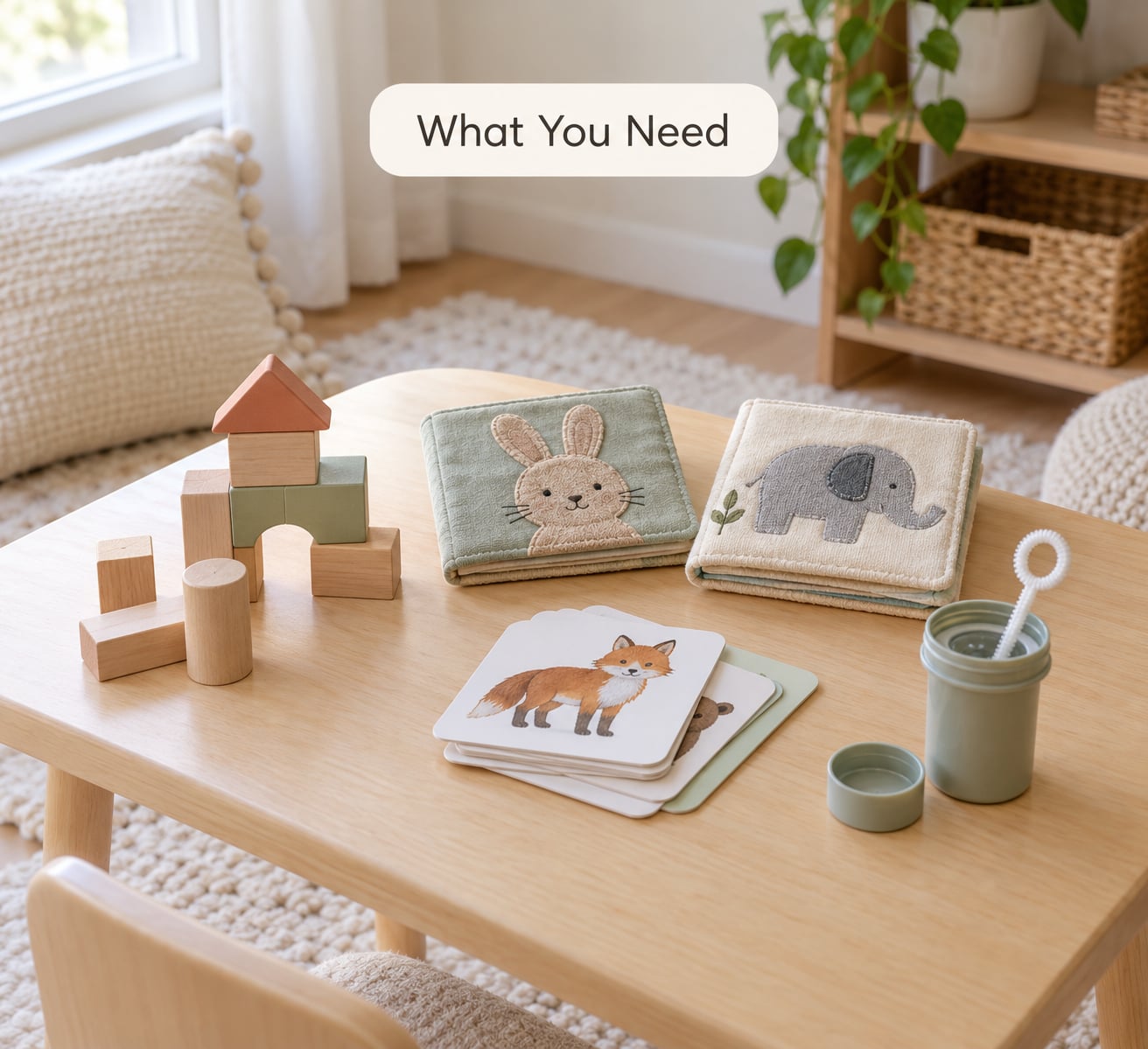
You do not need a curriculum, a flashcard app or a new set of toys. The whole method runs on a responsive adult, about fifteen minutes of unhurried attention a day, and repetition over weeks.
What helps most:
- A responsive adult. Someone who notices what your toddler is looking at or doing and comments on it within a second or two. Responsiveness matters more than how much you talk in total.
- A few open-ended toys. Blocks, a doll, a ball, a truck, pots and spoons, play dough. Toys that can be used in many ways, in ways nobody designed, create more chances to name, describe and take turns.
- Books and pictures. Wordless board books are ideal because there is nothing to read and everything to point at. A few animal or vehicle cards work just as well.
- Repetition. The same few phrases, used in the same routine, day after day. This is the part parents skip, and it is the part that works.
- A calm setting. Background television, a busy room and a phone in your hand all reduce the back-and-forth turns a toddler needs in order to learn.
- Time. A fifteen-minute daily routine, done consistently, beats a long session once a week.
If your child has hearing loss, ongoing medical conditions or a diagnosed developmental difference, add one item to that list: a note of what their own team has recommended, so your home practice supports their goals rather than competing with them.
Step-by-Step: How to Teach a Toddler to Talk
The eight steps below build on each other. Steps one through three create the exchange, steps four through six give you places to use it, and steps seven and eight are what keep it going across months.
Step 1: Join in With Your Toddler’s Attention
Notice where your toddler’s eyes and hands are already going, get down to their eye level, and attach a short phrase to exactly what is happening. Not what you want to talk about, what they are already attending to.
If they are pushing a red block across the floor, you say, “Red block. You push it fast.” If they are holding a shoe, you say, “Shoe. That’s your shoe.” This is called following the child’s lead, and it is the single behavior clinicians look for first. A toddler who is spoken to about their own focus of attention picks up far more vocabulary than a toddler who is lectured about a room.
How to tell it worked: your toddler looks back at you, hands you the block, or does the action again to hear the phrase a second time. Any of those is a real conversational turn.
Step 2: Use Short, Clear Sentences
Drop the baby talk that adds filler, but keep the melody. Infant-directed speech, often called parentese, is not silly talk. Its rising pitch, elongated vowels and clear stress are what make language easy for small ears to catch.
So you say “Ball! Big ball, round ball. Where is the ball?” and let the same two or three words carry the meaning. The goal is not more words per sentence. A toddler working on first words needs “more milk” repeated fifty times this week, not a two-minute description of dairy products.
Notice which words carry the most meaning in your house right now. For most families that is food, diapers, shoes, water, up, down, open, more, all done, help, and the family’s names. Repeat those same few words in the same real situations instead of a rotating vocabulary that never comes back.
How to tell it worked: you catch yourself saying the same three phrases on the same day, and your toddler looks up when you use one of them.
Step 3: Add Choice and Waiting Time
This is the technique parents find hardest and it is worth practicing on its own. Offer two manageable choices, then stop talking and wait about five seconds. Count them in your head if you need to. Five seconds feels much longer from the adult side than it does.
Two real examples:
- “Do you want the red cup or the blue cup?” Then wait. If your toddler reaches, grab, looks or makes any sound, treat that as the answer and name it: “Red cup. You chose red.”
- Put a favorite toy just out of reach rather than handing it over. A toddler who has to signal for something has a reason to communicate. The reaching, pointing, sign or sound all count as communication, not as failure.
Five seconds is a target, not a test. If nothing comes, say the phrase yourself and move on warmly. “All done, shoes on,” said cheerfully, is a good model; a second, longer pause usually is not.
How to tell it worked: the wait starts producing gestures, sounds or words that did not appear when you filled the silence.
Step 4: Build Language Into Everyday Routines
Routines are where most language is actually learned, because they happen every day and your toddler already knows what comes next. Narrating them, rather than staying silent in the middle of them, is free practice that does not add a single minute to the day.
Pick two routines and write down the few phrases that belong to each.
Mealtime: all done, more, no more, wash, open, yummy, hungry, help, spoon, cup.
Dressing and bath: up, down, arm, leg, sock, shoe, wash, all clean, tummy, sit, stand.
Cleanup and going outside: put away, in, out, turn off, look, more swing, car, go.
Say the phrase as the action happens, not before or after. Open the fridge and say open, hand over the sock and say sock, both hands up and say up. The word is a label for something real, which is the only kind of labelling that sticks at this age.
Some families use focused stimulation, a few minutes a day of repeating specific words during one routine, such as diaper changes or toothbrushing. It works, and it is easy to overdo. Five focused minutes is plenty; the rest of the day should stay ordinary.
How to tell it worked: your toddler starts using a routine word first in that routine, then a few weeks later somewhere unexpected, like saying sock while getting dressed but also at the sight of any sock.
Step 5: Play With Open-Ended Toys
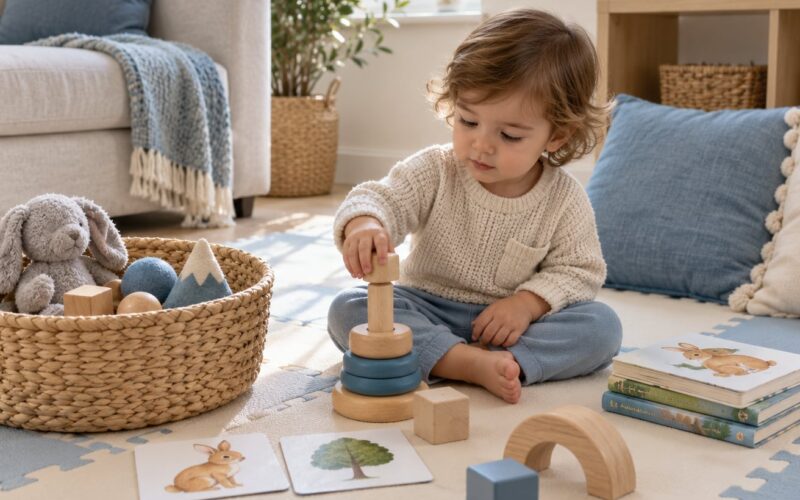
Open-ended toys give language a job. A ball needs words to ask for it and share it. A doll needs a feeding word, a sleeping word, a body part. A set of blocks needs up, down, tower, fall, and mine.
Play alongside before you play with. Sit near your toddler, copy what they are doing, and add a word to it rather than redirecting. When they stack two blocks, you say, “Two blocks. Tower!” When they put a doll in a box, you say, “Doll in the box. Hide!” They will show you the same trick next time because the word came with their idea, not yours.
Functional play, meaning using objects the way they are meant to be used, is a better sign of talking readiness than how many toys a child owns. A toddler who bangs a spoon on a pot, stirs with a wooden spoon, and brushes a doll’s hair is doing the kind of play that comes before words. A toddler who mouths everything and never uses anything correctly is telling you something different.
Once your toddler has a few words, add a small pretend script: feed the baby, wash the baby, put the baby to bed. Pretend play and two-word phrases grow together, because the sequence in the play gives your toddler the order for the phrase.
How to tell it worked: your toddler starts directing the play, handing you the spoon and saying more, or puts the doll to bed and says sleep.
Step 6: Read Together Every Day
Reading works best when it is interactive rather than performed. Sit so your toddler can see the pages. Point to the picture and name what is there, then stop and let them look.
Wordless books are the easiest place to start because there is no text to race through. When they point at a dog, you say, “Dog. Big dog.” When they turn the page, you wait. A three-minute book read twenty times teaches more than a chapter book read once.
Rhyming and repetitive books are the closest thing to a shortcut we have, because the language arrives before your toddler can produce it and they can join in on the predictable line. Songs work the same way. Repetitive lyrics such as head, shoulders, knees and toes, or the wheels on the bus, let a toddler produce language before they can produce conversation.
You do not need to read to a toddler to build language. You do not need to finish the book. Finishing the book is a polite adult habit, not a language milestone, and a toddler who closes the book has communicated something perfectly clear.
For children who are working on comprehension and answer-giving rather than first words, the step-by-step method in how to teach a child to answer wh questions builds on the same pause-and-wait habit.
How to tell it worked: your toddler brings you a book, points at a page expecting a sound, or fills in the end of a rhyme before you get there.
Step 7: Repeat, Pause, and Respond
Repetition plus waiting plus response is the engine of how to teach a toddler to talk. Repetition alone becomes background noise. Responsiveness alone cannot expand a vocabulary that never gets revisited. The three together produce vocabulary expansion, which is simply the habit of taking your toddler’s short attempt and returning a slightly longer version of it.
The scripts, in the moment:
- They say “car.” You say “Red car, fast car. That’s a fire truck!” then wait. Sometimes they will take the longer phrase next time. They usually will not, and that is fine.
- They say “juice.” You say “Juice. You want more juice.”
- They say “dog.” You say “Dog. The dog is running. Big dog.”
- They reach for the fridge and make a sound. You say “Milk. You want milk.”
Expand by one to two words, not by twenty. A toddler working toward two-word phrases needs more milk to feel reachable. A four-sentence reply about milk is beyond the shelf.
Then pause again. The silence is where the new word has to come from. Parents frequently answer their own pause, which is the most common way this method gets quietly undone.
Keep a short list. Write down the phrases your toddler produced this week, because a memory of a toddler’s vocabulary is unreliable and the list turns invisible progress into something you can see. If the list says ten words last month and sixteen this month, you are working, even when the everyday feeling is that nothing is changing.
How to tell it worked: the same word shows up in a new context, or a one-word attempt becomes a two-word attempt without anyone asking for it.
Step 8: Keep Communication Positive and Pressure-Free
Praise the effort and the attempt, not the accuracy. If your toddler tries to say dog and it comes out as do, do not correct it. Say, “Yes, dog!” and move on. Correcting pronunciation tells a toddler that talking with you is a place where they get graded.
Follow the child’s lead, keep sessions short, and stop while it is still going well. Five good minutes of back-and-forth beats twenty minutes of repetition, because the value is in the turns, not the minutes.
Some children need a bridge instead of more words. Simple signs such as more, all done, help, stop and eat are not a detour around speech. They give a child a way to communicate now, and the pressure to use a sign often keeps them in the interaction where words keep coming. In bilingual homes, teaching signs in one language while speaking both is also a reasonable way to reduce pressure on a child who is not yet talking.
For children with developmental differences, the same principles apply with more predictability and more waiting. Visual supports, a consistent order to the routine, and extra processing time matter more than the specific words you choose. If your child is working on early academic skills alongside communication, teaching reading to a child with Down syndrome covers how those two goals interact.
How to tell it worked: your toddler comes to you more often to show you things, which is the behavior that predicts words. Children who want to tell you something usually start talking soon after.
Milestones and When to Get Help
These are general ranges drawn from pediatric and NHS-style milestone guidance, and they are averages rather than deadlines. Use the table to see roughly where your toddler sits, then talk to your own pediatrician about your child.
| Age | Words used | What it sounds like | What to try |
|---|---|---|---|
| 12 months | A few single words, often a couple of sounds or a family name | Mama, dada, no, or one clear word used often | Narrate everything, follow their pointing, wave and clap and wait for the copy |
| 18 months | Roughly 10 to 30 words | Mostly single words, some two-word attempts, a lot of pointing and pulling your hand | Expand their words, use choices, add routine phrases to two or three daily routines |
| 24 months | Roughly 50 or more words | Clear two-word phrases such as more milk or go outside, mixed with single words | Predictable pretend play scripts, songs with repetitive lyrics, word expansion in short turns |
| 30 to 36 months | 100 words and growing, with more variety | Short sentences, questions like what’s that, pronouns starting to appear | Back-and-forth conversation, books with simple story lines, answering who, what and where |
Receptive language, which is understanding, usually runs ahead of expressive language, which is speaking. A two-year-old who follows “give me the ball” and brings you a book from another room may have a perfectly typical gap and a specific word-producing difficulty. It is also the pattern many parents read as “my child is ignoring me.” Understanding ahead of speaking is common, and it is one reason waiting a few weeks after a quiet spell is reasonable.
Two terms get confused constantly. A late talker means a child who is behind on word count but whose understanding, gestures, social interest, play and hearing are all tracking normally, and who tends to catch up. A language delay is a broader description used when development is behind across more than one area, or when the pattern is not resolving as expected. Only an evaluation can sort those out, which is why the list below matters more than any number in the table.
Talk to your pediatrician if:
- Your child does not point, show you things, or bring objects to you to get a response by around 18 months.
- Your child does not copy gestures such as waving, clapping or raising arms when you model them.
- There are no clear words by around 18 months, or very few words and no two-word phrases by 24 months.
- Your child used words and then stopped using them.
- Your child understands very little of what you say, even familiar routines.
- Your child has had repeated ear infections, fluid behind the eardrum, or has never had a hearing screening.
- You are worried. Caregivers notice patterns that checklists miss, and worry alone is a sufficient reason to ask.
Ask for a hearing screening and a referral to a speech-language pathologist. A speech-language pathologist, often written as SLP, can check hearing, assess how your child understands and produces language, and tell you whether the gap is age-appropriate or needs support. Ask what the wait time is, and ask whether a developmental pediatrics appointment makes sense alongside therapy.
While you wait, keep doing the eight steps. Fifteen minutes of responsive, turn-taking play every day is genuinely useful work, not a consolation prize, and it gives a therapist a clear picture of your child when the appointment finally comes.
One more point about screens, because it comes up constantly. Videos and apps do not teach a toddler to talk on their own. Language needs a live partner who looks at the child, follows their lead, waits, and responds to what they do rather than to what is happening on the glass. A toddler who can match shapes and colors in a game often has strong receptive language and simply is not yet producing, which is exactly the split described above. Video works as a warm-up or a shared joke between two people; it is not a substitute for the exchange. If video modeling is part of your plan, using video modeling to teach life skills explains how to pair it with real practice.
Common Mistakes
Most stalled progress is not caused by a lack of effort by the parent. It is caused by one of these habits, and every one of them is easy to change.
Quizzing instead of talking. Repeating “say mama,” “say ball,” “where’s the ball?” until a toddler goes quiet or turns away is the most common mistake on parent forums, and it works backwards. Quizzing is a test, and toddlers opt out of tests. Replace it with narration and wait time: you say “mama” while pointing at yourself, then pause. The child answers when answers feel useful.
Demanding perfect repetition. Asking for a word back after saying it yourself adds nothing. Your toddler is already listening; hearing their own word echoed at you is not a language lesson. Comment on what they said and keep going.
Talking over the child. Filling every silence yourself removes the only reason your toddler has to speak. Five seconds of genuine silence feels awkward and works.
Comparing progress with siblings, cousins or other parents. Comparing milestones across children is one of the most reliable ways to make a parent feel like a failure when nothing is wrong. Milestone charts describe averages across many children, and the spread around those averages is wide.
Practicing for too long. Fifteen focused minutes beats forty-five stretched minutes. Attention runs out, and once it does, every word you say lands on nobody.
Reading the silence as refusal. When a toddler does not answer, the useful first assumption is that they cannot yet, not that they will not. Some children answer with a gesture, a sound, a sign or a change of activity, and all of those are communication.
Letting videos do the teaching. An hour of toddler videos is an hour with no partner responding. Turn the television off during play, meals and reading, and put your phone down where your toddler cannot reach it.
Fixing on word count instead of interaction. A child who has forty words and brings them to you constantly is in better shape for language than a child who has a hundred words and uses them alone. Track turns and gestures alongside words, and the worry tends to shrink.
Frequently Asked Questions
How do I teach my toddler to talk when pointing is their main way to communicate?
Pointing is a real step before words, so treat it as communication rather than a lack of it. Get down to your toddler’s level, name what they point at, then add one word of detail: ball, big red ball. Then wait. Many toddlers move from pointing to gestures to single words to two-word phrases in that order. If pointing started late or never appeared, mention it to your pediatrician, because gesture and joint attention are among the first things a speech-language pathologist checks.
When should I be concerned if my toddler is not talking?
Raise it with your pediatrician if your child has no clear words by around 18 months, or few words and no two-word phrases by 24 months, or if words appeared and then disappeared. Also raise it if your child does not point, show you things, copy gestures like waving, or seems to understand very little of what you say, or if hearing has never been screened. You never need a reason beyond your own concern. Ask for a hearing check and a speech-language pathologist referral.
How can I encourage talking without making my toddler feel pressured?
Shift the goal from producing a word to keeping a conversation going. Narrate what your toddler is already doing, keep sentences short, expand whatever they say by one or two words, and then pause. Praise effort and attempts rather than correct pronunciation, keep sessions to about fifteen minutes, and stop while things are still going well. Follow their lead instead of quizzing, and accept gestures, sounds and signs as genuine communication along the way.
Do speech-learning apps really help toddlers talk?
Apps and videos are not a substitute for a responsive partner. Language grows through back-and-forth exchange: an adult looks at what the child is doing, comments, waits and responds to the reply. A screen cannot do any of that, and heavy screen use tends to reduce the talk time that practice depends on. A video can still work as a shared moment between two people, and a talker or keyword-imitating device can help a child who has none. Put the tablet away during meals, play and reading.
How do I teach language skills to a toddler with autism or another developmental difference?
The same principles apply, with more predictability and far more waiting time. Use visual supports, keep routines in a consistent order, and allow extra seconds to process before you help or repeat yourself. Work on imitation and joint attention alongside words, because those come first. Simple signs such as more, stop and help give a child a way to communicate now, which keeps them in the interaction. Your child’s own therapist should guide goals, and a waitlist does not mean you have to wait to interact.
How can bilingual toddlers learn to talk?
Children learning two languages at home generally reach the same milestones on a similar timeline, and mixing languages in one sentence is normal development rather than confusion. Keep one or two of the family’s key routines in the language your toddler hears less, such as singing the same song in Spanish or narrating bath time in one language, and use the other language for everything else. Total interaction matters more than which language a word comes from, and pointing and signs help in both.
Start With One Simple Conversation Today
Pick one routine your toddler already knows well, such as getting dressed or cleaning up. Narrate two or three things that happen in it, pause about five seconds when you reach the end of a sentence, and repeat the same words tomorrow.
That is the whole method. Join in with what your toddler is already attending to, keep sentences short, offer choices, use a few routine words consistently, and expand whatever they say back to them a little longer. Fifteen minutes a day, done most days, is more than enough to teach a toddler to talk. Reviewed for 2026, and general information only, so bring any specific concerns to your own pediatrician.