Mornings get calmer when the same short sequence runs in the same order every day. To start a morning routine for kids, begin with three or four steps instead of eight, keep the wording identical each morning, and add one step at a time once the first few feel boring rather than exciting.
A kids’ morning routine is just a repeated order of tasks: wake, toilet, wash, brush teeth, get dressed, breakfast, bag packed, out the door. Because the order never changes, children stop needing to be told what comes next and start moving through the steps themselves.
That predictability matters most for kids with autism, ADHD, sensory sensitivities, or anxiety, who lean hard on visual cues and advance warning. It matters just as much for you, because a fixed sequence turns twenty small decisions into zero.
Expect the first two weeks to be slower than you want. Most routines take about two weeks of consistent repetition before they start running themselves, and several weeks before your child does them without reminding you.
If mornings are falling apart for your own sake too, building a morning routine for yourself is worth ten minutes of reading, because caregiver energy is half the equation.
Table of Contents
- What You Need
- Step-by-Step: How to Start a Morning Routine for Kids
- Step 1: Choose a Routine That Fits Your Child
- Step 2: Make the Routine Predictable
- Step 3: Practice Before You Rely on It
- Step 4: Add One Routine Step at a Time
- Step 5: Use Calm, Flexible Support
- Step 6: Review and Adjust the Routine Weekly
- Common Mistakes
- Frequently Asked Questions
- How long should a morning routine be for kids?
- What do I do when my child refuses one step of the routine?
- How do I build a morning routine for an autistic or sensory-sensitive child?
- How do I handle mornings with school, work, or therapy appointments?
- What is a visual schedule for a morning routine?
- How long does it take before a kids morning routine sticks?
- Start With One Small Step Today
What You Need
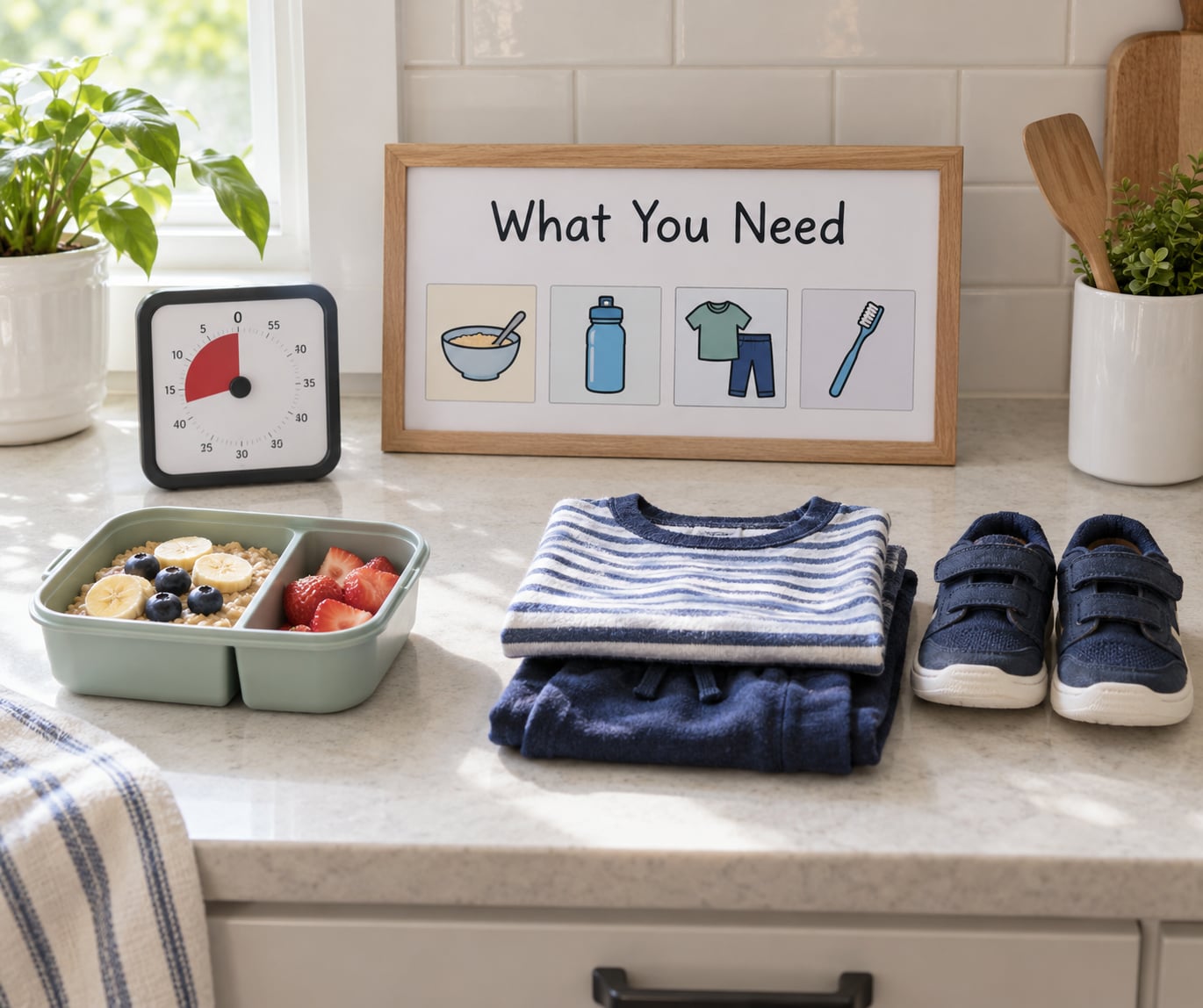
None of this costs money. Every item below is something you probably already own, and the whole setup takes about twenty minutes the night before you want to use it.
- A visual schedule. A hand-drawn list, printed picture cards, or a laminated chart on the fridge. Three to six steps is plenty at the start.
- Something to mark time. A kitchen timer or a clock face your child can read. A visible timer is often the single change that reduces morning arguing most, because it turns your hurry into something they can see.
- Breakfast that survives a rushed morning. Overnight oats, a waffle batter mixed the night before, yogurt with fruit, or toast with a spread. Batter mixed the night before is what can buy you a 30-minute routine instead of a 20-minute scramble.
- Two outfit options, picked out the night before. A basket by the door with shirt, pants, socks, and a spare in every outfit eliminates the where-are-your-socks conversation.
- Anything health-related, confirmed by your pediatrician. Medications, supplements, allergy-safe foods, and equipment your child needs should be scheduled with your child’s clinician, not worked around in a panic at 7am.
- A fallback plan. A short version of the routine for the mornings when a full one is not happening, plus a backup breakfast location for drop-off day.
Know your wake-up time before you plan anything else. Pediatric guidance generally puts total sleep at 9 to 12 hours for school-age children and 10 to 13 for preschoolers, so the wake time you choose has to leave room for that. If the math does not work with your school bell, the routine is the thing that flexes, not sleep.
Step-by-Step: How to Start a Morning Routine for Kids
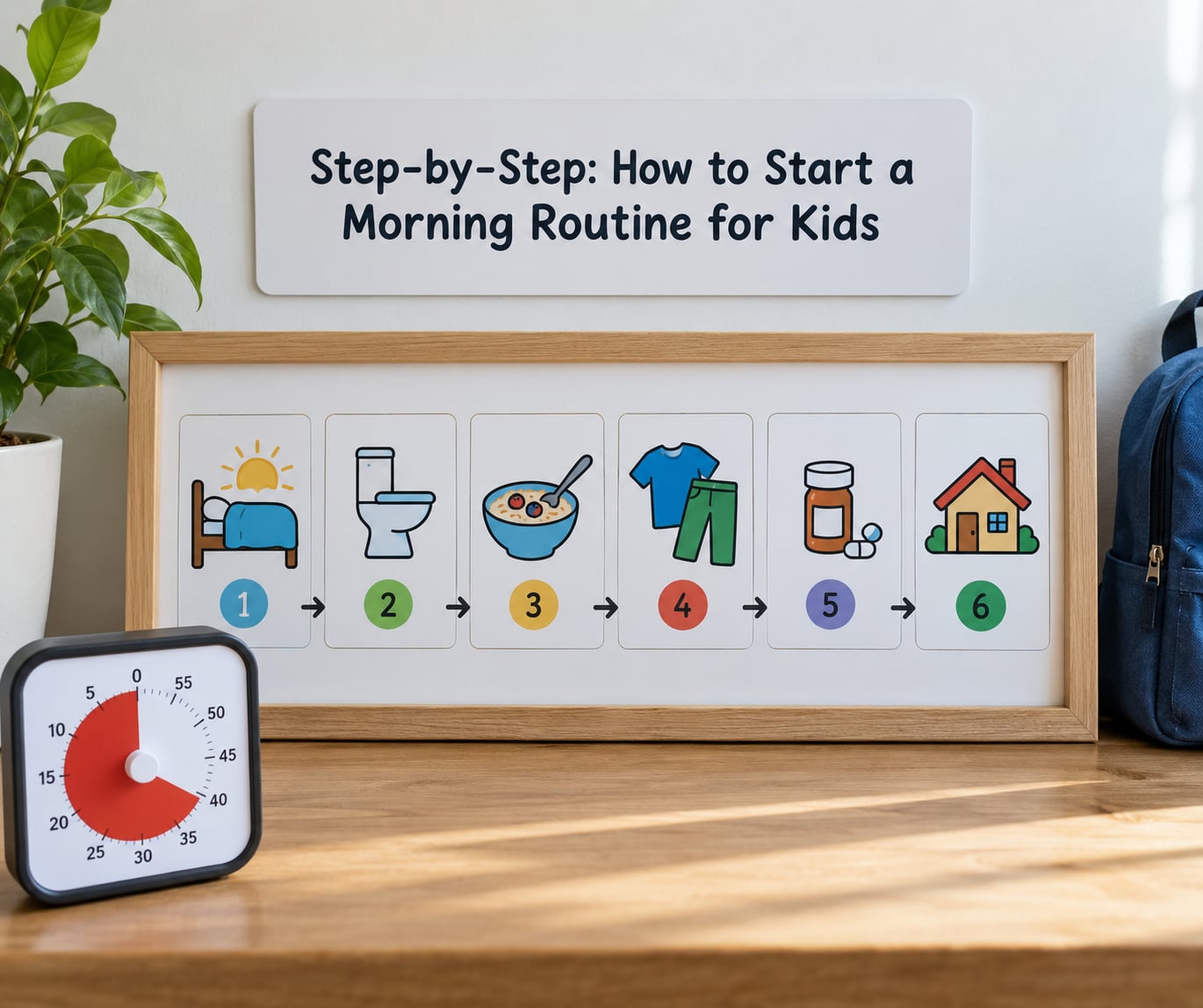
Here is what a starting routine actually looks like before you add anything.
A school-age version that fits a 45-minute window: wake at 6:45, toilet and wash, get dressed, breakfast, brush teeth, bag check, shoes on, out the door by 7:45. A toddler version for the same window: wake, diaper or potty, clothes, breakfast, shoes. On a hard day, drop to wake, clothes, breakfast, shoes and stop there. Four steps done calmly beats eight steps rushed.
Step 1: Choose a Routine That Fits Your Child
Write down every morning task that genuinely has to happen, then cut anything that only sometimes does. School mornings usually mean: bathroom, wash, teeth, dressed, breakfast, bag, shoes, out the door. Add school drop-off, a bus to catch, or a therapy appointment only if those are real parts of your week.
Then order those tasks around your child instead of around your calendar. Put the hardest transition first while energy and patience are highest, and move anything sensory-heavy, like hair washing or tight clothes, to a time of day your child tolerates better.
You will know the sequence is realistic when a full run-through fits the time you actually have with a few minutes of slack. If it only works on paper, cut a step now rather than failing on Thursday.
Step 2: Make the Routine Predictable
Consistency is what makes a routine stick. Same order, same words, same visual cue, every morning: say time to get up, then show the first card on the chart.
A visual schedule for a morning routine is simply the steps written or drawn in order where your child can see them, each with a picture when they are not a confident reader. Lamination and a dry-erase marker make one chart last all year. A picture checklist on the fridge tends to end the verbal reminders faster than one more reminder from you.
Use the supports your child responds to and no more. A first-then board works well for some kids, an audio recording of the steps for others, nothing written down for a third. Add one support at a time and give it a week before judging it.
Step 3: Practice Before You Rely on It
The school run is the worst possible time to introduce something new. Rehearse on a weekend morning, in ordinary clothes, with no clock pressure. Run the exact sequence you plan to use on school days, including the order of the words.
Keep practice to five or ten minutes. Movement-based practice works well here too, and these proprioceptive activities for kids at home give your child practice at transitions without the school-day stakes attached.
Signs it is landing: your child starts the step before you finish announcing it, asks what comes next, or walks to the right spot unprompted. Any of those means move to the next step. If nothing changes after a week of short practice, simplify that step rather than repeating it louder.
Step 4: Add One Routine Step at a Time
Add a new step only after the current routine feels unremarkable. That boredom is your green light; a meltdown at step two means you are not ready to add a third thing to expect.
When you do add one, keep the cue short and repeatable. Say the same sentence every morning rather than improvising a fresh reminder each time. Offer a choice where there is a real choice to offer, like which of two outfits, and skip choices on steps where there is only one option.
Never stack a new expectation on top of a routine that is already causing distress. A shorter routine that runs calmly is worth more than a complete one that ends in tears.
Step 5: Use Calm, Flexible Support
Most resistance is a transition problem, not a behavior problem. Two minutes of warning before a change cuts most of it: in ten minutes we are brushing teeth, then your favorite show.
When a step stalls, lower your voice and shorten your language rather than raising either. Offer help with the physical part, such as starting the zipper or opening the granola bar pouch, and let the child finish the rest. When a task is delayed past what your child can hold, do it yourself and move on without a lesson.
On sensory-heavy mornings, lower the demand. Dim the lights instead of flipping them, skip the outfit that needs the tag over the head, and build in a quiet low-demand first stretch. My guide to managing Christmas morning sensory overload covers the same idea for the holidays, when expectations are highest and nerves are worst.
Progress will not look identical on every child or every morning. Two good days out of five is real progress, and treating a bad morning as information rather than failure is what keeps the routine alive past week three.
Step 6: Review and Adjust the Routine Weekly
Pick one day a week to look at how the routine actually ran. Track three things only: how long each step takes, how much prompting it needed, and which transition felt hardest.
Those three numbers tell you what to change. A step that runs twenty minutes needs to be cut in half or moved. A step that always needs five reminders probably belongs later in the sequence, when your child is more able to hold the plan. A transition that is consistently hard usually needs its own warning card.
Simplify, move, combine, or delete. A routine that matches your real life holds up; one that only exists on paper falls apart the first week something changes.
Common Mistakes
Starting with the full routine. Eight steps on day one almost always ends in collapse. The fix is three steps for the first five days, then one more each week.
Vague instructions. Hurry up, get ready, and be quick tell your child nothing about what happens next. The fix is one concrete instruction per step, phrased the same way every day.
Changing the routine daily. Every variation forces your child to re-learn the sequence. The fix is picking an order and holding it for at least two weeks before judging it.
Turning every step into a reward contest. Bribing a child through six routine steps teaches that routines are unpleasant things to be paid for. The fix is one simple marker at the end of the morning, and stopping it once it feels expected. A child who completes a step without being asked needs no sticker at all.
Blaming your child for sensory or communication struggles. Refusing a shirt because the seam rubs, or melting down because the order changed, is a regulation issue, not defiance. The fix is to adjust the routine to fit your child’s nervous system rather than demanding they adjust to the routine.
Give yourself a few sloppy weeks. The first stretch is usually slower and louder than you expected, and that is not a failure.
Frequently Asked Questions
How long should a morning routine be for kids?
Most school-age routines run 30 to 60 minutes from wake-up time to out the door, and toddlers need closer to 20 to 35. The realistic budget is whatever fits between your child’s wake time and the school bell, minus travel. Measure one real morning before deciding. If the full sequence does not fit with a few minutes of slack, cut a step rather than rushing the rest.
What do I do when my child refuses one step of the routine?
Decide in advance which steps are non-negotiable, usually teeth, clothing appropriate for the weather, and leaving on time. Let go of the rest. When the refusal happens, give a two-minute warning, restate the same short instruction, and offer physical help with the part they cannot do. Then move on without a lecture. A routine you can run during a hard morning beats a perfect one you can only run on good ones.
How do I build a morning routine for an autistic or sensory-sensitive child?
Keep the order identical every morning, show each step visually with pictures or written cards, and give a clear warning before every transition. Start the day with lower light, lower noise, and lower demand, and build up from there. Keep one calm element in the morning, like music or a short stretch. Sensory-friendly pacing matters more here than speed, and a shortened routine that runs calmly beats a full one that ends in shutdown.
How do I handle mornings with school, work, or therapy appointments?
Build the routine around the hardest fixed time of the morning, since that deadline rarely moves. Prep the night before so the short steps need nothing from you. When a therapy or work appointment lands mid-morning, decide which routine steps happen before it and which simply get dropped that day, and say so out loud in advance so the change is announced rather than surprising. Consistency can include consistency about what will be skipped.
What is a visual schedule for a morning routine?
It is the morning steps written or drawn in order and placed where your child can see them, with a picture beside each one if they are not a confident reader. Start at three to six steps and add more only when the current set feels easy. Lamination and a dry-erase marker make a single chart reusable for months. The schedule’s job is to show what comes next without you repeating yourself every morning.
How long does it take before a kids morning routine sticks?
Expect about two weeks of consistent repetition before the sequence starts running itself, and several more before your child completes the steps without reminders. Shorter routines settle faster than long ones. Consistency of time and wording matters more than consistency of completion, so a partial morning done the same way daily still teaches the sequence. Expect a wobble after travel, illness, or a schedule change, and go back to three steps for a few days.
Start With One Small Step Today
Pick the single easiest morning task, the one that almost never causes a fight. Write it or draw it on one card and put that card in the same spot every morning. Run that one step the same way for a week before you add a second.
A routine should make your family lighter, not hand your child another standard to fail. When the first three steps run without you repeating yourself, you are already past the hard part.