Time management is not something children pick up by watching adults manage a calendar. It is a skill you build, one short routine at a time, using pictures, timers and a predictable order of steps.
Learning how to teach time management to kids starts small: one predictable routine, one visual cue, one timer your child can actually see. Most families see a change within two to four weeks of consistent practice, as long as the same routine runs the same way every day.
Table of Contents
- What You Need
- Step-by-Step: How to Teach Time Management to Kids
- 1. Create a Predictable Daily Schedule
- 2. Use One-Step Directions
- 3. Introduce a Visual or Audio Timer
- 4. Teach a Consistent Morning Routine
- 5. Build a Simple Task-Breakdown System
- 6. Practice Waiting, Switching, and Transitioning
- 7. Review the Routine and Adjust
- Common Mistakes
- Frequently Asked Questions
- What are 5 time management strategies for kids?
- How do you teach time management to kids with ADHD?
- How long can a child focus on one task by age?
- Do visual timers actually work for kids?
- What age can a child tell time on a clock?
- Conclusion
What You Need
None of this needs to be expensive. A timer, a written list and a clear finish cue will carry you most of the way.
- A daily schedule the child can see. Picture cards, written words, colour blocks or a first-then board all work. The format matters far less than the fact that it stays the same each day.
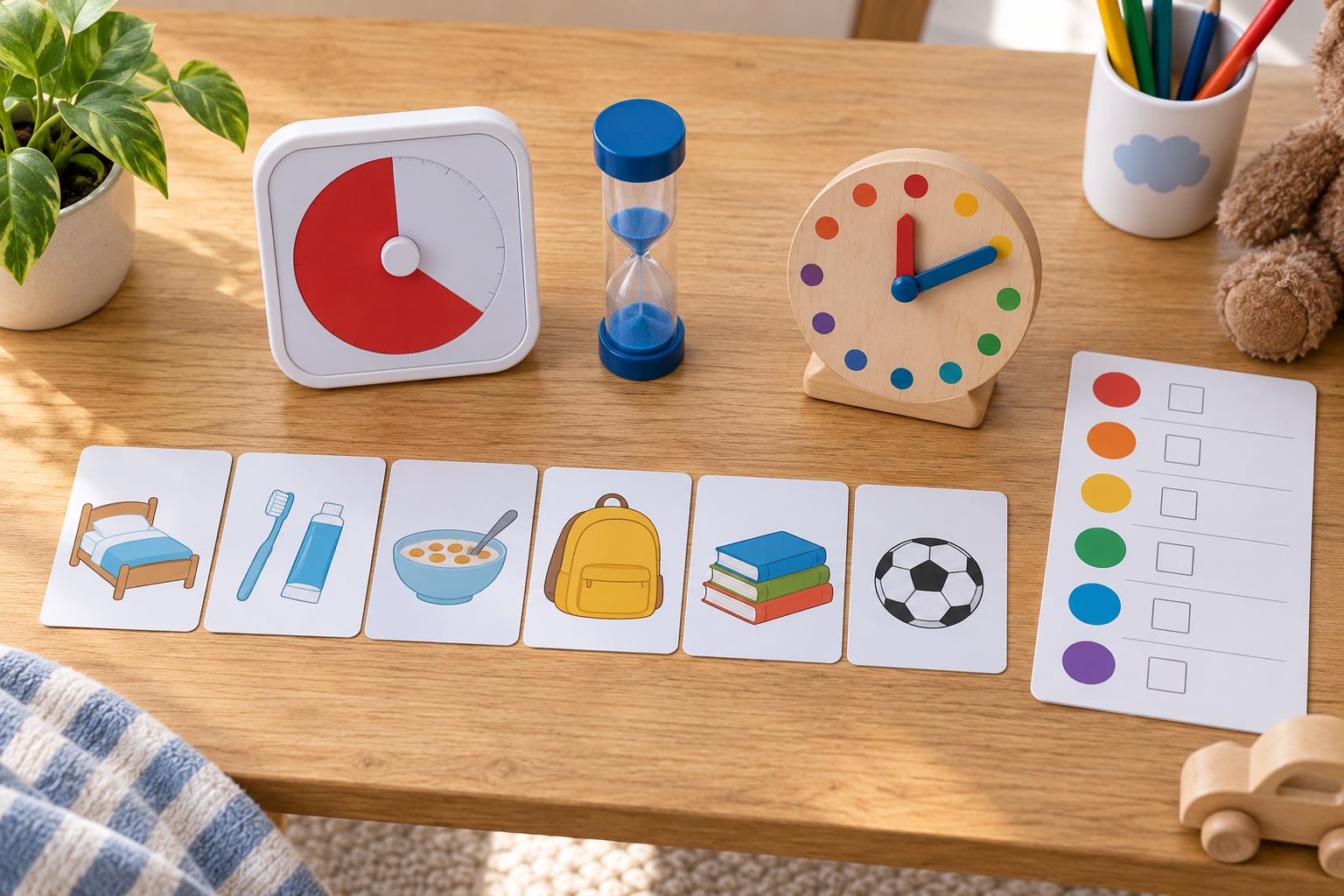
- A timer your child understands. A colour-draining visual timer or a sand timer beats a digital clock, because the child sees the amount of time shrinking rather than reading a number that changes.
- A transition cue. A five-minute warning, a specific song, or a quick countdown gives the child time to switch gears without a surprise.
- A task list for longer jobs. A short checklist broken into single steps turns one overwhelming chore into five small wins.
- A quiet place to practise. Time management skills land better when the child is not also managing noise, hunger or a busy room.
Adults matter as much as the tools here. If you tell your child to use a timer and then run your own evening late, the gap teaches them that the rule only applies to them. For practical ways to make rules that hold at home, see how we set screen time rules for autistic kids.
Step-by-Step: How to Teach Time Management to Kids
Work through these in order and give each one at least a week before adding the next. Rushing the sequence is the most common reason a time system collapses by week two.
1. Create a Predictable Daily Schedule
Break the day into blocks your child can hold in their head: wake up, breakfast, get dressed, school, after-school snack, homework, play, bath, bedtime. Six to nine blocks is plenty for a young child, and fewer for one who finds transitions hard.
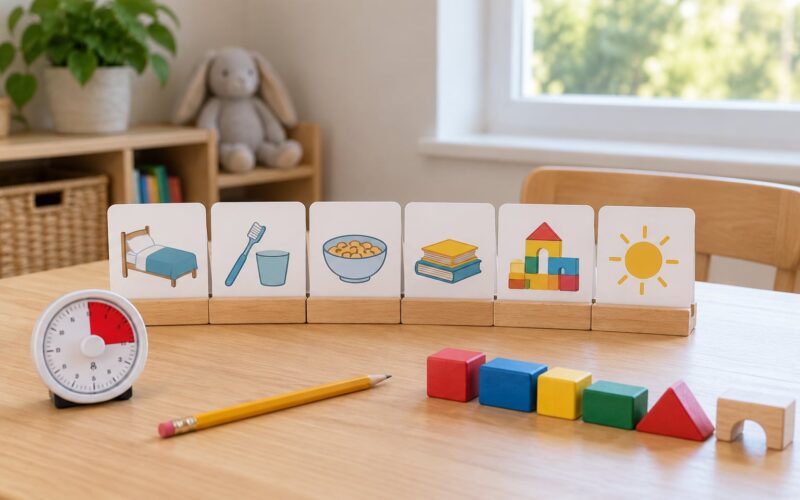
Show it in whatever form reads fastest. Colour-code it, photograph each step, or write it in short phrases. Let your child help place the cards in order, then confirm understanding by asking them to point to what comes after breakfast. If they cannot point, the schedule is too dense, not the child.
2. Use One-Step Directions
Children who lose track of time usually lose track of instructions first. Instead of “get dressed then brush your teeth then pack your bag,” give one direction and wait for it to finish before adding the next.
Leave five to ten seconds of silence after each instruction so your child has processing time. Repeat the same wording daily rather than rewriting it, and only add the second step once the first happens without a reminder. Single-step directions are also the fastest way to introduce a chore chart later.
3. Introduce a Visual or Audio Timer
A visual timer shows a bar draining from full to empty, or sand falling through a narrow waist. Because the remaining time is a shrinking object rather than a number, it works for children who cannot yet read a clock or who lose track of elapsed time easily.
Begin with intervals you know are winnable, usually five minutes for a young child and ten to twenty for an older one. Give a clear warning before the timer ends. Then let your child start and stop the timer themselves so beginning and ending stay connected to the object.
4. Teach a Consistent Morning Routine
Mornings are the easiest place to practise because the sequence never changes. Picture each step on its own card and stick them in order on the door, the fridge or a wall the child can reach.
Rehearse the whole routine once with you doing it and narrating, then once more with your child leading. Fade one prompt at a time rather than all at once. When it starts working, notice which step still takes longest; that is the one that still needs a picture or a timer. For families rehearsing new skills, video modeling to teach life skills is a good way to practise the steps without the pressure of the clock running.
5. Build a Simple Task-Breakdown System
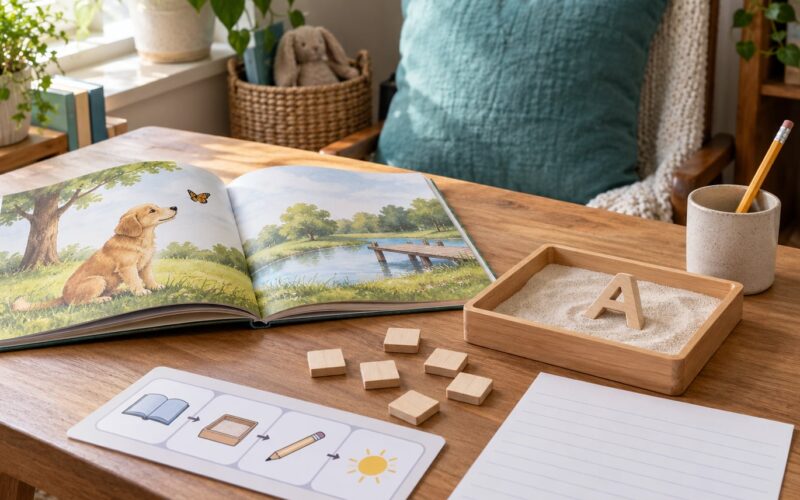
Long jobs fail because the child cannot see where the job ends. Cleaning a room, a bookshelf or a homework pile each become five written steps with a box to tick, and the child physically moves each item or card to a finished bin when the step is done.
Praise the starting. “You began without being asked twice” is the skill you are building, and it holds up better than praise aimed at a perfect finish. If chores are the goal, our walkthrough of how to teach chores to an autistic child builds on this same task list.
6. Practice Waiting, Switching, and Transitioning
Transitions are the hardest part of any schedule. Use a finish cue, a warning, and a small recovery period: five minutes to finish, two minutes of warning, then a quiet minute before the next activity begins.
Children who become overwhelmed by change need the warning earlier and repeated rather than louder. Keep a simple record of how long the recovery takes each week so you can see progress without turning it into a test.
7. Review the Routine and Adjust
Once a week, sit down for five minutes and ask what worked. A child pointing to a card that is now easy is more informative than any completion chart.
Reduce one kind of support at a time, never all of them together, and change only one thing about the schedule per week. That way, when something breaks, you know what broke it.
Common Mistakes
Most failed time systems share a handful of causes, and each has a simple fix.
- Too many instructions at once. Fix: one direction per turn, with processing time in between.
- Changing the routine every few days. Fix: hold a routine for two to three weeks before editing anything.
- Verbal reminders only. Fix: pair every spoken reminder with a visual one, because memory for time does not develop on its own.
- Unrealistic time limits. Fix: set the timer to a length your child can actually succeed at, then stretch it later.
- Correcting every small delay. Fix: correct nothing under two minutes. Time management is a rough sense early on, and perfectionism teaches avoidance.
- Rewarding the finished result only. Fix: reward starting, keeping going, and recovering after a delay, which is the real skill.
Two habits of ours took the longest to learn and are worth naming. The first is rolling out the whole system at once, which almost never sticks. The second is turning a timer into a punishment, which teaches a child that time is something done to them. If a timer already triggers anxiety, take it away for a week and use music or a song length as the boundary instead.
When a system stops working, work down this list: the timer may have lost its novelty, the schedule may be too long, or your own consistency may have slipped. Change one variable for a week before deciding the method is wrong.
Frequently Asked Questions
What are 5 time management strategies for kids?
The five that matter most are: a predictable daily schedule, one-step directions, a visual timer, breaking long jobs into short written steps, and countdown warnings before transitions. Introduce them one at a time, a week each, rather than all together. Children learn the sense of time from repetition, so consistency matters more than which tool you choose.
How do you teach time management to kids with ADHD?
Start with a visual timer rather than a digital clock, because a colour-draining bar or falling sand shows time shrinking instead of asking the child to track a changing number. Add a warning at ten minutes and again at two. Keep tasks to single steps, write the next step where it can be seen, and let your child move each finished item themselves so the tracking is external.
How long can a child focus on one task by age?
Use it as a starting point, not a target. Preschoolers often manage five to ten minutes, kindergartners ten to fifteen, elementary-aged children fifteen to twenty-five, and teens roughly half an hour before a real break is needed. Many children do better in shorter blocks with a movement break, so shorten a planned block rather than ending it in frustration.
Do visual timers actually work for kids?
They work best for a few weeks and then need refreshing. Once the novelty fades, children stop responding to the timer, so pair it with a countdown warning, move the timer where the child is working, and let them start and stop it. Some families also use an egg or sand timer, which feels different enough to renew attention.
What age can a child tell time on a clock?
Most children can count in fives by age five or six and read an analog clock reliably somewhere around seven or eight, though the range is wide. Reading a clock and feeling how long something takes are different skills. A child can read 3:00 and still have no idea whether brushing teeth takes two minutes or ten, which is why visual timers come before clock practice.
Conclusion
Start with one routine today. Pick the morning, write it into six cards in a fixed order, and run it the same way for a week.
Add a visual timer once the order feels automatic, then build from there. Understanding how to teach time management to kids is mostly patience with a schedule that never changes twice, and it works best when practice stays calm.
Last reviewed for accuracy in 2026. Educational guidance only; if your child is significantly delayed across areas of development or daily functioning, talk with their pediatrician or a developmental specialist.