Executive function skills are learned, not fixed. How to build executive function skills in kids comes down to the same thing that builds any other skill: repeated practice inside routines your child already lives. You pick one daily job, break it into small visible steps, do the hard part for them at first, and then hand each piece back a little at a time.
Most families can start tonight with nothing more than paper, a timer and ten minutes. Whole-brain regulation, sensory needs and diagnosis only change how much support you add, never whether you start.
Table of Contents
- What You Need
- Step-by-Step
- 1. Build a Predictable Morning Routine
- 2. Practice Working Memory With Simple Games
- 3. Use Visual Checklists for Planning
- 4. Teach the Child to Start and Finish Tasks
- 5. Practice Flexible Thinking With Change Games
- 6. Build Self-Control With Movement Breaks
- 7. Use Daily Habits for Planning and Time Management
- 8. Fade Prompts and Celebrate Progress
- Common Mistakes
- Frequently Asked Questions
- At what age do children develop executive function skills?
- How do you build executive function skills in a child with autism?
- How do you teach executive function to a child with delayed language?
- How long does it take to improve executive function?
- How do you help a child who refuses to start a task?
- When should we seek professional help for executive function?
What You Need
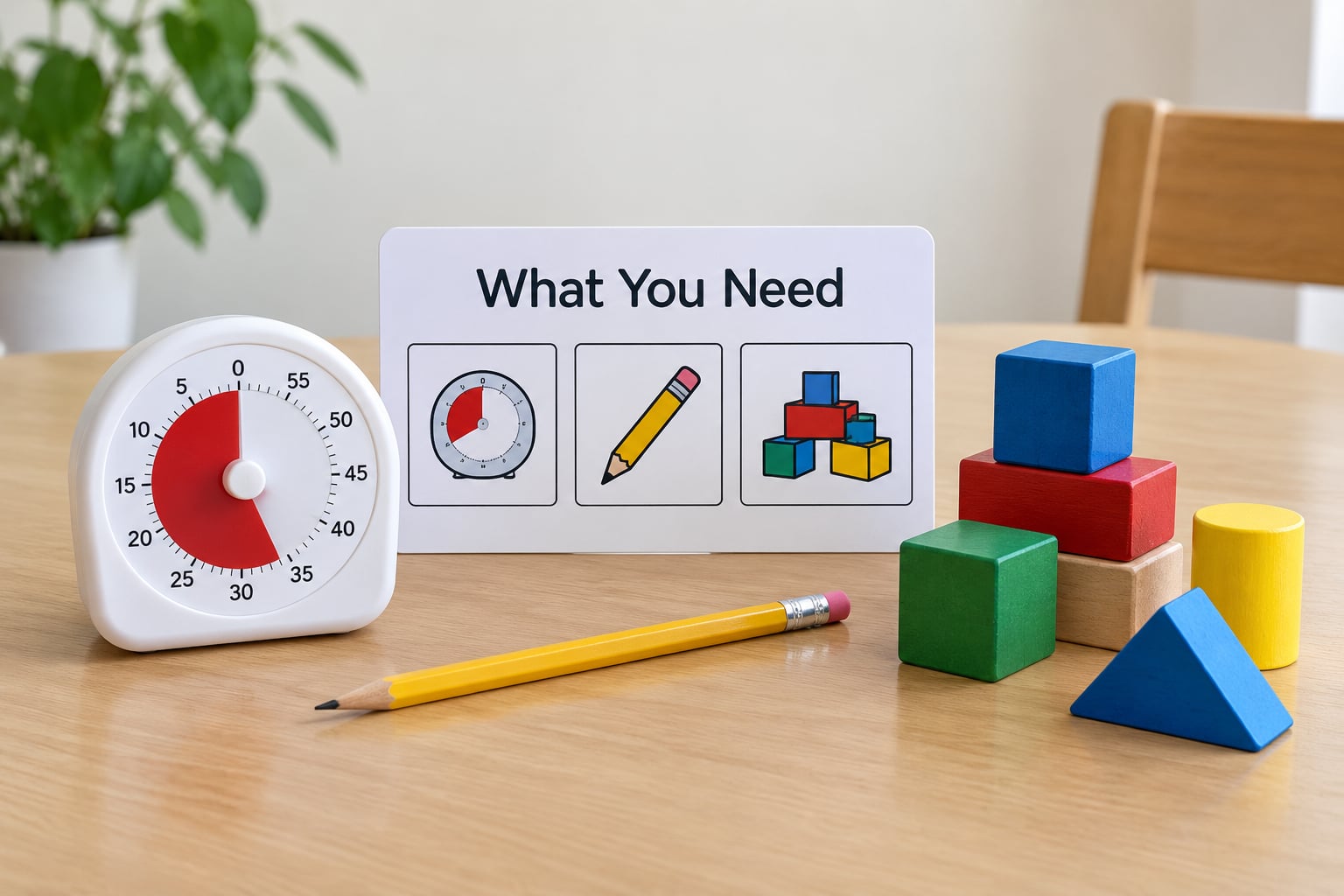
You need four things, and none of them require a diagnosis, a therapy referral or a special purchase.
- A short, fixed practice window. Ten to fifteen minutes at the same point in the day beats a long session you skip. Morning works well for most households because the routine is already there.
- One visual tool. That could be a picture checklist on the fridge, a laminated card, a visual schedule, or a first-then board. Paper is genuinely enough.
- An activity matched to the child’s current level. If two-step instructions are hard, that is where you start, not where you push.
- A calm place to practice. A clear surface, low noise, and no audience. Practising while other siblings watch and comment makes it harder, not easier.
For children with sensory needs, add whatever helps them feel regulated before you ask for anything from their brain. Some families find a weighted lap blanket, a wobble cushion, or a slow wall push before the checklist helps. If you need ideas for movement that works in a small space, my guide to building gross motor skills indoors has activities that double as regulation breaks.
Step-by-Step
These eight steps build executive function skills in the order that tends to hold up best. Start small, wait longer than feels comfortable for processing, and reward effort rather than finished results. A child who tries a hard step and misses it has practised the skill. A child who completes it while you do most of the work has not.
The seven skills underneath all of this are working memory, inhibitory control, cognitive flexibility, task initiation, planning and organisation, self-monitoring, and emotional regulation. Each step below trains one or two of them, and no single step works alone for long.
1. Build a Predictable Morning Routine
Executive function grows fastest where the demands repeat. Getting ready for school happens every single day, which makes it the ideal training ground.
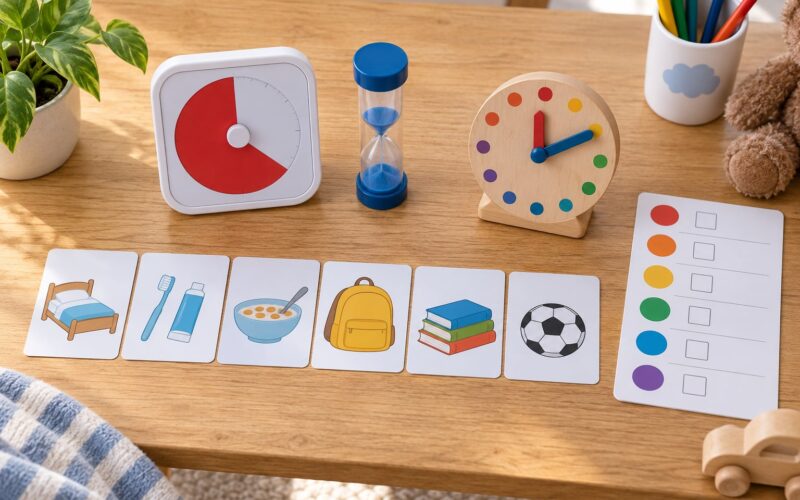
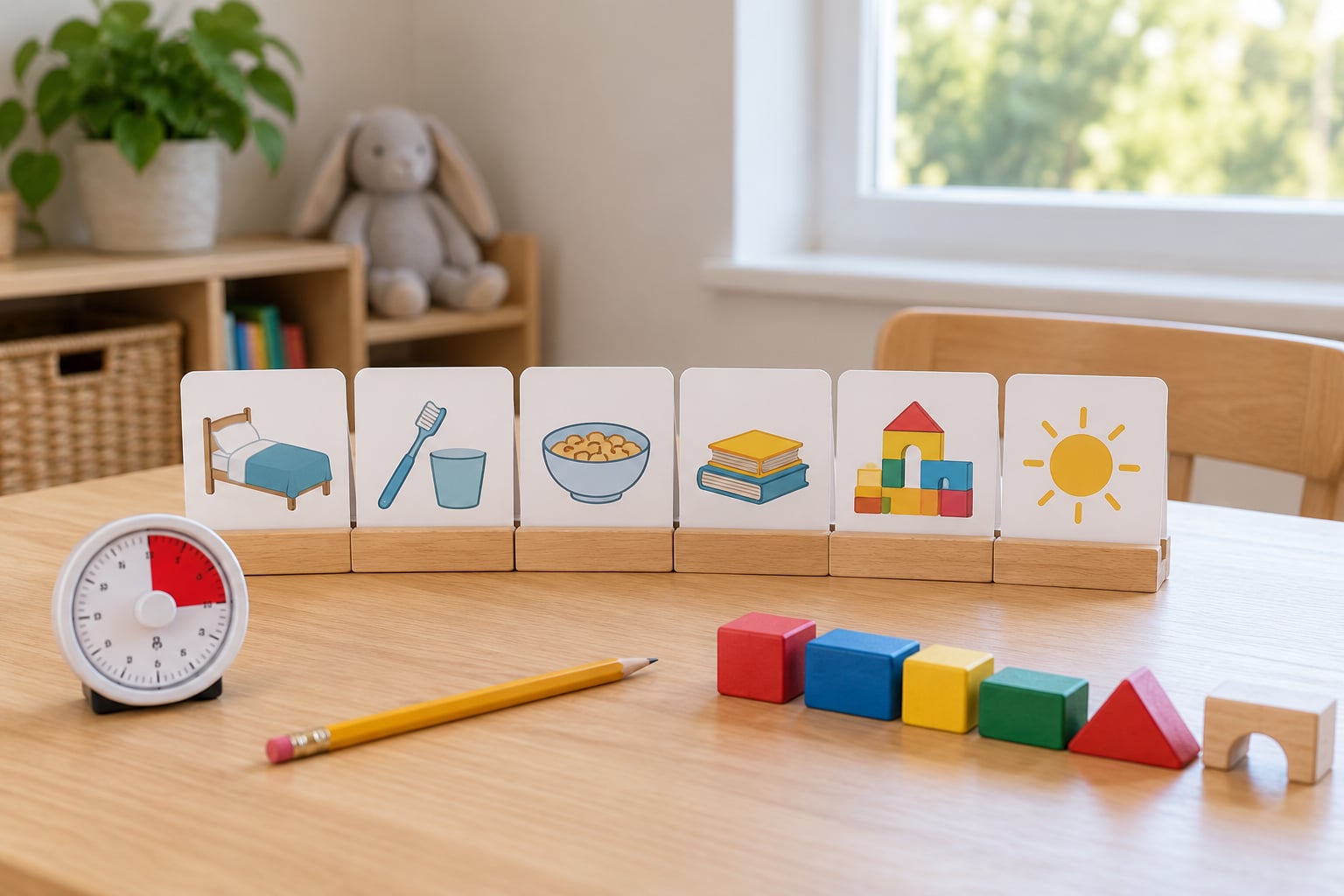
Write the sequence out as five to seven picture or word steps, then run it in the same order every morning. Say your own thinking out loud while you do it: “Pants first, because socks go on after shoes is too tight in the morning.” That narration gives your child a model of planning they can hear rather than imitate on their own.
Over the first two weeks, stay close. Point at the card, wait, and only step in if the pause has gone on long enough that the child is stuck rather than thinking. Then pull back one prompt at a time, moving from hand-over-hand, to pointing, to a single verbal cue.
You will know the routine is landing when the sequence starts happening in the right order before you say anything, and when a disrupted morning no longer derails the whole day.
2. Practice Working Memory With Simple Games
Working memory is the holding space in the brain, and it grows through games that ask a child to hold information and then act on it.
Good starting points depend on age. A preschooler can follow a two-step instruction like “clap twice then sit down.” An early elementary child can play a memory card game, repeat a sequence of three household objects in order, or follow a Simon Says variation where the rules change mid-game. A middle schooler can hold a list of five items in their head while you sort them, or play a card game that requires tracking whose turn it is.
Start at whatever the child can already do and add exactly one element at a time. Three items becomes four, not six. If accuracy drops below roughly three quarters, step back down. You are looking for a stretch, not a test.
3. Use Visual Checklists for Planning
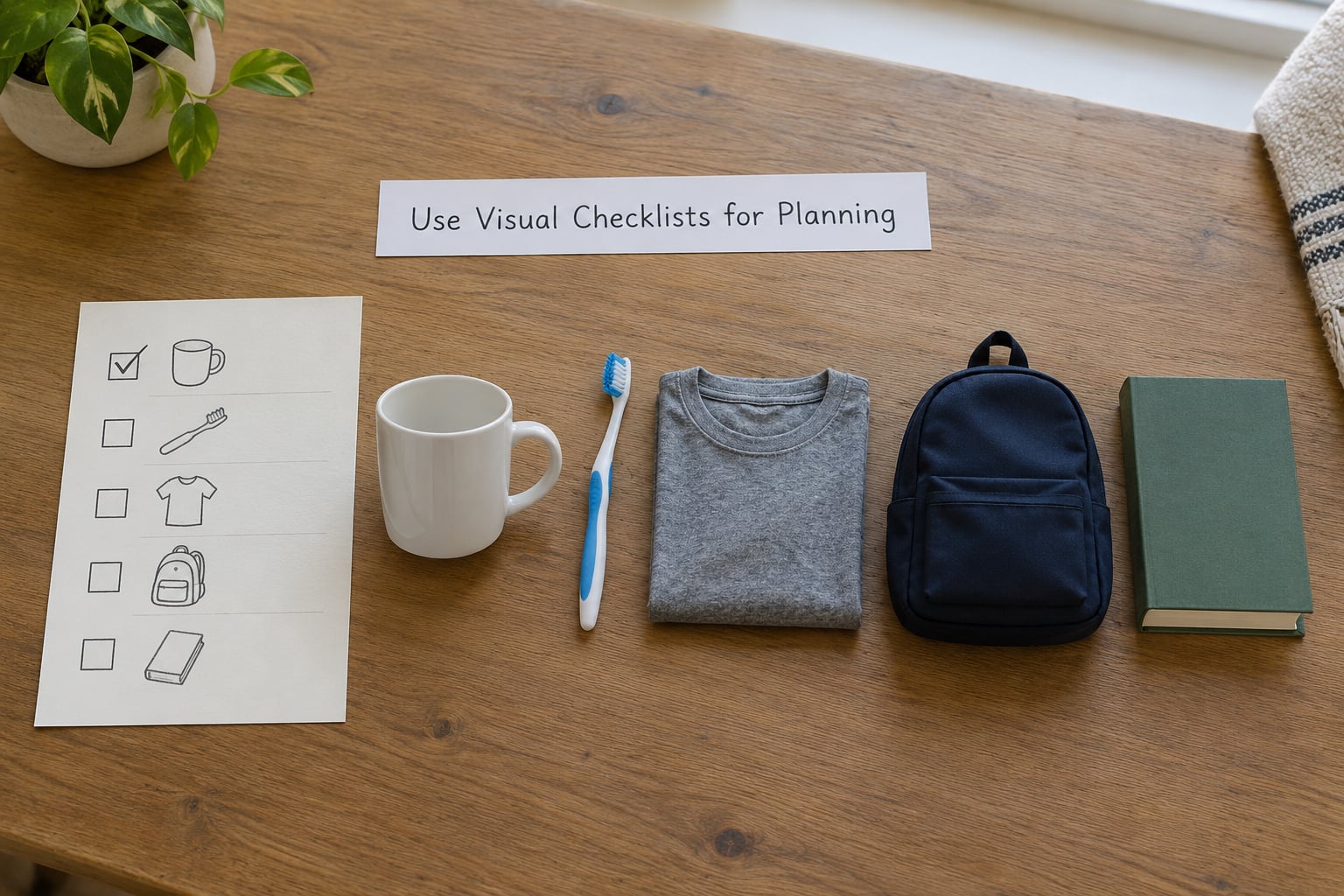
Planning becomes visible when a child can see the steps instead of holding them in their head.
Choose one familiar task, such as coming home from school, and write the whole thing out: bag in the bin, snack, water, homework, shoes off, then free time. Keep it to five or six lines. More lines than that and the child works from overwhelm rather than from a plan.
Model the first pass yourself. Do each step out loud while ticking it, then hand the checklist over and stay nearby without narrating. If your child can read, let them run it. If not, pictures work better than words, and one photo per line is plenty.
Checklists are scaffolding, not a permanent fixture. A child who never holds the checklist never owns the skill, so plan to remove one line every week or two once the routine feels reliable.
When routines are harder to hold in writing, a short video of yourself doing the same sequence can carry the same information. My piece on using video modeling to teach life skills covers how to record those without it turning into a production.
4. Teach the Child to Start and Finish Tasks
Task initiation is usually the hardest skill for parents to see, because the child is often still standing in the room.
Give each task a visible beginning, middle and end. A timer for the middle, a small defined project like one puzzle or matching the socks, and a clear finish line they can see. A card that says “start here” on one side and “done” on the other turns an open-ended demand into a bounded one.
On refusal, do not add volume. Get closer physically, shrink the task until it is almost insulting in its smallness, and start it together. Most refusals are overload or an unclear start, not defiance.
Ending matters as much as starting. When the timer goes, mark the finish explicitly, even if the work is incomplete. Learning to stop and reset is half the skill.
5. Practice Flexible Thinking With Change Games
Flexible thinking is the ability to switch strategies when the plan stops working, and it only strengthens in low-stakes settings.
Change one small thing in a familiar game: swap the order of steps in the morning routine, walk a different route to school, or play a matching game with the rules reversed so the child has to find differences instead of pairs. Keep announcing the change out loud so the shift is predictable even when it is new.
Notice and name what worked. “You changed the order and still got out the door” teaches that flexibility is a skill, not an identity trait.
6. Build Self-Control With Movement Breaks
A regulated body makes self-control possible. Movement breaks reset attention in a way that a request to sit still and try harder never will.
Keep them short and concrete: wall pushes, a balance path taped on the floor, an obstacle course through two chairs, or carrying a stack of books from one room to another. Two to five minutes is usually enough. Time them so the break has a clear end rather than drifting.
Adapt everything to what the child can safely do. A child with limited mobility still benefits from heavy work, like wiping a table or pushing a loaded cart, and a child who seeks movement gets that input on their own terms. If you want more structured options, the indoor gross motor activities I mentioned earlier include several that double as regulation breaks.
7. Use Daily Habits for Planning and Time Management
Time blindness improves when a child gets to practise estimating in situations that are not high stakes.
Try predicting before the event rather than correcting after it. Before breakfast, ask how many minutes getting dressed will take, then check the clock and talk about the gap. Let a child choose the order of three chores, then notice whether the first one they picked was the one that takes longest. A first-then board works here too, pairing something hard with something they enjoy.
Keep it to a couple of minutes a day. When every moment turns into a maths lesson, children stop enjoying the routine and start dreading it.
8. Fade Prompts and Celebrate Progress
Fading is what turns a supported routine into an owned skill, and it is the step most families skip.
When a step feels solid, remove one layer of support: drop the hand-on-hand assist, then the pointing, then the verbal reminder. Move one step at a time and give it a week or two before deciding it is not sticking. A step that collapses once is normal. A step that collapses every time means the support came out too early.
Keep a short record. A list of small wins on the fridge gives you something concrete at the four-week mark, which is roughly when most families give up. Missed steps are data about the prompt level, not evidence that the child is not trying.
Expect to adjust upward as your child grows. A routine that worked in September can need more steps by February, and that is normal development rather than regression.
Common Mistakes
Practising when the child is already overwhelmed. A checklist issued during a meltdown teaches nothing. Wait for regulation first, then start. The order matters more than the speed.
Giving three instructions at once. “Get dressed, brush your teeth and pack your bag” is one adult working memory, not a child’s. Give one step, let it land, then add the next.
Chasing perfect compliance. A child who does the routine only under your voice has not learned the routine. Judge progress by how much of it they now own, not by whether it looks like you would do it.
Changing everything at once. New checklist, new reward chart, new bedtime all in week one guarantees you will not know which change helped. Add one system, run it two weeks, then add the next.
Comparing progress with other children. Executive function develops across a wide range, and a child working on inhibition is not behind a peer who happens to be further along. Compare your child to your child four weeks ago.
The fix across all five is the same: keep practice short, keep it consistent, and keep it low-stakes. Five minutes most days will outrun an hour on Sunday every time.
Frequently Asked Questions
At what age do children develop executive function skills?
Executive function skills begin emerging around ages three to five, when children first learn to hold a rule in mind, shift attention, and hold back an impulse. Development continues through the school years, and the prefrontal cortex these skills depend on is not fully mature until the early twenties. That is why a kindergartner’s planning is not expected to look adult-level, and why skills can still grow meaningfully well past childhood.
How do you build executive function skills in a child with autism?
Structure works, but the emphasis shifts. Predictability matters more, unexpected change causes more distress, and visual schedules carry more of the load than spoken reminders. Introduce change gradually and warn before it happens. Many autistic children also need sensory regulation, sleep support and movement before a cognitive task is even possible, so those foundations come first rather than later.
How do you teach executive function to a child with delayed language?
Do not make any strategy depend on the child understanding complex spoken language. Use picture checklists, one-step instructions, gestures and demonstration instead of narration, and pair every spoken label with a visual. Give noticeably more processing time, often five to ten seconds, before repeating or rephrasing anything. Children with delayed language often understand far more than they can say, so modelling the task is more reliable than talking about it.
How long does it take to improve executive function?
Most families see small, observable changes within four to six weeks of short daily practice, such as needing fewer reminders on one routine step. Larger changes take months, because the skills are being built rather than taught once. Progress often looks uneven, with a good week followed by a flat one. Judge effectiveness at four-week checkpoints rather than day to day, and expect to adjust the routine upward as the child grows.
How do you help a child who refuses to start a task?
Shrink the task until starting is almost effortless, then start it together so the child feels the first step happen. Set a visible beginning and end, such as a timer or a start-here card, so the demand feels bounded. Avoid adding words when refusal escalates, because volume usually increases resistance. If avoidance persists across many tasks, an occupational therapist can assess whether sensory or motor factors are driving it.
When should we seek professional help for executive function?
Seek an assessment if difficulties appear across settings and more than one skill is affected, or if they block daily functioning at school or home. A psychoeducational evaluation can identify whether a learning, attention or processing issue is driving the difficulty, and an occupational therapist can advise on planning, organisation and sensory strategies. Requesting a formal evaluation does not automatically produce services, but it gives you a written map to work from and to share with teachers.
Start with one routine tonight. Write out your child’s morning sequence as five short lines, run it in the same order tomorrow, and start fading one prompt at a time once it feels routine. Everything else in this guide builds on that one habit. If screen time is part of your day, I also wrote about setting screen time rules for autistic kids in a way that keeps the transition predictable.