To teach a child to follow directions, get their attention first, give one short concrete instruction, wait in silence for about five to ten seconds, then name exactly what you saw them do. Practice that loop a few minutes a day, in routines you already have, and add supports gradually instead of all at once.
Most of the struggle is not defiance. It is working memory, processing speed, and a nervous system that got interrupted — skills that are still under construction in a young child, and that need more support, not more volume.
This guide is written for caregivers of children roughly two to ten years old, including autistic children, children with ADHD, children with hearing loss or auditory processing differences, and multilingual families. If you are supporting neurodivergent learners, you will find the visual supports and wait-time sections especially useful. If you also want a way to teach skills without relying on speech at all, my guide to how to use video modeling to teach life skills pairs well with step four below.
Table of Contents
- What You Need
- Step-by-Step: How to Teach a Child to Follow Directions
- 1. Start with one short, concrete direction your child already understands
- 2. Say the direction once, then wait
- 3. Add a visual or sensory cue
- 4. Practice inside everyday routines you already have
- 5. Praise the process, not just the result
- 6. Increase from one step to several
- 7. Check for independence and know when to get help
- Common Mistakes
- Frequently Asked Questions
- At what age should a child be able to follow directions?
- How long should I practice with my child each day?
- What do I do when my child refuses to follow directions?
- Do picture cards and visual schedules really help?
- When should I ask a professional for help with listening skills?
- A Gentle Place to Begin
What You Need
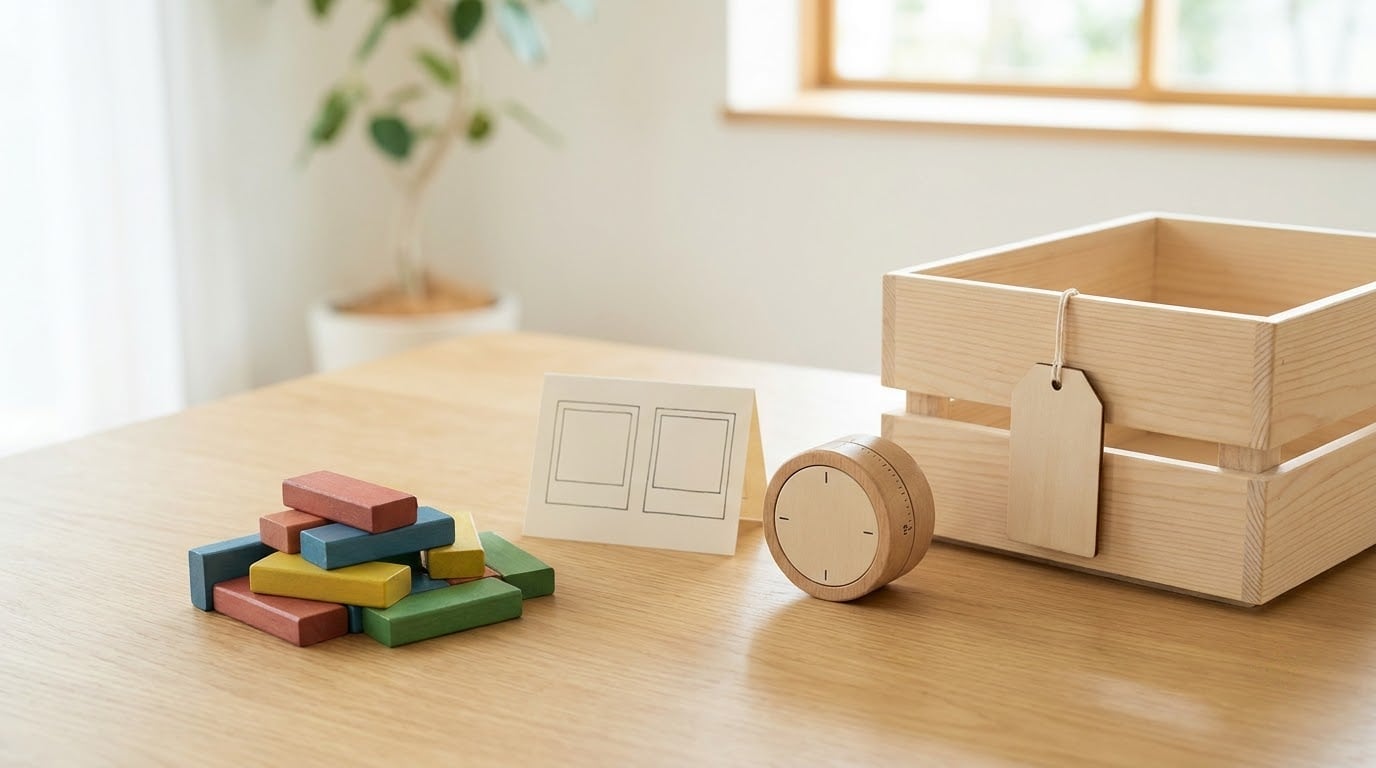
Nothing fancy. Before you practice, put four things in place and the rest gets much easier.
- One clear direction. A single action your child already understands, like “put the block in the box” or “clap your hands.”
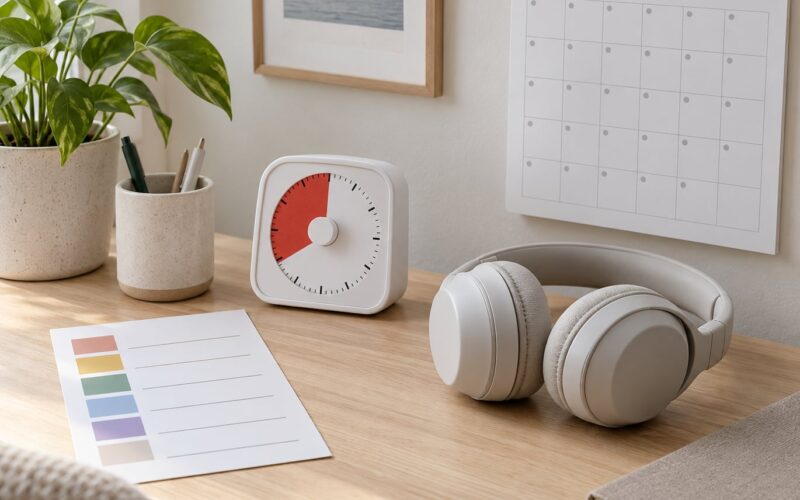
- A visual support, if it helps. A picture card, a written checklist, a gesture, or an object that marks where the task begins.
- One specific praise ready to go. Decide in advance what you will say so praise lands while the behavior is still fresh.
- A calm, low-distraction setting. Fewer people, less background noise, and you close enough to be at the child’s eye level.
Then adjust the whole setup for the child in front of you. Age matters enormously: a two-year-old can hold one step, a ten-year-old should manage several. So do communication method, hearing, attention span, and sensory needs. If a child finds your voice hard to process, the visual support is doing the heavy lifting, not the words.
For daily chores specifically, I break the whole process down in how to teach chores to an autistic child, with the same sequence applied to a longer routine.
Step-by-Step: How to Teach a Child to Follow Directions
The sequence below follows how children actually learn this skill. You model the action, you simplify the language, you rehearse it in a real routine, and you slowly take the scaffolding away. Expect weeks of short practice, not a breakthrough on Tuesday.
1. Start with one short, concrete direction your child already understands
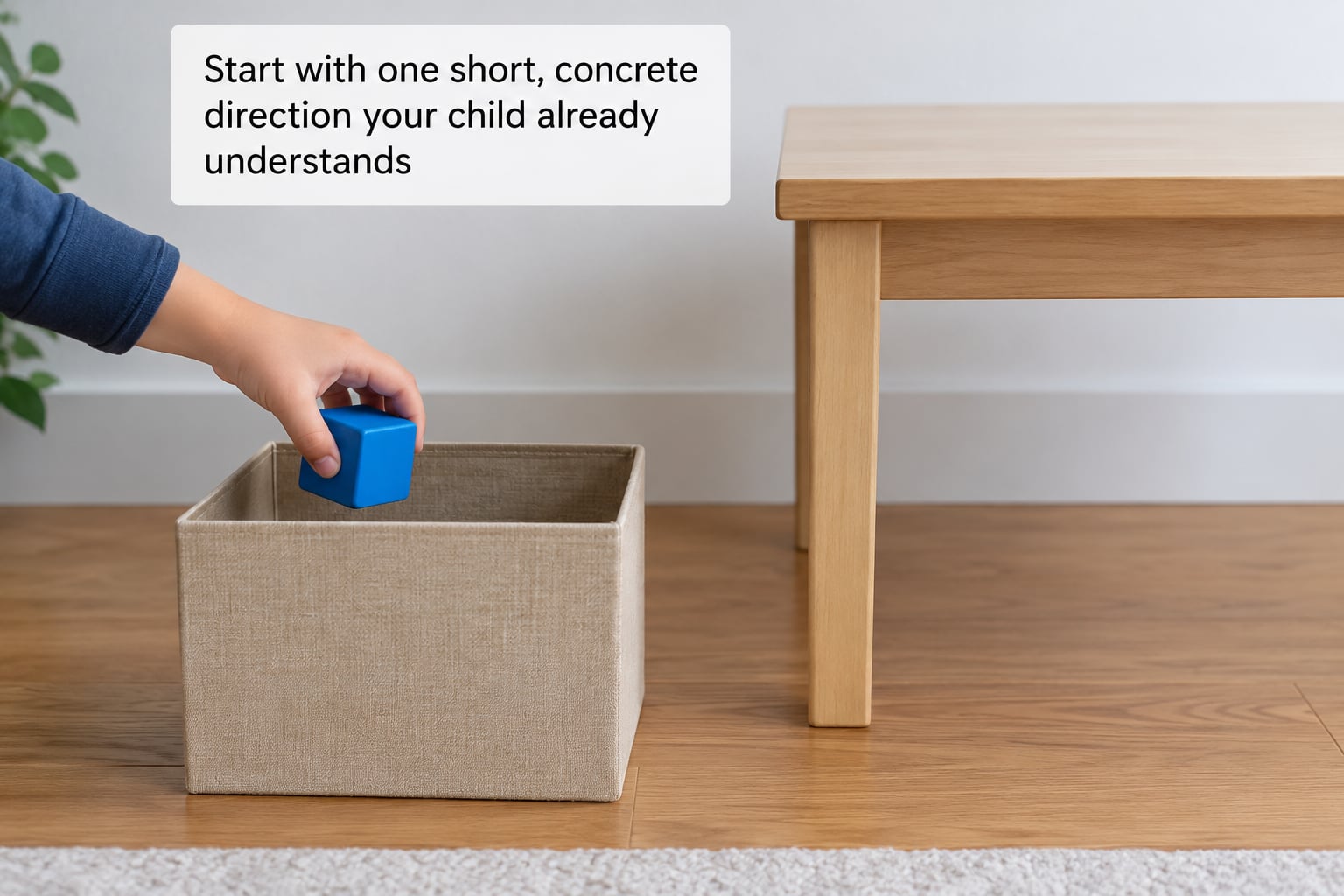
Pick an action the child can already do, and lead with the action verb. “Block in box” works better than “Can you put your block away for mommy?” because there is no question to interpret, no filler to discard, and one thing to do.
Pair the words with eye contact, a gesture, or a picture cue. Show the action yourself first if the child has never seen it done, then let the child copy you. When it works, you know exactly what success looks like, and you can mark it.
2. Say the direction once, then wait
This is where most adults quit early. Say the instruction once, in a calm flat voice, then be quiet for about five to ten seconds. Do not repeat it, do not rephrase it, and absolutely do not add a second command while you wait.
Counting silently feels unbearably long. Five seconds is roughly the length of “I love you,” and children with weaker processing speed often need the full ten. If they move toward the task during the pause, you have your answer: they heard it, they are just slow to start.
If they do not begin at all, prompt once, quietly and physically. A hand toward the box, a point at the picture, or simply standing closer is enough. Then go back to one direction next time.
3. Add a visual or sensory cue
Some children hear words fine and still miss the instruction, because they did not register that a direction was coming. A cue fixes that. Picture cards, a written checklist, a hand signal, a raised palm that means “wait for me to finish,” or a visible timer all work.
Introduce one support at a time, not a whole toolkit at once. Give the child the cue alongside the spoken direction until the two are paired, then fade the spoken part first.
4. Practice inside everyday routines you already have
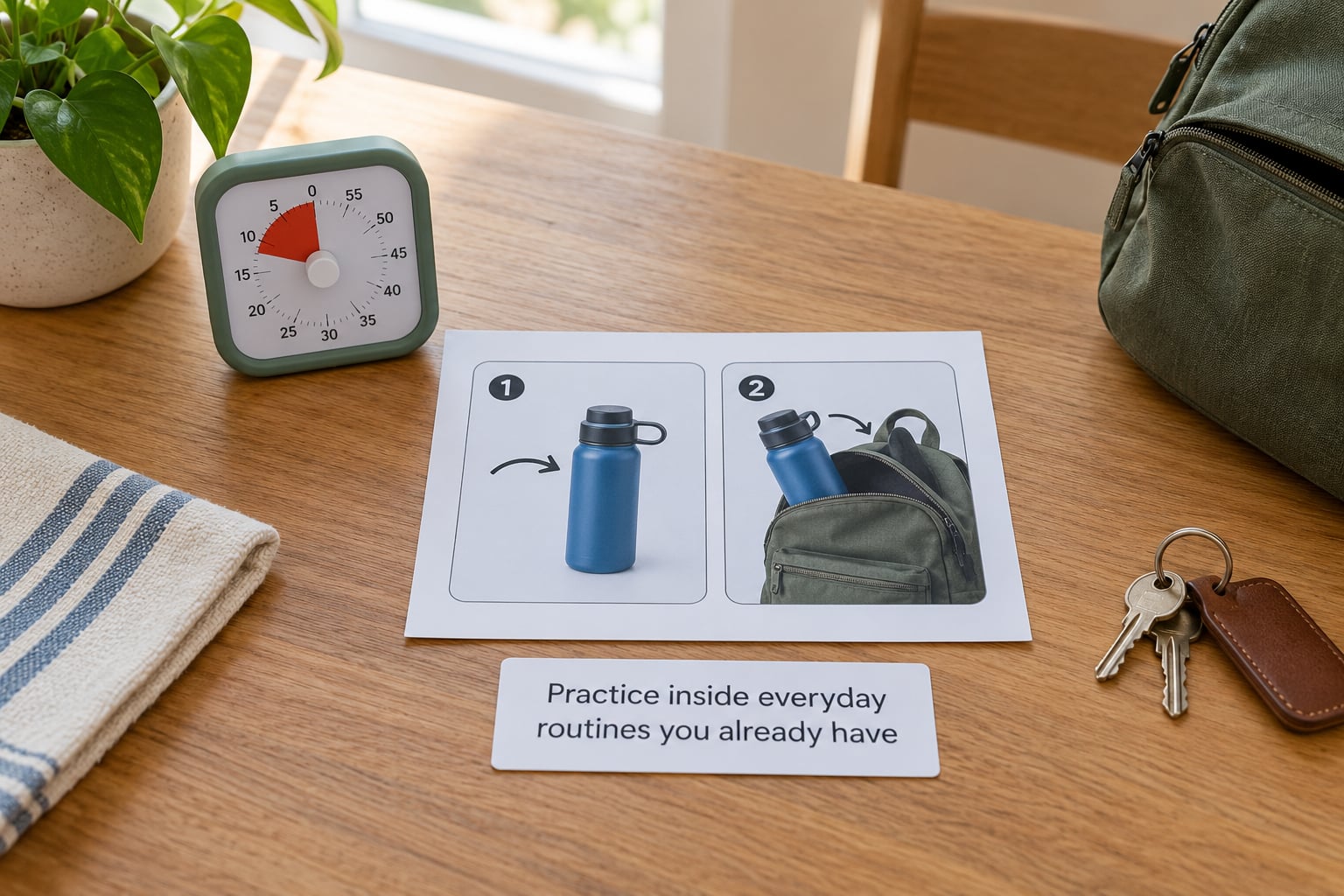
Cleanup time, getting dressed, meals, and transitions from one activity to the next are where real listening happens. Borrow those moments instead of scheduling a lesson. Give one manageable direction, let the child act, and acknowledge the success right away.
Keep each step inside what the child can already do. If they reliably follow one step, practice making that one step longer before you add a second one.
5. Praise the process, not just the result
Generic praise gets tuned out fast. Specific praise does not, because it tells the child what to repeat. Say “You listened to both steps” or “You checked the picture card on your own,” within a second or two of the behavior.
Calm acknowledgment beats a big reward every time. Families who make every single success worth a treat teach the child that ordinary life is not worth showing up for, and they teach nothing else. A specific word costs nothing and travels well.
When a reward does fit the plan, talk it through with the child’s teacher or therapy team first so home and school are saying the same thing.
6. Increase from one step to several
To move up, join a familiar first step to a second one and keep the exact same words and order every time. “Shoes on, then coat on.” Practice until it is routine, then lengthen.
Rough expectations by age, if you need a place to aim:
- Ages 2 to 3: one step at a time, eight words or fewer, with a gesture and a long pause.
- Ages 3 to 4: one step reliably, and two steps about half the time.
- Ages 4 to 5: two short steps most days, with a picture checklist for three-step routines.
- Ages 6 to 7: three steps with one connecting word such as “then,” still rehearsed in a fixed routine.
- Ages 8 to 10: three to four steps, including directions that are not spoken first, like a written note on a clipboard.
Only step up when the child completes the shorter version with decreasing support. Going backwards for a week is normal and does not mean the method failed.
7. Check for independence and know when to get help
Keep a simple record on the fridge: which direction, which support level, which routine. Mark each try as independent, needed a gesture, needed a picture, or needed an adult model. Two weeks of notes tells you far more than a bad afternoon does.
Reach out to a pediatrician, audiologist, speech-language professional, occupational therapist, or the school team when you notice hearing loss, language that is not growing, a marked gap between what a child understands and what they can hold in memory, or difficulty across more than one setting. Early support tends to make everything else on this list easier.
Common Mistakes
Giving three directions at once. “Get your shoes, then grab your jacket, then wash your hands” is three memories in a row. Fix: one direction per turn of the routine, and say plainly what the next one will be only after the first is done.
Repeating the command too fast. Repeating three times in five seconds teaches nothing and teaches urgency. Fix: one instruction, then a genuine pause of five to ten seconds.
Using vague language. “Get ready” means nothing to a child. Fix: name the object and the action, “put on your blue socks,” then “shoes.”
Piling on negative instructions. “Don’t run, don’t touch that, stop it” is three things a child must hold in mind at once. Fix: say what to do instead, “walk down the hall with me.”
Correcting constantly. A child mid-attempt is doing executive function work, and they are usually already annoyed with themselves. Fix: stop narrating every error, wait for the end of the attempt, then give one short correction.
Practicing only when everyone is already upset. Direction following cannot be learned in the middle of a meltdown. Fix: practice during calm, boring parts of the day, and if the after-school window is always the hard one, check with your child’s team about whether a transition warning helps.
Dropping visual support too soon. Pulling the picture away while the child still needs it reads as being set up to fail. Fix: fade one piece at a time, and only after several good tries.
Adults not matching each other. When one caregiver gives a warning and another gives a three-step lecture, the child learns that directions are arbitrary. Agree on one version of the routine, one signal, and one phrase across the house, grandparents included. If homework is the sticking point, my article on helping a child with homework meltdowns has a framework you can share with the whole team.
One more thing worth doing: if the child understands a second language better, give the direction in the language they hear most clearly at home. Understanding is the goal, not vocabulary testing.
Frequently Asked Questions
At what age should a child be able to follow directions?
Most toddlers handle one short step reliably around age two, and add a second step somewhere between three and four. By five, many children manage two short steps most days. By seven, three steps with a connecting word is a reasonable target. These are averages, not deadlines, and a child who is bright in language but slow with transitions may sit further back without anything being wrong.
How long should I practice with my child each day?
Five to ten minutes, most days, beats a long weekly session. Short repetitions during routines work better because the skill is not being drilled in isolation. Keep it positive and stop while things are still going well. If practice starts producing tears most days, the steps are too long or the moment is too stressful.
What do I do when my child refuses to follow directions?
Lower your voice rather than raising it, get down to eye level, and restate one simple direction while you wait. Try naming what you need, not what you do not want: walk instead of do not run. If the child is already flooded, regulate first and reteach later. Repeating, lecturing, and adding consequences in the heat of the moment rarely teaches anything.
Do picture cards and visual schedules really help?
For many children, yes, especially autistic children, children with ADHD, and children with auditory processing differences. A picture card or written checklist turns a spoken instruction into a visible one, which reduces the load on working memory. Introduce one support at a time, pair it with the spoken direction, and fade it slowly rather than removing it once the skill appears.
When should I ask a professional for help with listening skills?
Reach out when you notice hearing loss, language that is not growing, or a consistent gap between what a child seems to understand and what they can hold on to. It is also worth raising with a pediatrician or school team if difficulty shows up in several settings rather than one, or if frustration and anxiety around tasks are growing. Early support tends to make home practice easier.
A Gentle Place to Begin
Start with one direction your child already understands, model it once, and practice for two minutes inside something you were doing anyway. Name what you saw, repeat the same routine for a week, and only then consider adding a second step. If hearing, language, or memory concerns keep showing up, talk with your pediatrician or your child’s school team rather than pushing harder at home.