

To help an autistic child cope with changes in routine, you give clear early notice, show the new sequence visually, keep a few anchor routines untouched, and offer familiar sensory supports. Children who get a two-minute warning handle a change far better than children who are surprised, even when the change itself is small.
Routine changes are rarely optional. Therapy gets cancelled, a teacher changes at the end of term, a sibling gets chickenpox, snow closes school for three days, the van breaks down outside the city. You cannot prevent them, so the goal is to make the unfamiliar predictable.
What follows works for toddlers through teens, though the wording and the tools shift with age. It also works for non-speaking children, where the visuals carry most of the load. Parents on the r/Autism_Parenting and r/AutisticParents communities describe the same pattern again and again: consistency and follow-through do more than any single technique.
One note before you start. This is general information, not medical advice. If routine changes trigger severe distress, sleep disruption, or loss of skills, bring it to your child’s pediatrician, occupational therapist, or school team rather than working it out alone.
Table of Contents
- What You Need
- Step-by-Step: How to Help an Autistic Child Cope With Changes in Routine
- Step 1: Identify What Is Changing
- Step 2: Give Clear, Early Notice
- Step 3: Show the New Routine
- Step 4: Practice Before the Change
- Step 5: Prepare Sensory and Regulation Supports
- Step 6: Make the Transition Concrete
- Step 7: Follow Up and Adjust
- Common Mistakes
- Frequently Asked Questions
- How much notice should I give my autistic child about a change in routine?
- What should I do if my autistic child’s routine changes unexpectedly?
- Can a visual schedule help my autistic child cope with changes?
- How can I help an autistic child during a change-routine meltdown?
- Should I keep the rest of the routine the same when one activity changes?
- When should I ask a doctor, therapist, or school team for help with routine changes?
- Start With One Small, Predictable Change
What You Need
You do not need a stack of new products. You need four things, and most families already have three of them.
- A simple change plan. One page, or one card. What is changing, when it starts, and what stays the same. Written down, because stressed caregivers forget what they promised.
- Your child’s known sensory and communication needs. What overloads them, what calms them, how they tell you something is wrong if they cannot use words.
- A predictable way to give notice. A word you always use, a visual timer, a written note, a picture, or a specific phrase. Consistency matters more than the format.
- Support tools your child already accepts. Headphones, a fidget, a weighted blanket, a comfort item, a quiet corner, a communication app. New tools introduced during a disruption usually get rejected.
If your child uses AAC or a communication device, add the specific words or icons you will need to the change plan. Rereading how to help an autistic child sleep through the night is worthwhile if the disruption is likely to affect nights, which it usually does within a day or two.
Step-by-Step: How to Help an Autistic Child Cope With Changes in Routine
Step 1: Identify What Is Changing
Most families over-explain and under-target. Separate the actual change from everything around it. If the therapy appointment on Tuesday is cancelled, the change is one appointment, not the whole afternoon.
Write down three columns: what is changing, what stays exactly the same, and what is uncertain. The third column is the honest one, and naming it prevents a dozen small surprises later.
How to adapt it: For a school-age child, list people, place, and start time. For a toddler, list the single activity. For a teen, list the social expectation that changed.
How to tell it is working: Your child can state or point to one thing that is different, and gets the rest right. If they are focused on details that did not change, the plan is too broad.
Step 2: Give Clear, Early Notice
Give as much warning as the change allows, not as much as feels comfortable. Two minutes of warning genuinely reduces resistance, and parents on parenting forums report that even a short heads-up makes the following ten minutes bearable.
Say it in plain, concrete language. “We are going to the park, then home. The splash pad is closed. After the park we come straight home.” Avoid “big news” and “we need to talk later.” Both are famously bad opening lines with autistic children.
How to adapt it: Younger children get a countable warning, like a 10-minute visual timer. Older children and teens get the reason and the plan, because an unexplained change with no reasoning is harder to accept. Non-speaking children get the notice as a picture, a written card, or a pre-recorded voice message.
How to tell it is working: There is no immediate protest, or the protest is small and short. If the reaction escalates each time you add detail, you are giving too much information at once. Cut it in half.
Step 3: Show the New Routine
Show the changed part of the day while leaving every familiar step in place. Autistic children read sequences, not concepts, so the visual is doing the work your words cannot.
There are three reliable formats. A first-then board works for a single swap. A full day schedule with the changed card swapped out keeps the child oriented inside the rest of the day. A countdown calendar handles changes that are days away, with you crossing off each day as it passes.
Reference points beat clock times for many children. Morning tea, then lunch, then home travels better than 10am, 12:30, 1:15, because a delayed morning does not break it.
How to adapt it: Laminated picture cards on a strip, a whiteboard, a printed schedule in a pocket, or a calendar app the child checks themselves. Older children often prefer a written list or a shared note in a group chat. Teens sometimes manage their own reminders better than you do.
How to tell it is working: Your child finds the changed card without help, or asks you where it is. That is a good sign, not a bad one. It means the schedule is doing the explaining so you do not have to.
Step 4: Practice Before the Change
Practice when your child is calm and receptive, not on the day. Rehearsal turns an abstract explanation into something familiar, which is the whole point.
Options that work in real homes: pretend play through the exact sequence, photographs of the new location or the new people, a short early visit before the real thing, a social story read several times over several days, or a video of you walking through the steps yourself. Video modeling is the least common of these and often the most effective with school-age children.
Keep the practice short. Two minutes, done repeatedly, beats twenty minutes once. A social story read the night before and again in the morning does more than a ten-page story read once a week.
How to adapt it: A preschooler might practice the new shoes for ten minutes indoors. A school-age child might role-play the handoff at a new classroom door. A teen might rehearse an explanation for a classmate.
How to tell it is working: On the day, the change meets recognition rather than surprise. You see a pause and a look, not a refusal. That pause is a good outcome, and stopping there is fine.
Step 5: Prepare Sensory and Regulation Supports
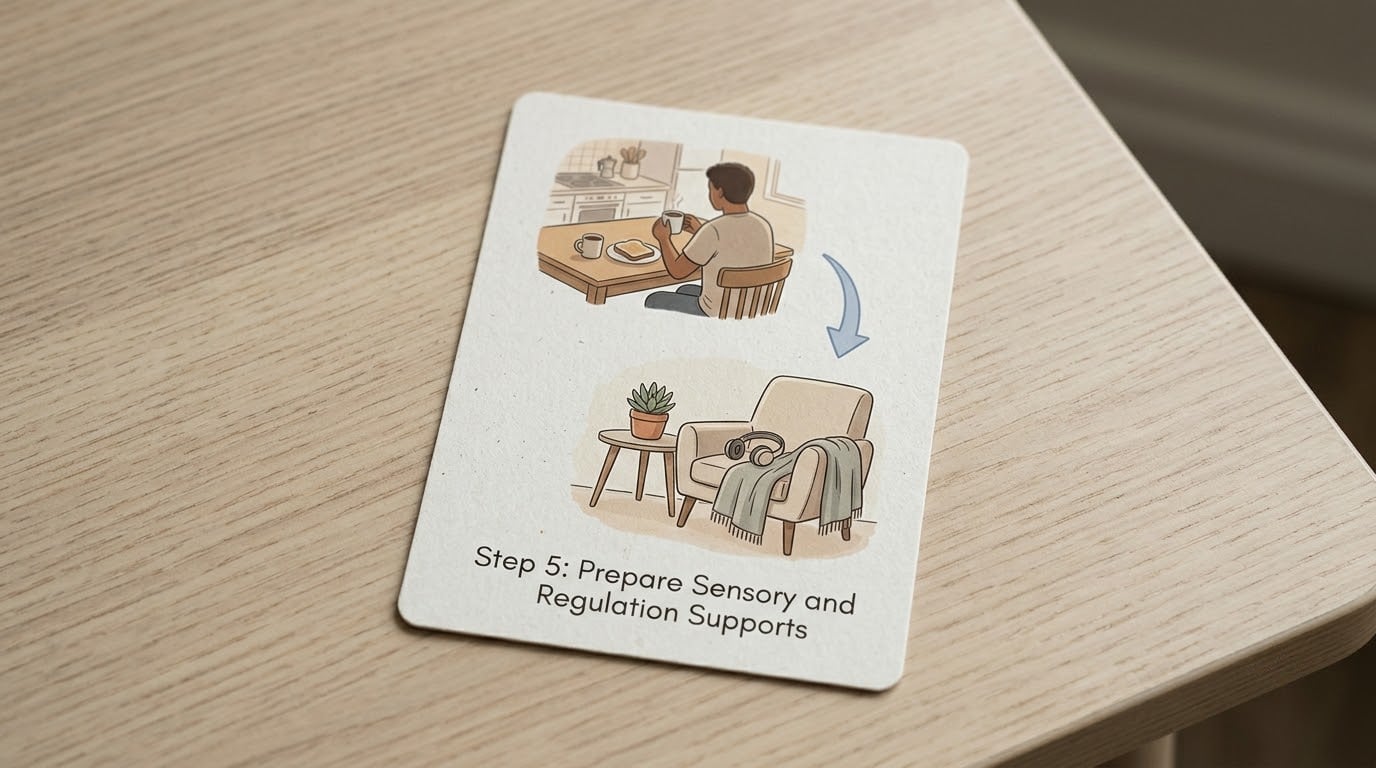
Anticipate the sensory side before it arrives. What is loud, bright, crowded, cold, or unpredictable at the new plan, and what does your child reach for when it is too much?
Have the supports within reach rather than fetching them during the peak. A quiet corner with a blanket, noise-reducing headphones, a familiar fidget, a cool drink, a heavy lap pad, or a chair in a low-traffic spot of the room. Each of these needs to already be established, because introducing a new regulation tool during a crisis does not work.
Movement is often the fastest regulation tool available. A 10-minute dance party, a wall push, a lap bounce, or a walk around the block beforehand can head off a lot of difficulty. It is far easier to do than to catch.
Keep a small coping toolbox your child builds with you, so the tools belong to them rather than being imposed. Most families end up with a pouch of three or four things that travel everywhere.
How to adapt it: Ask your occupational therapist which supports match your child’s actual sensory profile rather than guessing from a list. A child who seeks input and a child who avoids it need opposite things, and mixing them up makes things worse.
How to tell it is working: Your child reaches for a support on their own. That is the goal, and it takes longer than most parents expect. Some children take months.
Step 6: Make the Transition Concrete
At the moment of change, give one short instruction, not a paragraph. Use the same warning phrase every time so it means something on its own. “Five more minutes of the park, then the car.”
Use a visual timer rather than an announcement. When the bar runs out, the thing happens, and the child watched it happen rather than being told it happened. Then allow silence. Autistic children often need ten to thirty seconds of processing, and repeated instructions during that window usually restart the whole process.
Reduce demands where you can. The move from a park to a car can be one change or three, and combining them is kinder. Then protect the anchors: mealtimes, the bedtime sequence, the bath, the particular order things happen. If one thing has to move, choose something that matters less and keep the rest.
How to adapt it: If verbal instructions fail, hand over the card, the symbol, or the icon. If the child is overloaded, drop all instruction entirely and just stay close. If the change is unavoidable, offer a real choice within it, like which of two songs plays in the car, which restores a sense of control over something that is not actually controllable.
How to tell it is working: Fewer repetitions, less recovery time afterward, and a quicker return to baseline. Track the recovery time rather than the behavior. That is the number that shows progress over weeks.
Step 7: Follow Up and Adjust
Check in without demanding an immediate explanation. A child who just navigated a change rarely wants to debrief about it, and pushing for a verbal account often produces a flat one.
Notice what actually worked. Most parents can feel which support made the difference, and writing it down is how the next disruption gets easier. Keep a short log for two weeks: what changed, what you did, how long recovery took. After a few entries, patterns appear that intuition alone misses.
Then plan for the school side. Teachers and aides need the same approach you use at home, and consistency across environments is what makes the skill generalize. If school changes are a recurring source of distress, how to handle school refusal in an autistic child covers the daily version of the same problem.
How to adapt it: Younger children show growth in the moment, so watch for the pause instead of the farewell. Teens may want to debrief days later, or not at all, and both are fine. A nonverbal child shows you through reduced recovery time and fewer distressed mornings.
How to tell it is working: The same change six weeks ago ends in distress, and now it ends in a pause and recovery. That is the whole measure.
Common Mistakes
Waiting too long to explain. The most common error, and the easiest to fix. Telling a child about a change on the way to it leaves no processing time. Move the conversation back as far as you can, even to a heads-up that something is coming before you know what it is.
Assuming visual schedules always work. A schedule is a tool, not a treatment. If your child ignores the board, the board is probably too long, too abstract, or placed where they cannot see it. Try a three-card version on a first-then board before adding detail back.
Changing too many things at once. A new school, a new therapist, and a new bedtime in the same month is three changes, not one. Most families do better morphing one routine gradually into another than replacing everything at once. Stack the changes, and the visible distress rises sharply.
Forcing a distressed child to continue. Once regulation is gone, instructions do not land. Reducing demands is not giving up, and pushing through often adds an hour to the total. That is the same guidance pediatric and clinical sources give for sensory overload generally.
Treating a smooth transition as proof nothing happened. A quiet afternoon after a hard change can look like success and still leave your child depleted for a day or two. Watch the following night, not the transition itself.
Reinforcing the wrong thing. Praise the coping, specifically and immediately, not the compliance in general. “You used your headphones by yourself and got through it” teaches something. A blanket “good job” does not.
On a practical note, if school routines shift often, it is worth asking how your child is managing the classroom pace alongside the changes. Our guide to helping a child keep up with classroom pace covers the transitions inside a school day that most adults overlook.
Two things are worth raising with the team rather than handling alone. First, OCD is common alongside autism, and it makes routine interruption much harder than the autism alone would. Second, any new or worsening anxiety, sleep regression, or loss of skills deserves a conversation with the pediatrician, an occupational therapist, or the school team. Those are signals, not parenting failures.
Frequently Asked Questions
How much notice should I give my autistic child about a change in routine?
As much as the change allows, and earlier feels better than later. When you learn about a schedule change, tell your child right away even if the details are not settled, because the warning itself is what reduces anxiety. Two minutes of notice is genuinely useful, and days of notice is better when the change is planned. Give the reason as well as the fact, and repeat the same information in the same words rather than adding new detail each time.
What should I do if my autistic child’s routine changes unexpectedly?
Keep the anchor parts of the day exactly where they are and change only what has to change. Say what happened in one short sentence, show it on the schedule or first-then board, and offer a real choice within the part you control. Stay calm and close, reduce demands, and lower the bar for what a good outcome looks like today. Recovery is normal, and the pattern usually improves with repetition.
Can a visual schedule help my autistic child cope with changes?
Yes, and it is one of the most reliable supports available, because a schedule turns time and sequence into something a child can read instead of infer. The key is showing what changed while leaving familiar steps in place, so the change sits inside a known day rather than replacing it. If your child ignores the schedule, shorten it or try a first-then board, and use reference points such as meals rather than clock times.
How can I help an autistic child during a change-routine meltdown?
Reduce sensory input first, by lowering noise, dimming lights, or moving to a quieter spot. Say one short validating line such as u0022I know this is hard,u0022 then stop talking, because instructions during a meltdown rarely land. Offer comfort without forcing contact, keep supports like headphones or a weighted blanket available, and make sure everyone nearby is safe. Wait it out, then plan the next disruption more carefully rather than treating this as a failure.
Should I keep the rest of the routine the same when one activity changes?
Yes. Predictable anchor routines such as meals, bath, and the bedtime sequence are what make a disruption survivable, so protect them deliberately and change something less important instead if you have to. Mark the changed item clearly on the visual schedule so your child can see that one thing is different and everything else is not. Most children calm faster when the rest of the day is visibly unchanged.
When should I ask a doctor, therapist, or school team for help with routine changes?
Reach out when distress is intense, lasts hours or days, or is happening several times a week, and whenever you notice sleep changes, regression, new anxiety, or loss of skills. Ask the school team for help when transitions at school trigger the difficulty, since they can adjust the environment and share the plan with other staff. An occupational therapist can match sensory supports to your child’s profile, and a behavioral therapist can build a gradual practice plan.
Start With One Small, Predictable Change
Pick the next change that is coming, however ordinary. Tell your child only what is genuinely necessary, show it on one visual or written support, and protect two or three anchor routines. Then notice what happened, especially how long recovery took.
That is enough for this week. Progress on flexibility skills is slow and uneven, and it usually shows up as a shorter recovery rather than a calmer morning, which is a harder thing to notice but a real one. Parents who keep a two-week log of changes and recovery times tend to see the pattern sooner than the rest of us.
And if you are autistic yourself, or managing a hard week of your own while supporting your child through a change, your own support matters here too. Caregivers who are running on empty cannot deliver the calm they are aiming for, so build your own plan in parallel rather than last. Updated for 2026.