Masking in autistic girls is the effort a girl puts into hiding or holding back her autistic traits so she seems to fit in at school, at home and around other people. It can look like eye contact, small talk, good grades and easy friendships, while the whole thing runs on constant, exhausting effort that nobody around her can see. Below I break down what masking actually is, why girls lean into it harder, the signs worth paying attention to, and what parents can do at home and at school to lower the cost.
This is general information to help you notice patterns and start better conversations, not a way to diagnose your daughter. If what you read here matches something you have watched for months, the next step is a conversation with her pediatrician or a developmental psychologist.
Table of Contents
- What Is Masking in Autistic Girls?
- Why Do Autistic Girls Mask?
- Fear of being the difficult one
- Gender expectations that mirror autistic traits
- Family reactions to the real her
- Pressure to smooth things over
- Common Signs of Masking in Autistic Girls
- Signs in a young child, roughly ages three to six
- Signs in a school-age child, roughly ages seven to twelve
- Signs in a teenager
- How Masking Differs From Camouflaging and Social Skills
- What Masking Can Look Like at School and Home
- At school
- At appointments and family gatherings
- At home, and online
- How the pattern shifts with age
- How Parents Can Support a Girl Who Is Masking
- Stop rewarding the performance out loud
- Ask open questions and let the silence sit
- Protect recovery time
- Let interests be ordinary
- Build bridges at school
- When to Talk With a Professional About Masking
- Signs worth booking an appointment over
- Who to see and what to ask
- Ask about the conditions that travel with masking
- Frequently Asked Questions
- How do autistic girls mask their autism?
- How can you tell masking apart from being shy?
- At what age does masking start in autistic girls?
- What happens when an autistic girl stops masking at home?
- Can masking cause autistic burnout?
- How do I get an assessment when my child copes well at school?
- What to Do First
What Is Masking in Autistic Girls?
Masking, also called social camouflaging, is the conscious or unconscious hiding of autistic characteristics so a girl reads as neurotypical. Suppressing stimming, forcing eye contact, rehearsing what to say, copying how peers move and talk, and pushing through sensory overload without saying anything are all part of it.
Some of it is deliberate. A girl learns that the class laughs when she jokes in the right way, so she practises jokes. Some of it is learned so thoroughly it feels automatic, the way anyone learns to answer a question in a classroom. Girls describe living in what one writer on a women-and-autism forum called a human suit, updating their responses in real time like software running in the background.
That is why masking is easy to miss. From the outside, the child is compliant, quiet and pleasant. The cost only becomes visible at the moment the performance stops, usually at the front door.
Why Do Autistic Girls Mask?
Girls mask because fitting in is rewarded more often than being understood. Boys who stim, interrupt or line up their toys are sent for assessment. A girl who does the same things is told to stop fidgeting, be ladylike and quiet it down, so the message she absorbs is that her autistic traits are the problem and compliance is the fix.
Fear of being the difficult one
Bullying, exclusion and criticism are powerful motivators. A girl who watched another child get teased for being odd learns quickly which parts of herself are safe to show. Over years, that lesson becomes a system.
Gender expectations that mirror autistic traits
Girls are often expected to be passive, quiet, well behaved and agreeable. Those expectations overlap with traits that get flagged as autistic in boys, so a girl who is naturally reserved, literal and rule-bound can slip under every radar simply because her presentation matches the stereotype of a good girl.
Family reactions to the real her
Special interests and stimming are the most common triggers. One woman described how her family mocked her interest in a particular fashion style, so she hid everything about it. When a child learns that the authentic self invites teasing or a lecture, the authentic self goes quiet.
Pressure to smooth things over
Hyper-empathy plays into this too. Girls who feel other people’s feelings strongly can become people-pleasers, absorbing conflict to keep the room calm. Adults often praise this as maturity, which makes the cost of maintaining it invisible right up until she falls apart.
Common Signs of Masking in Autistic Girls
Masking usually looks like good behaviour rather than like a struggle. These are the patterns parents describe most often, and none of them on their own means a child is autistic.
Signs in a young child, roughly ages three to six
At this age masking is mostly imitation and appeasement. You might notice a child who keeps still in circle time, holds in the urge to fidget, or answers questions with a rehearsed phrase instead of what she actually thinks. Watch for a child who never asks for a break, sits through noise that visibly bothers her, or becomes very quiet the day a school event is on the calendar. Some small children also copy characters from a TV show as a template for how to behave, using those scripts as a manual for everyday interactions.
Signs in a school-age child, roughly ages seven to twelve
This is where performance sharpens. A girl may keep a careful circle of friends she watches closely before joining in, follow conversation rules she has memorised, and hide a special interest because she worked out it was not socially acceptable. Look at what happens after school: an abrupt collapse, tears within minutes of getting home, or a meltdown that lands exactly on the days she had a lot of social contact. Teachers say she coped well and behaved all day. At home she cannot hold it together. That gap is the single clearest clue.
Signs in a teenager
Teenage masking adds strategy and insight into the people watching. A teenager might scan a room to work out the expected affect and match it, avoid talking about her interests unless prompted, disclose very little about her internal state, and become flat or irritable in the evening. Depression, anxiety, panic around school, loss of interest in things she used to enjoy, or sudden school refusal often show up alongside heavy masking at this age.
How Masking Differs From Camouflaging and Social Skills
The terms get used interchangeably, but research on camouflaging separates it into three layers, and the layers cost different amounts of energy. Compensation, masking and assimilation are not separate diagnoses; they are degrees of how far a child goes to present as neurotypical.
| Strategy | What it looks like | What it costs |
|---|---|---|
| Compensation | Learning social rules and scripts so she can navigate interaction, for example rehearsing conversations or using learned phrases | High mental effort, but she still shows her real preferences and interests |
| Masking | Hiding autistic behaviours such as stimming, suppressing interests, faking eye contact and controlling volume or tone | More effort, plus the sense that the real self is unacceptable |
| Assimilation | Passing as fully neurotypical, editing herself so thoroughly that preferences, needs and even her voice tone shift around other people | Highest cost, often with exhaustion, dissociation and burnout afterwards |
Social skills are a separate thing. A child can have strong social skills and still mask, because the skills are being deployed to hide something rather than to express what she wants. That is why a girl can be genuinely popular and still fall apart every evening.
Researchers have also noticed what gets called linguistic camouflage. Highly masking girls tend to use fewer filler sounds and less filler vocabulary than their peers, producing speech that sounds unusually tidy and edited. It is a subtle marker, not a diagnostic tool on its own, but it fits alongside everything else.
Autistic people sometimes talk about the six second rule: the sense that you have about six seconds to process a question and react before the room has moved on. A girl who cannot pause to process in real time learns to grab an answer fast, which is exactly how fluent, prepared responses get built.
What Masking Can Look Like at School and Home
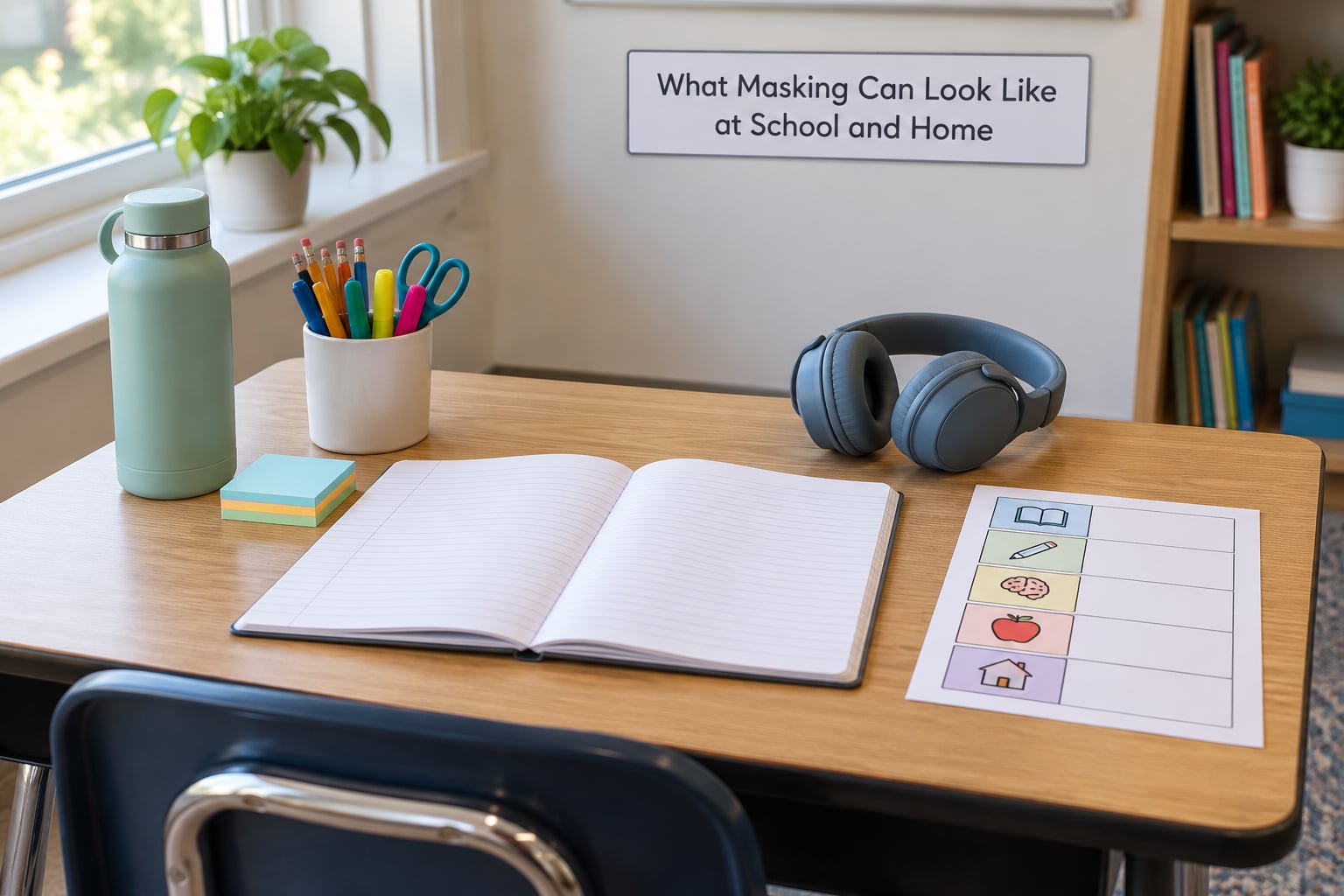
The clearest pattern is a full day of performing followed by collapse the moment she gets home. This is often called after-school collapse or restraint collapse, and parents describe it as the girl holding everything together until the door closes.
At school
Watch for physical complaints that only happen on school days, for eating lunch in a quiet place rather than socially, for permission to leave the room often, for the child who never has her hand up but performs well, and for the tidy, low-trouble student whose desk is organised around avoidance rather than interest. A girl who can describe exactly what each teacher expects has been studying people, not just subjects.
At appointments and family gatherings
Clinicians and relatives often see the best version. Parents sometimes hear from a doctor that everything seems fine, then watch their daughter dissolve in the car afterward. Long family gatherings, where polite conversation and turn-taking run for hours, are a classic pressure point.
At home, and online
Home is where the mask usually comes off, which is why it is the most informative place to look. Low-demand screen time is often the only genuinely relaxing part of her day, which is a useful clue about what her nervous system actually wants. If you are setting limits around that, our guide to setting screen time rules for autistic kids covers how to keep the boundary without treating rest as something she has to earn.
How the pattern shifts with age
| Age or stage | Typical picture | Where the cost shows up |
|---|---|---|
| Preschool | Imitates peers or TV characters, suppresses movement to keep the room calm | Tantrums after stimulating activities |
| School-age | Scripts, small-talk rules, hidden interests, a careful friend group | After-school collapse, panic, sensory avoidance |
| Teen | Room-reading, affect matching, very little disclosure, polished outside | Depression, anxiety, school refusal, burnout |
| Adult | Workplace masking, lost friendships, exhaustion that ends jobs | Burnout, misdiagnosis as anxiety or depression, late diagnosis |
How Parents Can Support a Girl Who Is Masking
Support means lowering the cost of being herself, not asking her to cope harder. A few practical shifts tend to matter more than a long list of strategies.
Stop rewarding the performance out loud
Praise her effort and her mind, not her compliance. Telling a girl how proud you are that she made eye contact all afternoon teaches her that the real version was not worth liking.
Ask open questions and let the silence sit
Try how hard was today on a scale of one to ten, and let her answer. Debriefing questions asked in the car, while she is still in transition, tend to produce one-word answers. A quieter question at the kitchen table works better.
Protect recovery time
Do not schedule the evening after a heavy social day. Low sensory input, a snack, movement of her choosing and no homework for an hour is a reasonable trade.
Let interests be ordinary
Treat her special interests as a topic worth knowing rather than a quirk to survive. If she has kept one hidden for years, that is a sign about our safety, not about her.
Build bridges at school
Accommodations written down, a named adult she can go to, and a way to signal that she needs a minute matter more than she says out loud. If friendships are the hard part, our piece on helping an autistic child make friends at school covers one-to-one play and interest-based activities. Whatever route you take, how to tell your child they are autistic is worth reading before the conversation, so you are ready for whatever she says back.
When to Talk With a Professional About Masking
Talk to a professional when the cost of masking shows up as distress, withdrawal or a drop in how she is functioning. Waiting for proof is how masking gets missed for years.
Signs worth booking an appointment over
- After-school or after-work collapses that are getting more frequent
- Sleep problems, stomachaches or headaches that cluster around school days
- Loss of interest in activities she used to enjoy
- Withdrawal from people, or a sudden end of friendships
- School refusal, panic, or a sudden drop in grades in a child who was managing
- Statements about being a burden, wanting to disappear, or not being worth the effort
If any of the last line shows up, treat it as urgent and contact a crisis service or emergency department.
Who to see and what to ask
A pediatrician can refer to a developmental psychologist or a child psychiatrist. Ask explicitly whether the clinician knows about masked presentations and whether they will hear from you alone. Bring notes on the collapse at home versus the report from school, because that contrast is often the most useful piece of information you can give them. A CAT-Q, the Camouflaging Autistic Traits Questionnaire, is a screening tool used with adults, and there are versions aimed at families, but it never replaces a proper assessment. An occupational therapist can also help with sensory and daily-living demands that masking tends to hide.
Ask about the conditions that travel with masking
ADHD, anxiety and disordered eating show up alongside autism often enough that clinicians should look, but each can also be mistaken for a masked presentation. Treat an unexpected anxiety or eating disorder diagnosis as a prompt to reassess autism, rather than as the final word.
Frequently Asked Questions
How do autistic girls mask their autism?
Autistic girls mask by hiding traits that attract attention: suppressing stimming, forcing eye contact, rehearsing small talk, copying how peers move and talk, hiding special interests and pushing through sensory overload without saying anything. The result is a child who looks easy to work with while running on constant mental effort. Girls describe the experience as living in a human suit and updating their answers in real time like software in the background.
How can you tell masking apart from being shy?
Shyness fades when a child feels safe. Masking stays switched on and gets more sophisticated as the child grows. Look for the contrast between settings: a girl who is calm and chatty at home but exhausted after a school day, or who prepares carefully for every social situation, is more likely masking than simply being shy. Neither can be diagnosed from behaviour alone, so talk to a qualified clinician about your specific child.
At what age does masking start in autistic girls?
Masking usually begins as imitation in the preschool years, often around ages three to six, when a child learns to copy peers or characters from television. It sharpens through the primary school years as social rules get more complex, and a teenager typically adds room-reading and affect matching on top. Early imitation is easy to miss because it looks exactly like a well-behaved child developing social skills.
What happens when an autistic girl stops masking at home?
Many girls only unmask at home, where there are fewer people to perform for. What you may see is stimming, flat affect, blunt comments, sensory seeking, difficulty with transitions, or simply deep silence. Some adults say they cannot drop the mask even when they are alone. This is often described as restraint collapse or after-school collapse, and it is a sign that the mask was working hard, not that she is being difficult.
Can masking cause autistic burnout?
Yes. Sustained masking is a large ongoing demand on attention and self-regulation, and many autistic people describe burnout as the result of holding a mask for long stretches without recovery. Signs include exhaustion, reduced capacity to cope, loss of skills or interests, increased distress, and shutdowns. Burnout in autistic people can look like depression but needs a different approach, so tell any clinician about the masking before treatment starts.
How do I get an assessment when my child copes well at school?
Ask for a developmental evaluation rather than a school behaviour check, and describe what you see at home instead of what the school reports. Bring written notes of after-school collapses, sensory responses and recovery times, since the contrast between your account and the school impression is often what tips a clinician toward a deeper assessment. A CAT-Q is a screening tool used with adults and there are family versions, but neither it nor a school report can stand in for a full assessment.
What to Do First
Notice the effort behind the coping. If your daughter is bright, tidy, quiet and managing well, that is worth paying attention to rather than relaxing about.
Ask her what helps and what costs the most, then listen without fixing anything. Pick one avoidable demand and remove it this week, such as a trip, a sport or a nightly routine. And when the masking is affecting sleep, school or mood, book the appointment instead of waiting for proof that she cannot cope, because the collapse at home is the proof.