Teaching emotional regulation to kids comes down to one habit: you regulate yourself first, name the feeling, and only teach strategies when your child is calm enough to actually learn them. Emotional regulation is the developing ability to notice, understand, and respond to feelings in ways that fit the situation. It is not the ability to stay calm all the time, hide distress, or obey on the spot.
Children learn this skill through co-regulation, which simply means a calm adult does the work their nervous system cannot yet do alone. Most parents get this backwards and try to lecture in the middle of a meltdown, when no new learning is possible.
Two ideas run through everything below. All feelings are valid, and all behaviors are not. And you practice tools while calm, never mid-meltdown.
This guide covers what you need, seven steps in order, the mistakes that slow families down, and answers to the questions parents ask most. It also works for autistic children, children with ADHD, and children who shut down instead of acting out.
Table of Contents
- What You Need
- Step-by-Step: How to Teach Emotional Regulation to Kids
- 1. Help Your Child Notice Feelings Without Judgment
- 2. Teach a Simple Feelings Vocabulary
- 3. Practice Emotional Regulation With Role-Play
- 4. Co-Regulate Before Asking Your Child to Self-Regulate
- 5. Create a Calm-Down Plan the Child Can Understand
- 6. Rehearse the Plan During Calm Moments
- 7. Follow Up With Consistency and Repair
- Common Mistakes
- Frequently Asked Questions
- How can I teach emotional regulation to young children who cannot name feelings?
- What are the best calming techniques for a child who is overwhelmed?
- How do I teach emotional regulation to an autistic or sensory-sensitive child?
- Should I make my child take deep breaths when they are upset?
- How long does it take for a child to learn emotional regulation skills?
- When should I talk with my child’s doctor or therapist about emotional regulation?
- Conclusion
What You Need
Nothing special. You do not need a curriculum, a therapy program, or a printable budget. What you need is a place on your own body and a few minutes of a reasonably calm day.
These supports help, and all are optional:
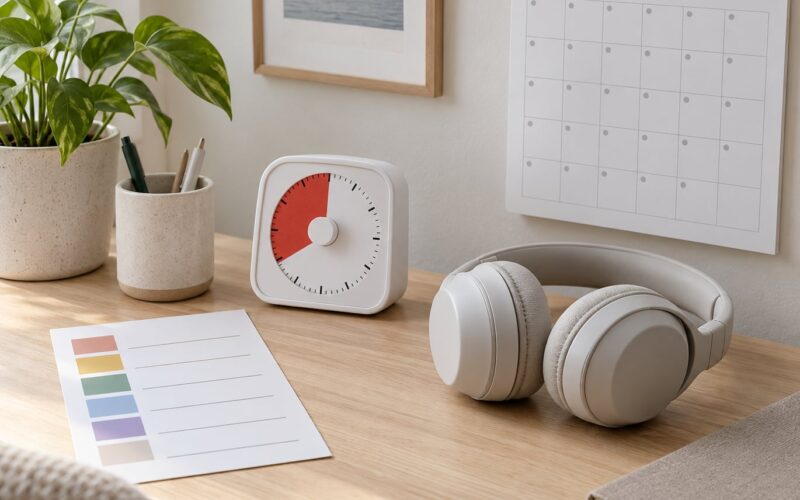
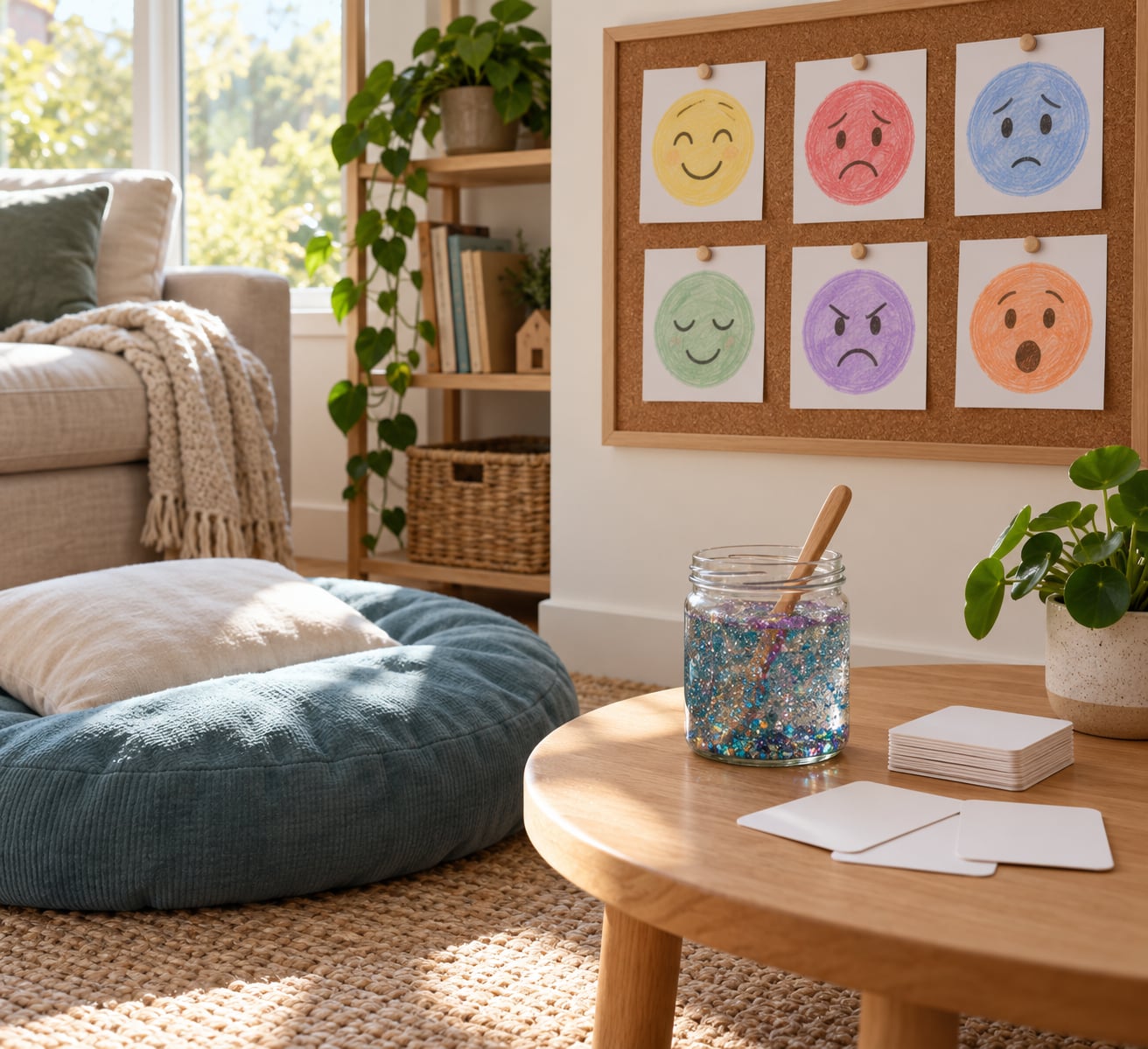
- A simple feelings chart you can draw on plain paper in two minutes. Faces work early; color words work with older kids.
- A calm-down space that is available without permission. A corner of the couch counts. It should not be a punishment and it should not be locked away.
- Picture or symbol cards for a child who has few words, uses AAC, or signs rather than speaks.
- A sensory tool or two such as a water bottle, playdough, a fidget, a wall to push, or music you know works.
- A short practice routine, three to five minutes, at a time when nothing is wrong.
If your child is autistic, has communication differences, or has sensory needs, the chart and cards matter more than the conversation. Keep sensory tools available without making the child ask or explain. Some autistic children find slow exhalation irritating rather than settling, and telling them to breathe is one more demand. Movement and heavy work often do the job instead.
Step-by-Step: How to Teach Emotional Regulation to Kids
The seven steps below run in order, but you will use the first four during a hard moment and the last three during calm ones. Most of the real teaching happens after a child has recovered, not during. Adjust the language to your child’s age and to how they communicate.
1. Help Your Child Notice Feelings Without Judgment
Start with body signals, because those show up before words do. Point out neutral observations: your cheeks are hot, your voice is going fast, your stomach is tight, your hands are squeezed shut. Then name the feeling without pinning a label on your child: your body feels tight right now.
You will know it is working when your child points to a chart, hands you a card, uses a sign, or says a single word like big or mad. That is a real skill, even if the word is inaccurate.
If your child will not engage, keep narrating anyway. One short comment a day, in the moment, over weeks, does more than a long conversation. Do not require eye contact or a verbal answer to keep teaching.
2. Teach a Simple Feelings Vocabulary
Pick six to eight feeling words and stick with them for months. Mad, sad, scared, happy, frustrated, lonely, tired. Pair each one with a picture, a gesture, a character from a story they love, or something that happened to them last week. A manageable list that is actually used beats a poster with forty faces.
Use the same words yourself out loud in ordinary moments. My shoulders are tense, I am irritated, I am nervous about that meeting. Toddlers learn vocabulary by hearing it used, not by being tested on it.
Progress looks like a child choosing a word unprompted, or accepting a card you offer. A preschooler may hold three or four feeling words reliably. A five-year-old often handles six to ten. Do not count these as rules, just as rough markers.
3. Practice Emotional Regulation With Role-Play
Rehearse the small frustrations, not the big disasters. Waiting for a timer, losing a turn, finding the wrong crayon, saying goodbye at the park. Use dolls, puppets, a comic you draw together, or a plastic cup and pretend play.
Model one calm response yourself, out loud: okay, I am frustrated too, and my voice stays in my body. Then hand over the puppet and wait a long time. Five slow seconds feels like a minute to you and like an eternity to them. When you want the child to see the same response more than once, our walkthrough of how to use video modeling to teach life skills covers recording a short clip and replaying it until it sticks.
How do you tell it is working? Your child starts using the phrase, or reaches for the tool. Expect mistakes and expect several rounds before anything transfers. Success is not staying calm every time. It is recovering faster and needing me less each week.
4. Co-Regulate Before Asking Your Child to Self-Regulate
Co-regulation means you help a dysregulated child become safe and ready to choose a next step. It is not the same as solving the problem or giving in. Keep it to four short moves, and give no more than two clear instructions in the heat of the moment.
1. Regulate yourself first. One slow breath out, longer than the inhale. Lower your voice. Drop your shoulders. If you are at your limit, say so plainly: I need one minute, and I am not leaving.
2. Lower the load. Reduce noise, light, and words. Move to a quieter spot if you safely can. Remove the audience, not the child.
3. Name and validate. Your body is really loud right now, and being angry is allowed. Hitting is not.
4. Set the boundary and offer choices. I am here to help when you have safe hands and feet and a regular voice. Feet on the floor, or the beanbag, whichever you pick.
A script parents like: I will not yell and I will not shame you. That line does more work than most advice I have read. Then wait. Silence while a child calms is hard to sit in, and it is usually where the work happens.
If your child rejects touch, gets more distressed by talking, or covers their ears, stop talking and simply sit nearby. Presence without words is still co-regulation. Some children shut down instead of lashing out; that is a shutdown state needing low-demand company, not more questions.
5. Create a Calm-Down Plan the Child Can Understand
Build it while calm, in words short enough for a child to repeat. Draw a three-step strip: notice, choose, try. Notice means my body is hot. Choose means pick one. Try means the tool on the couch.
Offer two or three options from several channels rather than one mandatory strategy:
- Body: five-finger breathing, wall push-ups, a short walk, jumping, water.
- Sensory: playdough, kinetic sand, a fidget, a weighted blanket or lap pad, a glitter jar to turn slowly.
- Connection: sitting on the sofa, a hug if wanted, a pet, a quiet talk with no questions.
- Thinking (later, when calm): emotion wheel, drawing, journaling, a break card.
Need ideas for the body channel? These proprioceptive activities for kids at home double as regulation practice, because heavy work settles a wired nervous system better than another reminder to sit still.
No single tool is a cure, and none of them works for every child. Test each one during an ordinary mildly frustrating moment and watch what actually helps. If deep breathing makes your child more agitated, take it off the list without guilt. What helps one nervous system annoys another.
Progress looks like your child asking for a tool unprompted, or choosing one from the drawn strip.
6. Rehearse the Plan During Calm Moments
This is the step families skip, and it is the one that decides whether a strategy works on a bad day. A child who knows a tool while calm but cannot reach it mid-meltdown is completely normal. Skill has to be rehearsed under low pressure so it can be retrieved under high pressure.
Practice once a day for three minutes: a pretend scenario, a song, a drawing of the three-step strip, or a real rehearsal of the next transition. Practice the transitions your family actually struggles with, like leaving the house, stopping a game, or getting into the car. Ordinary transitions cause more blowups than special events.
Add one strategy at a time and let it become boring before adding another. If your child cannot use two tools, they have one tool and a good week.
7. Follow Up With Consistency and Repair
Once your child has recovered, spend two minutes on it. What happened? What did your body do first? What could you try next time? Keep it curious rather than cross-examining, and skip the lecture about gratitude.
Teaching is not blaming. The test is whether your child gets curious about their own pattern, not whether they feel caught. Note what you see for two weeks: time of day, trigger, body clues, what helped. Patterns show up in the notes, not in the moment.
When you have the words, say what you should have done differently. Adults who model repair give children permission to repair too.
Seek a conversation with your child’s pediatrician, a child psychologist, or a therapist when dysregulation is constant across settings, when your child is hurting themselves or others, when they shut down for long stretches, when sleep or eating changes, or when your own stress is running out. Urgent help matters most in a crisis: in the United States, call or text 988 for the Suicide and Crisis Lifeline, or your local emergency number if someone is in immediate danger.
Common Mistakes
Expecting instant self-control. A child learning this skill needs years, not days. Fix it by tracking one small change, like recovering in five minutes instead of twenty, instead of tracking whether the meltdown happened.
Correcting behavior during dysregulation. Mid-meltdown, the brain is not online for reasoning. Fix it by moving teaching to step 7 and keeping the moment to connection plus two clear instructions.
Overloading them with feeling words. Forty faces on the wall produces a decorative wall. Fix it by using six to eight words for months.
Forcing eye contact or touch. Both can raise the alarm in a child who is already flooded, and both make a neurodivergent child shut down harder. Fix it by narrating beside them instead of demanding a face-to-face conversation.
Using one plan for the whole family. A calming corner that works for one child is a punishment for another. Fix it by offering a choice of two, every time.
Treating every emotion as a problem. Anger is information. Fix it by validating the feeling and separately naming the limit: the feeling is allowed, hitting is not.
Promising that a strategy will always work. It will not, on every day, and a child who learns that can feel personally broken when it fails. Fix it by keeping several tools in the menu and treating a failed attempt as information.
A few adjustments worth making. With toddlers, physical co-regulation comes first: holding, rocking, and soothing, with words later. With preschoolers, picture cards and two-step plans beat conversation. With school-age children, a written plan on the fridge works, plus a break card they can show a teacher. With tweens and teens, ask permission before coaching and narrate your own coping instead of lecturing. Screen transitions deserve their own plan, and our guide to setting screen time rules for autistic kids covers how to set limits without a nightly negotiation.
At school, ask the teacher which two signals mean dysregulation in that classroom and agree on the same two. Write it down, one page, and put a copy in your bag.
And take care of yourself. Your regulation capacity is the bottleneck, not your child’s character. Ten minutes of quiet before you walk into the room is a regulation strategy, not selfishness.
Frequently Asked Questions
How can I teach emotional regulation to young children who cannot name feelings?
Children who cannot name feelings can still show them, so start with the body. Say things like your cheeks are hot or your hands are squeezed shut, and offer a picture card or a gesture they can hand back to you. Narrate feelings out loud during ordinary moments rather than quizzing your child. Two years of hearing you name feelings matters more than one lesson.
What are the best calming techniques for a child who is overwhelmed?
When a child is overwhelmed, use your own calm voice, lower the noise and light, and give no more than two clear instructions. Movement often lands fastest: a walk, wall push-ups, or water. Then let the anger run for five to ten minutes while you keep the behavior boundary safe hands and safe feet. Teaching comes later, once your child has recovered.
How do I teach emotional regulation to an autistic or sensory-sensitive child?
Autistic children often need sensory tools available without having to ask for them, and some find slow exhalation irritating instead of calming. Replace deep breathing with movement, heavy work, or a fidget when breathing escalates them. Read stimming and withdrawal as regulation rather than misbehavior. Keep the language literal, skip eye contact, and give extra warning before every transition.
Should I make my child take deep breaths when they are upset?
Not always. For some sensory-sensitive or autistic children, counting or breathing out slowly adds a demand they cannot meet yet and makes them angrier. Watch what happens and take it off the list if it does not help. Five-finger breathing, movement, water, or quiet companionship may work better. The test is whether your child settles, not whether the technique looks right.
How long does it take for a child to learn emotional regulation skills?
There is no fixed timeline. Most children show gradual change over months and years, and progress looks like recovering faster or needing less help rather than never melting down. Children who struggle daily with transitions, sleep, or relationships at school deserve an earlier conversation with a pediatrician or child psychologist, because support can shorten the wait.
When should I talk with my child’s doctor or therapist about emotional regulation?
Talk with your pediatrician or a child psychologist when dysregulation shows up across settings, when your child hurts themselves or others, when they shut down for long periods, or when eating and sleep change. Mention it if your own stress is close to breaking. In a crisis in the United States, call or text 988 for the Suicide and Crisis Lifeline.
Conclusion
If you do one thing this week, pick one feeling, one early body clue, and one safe regulation support, then practice all three together during a calm moment.
Progress looks different for every child, and some need a longer runway or professional support. Your own regulated presence is doing more of the teaching than any technique. Take care of yourself, and then try the next small thing.