The trick to a reward chart that works is making it match your child, not a template you found online. One goal, one reward your child actually wants, a visual everyone can read without narration, and a review point after the first week. That is the whole method, and it takes about an hour to set up.
Most charts fail for predictable reasons: too many goals, rewards too far away, and marks taken back as a punishment. Autistic children are especially likely to notice those problems fast, because predictability and fairness matter so much to them.
I have made more of these than I can count, in pencil on the fridge and laminated on the door, and the ones that lasted all followed the same low-pressure pattern. Think of the chart as a support, never as a scorecard your child can fail.
Table of Contents
- What You Need
- Step-by-Step
- Choose One Clear Goal
- Pick a Goal Your Child Can Understand
- Choose a Reward That Matters
- Make the Chart Easy to Read
- Introduce the Routine Without Pressure
- Review and Adjust the Chart
- Common Mistakes
- Frequently Asked Questions
- How can I use a reward chart with a nonverbal autistic child?
- What should I do when my child loses interest in the reward chart?
- Can a reward chart help with tantrums or sensory overload?
- What if my child does not complete the behavior every day?
- Should I give my child praise and a reward for the same behavior?
- How to Make a Reward Chart That Works in Daily Life
What You Need
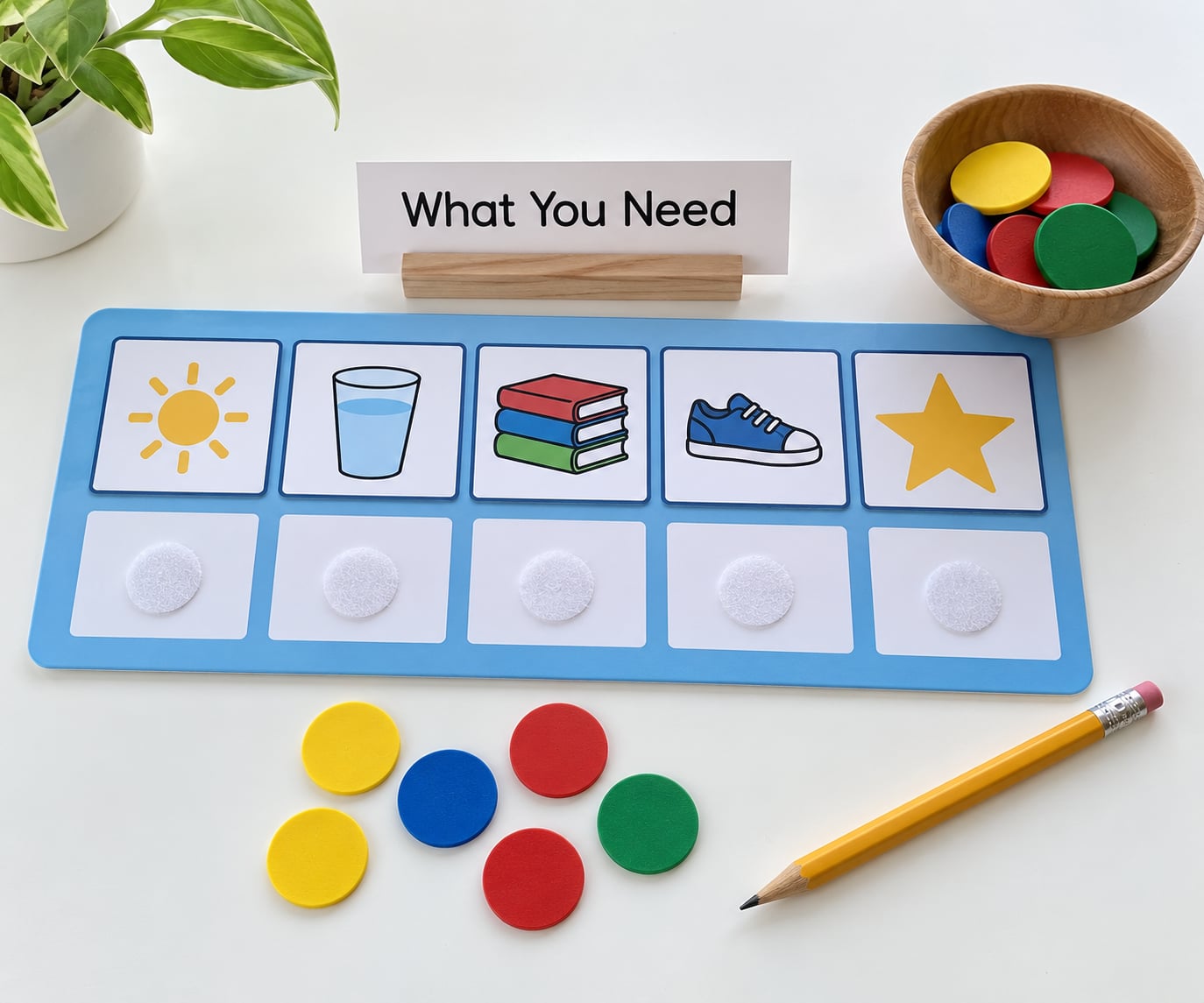
Almost nothing. If you have paper and something to mark with, you can start today.
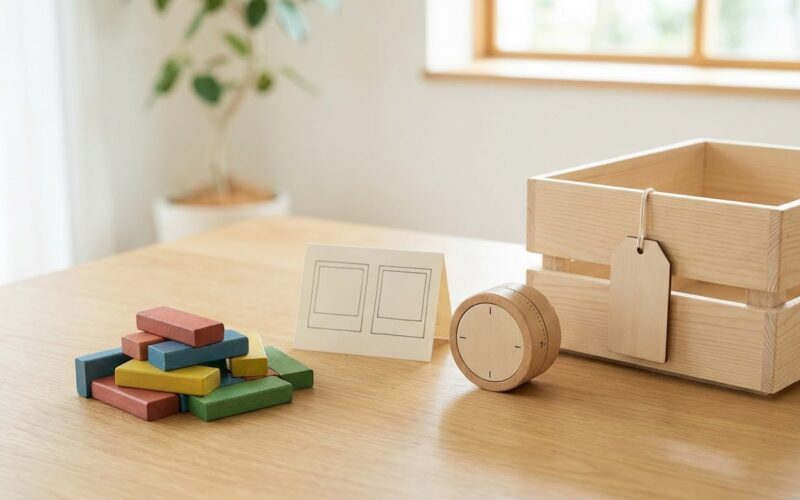
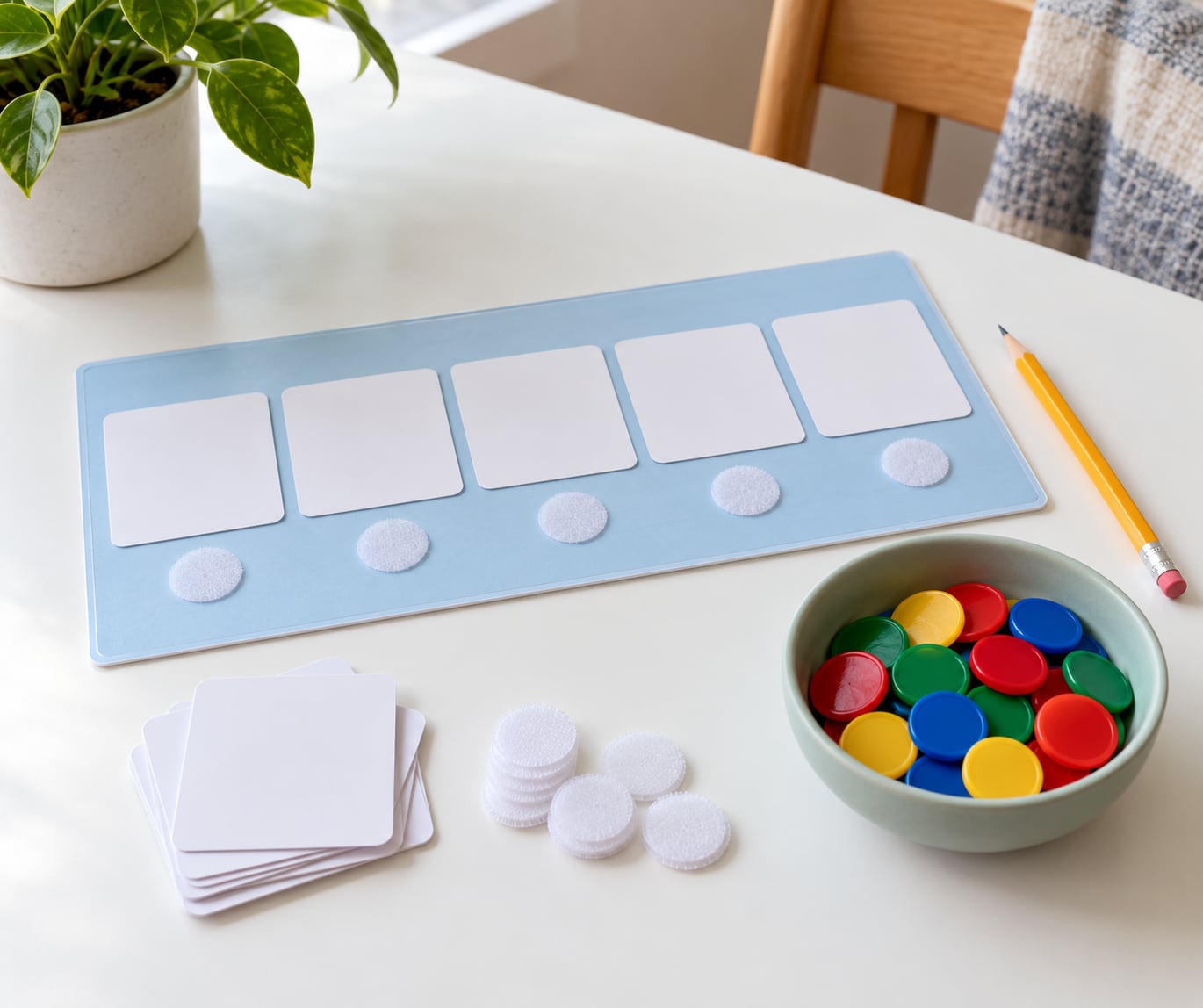
- Large visual cards — printed pictures, cut-out magazine images, or hand-drawn symbols that your child recognizes instantly.
- A broad felt-tip marker or thick crayon — thin pens disappear for children with low vision or motor planning differences.
- Hook-and-loop dots — reusable, so a mistake costs nothing and nothing gets torn off.
- A calm-down card — a symbol that always means break, available anytime, with no earning required.
- Small tokens — pom-poms, wooden counters, or folded paper shapes moved from a cup to a jar.
Paper and reusable stickers work. A laminated chart on the door beats a printable in a drawer, because it is visible without anyone asking for it.
A digital version also works if screen time is already part of your routine, though a physical chart tends to be more predictable and easier to carry around. If your child travels or has appointments, a small version in a folder beats a chart that stays home on the fridge.
Step-by-Step
Choose One Clear Goal
Pick one behavior you can see and name in a few words. Following a transition, asking for a break, finishing a morning checklist, trying one new food. That is enough to start.
Avoid broad goals like better behavior or being nicer. Your child cannot act on them, and you cannot tell whether the day counts. A good goal takes under five seconds to spot.
Transitions are a strong first target because they happen several times a day and are hard to change through talk alone. If leaving the park is your sticking point, how to make transitions between activities easier has routines worth borrowing for the chart.
How to tell it worked: you can mark it reliably at the end of most days without guessing.
Pick a Goal Your Child Can Understand
Match the goal to what your child already understands about cause and effect, not to what you wish they understood.
Some children get it immediately. Others need to watch it happen with someone else first. Try modeling: you move the token yourself, say what happens next, and do it again tomorrow. Pretend practice with a doll works the same way.
If your child is not ready for a full chart, shrink the goal to the first step only. Getting socks on counts. Then the whole chart can grow later.
How to tell it worked: your child anticipates the token before you hand it over, even occasionally.
Choose a Reward That Matters
Choose the reward with your child, not for them. What they ask for is the reward, even when it is something that seems small to you.
Free options work well: a specific song on the car stereo, choosing dinner, ten extra minutes of the thing they like, a dance break, choosing the route on the way home, or a parent coming to sit with them for one story before the rest of the house settles.
Keep the reward predictable and the wait short. A reward two weeks out reads as impossible to a child who lives in the moment.
Be careful with food rewards. Skip them for children with allergies, dietary restrictions, ARFID, or difficulty around eating, since pressure around food can make eating harder rather than easier.
If your child needs a predictable place to go when it all gets too loud, how to make a calm down corner at home is worth building alongside the chart, not after it.
How to tell it worked: the reward pulls your child toward the routine instead of needing a reminder.
Make the Chart Easy to Read
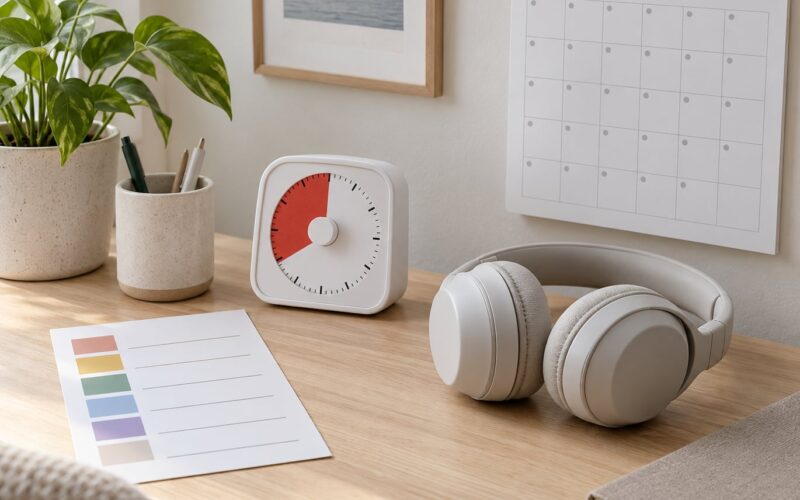
Use large symbols, consistent placement, and limited color. Three colors is plenty; four is usually where charts get busy and confusing.
Put the goal picture and the reward picture in the same spot every time, so nothing has to be re-read. Leave enough space for your child to mark progress if marking is part of the plan.
Write the reward on the chart itself. Children who cannot rely on memory need to see what they are working toward.
For outings, put a mini version and a small token cup in a pouch. For days that go sideways, how to make a go bag for a child with medical needs is a good model for what travels with you and what stays home.
How to tell it worked: your child can point to what happens next without you explaining it.
Introduce the Routine Without Pressure
Show the chart, name the goal in one sentence, demonstrate the token moving, then let it go. That is the whole introduction. Most of the time that is enough.
Keep the language calm and factual. This chart is for socks. Tokens fill the jar. When the jar is full, we do the thing on the reward picture.
Do not bargain, lecture, warn, or threaten. No marks come off for a hard day, ever. The moment a chart can be lost, children stop trusting it, and trust is the only thing holding it together.
Skip public praise in front of others. A quiet word when you hand over the token does more work than applause.
How to tell it worked: the routine happens with fewer reminders after a few days.
Review and Adjust the Chart
Look at the chart after several days, then again after a week. You are looking for evidence that the routine is getting easier, not for a perfect week.
Change one thing at a time when something is off. If your child cannot explain the routine, simplify the layout or shrink the goal. If they understand it but ignore it, the reward is wrong, so ask them what they would want instead.
Lower the difficulty if there are lots of frustration days, and raise it when the goal feels too easy. And when the routine starts happening without the chart, take the chart down and say so out loud.
How to tell it worked: the goal happens with less reminding, and your child still seems calm about it.
Common Mistakes
Too many goals on one chart. Five rows sounds efficient and lands as noise. Pick one, get it running, then add a second chart only once the first feels routine.
Rewards the child does not value. If your child shrugs at the reward, the chart has no fuel. Ask directly, take the answer seriously, and expect the first choice to be small.
Charts that are too complicated. Dense grids, color coding, and tiny rows mean an adult has to explain the system. If it needs a paragraph to explain, it needs simplifying.
Marking rewards after your child is already overwhelmed. A distressed child cannot process a token. Offer the break first, then mark the chart once things have settled, and treat the break as part of the plan rather than a failure.
Using marks as punishment or public praise. Taking a mark away teaches that marks can be lost. Applause in front of siblings turns progress into a performance. Keep the routine private and never take marks back.
Keeping a system running after it stops helping. If a chart adds pressure, arguments, or anxiety, stop using it. A faded or removed chart is a normal outcome, not a parenting failure.
Two habits keep the rest workable. Stay boringly consistent about when tokens appear, and stay flexible about what the reward is. Consistency in the mechanics builds trust; flexibility keeps the chart alive once the novelty wears off.
Frequently Asked Questions
How can I use a reward chart with a nonverbal autistic child?
Skip words entirely and use symbols. Put a picture of the goal in one fixed spot and a picture of the reward in another, then move a token from a cup to a jar each time the routine happens. Let your child watch you do it first so the sequence is visible before they are expected to participate. Keep the same layout for weeks, because consistency is what carries the meaning when language cannot.
What should I do when my child loses interest in the reward chart?
Treat it as a design problem, not a behavior problem. Change the reward first, since a chart they no longer care about cannot be rescued by a new grid. If the reward is still right, make the visual simpler or add a mid-week reward halfway to the goal. If interest has faded because the routine is already happening on its own, retire the chart deliberately and tell your child it worked.
Can a reward chart help with tantrums or sensory overload?
Not really. Reward charts shape routines, and overload is a nervous system response that a token cannot prevent. What helps is having a break symbol available at all times, with no earning and no explanation required, and using the chart only for the calm moments before escalation. If distress is regular or intense, talk with your child’s doctor or therapist rather than trying to solve it with a chart.
What if my child does not complete the behavior every day?
Expect uneven days and plan for them. Leave blank rows without comment, and never mark a day that felt like a win as a loss. Over a week you are looking for a pattern, not a perfect run. If there is no pattern at all after a week, the goal is probably too big, too vague, or not connected to anything your child wants, so shrink it to the first step.
Should I give my child praise and a reward for the same behavior?
Yes, and this is the part most charts miss. The token marks what happened, while your words carry the meaning. Keep the praise short and specific, like you remembered the socks, and say it quietly when you hand over the token. Long speeches turn a reward into a lecture, and children who are still learning a routine cannot absorb explanation and motivation at the same time.
How to Make a Reward Chart That Works in Daily Life
Start with one goal your child can see and one reward they asked for. Watch for a week, then adjust the smallest thing that is not working.
Progress with autistic children rarely looks like a straight line, and a chart is only useful when it lowers pressure rather than adding it. Keep it visible, keep it kind, and take it down when the routine stands on its own.