
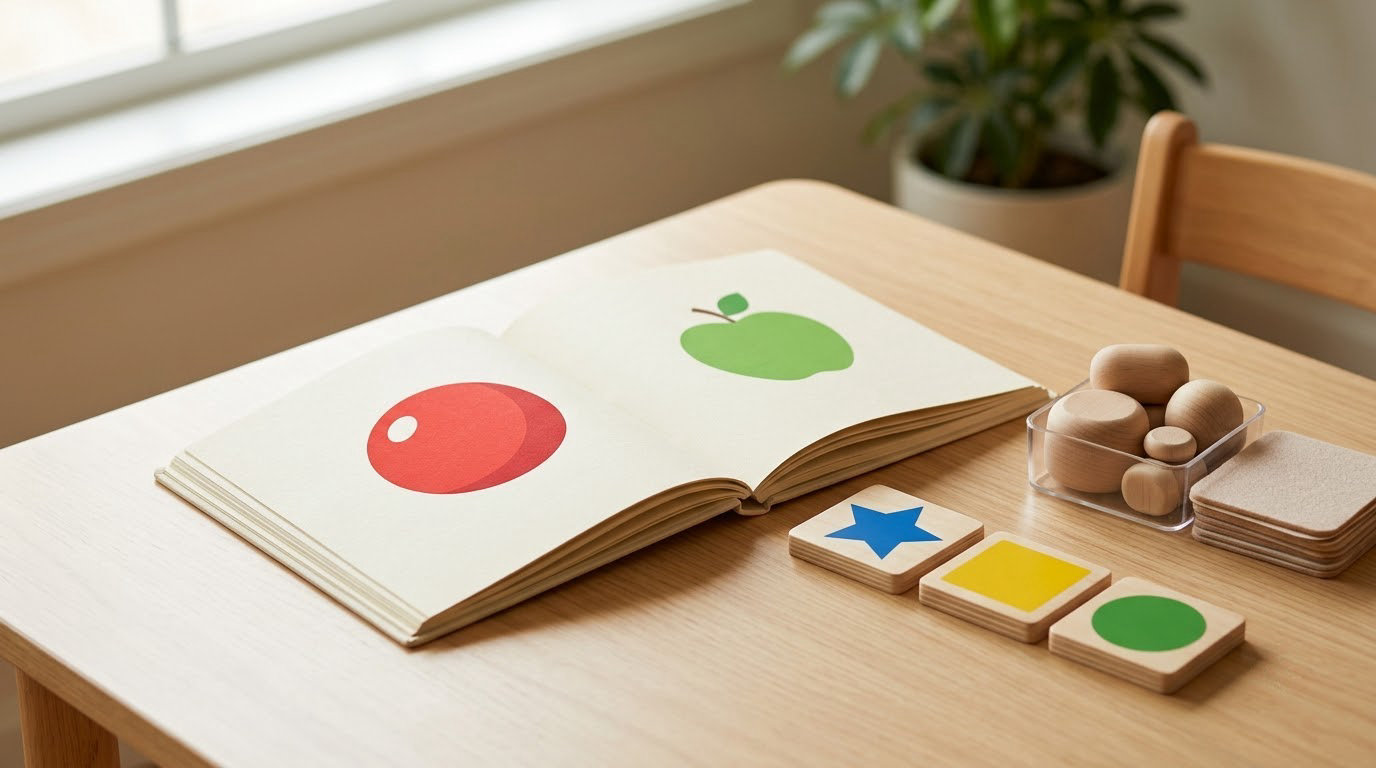
Yes, children with Down syndrome can learn to read, and the method that gets them reading is not a special one. It is short, repetitive, play-based practice built around books and words your child already cares about. Most families who make progress run five-minute sessions several times a day, keep every activity errorless so your child succeeds every single time, and layer letter sounds on top of a bank of familiar sight words rather than starting with an alphabet.
This guide walks through exactly how to teach reading to a child with Down syndrome, from choosing books to blending the first words. It is written for parents, grandparents and teachers working at home between school sessions, especially when the classroom program stops at functional signs and never gets to decoding.
A word of caution before you begin: nothing here replaces your child’s educational team, speech-language pathologist or reading specialist. Down syndrome affects hearing and vision in a large share of children, often with the kind of mild, fluctuating loss that gets mistaken for a learning difficulty. Get an audiology and vision check current before you decide a method is not working.
Table of Contents
- What You Need
- Step-by-Step: How to Teach Reading to a Child With Down Syndrome
- Step 1: How to Start Teaching Reading to a Child With Down Syndrome
- Step 2: Choose One or Two High-Interest Books
- Step 3: Teach Print Awareness Before Decoding
- Step 4: Practice Letter-Sound Knowledge in Short Doses
- Step 5: Blend Sounds Into Simple Words
- Step 6: Build Reading Into Everyday Routines
- Step 7: Track Small Wins and Adjust the Plan
- Step 8: Common Mistakes and How to Fix Them
- Frequently Asked Questions
- When should I start teaching my child with Down syndrome to read?
- How long should reading practice be for a child with Down syndrome?
- Can a child with Down syndrome who does not speak learn to read?
- Should I teach phonics or sight words first?
- How do I teach reading comprehension to a child with Down syndrome?
- When should I bring in a reading specialist, audiologist or speech-language pathologist?
What You Need
You need very little. The materials for teaching reading at home cost less than a single tutoring session and most of them are already in a drawer somewhere in your house.
- A five-minute daily routine. Pick a time your child is already calm and alert, usually after a snack or a nap rather than at bedtime. Same place, same time, most days.
- Two or three familiar books. Chosen for interest rather than reading level.
- Print cards or large letters. Index cards and a thick marker are enough. You do not need a full flashcard deck.
- A quiet practice space. A small table or a clear patch of floor with visual distractions removed.
- A progress record. A notebook or a notes app. One line per session.
- Optional professional input. A speech-language pathologist, a reading specialist or your child’s teacher can tell you where to start.
Notice that list contains no age target. Your child’s current skills and interests decide where you start, not a chart that says a five-year-old should be reading at level C. Comparing your child to a classroom peer tells you nothing useful and costs you a lot of energy.
One more thing worth having: a way to capture your child’s words. Down syndrome brings a gap between understanding and speaking, and a written or spoken word bank of everything your child has said that week gives you material for the next session for free.
Step-by-Step: How to Teach Reading to a Child With Down Syndrome
The plan below runs in order because each step makes the next one easier. Start where your child is, build a base of recognised words, then add print concepts, then sounds and blending, then comprehension. You can move slowly. Most families take months, not weeks, and that pace is normal.
Step 1: How to Start Teaching Reading to a Child With Down Syndrome
Begin by watching what your child already does, without teaching anything. Sit with a book they like and note whether they bring it to you, turn the pages, look at the pictures, point at print, or copy your expression.
Then check how your child communicates, because reading has more than one door. Some children speak clearly, some speak in short phrases, some use signs, some point to a picture or a letter board, and some are still working with an AAC device. A gesture, a sign, a symbol selection or a point counts as a reading response. For many children the gap between what they understand and what they can say is wide, and reading gives them a grammatically correct model of language they cannot yet produce on their own.
Choose one first goal you could recognise today. For many children the earliest real goal is simply attending to the book for a few minutes with you. For others it is pointing to a familiar object when you name it. Write the goal down in one sentence and revisit it in six weeks rather than measuring it daily.
Step 2: Choose One or Two High-Interest Books
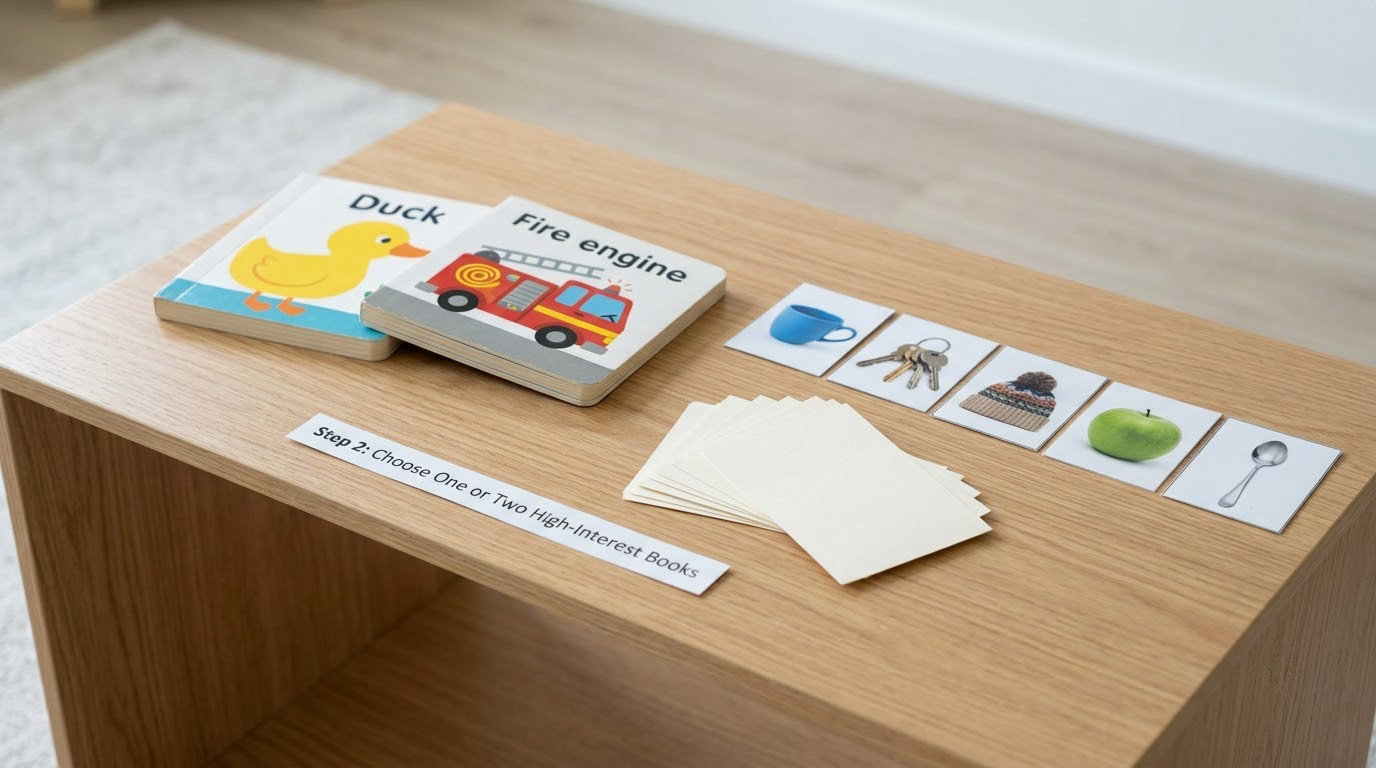
Pick books about what your child loves, not what is easiest to teach. If the obsession this month is dogs, construction vehicles or a particular cartoon character, the words inside those books are the words you will use. Parents repeatedly report that switching to genuinely high-interest material was the single biggest change that made practice stick.
Look for text that repeats. A line that comes back on every spread gives your child a predictable rhythm, and predictable text is what lets a new reader join in instead of sitting silent while an adult does all the reading.
Adapt without fuss. Use a board book with one large picture per page. Read a longer book but only the parts your child reacts to. Add a finger or a thin pointer for tracking. Try a cloth or bath book when paper gets destroyed within a day, and an audio book alongside the printed one when print holds no meaning yet. Sit in a predictable spot and open the book the same way every time.
Step 3: Teach Print Awareness Before Decoding
Print awareness means understanding that marks on a page carry meaning, and that pages have rules. Children who skip this step try to decode illustrations and get frustrated, because they have not been taught that the words are separate from the pictures.
Work through the basics in a few minutes at the start of a session. Point out that pictures and words are different things. Show the front cover and the back cover. Open to the page where reading begins. Trace the first line of text with your finger and move toward the end of it, so direction becomes a familiar motion rather than a rule to be explained.
Keep it light. Model the behaviour while you read and let your child copy you. This is not a test, and if a session turns into an interrogation about concepts, back off and go back to enjoying the book.
Step 4: Practice Letter-Sound Knowledge in Short Doses
Add letter knowledge in small pieces, a couple of letters or sounds at a time, and use your child’s strongest route in. Children with Down syndrome have a documented relative strength in visual processing and memory alongside a relative weakness in phonological processing, so a letter you write large, colour in and post somewhere the child sees daily often lands better than a sound produced out of thin air.
Connect each letter to its sound with something physical. Hold up the letter card, say the sound, then hand over an object that starts with it. Move, gesture, clap. Say the sound while your child watches your mouth and mirror it back. Practise recognition in more than one setting, because a sound learned only at the table does not travel.
Stop while your child is still enjoying it. A short session that ends on a success is worth more than a long one that ends in frustration, and this is where most families find their own workable number of minutes.
Step 5: Blend Sounds Into Simple Words
Blending is the moment individual sounds become a word your child can read. It is also where phonological processing puts the most pressure on working memory, so keep the words tiny at first.
Use pictures and letter tiles. Lay out the tiles for the sound for s, a and t, slide them together slowly, and say the word. Repeat with at, it and on, all short function words that appear constantly in simple text. Picture cards work well for concrete words such as sun, dog and cat.
Give support first, then take it away. You can model the whole thing, then prompt just the first sound, then wait. When your child gets it wrong, do not correct mid-attempt. Simply go back to the last word they read easily and rebuild from there. Nobody learns to read by being corrected, and a run of errors tells you the words are too hard, not that your child cannot do it.
Keep a word bank of everything your child can currently read without help. Reviewing that bank is worth more than introducing anything new, and it gives you an accurate picture of what is secure.
Step 6: Build Reading Into Everyday Routines
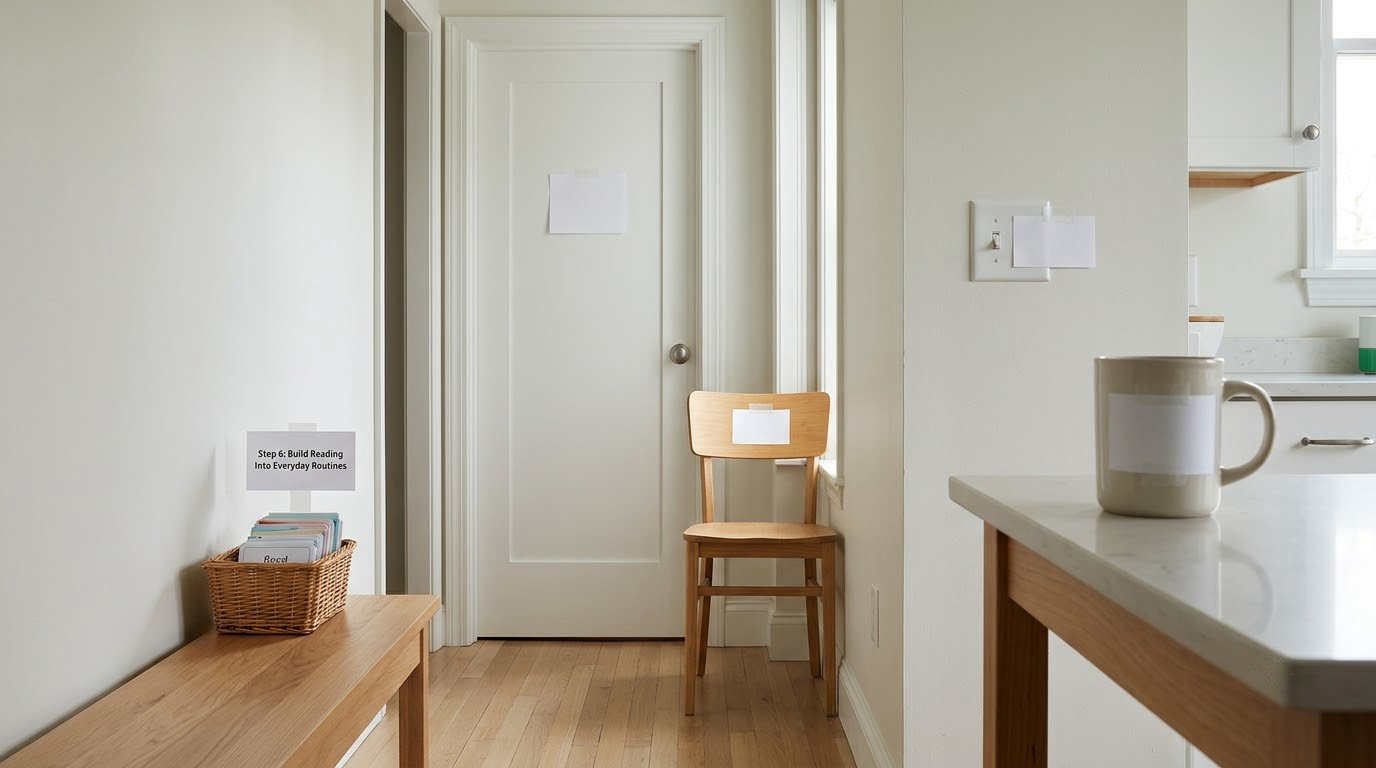
The best daily practice barely looks like practice. Put labels on household objects so the words are there to be read all day without anyone having to teach anything. Keep a basket of word cards by the door for a quick review while waiting for something. Read the same book at the same mealtime so the words and the moment are joined together in memory.
Reading aloud is doing more than you might expect. Because a child with Down syndrome often understands considerably more than they can say, hearing a story gives them access to vocabulary, grammar and sentence structure they could not generate spontaneously, and many parents notice articulation and sentence length improving along the way.
Try a conversation diary. Each day, add one short line about something your child actually did or said, using their exact words. Read it back the next day. It is the cheapest personalised book you will ever make, and it turns your child’s own language into text they want to read.
Step 7: Track Small Wins and Adjust the Plan
Write down one or two things per session, not a score out of ten. Useful indicators include attention to print for the length of a book, bringing you a book independently, pointing to a familiar symbol when you name it, producing a sound, or blending one word. A line like “asked for the dog book twice” tells you more than a chart does.
Review every four to six weeks and ask one question: is this working or is this just hard? If your child is engaging, understanding more and asking for books, repeat and stretch. If sessions have become avoidance, go back a step, cut the choice ratio, or return to the most enjoyed activity for a while. If nothing has moved in a couple of months despite regular short sessions, that is a good moment to ask your child’s team about a reading specialist, a hearing recheck or a vision assessment rather than a harder worksheet.
Step 8: Common Mistakes and How to Fix Them
Rushing the session. Two calm minutes beat ten distracted ones. If your child looks away, finish. You can always come back later in the day.
Using materials above your child’s level. Text that is too hard turns reading into guessing. Drop back to words your child already knows and rebuild from the last thing that worked.
Correcting every error. Constant correction makes reading feel like failure and teaches your child to avoid the activity. Accept an approximation, model the word yourself, and move on. This is the practice usually called errorless learning: every attempt ends in success.
Practising too long. Attention spans are short and variable. Plan two or three five-minute sessions rather than one long one, and let the day build the total.
Measuring accuracy only. Recall, enjoyment, attention to print and spontaneous book requests all count. Progress in reading instruction is individual, and a slower route to the same skills is still a working route. Compare your child to where they were eight weeks ago and to nobody else.
Frequently Asked Questions
When should I start teaching my child with Down syndrome to read?
Start when your child shows readiness signs, not at a set age. Readiness looks like sitting with you for a few minutes, turning pages, pointing at pictures, matching objects, and showing interest in print or signs. Reading aloud from the start is worthwhile regardless, because it builds vocabulary and grammar. When formal word teaching begins, match it to how your child currently communicates, including signs and AAC.
How long should reading practice be for a child with Down syndrome?
Most families find that sessions of about five minutes work better than one longer block, and two or three short sessions in a day add up to more progress than a single session. Watch for the point where your child’s attention drops, because that point is different every day. Ending early on a success keeps reading something your child wants to come back to tomorrow.
Can a child with Down syndrome who does not speak learn to read?
Yes. Reading is about recognising and responding to print, not about speaking aloud. Pointing to the correct picture, signing the word, selecting it on an AAC device or saying it in any form all count as correct responses. Because children with Down syndrome frequently understand more than they can say, reading simple text aloud also gives them a correct grammatical model of language they are not yet producing on their own.
Should I teach phonics or sight words first?
Sight words first, then phonics on top. Children with Down syndrome tend to recognise words as whole visual shapes far more easily than they can sound letters out, so a bank of familiar words builds reading confidence while decoding skills are still developing. Teach letter sounds explicitly and systematically once your child has a secure base of recognised words, and keep returning to those words so decoding is taught inside material they already enjoy.
How do I teach reading comprehension to a child with Down syndrome?
Ask about the book, not the words. After reading, ask who was in the story, what happened first and then next, and where it happened, each with the pictures still open in front of your child. Let them point or show you rather than requiring an answer out loud. Retell one page to you with the book closed, and write their retellings into the conversation diary so the story becomes text they can read again.
When should I bring in a reading specialist, audiologist or speech-language pathologist?
Get hearing checked early and regularly regardless, since mild and fluctuating hearing loss is common and is often mistaken for a learning problem. Ask for a reading specialist or speech-language pathologist if your child shows little progress after a couple of months of short regular sessions, loses interest quickly, or seems to understand far less than you expect. Bring your session notes, since they make the conversation with the team far more productive.
If you take one thing from this guide, make it this: pick two books your child loves, write one word from each on an index card, and sit down for five minutes today. Everything else in the plan follows from that.
And if someone has already told you not to bother because reading will not happen, keep going anyway. Progress here is real, it is uneven, and it is rarely linear, but it belongs to your child and it is worth the five minutes.