
To help a child with anxiety at bedtime, build one predictable wind-down routine that runs in the same order every night, keep screens off an hour before, and answer worries with short calm replies instead of long reassurances. Most families see calmer evenings within two to three weeks of keeping that sequence steady, though bad nights still happen along the way.
Bedtime is when worry gets loud. During the day a child’s mind is occupied with school, play and people, which keeps anxious thoughts out of reach. Once the house goes quiet, those same worries surface, the body stays on alert, and falling asleep turns into work. Poor sleep then feeds the anxiety the next night, and the loop tightens.
That is why the fix is rarely a new gadget. It is a sequence your child can predict, a room that feels safe, and a response you can repeat without losing your temper at 9:40pm.
Table of Contents
- Do These Five Things Tonight
- What You Need
- A fixed evening start time
- A calm sleep space
- A comfort item
- A simple record
- Step-by-Step: How to Help a Child With Anxiety at Bedtime
- 1. Identify What Is Making Bedtime Feel Hard
- 2. Build a Predictable Wind-Down Routine
- 3. Make the Bedtime Environment Feel Safe
- 4. Replace Questions With Calm, Short Responses
- 5. Practice the Routine Before the Child Is Exhausted
- 6. Use a Gradual Response to Bedtime Resistance
- 7. Track What Helps and Adjust Slowly
- Common Mistakes
- Adding more stimulation to a hard evening
- Promising a permanent fix
- Making every night different
- Arguing during distress
- Letting a persistent problem drift along
- Frequently Asked Questions
- How long should it take for bedtime anxiety to improve?
- Should I let my child stay in my room until they fall asleep?
- How do I calm a child who gets upset every time I leave the room?
- Can comfort blankets or stuffed animals help with bedtime anxiety?
- When should I talk to my child’s doctor about bedtime anxiety?
- How do I keep the routine consistent when family schedules change?
- How to Help a Child With Anxiety at Bedtime: Start Small
Do These Five Things Tonight
- Start at the same time every night. A predictable start time, not a perfect bedtime, is what tells a child’s body sleep is coming.
- Turn screens off at least one hour before. Blue light and alert content keep the brain switched on when it needs to power down.
- Connect for five minutes on purpose. A short hug, a chat about something good, or reading one book together signals the day is over.
- Use one calming skill, not four. Slow breathing, a safe-place picture or a worry box works better than a menu of options every night.
- Move your own distance one small step. Sitting at the door instead of beside the bed is progress, even on a week when it feels like nothing.
If your child has autism, sensory needs or ADHD, the same structure usually applies with adjustments to the sensory pieces. Our guide to helping an autistic child sleep through the night covers those adjustments in more detail.
What You Need
You need very little to start, and most of it is free. Think of it as four things.
A fixed evening start time
Pick a start time for the wind-down, not just a lights-out time, and write it down where everyone can see it. A preschooler’s routine might run 45 minutes, a school-age child’s 60 minutes, a teen’s 30 minutes of reading before sleep. Consistency matters more than the exact number of minutes.
A calm sleep space
The room should be dark, cool and quiet, with a nightlight if darkness is the trigger. Keep the bed for sleep only, and remove anything that has become a standing objection, like a stack of laundry or a chair full of clothes.
A comfort item
A blanket, a soft toy or a familiar pillow gives a child something predictable to hold. Older children often reject stuffed animals, so a weighted throw, a specific shirt or a calming playlist can fill the same role.
A simple record
A notebook by the bed where you jot down the time your child fell asleep, how many times they got up and what the day looked like. Twenty seconds a night is enough to show you what is changing and what is not.
Step-by-Step: How to Help a Child With Anxiety at Bedtime
1. Identify What Is Making Bedtime Feel Hard
Watch for a pattern over several nights instead of guessing from one bad evening. Common triggers include darkness, noise, being left alone, unfamiliar sensations, worries from school, pain such as a headache or toothache, and a routine that suddenly changed.
Note the trigger, not a diagnosis. “Asleep at 8:50 after three check-ins” tells you far more than “anxious again,” and it tells your pediatrician something useful too. Parents often find the anxiety shows up in the body first, as a stomachache or headache that appears right when the lights go out.
2. Build a Predictable Wind-Down Routine
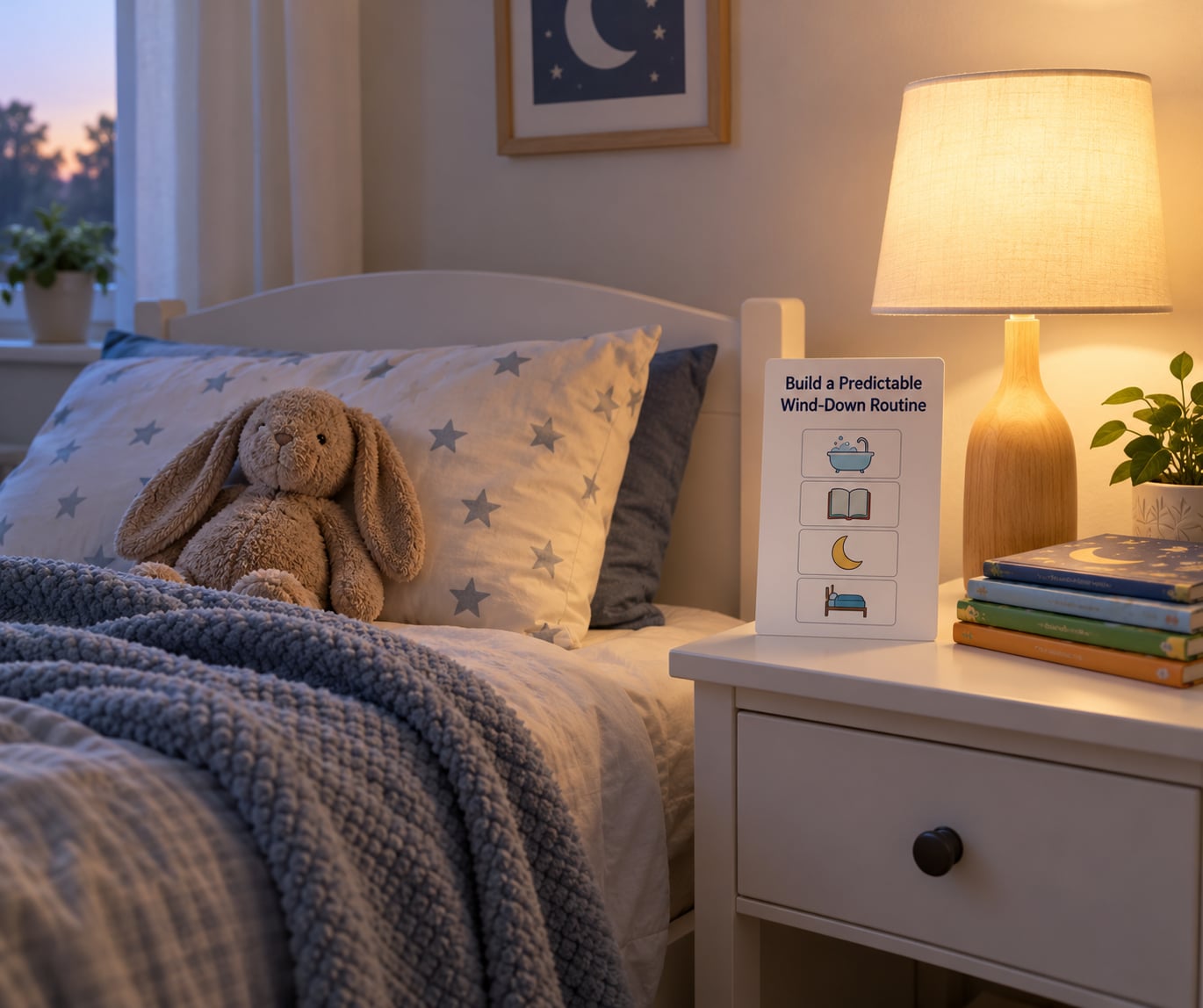
Write the sequence in the same order every night, with five or fewer steps. A workable version: bath or wash, pajamas, brushing teeth, a short read, one breathing practice, lights out.
Give a warning before each transition, such as “two more pages and then the light goes off.” Small choices give a worried child some control, so let them pick which of three books to read or whether the nightlight is on the low or high setting. Choices reduce the sense of being trapped by the routine.
Do the worries earlier. Many families set aside ten minutes in the late afternoon as worry time, so school-day worries get talked about while the light is still on. That gives the child a place to put the worry instead of rehearsing it in the dark.
For children who resist brushing teeth as part of the wind-down, our piece on how to help a child tolerate tooth brushing has sensory strategies worth borrowing.
3. Make the Bedtime Environment Feel Safe
Cut what you can from the room. Darkness, an unexpected noise or a chair in a doorway can be enough to keep a child in a state of hyperarousal for an hour.
- Use blackout curtains where possible, or a dim warm nightlight rather than a cold bright bulb.
- Run steady white noise or rain sounds if the house is quiet in a way that highlights every creak.
- Let the child sleep where they feel safest, including on their side if lying flat feels exposed. Position matters more than rules about it.
- Try a weighted blanket or weighted throw only if your child finds it comforting, and only if it fits their size and weight comfortably. Skip it for very small children, and stop if they cannot lift it easily.
For many families the nightlight was the single biggest visible change. Once darkness stopped being the problem, the rest of the routine became workable.
4. Replace Questions With Calm, Short Responses
When a child asks “is there a monster under the bed” or “will something happen tomorrow,” acknowledge first and answer second. Something like “I hear you, that sounds scary, and I am here. Nothing is under the bed.” Then stop talking.
Do not argue with the fear or reason it away during the peak of distress. A child mid-panic is not processing logic, and a debate about whether monsters are real only teaches them that the topic is worth debating. Pick one short sentence and reuse it every single night so it becomes predictable.
Careful with the reassurance trap. Repeating “there is nothing to worry about” over and over can teach a child that their worry is something big enough to need checking. If you find yourself on the third tuck-in of the night, that is a signal to shorten the response, not lengthen it.
Calm yourself first if you can. Two slow breaths before you open the door change the tone of everything you say. Caregiver anxiety transfers quickly at bedtime, especially after a long day.
5. Practice the Routine Before the Child Is Exhausted
An exhausted child cannot participate, they can only resist. Begin the wind-down while they still have some energy left, and for the first week or two, walk them through it rather than running it.
Practise the steps during the day too. Sit in the dark room together in the afternoon. Let them lie in their bed with the door closed and practice the breathing while you sit on the stairs. A skill rehearsed calmly at 4pm is easier to use at 8pm than one introduced for the first time in the dark.
Some children also struggle with homework winding down right before bed. Our guide to how to help a child with homework meltdowns has ways to move that stress earlier in the evening.
6. Use a Gradual Response to Bedtime Resistance
Consistency matters more than firmness. When a child asks for water, another story or a monster check, acknowledge the request, redirect once, and keep the outcome the same.
- Say “it is nighttime, I checked, everything is fine,” then walk out.
- Return to one or two brief check-ins later, each one the same length as the last.
- Skip long negotiations. If the conversation starts, it becomes the interesting part of the evening.
- Move your own presence in steps: chair at the bedside, chair by the door, door ajar, check-in from the hallway. Advance only after several calm nights.
If your child asks to come into your bed tonight, decide once, say it warmly, and hold it. “Not tonight, but you can have me sit here until you’re settled” keeps you close while protecting the boundary. Mixed messages are harder to follow than a firm no.
Distinguish the episodes. A nightmare wakes a child fully and they can describe it in the morning. A night terror, more common in younger children, happens in the first hours of deep sleep and the child is often hard to wake or console; keep them safe, stay nearby and put them back to bed. A nocturnal panic attack shows up around the natural waking time, with rapid breathing and a child who insists something is very wrong; stay until breathing settles, then keep the lights low and avoid checking the room repeatedly, since each check feeds the belief that something might be there.
7. Track What Helps and Adjust Slowly
Change one thing at a time. Adding a nightlight, a new routine and a new rule all at once means you will never know which one worked, or which one your child objected to.
For two weeks, write down four things each night: what time the routine started, roughly when sleep began, how many times your child got up, and any trigger you noticed. Most parents discover the pattern themselves within a week, because the log makes the pattern visible.
Expect slow movement rather than a clean fix. A night that goes badly is not a step backwards and it does not mean you are doing this wrong. Keep the routine the same the next night and let the record, not the mood, tell you whether things are improving.
Common Mistakes
Adding more stimulation to a hard evening
A busy afternoon, a movie in bed and a family debrief at 9pm all push bedtime later and keep the brain switched on. Move stimulating activity earlier and leave the hour before bed quiet.
Promising a permanent fix
“You will never be scared again” sounds kind and it is not something you can deliver. Say “I am here and we will get through tonight,” which is true and keeps you credible.
Making every night different
Changing the order, adding new steps or skipping the routine on weekends resets the predictability you worked to build. Same sequence, same times, even when travel or illness gets in the way.
Arguing during distress
Debating whether the fear is reasonable or making them prove it is silly takes the calm out of the room. Validate, redirect, leave. You can talk about the worry tomorrow when both of you can think clearly.
Letting a persistent problem drift along
Anxiety that has lasted weeks, night after night, is worth a professional look rather than more experimenting at home.
One last tip: talk to your child about sleep once during the day, when things are calm. Naming it out loud, “you’ve had a hard time settling and that’s okay,” does more for a worried child than another conversation about how to behave at bedtime.
Frequently Asked Questions
How long should it take for bedtime anxiety to improve?
Most families notice calmer evenings within two to three weeks of keeping the same wind-down routine every night, but change is rarely linear. Expect a good week followed by a bad one, especially after a school change, a new sibling or illness. Judge progress from your notes over several weeks rather than from one night, and keep the routine steady rather than rebuilding it after every hard evening.
Should I let my child stay in my room until they fall asleep?
Occasional co-sleeping during an anxious patch is not harmful, but if it happens every night your child may come to depend on it and you may end up with the same problem again in a few months. A middle path works well: sit beside the bed or in the chair nearby until they settle, then move your chair closer to the door each night that goes calmly. Consistency is what teaches a child that the room is safe on its own.
How do I calm a child who gets upset every time I leave the room?
Acknowledge the feeling, say one short reassuring line, and leave. Try one line such as I hear you, this is hard, and I am right outside, then close the door. Come back for one brief check-in after a few minutes and keep it identical each time. Picking the child up or coming back immediately teaches them that leaving the room is what causes the upset, which is the opposite of what you want them to learn.
Can comfort blankets or stuffed animals help with bedtime anxiety?
Yes, for many children a consistent comfort object makes the room feel predictable and gives them something to hold when words fail. For older children who find stuffed animals babyish, a weighted throw, a familiar shirt or a short calming playlist can take the same role. A weighted blanket should fit comfortably, never restrict movement, and be skipped for very small children. If your child dislikes it, take it out rather than arguing.
When should I talk to my child’s doctor about bedtime anxiety?
Reach out if anxious nights have persisted for more than a few weeks, if sleep loss is affecting daytime mood, schoolwork or behaviour, or if anxiety also shows up in other settings. Get help sooner if there is a sudden regression after a frightening or stressful event, panic attacks at night, or any sign your child is hurting themselves. Bring your sleep notes, because what you record over two weeks is more useful to a pediatrician than one bad night.
How do I keep the routine consistent when family schedules change?
Keep the pieces you control and let the rest move. The order of the wind-down, the sleep environment and your response to a check-in can stay identical even on a late evening elsewhere. When the start time has to shift, a picture routine card in the same format tells your child what comes next, and a brief note of what changed keeps the sequence predictable. Ask for help with handover nights if your child struggles with transitions between homes.
How to Help a Child With Anxiety at Bedtime: Start Small
Pick the single trigger that costs your family the most and deal with that one first. Usually it is darkness, or the moment you leave the room, or a worry that has nowhere to go during the day.
Then set one wind-down start time, write the steps in order, and run them the same way for at least two weeks. Use one short response to worries, repeated word for word, and move your own distance a single step when the week goes well.
If nights are still hard after a few weeks of consistency, or if anxiety is showing up during the day too, talk to your pediatrician or a qualified mental health professional. They can check for physical causes such as pain or breathing problems, talk through approaches like cognitive behavioral therapy, and advise on anything you are considering giving your child, including melatonin or other supplements, which is a conversation to have with a clinician rather than a decision to make alone.