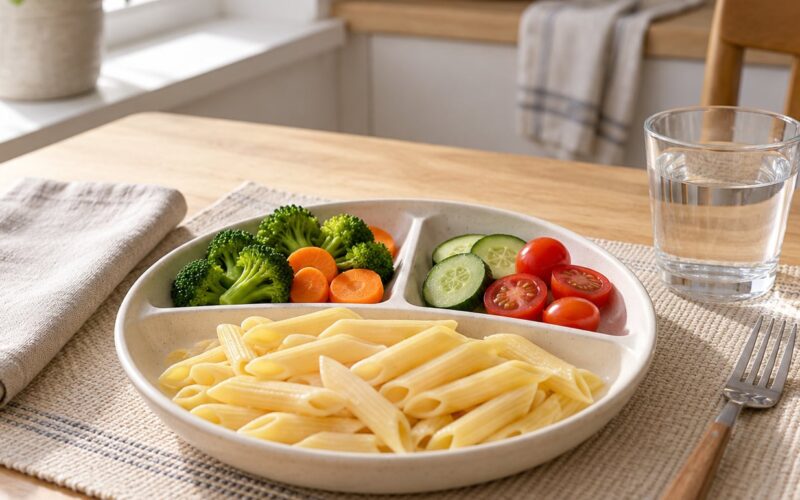
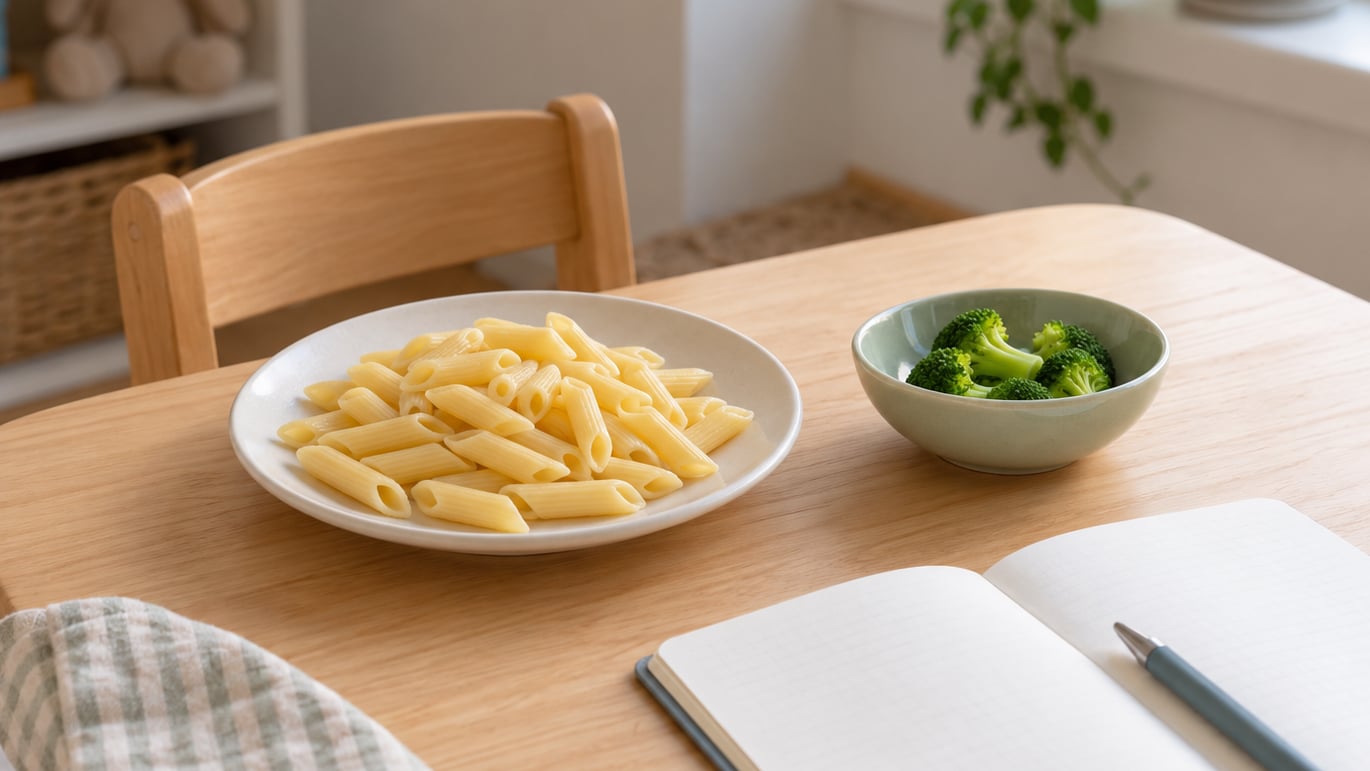
How to deal with food aversions in kids comes down to a few repeatable moves: work out what is actually triggering the refusal, keep meals predictable and pressure-free, keep a safe food on every plate, and offer the rejected food again and again in small, non-demanding portions. Most children widen their food range over weeks or months of repeated neutral exposure, not over a single successful meal.
This is general guidance for home, not a diagnosis or a treatment plan. If eating is limited enough to affect growth, hydration or daily life, talk to your pediatrician or a registered dietitian.
One more thing before we start. Food aversion is one of the most common things parents bring up on sensory and autism parenting forums, and the tone in those threads is rarely about what is wrong with the child. It is about the guilt, the dread before 5pm, and the sense that everyone else seems to be managing this fine. Your child is not broken, and neither are you.
Table of Contents
- What You Need
- Step-by-Step: How to Deal With Food Aversions in Kids
- Step 1: Identify What Is Triggering the Refusal
- Step 2: Make Mealtimes Predictable and Low Pressure
- Step 3: Offer a Safe and Familiar Food First
- Step 4: Introduce New Foods Without Pressure
- Step 5: Expand the Child’s Accepted Foods Gradually
- Step 6: Track Progress and Protect Nutrition
- Common Mistakes
- Frequently Asked Questions
- How long does it take for a child to overcome food aversion?
- Should I let my child eat only foods they already accept?
- How do I know whether a food refusal is sensory or caused by an allergy?
- What foods should I offer a child with autism or sensory sensitivities?
- When should I see a doctor or registered dietitian about my child’s eating?
What You Need

Before you change anything about meals, gather a few things. Without them, you are guessing, and guessing is what makes most parents feel like they are failing at something random.
- A simple observation notebook. One page per food, or one page per week. Write down what was offered, what happened, and roughly how much went in. This turns a guessing game into a record you can actually learn from.
- Your child’s known safe foods. Write the full list out, including specific brands and preparation methods. A safe food is one your child reliably eats, without distress, more than a few times a week.
- Utensils your child accepts. A familiar fork, a spoon they actually tolerate, or their own cup. Tableware changes can be more disruptive than food changes for some kids.
- Small portion tools. A teaspoon, a silicone cup, a small ramekin. A tiny portion of a much-disliked food feels manageable; a full serving feels like a demand.
- Your child’s allergy and medical notes. Confirmed allergens, current medications, recent illness, any reflux history, and the name and phone number of the pediatrician and any dietitian you see.
- Access to professional input. If eating is already limited to a very small range, arrange a conversation with a registered dietitian, occupational therapist or speech-language pathologist sooner rather than later. Not because something is wrong, but because early input shortens the timeline.
A word on texture, because it is the single most common trigger I see described. It deserves more attention than taste does, and I wrote about why food texture matters more than taste for some kids separately.
Step-by-Step: How to Deal With Food Aversions in Kids
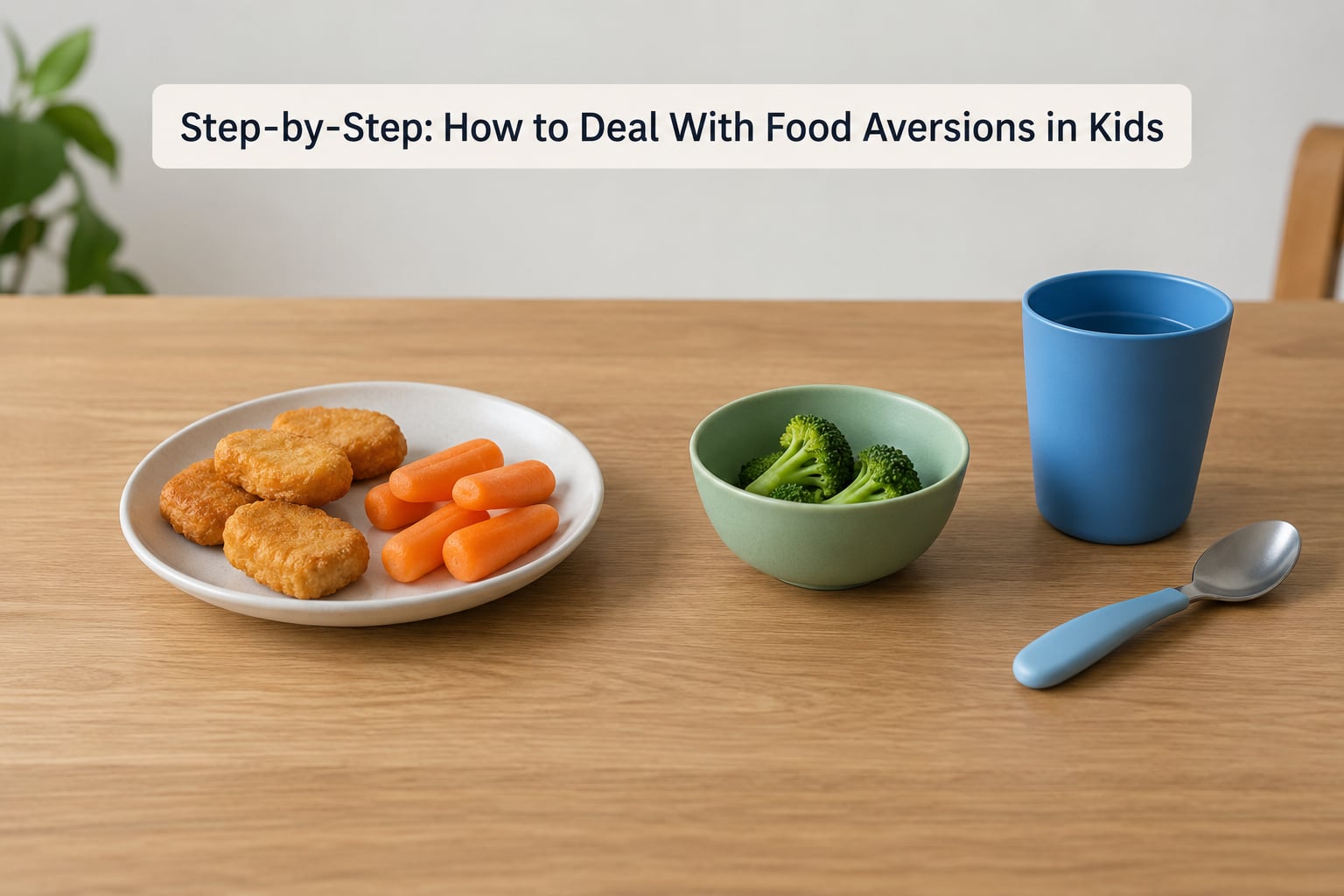
The plan runs in order, and each step depends on the one before it. Skipping ahead to the introduction of new foods tends to backfire, because pressure without observation usually makes the aversion worse rather than better.
Step 1: Identify What Is Triggering the Refusal
Write down the specific trigger rather than labelling your child difficult. In practice the trigger is usually one of a small number of things: a texture, a temperature, a smell, a colour, a food touching another food on the plate, a mixed dish, or a memory of being ill or pressured while eating that food.
Mixed textures come up again and again. Parents in r/raisingkids and r/Autism_Parenting describe children who happily eat plain pasta and plain chicken but gag at marinara, casserole and anything where one food touches another. One parent described a child who refused anything that was both smooth and yellow. That level of specificity is normal, and it is exactly what your notebook is for.
Separate taste from texture by testing one variable at a time. Serve the same food prepared two ways, for example raw carrot sticks alongside cooked soft carrot. If one works and the other does not, you have your answer, and it is a texture issue, not a taste issue.
Also rule out pain before you treat this as behaviour. Reflux, constipation, a mouth sore, a recent viral illness or an untreated dental problem can all look exactly like fussiness. If a child winces on chewing, swallows oddly, or eats very slowly, note that and raise it with the pediatrician.
How to know it worked: after a week of notes, you can name the trigger rather than describe a feeling. That is the milestone before moving on.
Step 2: Make Mealtimes Predictable and Low Pressure
Predictability lowers the stress response, and stress is what turns a meal into a fight. Aim for three meals and one or two snacks at roughly the same times each day, in the same place, with a duration you can predict and stick to.
Ellyn Satter’s division of responsibility framework is the most useful version of this idea for most families. The parent decides what is served, when it is served and where it happens. The child decides whether to eat and how much. That split keeps you in charge of nutrition while removing the power struggle over every bite.
Keep your tone flat and neutral. No pleading, no sighing, no comments about how much they liked it last week. Comments about eating carry enormous weight with young children, and a neutral tone is the part most parents find hardest and most effective at the same time.
You can also get an early signal by watching the rest of the day. Cortisol and a busy sensory system both suppress appetite. If your child has had a hard morning or a noisy afternoon, a small evening meal may be realistic, and asking for more at that point usually produces a refusal rather than an appetite.
How to know it worked: meals become shorter and less intense within about two weeks. The food itself does not need to change yet.
Step 3: Offer a Safe and Familiar Food First
Put a safe food on every plate. This is the single most protective move in the whole plan, and parents in feeding therapy forums say it cuts meltdown frequency more than anything else they tried.
The reason is straightforward. A child who knows pasta is there has a floor to stand on. That safety is what lets them look at the unfamiliar food without the whole meal feeling like a threat.
Keep the new food physically separate, at least to start. A spoonful of mashed vegetable sitting in the middle of the pasta is a very different experience from the same spoonful three inches away in its own little dish.
Reduce the demand to almost nothing. The goal at this stage is not eating. It is that the food is on the table, in the room, on the child’s plate, and nothing happens if it stays there.
How to know it worked: your child starts to touch, move or smell the new food without distress. Smelling at it counts. So does just leaving it alone. That is progress, not failure.
Step 4: Introduce New Foods Without Pressure
Offer the new food in tiny portions, on a schedule, without comment. Many children need eight to fifteen or more separate offerings of the same food before acceptance appears, and the number is routinely higher than parents expect.
Outside mealtimes, add low-stakes sensory play. There is no single right activity, and the ones that work best are the ones that use your child’s preferred sensory property as the entry point:
- Play dough and clay for a child who prefers touch.
- Coloured water and ice for a child who likes temperature and watching things change.
- Dumping and pouring with dry rice or beans on a tray, for a hands-only learner.
- Stacking and sorting food-shaped toys before any real food appears.
- Painting, printing or stamping with a food-coloured paint on paper.
- Blowing bubbles and making sounds tied to a food word, for oral-motor work.
- Cutting, tearing and squeezing soft fruit for a child who avoids crunch.
- Food hunts and hiding pieces around the room for a child who moves better than they sit.
- Water play with floating and sinking foods.
- Cooking involvement of any kind, from washing mushrooms to stirring batter.
Skip coercion, bargaining, threats and short-term rewards. The research and clinical guidance are consistent on this: pressure and bribery tend to teach that food is something to negotiate with, not something safe to eat. Several parents noted that stopping dessert as a reward made the first two weeks noticeably harder and the dinners dramatically calmer afterwards.
Hiding food is worth calling out separately. When a child finds a hidden vegetable in a smoothie, the discovery costs you more than the vegetable gained you. Parents report that it damages trust in a way that makes later foods much harder to approach.
How to know it worked: your child engages with the food without a fight, and you have kept offering it on a schedule rather than waiting for enthusiasm.
Step 5: Expand the Child’s Accepted Foods Gradually
Build from what already works. Food chaining means using one accepted food as a stepping stone to a food that is currently refused. Plain pasta becomes pasta with butter, then with cheese, then with a sauce. Familiar crackers become crackers with cheese, then crackers with a soft topping.
Food bridging works slightly differently, using a familiar food as a bridge to a similar one. The example I use most often is a nugget or breaded form, because the coating removes the texture and colour that the child is actually avoiding. A breaded chicken strip or a breaded vegetable often gets accepted when the plain version has not.
Change one variable at a time. If you alter the sauce, the shape and the temperature in the same meal, you will not know what worked. Give each change a week or two on its own.
Do not let a food jag harden. When a child eats the same handful of foods for months and the range narrows rather than widens, that is a signal to get more support, not more prompting. The specifics of widening a narrow list are covered in how to expand a limited food list step by step.
Keep the family meal happening even when the child is not eating from it. Cooking one dinner that everyone shares, with a small safe portion set aside for your child, protects your own evening and models eating without pressure.
How to know it worked: your list of accepted foods grows by one or two items a month, and new refusals start shrinking the list less often.
Step 6: Track Progress and Protect Nutrition
Keep the log going, because it is your best defence at the next appointment and your best motivation at 5pm when nothing is going to plan. Record what was offered, whether it was touched or eaten, and how the child reacted.
Watch a few specific things rather than trying to judge the whole diet. Is the child growing along their own curve at the pediatrician’s office? Is fluid intake steady? Is there regular bowel movement? Is protein appearing somewhere in the day? Are energy levels normal, including at bedtime?
On a narrow diet, iron, zinc, vitamin D and protein are the nutrients most likely to fall short. That is a conversation for a registered dietitian rather than a guesswork supplement plan. A multivitamin can cover the baseline, but it should not replace the referral.
If the school lunch matters to you, send something your child reliably eats rather than the meal everyone else is having. It protects their day and it removes a battle from your afternoon. If there are allergies involved, keeping the school informed matters more than most parents realise, and how to talk to a teacher about food allergies covers that conversation.
How to know it worked: you have a record you can show a professional, and any nutrition concerns are being handled by someone qualified rather than by guesswork.
Common Mistakes
Forcing, or holding a spoon in place. It does not produce eating and it damages the trust the rest of the plan depends on. Fix: serve a safe food, drop the pressure, and let your child decide whether and how much.
Putting the rejected food on the plate every single night and never varying it. Repetition matters, but it works alongside familiarity and on a schedule, not as an endurance test every evening for months. Fix: keep a schedule of regular offerings and use non-mealtime exposure for the rest of the week.
Using food as reward or punishment. Both teach that food is leverage, and dessert bribes tend to make the vegetable more suspect, not less. Fix: dessert is dessert, offered on its own terms, not tied to finishing anything.
Changing five variables at once. If you introduce a new food, a new texture, a new utensil and a new mealtime in the same week, you learn nothing. Fix: one change at a time, held for a week or two.
Assuming every refusal is behavioural. Pain, reflux, constipation, dental problems and post-illness effects all present as refusal. Fix: if the child winces, swallows oddly, or the change came right after being unwell, raise it with the pediatrician before changing your approach.
Hiding food in familiar dishes. Fix: offer it visibly and separately instead, where the child can build their own trust in it.
Running separate meals for everyone, every night. It doubles your cooking, and it puts the safe-food boundary at the whole-family level where it does not belong. Fix: one family dinner, with a small safe portion set aside for your child only.
One last practical note. Most of this is easier when the child’s screen time is reduced around meals and when the whole household eats together. And if your child eats happily at daycare but refuses the identical food at home, that is common rather than alarming. Home is where they feel safe enough to say no.
Frequently Asked Questions
How long does it take for a child to overcome food aversion?
Most children widen their accepted foods over weeks to months, not days. A typical food may need eight to fifteen or more separate neutral offerings before acceptance appears, and a child with a sensory food aversion often needs a safe food on the plate throughout. Expect steady, small gains rather than a breakthrough. Keep the log going and judge progress over two to three months, not one week.
Should I let my child eat only foods they already accept?
For now, yes. A safe food on every plate is what makes the rest of the plan work, because it tells your child the meal is not a threat. The goal is to keep that safe food present while adding others alongside it, one variable at a time. Removing the safe food makes things harder rather than easier. Keep the family’s own meals intact too, so a separate child meal does not become the default.
How do I know whether a food refusal is sensory or caused by an allergy?
Sensory refusal usually shows as distress around the sensory properties: gagging, pushing away, leaving it untouched, distress about texture, smell, temperature or colour, especially on mixed dishes. An allergic reaction involves the immune system and can bring hives, swelling, vomiting, wheezing or sudden distress after eating, and any of those need urgent medical attention. If you are unsure, ask your pediatrician rather than testing at home.
What foods should I offer a child with autism or sensory sensitivities?
There is no universal list, because sensory preferences differ widely, but a predictable set helps. Start with familiar, non-mixed textures the child already accepts, such as plain pasta, plain rice, a single-protein dish or simple fruit. Serve new or less-liked foods separately in small amounts rather than mixed into meals. Many autistic children eat a narrow range for a time, and the safest approach is keeping safe foods available while expanding slowly.
When should I see a doctor or registered dietitian about my child’s eating?
Seek advice if the child loses weight or drops across growth percentiles, is not drinking enough, has regular constipation, seems tired or unwell, avoids an entire food group, gags or vomits regularly, or eats a very small range of foods across all settings. The same applies if an aversion appeared after an illness or reflux flare, or if a safe food list keeps shrinking rather than widening. A registered dietitian, occupational therapist or speech-language pathologist can build a plan a pediatrician cannot do alone.
Start tonight with the smallest version of this. Write down your child’s five safe foods, pick one rejected food, and put a teaspoon of it next to the familiar pasta with no comment at all. That is the whole plan for day one. If the range stops growing, the child loses weight, or meals keep escalating, book the appointment with a pediatrician or registered dietitian while you keep logging.